 The New History National Movement held an inaugural academic seminar on the 4th at the auditorium on the 3rd floor of the Damsuhoe building in Daegu under the theme of "Re-examining the May 18 Democratization Movement." From left: presenters Joo Dong-sik, Kim Yong-sam, Rhee Young-hoon, and Ryu Seok-chun. [Photo = Reporter Im Yo-hee]
The "New History National Movement," led by former Seoul National University professor Rhee Young-hoon, held an academic seminar in Daegu.
The newly formed New History National Movement hosted its inaugural academic seminar on the 4th at the auditorium on the 3rd floor of the Damsuhoe building in Daegu, centered on the theme of "Re-examining the May 18 Democratization Movement."
Prior to the discussion, Professor Rhee Young-hoon stated in a declaration, "With the impeachment of presidents Park Geun-hye and Yoon Suk-yeol, the conservative political camp has fallen into disarray," adding, "This is all due to an absence of historical consciousness. There is a need to renew our historical perspective."
The four tenets put forth by the New History National Movement to create a new historical perspective are: ① Liberate Gwangju; ② Stop the current Korean history education; ③ The long-term rule of Syngman Rhee and Park Chung-hee was legitimate; and ④ Participate in an international war to defend free Taiwan.
Kim Dae-jung established the 'Gwangju Spirit'
Professor Rhee Young-hoon, the first presenter, spoke on the topic "What is the historical reality of the Gwangju Spirit?" and analyzed "what injustices the Gwangju of 1980 was resisting, what it intended to overthrow, and what it sought to establish."
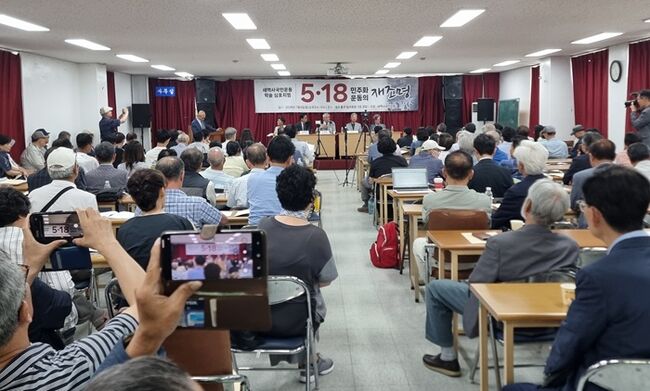 The New History National Movement held an inaugural academic seminar on the 4th at the auditorium on the 2nd floor of the Damsuhoe building in Daegu under the theme of "Re-examining the May 18 Democratization Movement." [Photo = Reporter Im Yo-hee]
According to Professor Rhee, Kim Dae-jung, who was an "outstanding orator and thinker," said in his 1987 speech for the founding of the Peace and Democracy Party, "The Donghak Movement represented the rights of the people, the March 1st Movement represented the spirit of national independence, and the April 19 Revolution represented the nation's resolve for democratization." He added, "The Gwangju Uprising of 1980 was a total expression of the will for national unification based on this grassroots and national democratic will."
Professor Rhee Young-hoon assessed, "This is where the Gwangju Spirit, as described by Kim Dae-jung, lies," and added, "Although Kim Dae-jung is someone who both ruined and rebuilt an era, it is unfortunate that all the events he spoke of were merely political upheavals, not revolutions."
Choi Ik-hyun, chairman of the Freedom and Innovation party council in Dong-gu, Daegu, who attended the event, expressed skepticism about the "Gwangju Spirit," saying, "There must have been 'agitation' in Gwangju in 1980, whether through peaceful methods or false propaganda, to achieve certain goals," adding, "You can immediately understand what the Gwangju Spirit is by observing Gwangju's attitude toward Jung Yul-soo."
Jung Yul-soo (1914–1976) was born in Gwangju, Jeollanam-do, moved to China, and joined the Communist Party of China in 1939. He composed the "March of the Eighth Route Army" (currently the official anthem of the Chinese People's Liberation Army) and the "March of the Korean People's Army" of North Korea. In 1992, Gwangju Metropolitan City regarded him as a symbol of Korea-China friendship and proceeded to create the Jung Yul-soo Street and erect a statue.
The culprits of the May 18 tragedy: Yoon Heung-jung, Jung Woong, and Ahn Byung-ha
The second speaker, senior reporter Kim Yong-sam, continued his briefing for about 30 minutes on the topic "A New Perspective on the May 18 Gwangju Incident."
He stated, "When President Choi Kyu-hah tasked General Lee Kwang-ro with investigating the full scope of the Gwangju incident in 1980, the investigation discovered serious misconduct by 31st Division Commander Jung Woong and Combat Education Command Commander Yoon Heung-jung during the initial suppression operations and recommended their punishment. However, Choi Kyu-hah did not accept the results, citing a disagreement with Martial Law Commander Lee Hee-sung." He expressed regret, adding, "If they had been punished in accordance with the recommendations of the government's joint investigation team, the controversy over Gwangju would not have been raised."
In this process, an absurd situation occurred. Jung Woong, who exacerbated the May 18 incident into what was termed the "Gwangju Incident," turned into a hero of Gwangju. Jung Woong claimed that he was a victim who opposed forceful suppression and was therefore stripped of his command and forcibly discharged after the suppression operation ended, and as a result, he ran for the National Assembly in Gwangju and was elected with the highest number of votes in the country at 91.5%.
However, senior reporter Kim Yong-sam stated that history proves his claims are false. At the time, the paratroopers' method of suppressing demonstrations was to use a show of force to intimidate protesters, then block three directions while leaving one exit open to disperse the crowd.
Yet, Jung Woong ordered, "Block the protesters' escape route, pursue them to the end, and arrest everyone." Due to this order, there was a violent clash between the 7th Airborne Brigade's 33rd-35th battalions and the protesters during the arrest process. From that evening, malicious rumors spread throughout Gwangju, and the situation spiraled out of control.
According to the prosecutor's statement of the 7th Airborne Brigade's 33rd-35th battalion commanders at the time, Jung Woong said, "There is chaos in the city. The police are confronting them but have lost their ability to suppress the situation, so our military must move out. If the military fails to suppress them, it will be a major problem, so suppress them even if you have to risk your lives."
Furthermore, when suppression became difficult, Jung Woong continuously deployed troops in small increments, which resulted in the military being scattered in units of 10 and conversely surrounded by protesters, leading to physical clashes as the troops attempted to break through the encirclement.
It was also Division Commander Jung Woong who exacerbated the tragedy by failing to protect the armories. At 3:05 AM on May 18, 2nd Army Commander Jeon Jong-chae ordered safety measures for the armories. That evening, Division Commander Jung Woong recommended to Commander Yoon Heung-jung that he authorize firing upon those approaching the armories, but Yoon Heung-jung instructed him to "act at the discretion of the commander in accordance with military service regulations." It is said that even though Jung Woong made the recommendation, he failed to take appropriate measures, ultimately leading to citizens seizing weapons and sparking the tragedy.
Eventually, on May 20, the paratrooper battalion commanders on the scene recommended withdrawing troops from downtown Gwangju. On the night of May 20, at 9:00 PM, Commander Yoon Heung-jung requested and received approval from Martial Law Commander Lee Hee-sung to withdraw the paratroopers to the outskirts. However, even after receiving approval, Yoon Heung-jung did not issue the withdrawal order to the field commanders.
Another problematic figure is Ahn Byung-ha, the former Jeonnam Police Bureau Chief who was in charge of suppressing the demonstrations. On the morning of May 18, students and paratroopers clashed in front of Chonnam National University, resulting in the attacking of a police substation and the burning of police cars. In this emergency situation, Chief Ahn Byung-ha, who was in charge of suppression, left the bureau headquarters for lunch and lost contact, only returning to duty late in the afternoon when the situation had greatly worsened. Nevertheless, he is treated in Gwangju as a "hero who protected the people and the police."
In summary, Kim Yong-sam stated that Yoon Heung-jung, Jung Woong, and Ahn Byung-ha were the figures who worsened the tragedy of May 18, and that the then-Security Commander Chun Doo-hwan was not responsible. He added that Chun Doo-hwan was branded a "sinner of history" only because he was elected president and became a target of the left wing.
The Juche faction corrupted May 18
Joo Dong-sik, former chairman of the People Power Party’s Gwangju Seo-gu Gap constituency, delivered a presentation on the topic, "May 18 is the culprit of the pollution and corruption of the '87 system." He said, "The citizens of Gwangju tried to protect the Republic of Korea in their own way, but because there was a political and philosophical vacuum, the Juche faction filled that vacuum." He continued, "We have reached a point where we cannot stop the criticism of May 18 without law enforcement," indicating how cornered the left has become.
On this day, Ryu Seok-chun, co-representative of the New History National Movement, summarized the academic presentations and remarked, "Senior reporter Kim Yong-sam’s presentation was very fresh. It is surprising that the local commanders were that incompetent." He then denounced "the irresponsibility of former President Kim Young-sam, who liquidated the May 18 incident immediately without uncovering the truth."
Meanwhile, during the event, when a question regarding election fraud arose, one of the panelists stated, "Election fraud cannot happen," leading to an uproar in the room with shouting and commotion. Furthermore, with an atmosphere suggesting that the New History National Movement recognized May 18 as a "democratization movement" in line with the seminar's title, voices of dissatisfaction erupted from the audience.
Daegu = Reporter Im Yo-hee

 Iranian Foreign Ministry: "Continuing Message Exchanges with the U.S. and Activities of Mediating Countries"
Esmaeil Baghaei, Spokesperson for the Iranian Ministry of Foreign Affairs [Xinhua, Yonhap News file photo]Esmaeil Baghaei, spokesperson for the Iranian Ministry of Foreign Affairs, stated on the 26th
Iranian Foreign Ministry: "Continuing Message Exchanges with the U.S. and Activities of Mediating Countries"
Esmaeil Baghaei, Spokesperson for the Iranian Ministry of Foreign Affairs [Xinhua, Yonhap News file photo]Esmaeil Baghaei, spokesperson for the Iranian Ministry of Foreign Affairs, stated on the 26th
 President Yoon: "Do You Really Think You Are Safe from a Special Counsel?"... Final Statement Video Released
President Yoon Suk Yeol rebuking the special prosecutor on the 24th. [Court Video / Subtitled GIF from @birds_justice X account] A video capturing the live footage of President Yoon Suk Yeol’s final
President Yoon: "Do You Really Think You Are Safe from a Special Counsel?"... Final Statement Video Released
President Yoon Suk Yeol rebuking the special prosecutor on the 24th. [Court Video / Subtitled GIF from @birds_justice X account] A video capturing the live footage of President Yoon Suk Yeol’s final
 President Yoon, regarding the first-instance ruling on the Public Official Election Act: “An excessive political verdict that distorts the facts… We will appeal immediately.”
The first-instance sentencing hearing for President Yoon Suk Yeol regarding violations of the Public Official Election Act is being broadcast live at Seoul Station on the 27th. [Photo=Yonhap News]Pres
President Yoon, regarding the first-instance ruling on the Public Official Election Act: “An excessive political verdict that distorts the facts… We will appeal immediately.”
The first-instance sentencing hearing for President Yoon Suk Yeol regarding violations of the Public Official Election Act is being broadcast live at Seoul Station on the 27th. [Photo=Yonhap News]Pres
 WSJ: "SK Hynix ADR Premium Is a Sign of AI Trading Overheat"
Advertisement for SK Hynix ADR listing in New York's Times Square [Reuters=Yonhap News file photo]The Wall Street Journal (WSJ) has pointed out that the price of SK Hynix’s American Depositary Recei
WSJ: "SK Hynix ADR Premium Is a Sign of AI Trading Overheat"
Advertisement for SK Hynix ADR listing in New York's Times Square [Reuters=Yonhap News file photo]The Wall Street Journal (WSJ) has pointed out that the price of SK Hynix’s American Depositary Recei
 'Godfather of Japanese Mystery Novels' Keigo Higashino Passes Away After Battle with Cancer at 68
Famous Japanese mystery novelist Keigo Higashino [AFP=Yonhap News]It has been belatedly reported that Keigo Higashino, the "godfather of Japanese mystery novels" and author of bestsellers such as "The
'Godfather of Japanese Mystery Novels' Keigo Higashino Passes Away After Battle with Cancer at 68
Famous Japanese mystery novelist Keigo Higashino [AFP=Yonhap News]It has been belatedly reported that Keigo Higashino, the "godfather of Japanese mystery novels" and author of bestsellers such as "The
 [Park Pil-kyu Security Column] To the Ignorant Trying to Clothe a Beast in Sheep's Clothing
Rep. Kim Byung-joo of the Democratic Party of Korea [Photo=Yonhap News]“The Air Force Academy doesn't teach you how to fly a plane!” “The Army, Navy, and Air Force academies are exactly the
[Park Pil-kyu Security Column] To the Ignorant Trying to Clothe a Beast in Sheep's Clothing
Rep. Kim Byung-joo of the Democratic Party of Korea [Photo=Yonhap News]“The Air Force Academy doesn't teach you how to fly a plane!” “The Army, Navy, and Air Force academies are exactly the
 [Issue Diagnosis] Two Effects of the Election Petition Review
 [Photo] Evidence of Election Fraud Flooding U.S. Media… Trump Had 2.7 Million Votes Stolen
 [Video] U.S. Semiquincentennial Air Show... 'Art in the Sky' streaks across New York
 [Editorial Cartoon] A Draconian Law That Undermines Freedom of Expression

 List
List









