 Solon explaining his reforms. An illustration related to Solon from a book published in Augsburg, Germany, in 1832.
In ancient Athens, democracy was not merely a change in political institutions, but a revolution that fundamentally reshaped the consciousness and power structure of the entire civic community.
As the term "dēmokratia" itself signifies the "rule (kratos) of the people (dēmos)," this system represented a novel experiment in which ordinary citizens managed the city-state directly, moving beyond the long-standing traditions of monarchy, aristocracy, and tyranny.
This column academically examines the emergence of Athenian democracy through its historical context, the reforms of key figures, institutional developments, and its significance and limitations. Through this process, we will explore how democracy was gradually formed amidst crises, compromises, resistance, and innovation.
Crisis and Compromise: The Reforms of Solon (594 BC)
In the late 7th century BC, Athenian society was fractured by extreme inequality and class conflict. While traditional aristocratic families (eupatridae) monopolized land and political power, small farmers frequently fell into debt using their grain as collateral; if they were unable to repay, they would lose their land and often be reduced to slavery. This system of debt slavery (the hektemoroi system) threatened the stability of the entire society and fueled the fires of civil war.
In this crisis, the citizens appointed Solon, a poet and merchant, as the archon (chief magistrate) and granted him full authority. Solon's most groundbreaking measure was the "Seisachtheia" (the "shaking off of burdens").
He retroactively annulled existing debts, permanently prohibited the enslavement of citizens due to debt, and used state funds to redeem Athenian citizens who had been sold abroad. Beyond mere economic relief, this was a declaration that legally protected the freedom and dignity of citizens.
Politically, Solon introduced a "timokratia" (timocracy), shifting the basis of power from aristocratic lineage to wealth. He classified citizens into four classes based on their annual agricultural output: the highest class (Pentakosiomedimnoi, 500 medimnoi or more), the cavalry class (Hippeis, 300 or more), the middle class (Zeugitai, 200 or more), and the lowest class (Thetes).
Public office was restricted to the top three classes, but the Thetes were granted the right to participate in the People's Assembly (Ekklesia) and the right to appeal legal rulings. Furthermore, he established a Council of 400 and curtailed some of the powers of the Areopagus (the aristocratic council of former archons), thereby mitigating the aristocratic monopoly.
In his own poems, Solon stated, "I stood with my shield before both sides, and allowed neither to win unjustly." Although he did not pursue full-fledged democracy, he laid the foundations for the rule of law (eunomia) and civic participation. His constitution was respected as the benchmark for Athenian politics for the next 200 years and became a vital cornerstone for the development of democracy.
The End of the Tyrant Era and Citizen Resistance
Despite Solon's reforms, Athens did not achieve total stability. Around 560 BC, Peisistratos seized power as a tyrant (tyrannos), bringing temporary political stability and economic and cultural prosperity.
He gained popular support by promoting policies to assist farmers and undertaking large-scale public works; however, the transition to the rule of his son, Hippias, led to increased oppression and corruption.
In 510 BC, Hippias was expelled due to Spartan military intervention and internal resistance. Subsequent power struggles between aristocratic factions intensified, and in the midst of this chaos, Cleisthenes of the Alcmaeonid family chose to align himself with the commoner faction. His emergence signaled not just a change in government, but a fundamental redesign of the Athenian political system.
The Structural Revolution of Cleisthenes (508–507 BC)
Cleisthenes, regarded as the true founder of Athenian democracy, dismantled the traditions centered on bloodlines and nobility, creating a new framework centered on geography and citizenship. He reorganized the entire Attica region into 139 demes (basic local units).
The deme functioned as the basic unit for citizen registration and local administration. He then organized these into 30 trittyes (thirds), composed of three regions—city, inland, and coast—and mixed individuals from different regions to form 10 new tribes (phyle). This artificial mixing fundamentally weakened the regional and genealogical influence of specific aristocratic families.
The core institution of the reform was the Council of 500 (Boule). Every year, 50 members from each tribe were selected by lot to gather daily near the Agora to handle administration and prepare and deliberate on the agenda for the People's Assembly. By limiting individuals to serving no more than twice in their lifetime, he prevented the concentration of power.
The People's Assembly (Ekklesia) was the supreme sovereign body open to all free Athenian men over 20, exercising authority in legislation, decisions on war and peace, treaty making, budget approval, and the selection of high-ranking officials. The assembly met about 40 times a year, and important matters (such as ostracism) required a quorum of 6,000.
He also introduced ostracism. Citizens would vote by writing a name on a piece of pottery (ostrakon), and the person who received at least 6,000 votes could be banished for 10 years.
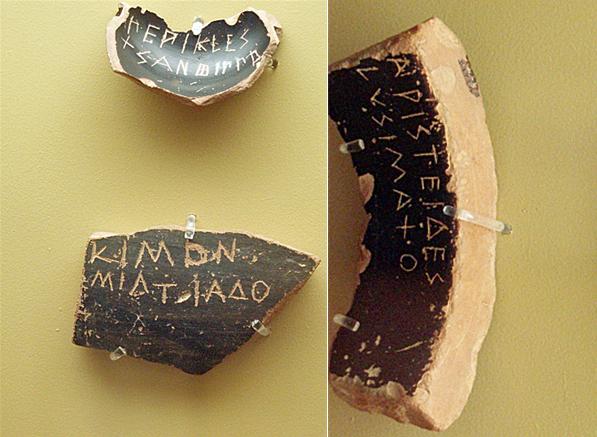 A piece of pottery used in ostracism.
This was a safety mechanism to prevent the excessive concentration of power before it could occur. Herodotus' description of Cleisthenes as the one who "created tribes and introduced democracy" highy values this structural innovation. His reforms firmly established the institutional foundations of democracy in Athens.
Radicalization and the Golden Age: The Era of Ephialtes and Pericles (After 462 BC)
Around 462 BC, Ephialtes and his successor Pericles developed democracy even more radically. They transferred the remaining supervisory and judicial powers of the Areopagus to the People's Assembly and the courts.
Pericles introduced a system of daily pay for public office, allowing even impoverished citizens to participate in political activities. Through this, democracy evolved into a more comprehensive and substantive form.
During this period, the tripartite institutions of Athenian democracy—the Ekklesia, the Boule, and the People's Courts (Dikasteria)—operated stably. The People's Courts were formed by selecting a pool of 6,000 jurors annually by lot, with 201 to 501 jurors delivering verdicts for each case per day.
It was an amateur-centered system without professional judges or lawyers, where the parties argued their cases directly; the principles of selection by lot, public debate, and majority rule emphasized equality and participation. The age of Pericles (443–429 BC) represents the practical golden age of democracy, accompanied by a cultural peak such as the construction of the Parthenon. Citizens cultivated their civic virtue through military service, attending theatrical performances, and public debate.
Historical Significance and Limitations of Athenian Democracy
Athenian democracy developed through stages of compromise in crisis (Solon), resistance and structural innovation (Cleisthenes), and radical completion (Ephialtes and Pericles).
Principles such as direct participation, freedom of speech (parrhēsia), equality of opportunity through the lottery, equality before the law, and civic education and public duty have profoundly influenced later Western political thought. This was a great experiment that institutionalized the political philosophy that "the people are the masters" for the first time in human history.
However, the limitations were also clear. Citizenship was strictly limited to free Athenian men (those born to Athenian parents), meaning only about 10% of the total population could participate in politics. Women, slaves, and foreigners (metoikoi) were excluded.
Furthermore, cases of excessive mob trials (e.g., the execution of Socrates) and the return to oligarchy during wartime chaos (411 BC, 404 BC) revealed the vulnerability of democracy. Following the victory in the Persian Wars, it also became intertwined with imperial expansion, which exacerbated internal contradictions.
Ultimately, while Athenian democracy was an incomplete experiment, its legacy remains a valid benchmark for reflecting on and advancing democracy to this day. Born out of a history of crisis and change, this system serves as an eternal lesson in how civic participation and institutional innovation can generate the power of a community.
◆ Song-san Jeong Gwang-je
A poet and researcher of history and philosophy. Former director of the Syngman Rhee Institute. Currently serves as a research advisor to the Korean Modern History Research Society and representative of the philosophy forum "Lyceum." He has published four books of poetry, co-translated "Heroes of Pork Chop Hill," and authored humanities books such as "Joseon Turned into Myth," "Humanities on the Tatami," and "A Liberal’s Reading of Gramsci."

 Iranian Foreign Ministry: "Continuing Message Exchanges with the U.S. and Activities of Mediating Countries"
Esmaeil Baghaei, Spokesperson for the Iranian Ministry of Foreign Affairs [Xinhua, Yonhap News file photo]Esmaeil Baghaei, spokesperson for the Iranian Ministry of Foreign Affairs, stated on the 26th
Iranian Foreign Ministry: "Continuing Message Exchanges with the U.S. and Activities of Mediating Countries"
Esmaeil Baghaei, Spokesperson for the Iranian Ministry of Foreign Affairs [Xinhua, Yonhap News file photo]Esmaeil Baghaei, spokesperson for the Iranian Ministry of Foreign Affairs, stated on the 26th
 President Yoon: "Do You Really Think You Are Safe from a Special Counsel?"... Final Statement Video Released
President Yoon Suk Yeol rebuking the special prosecutor on the 24th. [Court Video / Subtitled GIF from @birds_justice X account] A video capturing the live footage of President Yoon Suk Yeol’s final
President Yoon: "Do You Really Think You Are Safe from a Special Counsel?"... Final Statement Video Released
President Yoon Suk Yeol rebuking the special prosecutor on the 24th. [Court Video / Subtitled GIF from @birds_justice X account] A video capturing the live footage of President Yoon Suk Yeol’s final
 President Yoon, regarding the first-instance ruling on the Public Official Election Act: “An excessive political verdict that distorts the facts… We will appeal immediately.”
The first-instance sentencing hearing for President Yoon Suk Yeol regarding violations of the Public Official Election Act is being broadcast live at Seoul Station on the 27th. [Photo=Yonhap News]Pres
President Yoon, regarding the first-instance ruling on the Public Official Election Act: “An excessive political verdict that distorts the facts… We will appeal immediately.”
The first-instance sentencing hearing for President Yoon Suk Yeol regarding violations of the Public Official Election Act is being broadcast live at Seoul Station on the 27th. [Photo=Yonhap News]Pres
 WSJ: "SK Hynix ADR Premium Is a Sign of AI Trading Overheat"
Advertisement for SK Hynix ADR listing in New York's Times Square [Reuters=Yonhap News file photo]The Wall Street Journal (WSJ) has pointed out that the price of SK Hynix’s American Depositary Recei
WSJ: "SK Hynix ADR Premium Is a Sign of AI Trading Overheat"
Advertisement for SK Hynix ADR listing in New York's Times Square [Reuters=Yonhap News file photo]The Wall Street Journal (WSJ) has pointed out that the price of SK Hynix’s American Depositary Recei
 'Godfather of Japanese Mystery Novels' Keigo Higashino Passes Away After Battle with Cancer at 68
Famous Japanese mystery novelist Keigo Higashino [AFP=Yonhap News]It has been belatedly reported that Keigo Higashino, the "godfather of Japanese mystery novels" and author of bestsellers such as "The
'Godfather of Japanese Mystery Novels' Keigo Higashino Passes Away After Battle with Cancer at 68
Famous Japanese mystery novelist Keigo Higashino [AFP=Yonhap News]It has been belatedly reported that Keigo Higashino, the "godfather of Japanese mystery novels" and author of bestsellers such as "The
 [Park Pil-kyu Security Column] To the Ignorant Trying to Clothe a Beast in Sheep's Clothing
Rep. Kim Byung-joo of the Democratic Party of Korea [Photo=Yonhap News]“The Air Force Academy doesn't teach you how to fly a plane!” “The Army, Navy, and Air Force academies are exactly the
[Park Pil-kyu Security Column] To the Ignorant Trying to Clothe a Beast in Sheep's Clothing
Rep. Kim Byung-joo of the Democratic Party of Korea [Photo=Yonhap News]“The Air Force Academy doesn't teach you how to fly a plane!” “The Army, Navy, and Air Force academies are exactly the
 [Issue Diagnosis] Two Effects of the Election Petition Review
 [Photo] Evidence of Election Fraud Flooding U.S. Media… Trump Had 2.7 Million Votes Stolen
 [Video] U.S. Semiquincentennial Air Show... 'Art in the Sky' streaks across New York
 [Editorial Cartoon] A Draconian Law That Undermines Freedom of Expression

 List
List









