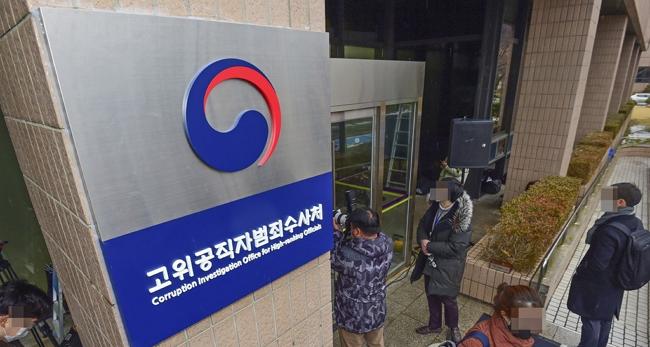
 Signboard of the Corruption Investigation Office for High-ranking Officials at the Government Complex Gwacheon [Photo courtesy of Yonhap News]
As the abolition of the Prosecutors' Office and the launch of the Public Prosecution Office and the Serious Crimes Investigation Agency approach, the proposal to abolish the direct supplementary investigation power of prosecutors at the Public Prosecution Office is sparking controversy.
The rationale for the criminal justice system reform is to reduce the power of the prosecution by separating investigation and prosecution. However, the Corruption Investigation Office for High-ranking Officials (CIO) can independently identify and investigate crimes by high-ranking public officials and directly indict them in certain cases.
We have summarized the key points in a Q&A format: Is it a consistent institutional design to prevent Public Prosecution Office prosecutors from directly supplementing cases referred by investigative agencies while leaving the power to initiate investigations and limited indictment powers with the CIO? And, if the CIO turns into a tool for political power, who will control it?
[Q. Are direct investigation power and direct supplementary investigation power the same?]
No, they are not.
Direct investigation power is the authority for a prosecutor to identify criminal charges on their own, initiate a case, and conduct the investigation from the start. Direct supplementary investigation power is the authority for a prosecutor to personally investigate aspects such as missing evidence or contradictory testimonies in cases referred by the police or other investigative agencies.
Suppose the police refer a fraud case, and the prosecutor finds missing bank records or contradictions in a witness statement.
If the prosecutor uncovers separate criminal charges and starts a new case, that is a "direct investigation." If the prosecutor personally interviews a witness or secures missing documents for the referred case, that is "direct supplementary investigation." If the prosecutor asks the police to re-examine bank records and interview the witness again, that is a "request for supplementary investigation."
The current debate is not about restoring the sweeping direct investigation powers the prosecution previously held. The core issue is whether to allow prosecutors to personally verify missing elements in referred cases now that their power to initiate investigations has been abolished.
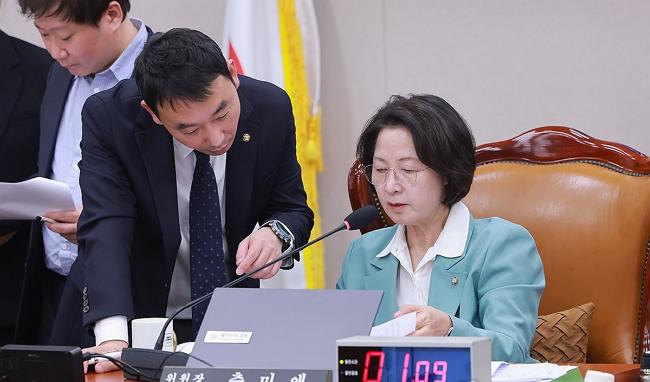 Ruling party lawmakers talk ahead of the deliberation on the bills to establish the Serious Crimes Investigation Agency and the Public Prosecution Office at the National Assembly's Legislation and Judiciary Committee. The proposal to strip the Public Prosecution Office of direct supplementary investigation powers, leaving only the right to request supplementary investigations from investigative agencies, is facing controversy. [Photo = Yonhap News][Q. Does the Democratic Party's proposal mean eliminating supplementary investigations altogether?]
Not exactly.
The amendment, effectively representing the party line drafted by the Democratic Party's Prosecutor Reform Task Force, is structured to prohibit direct supplementary investigations by Public Prosecution Office prosecutors while retaining the power to request supplementary investigations from investigative agencies like the police and the CIO.
Public Prosecution Office prosecutors can provide a document outlining what needs to be supplemented and why. In principle, the investigative agency must examine the requested items and report the results back to the Public Prosecution Office.
Therefore, it is difficult to conclude that the Public Prosecution Office would be merely an agency that passively accepts police records to decide whether or not to indict.
The controversy lies in the fact that even if a prosecutor discovers critical missing evidence or contradictions in testimony, they cannot personally investigate the witness or secure documents; they must refer the tasks back to the original investigative agency.
The question is whether re-assigning cases back to the same agency—even when there is suspicion of incompetence or collusion—can serve as an effective check and balance.
[Q. Is the People Power Party demanding the revival of the prosecution's direct investigation power?]
In the current debate, what the People Power Party is primarily calling for is not the restoration of the prosecution's past broad investigative powers, but the retention of "direct supplementary investigation power" for referred cases.
They argue that if there is missing evidence or contradictory testimony in the records investigated by the police or the Serious Crimes Investigation Agency, the prosecutor responsible for the indictment must be able to verify the necessary parts personally.
In particular, they believe that it is difficult to properly check investigative agencies if cases where there are allegations of collusion or scaled-back investigations by police teams are simply sent back to the same police.
Some members of the Democratic Party have proposed a compromise: prohibiting direct supplementary investigations in principle, but allowing them as an exception for crimes against vulnerable social groups, livelihood-related crimes, or cases where collusion by investigative agencies is suspected.
The political conflict is not about whether to give the prosecution back its power to initiate investigations, but about whether a Public Prosecution Office prosecutor can directly supplement referred cases.
[Q. Do prosecutors in other countries only handle indictments and not get involved in investigations?]
The system varies by country.
In Japan and Germany, prosecutors legally possess direct investigation powers. If a prosecutor deems it necessary, they can investigate crimes themselves or conduct investigations through the police.
In the United States, specialized agencies like the FBI primarily handle field investigations. However, federal prosecutors participate from the early stages of an investigation, discuss investigative strategies, and are deeply involved in the evidence-gathering process through grand juries, subpoenas, and warrant procedures.
There are countries like the UK, Canada, and Australia where prosecutors do not conduct general field investigations themselves. Even in these countries, however, prosecutors request investigative agencies to secure additional evidence, provide legal advice necessary for indictment, and require the correction of flaws in investigative records.
While systems exist where prosecutors do not conduct direct supplementary investigations, it is difficult to view the total blockage of supplementary and cooperative channels between investigative and prosecutorial agencies as a general model in major countries.
[Q. Unlike the Public Prosecution Office, what powers remain with the CIO?]
The CIO can independently identify criminal charges against high-ranking public officials and initiate investigations. They can personally interrogate suspects and witnesses and request warrants for search and seizure, arrest, or detention.
The subjects of investigation include the President, members of the National Assembly, the Prime Minister, ministers and vice-ministers, the Chief Justice and Justices of the Supreme Court, Justices of the Constitutional Court, the Prosecutor General, judges, prosecutors, police officials at the rank of superintendent or higher, military officers of general rank, and heads of metropolitan local governments.
Essentially, key figures from the legislative, executive, judicial, and constitutional branches are all covered.
Among these, the CIO can directly indict and maintain the prosecution for crimes under the CIO Act committed by the Chief Justice and Justices of the Supreme Court, the Prosecutor General, judges, prosecutors, and high-ranking police officers.
For the President, members of the National Assembly, and ministers, the CIO can investigate but cannot directly indict them. After completing the investigation, they must demand the Public Prosecution Office to file an indictment.
The CIO does not directly indict all high-ranking public official cases. However, for certain job categories and crimes, the initiation of investigations, compulsory investigative measures, indictment decisions, and the maintenance of prosecutions are all consolidated within a single agency.
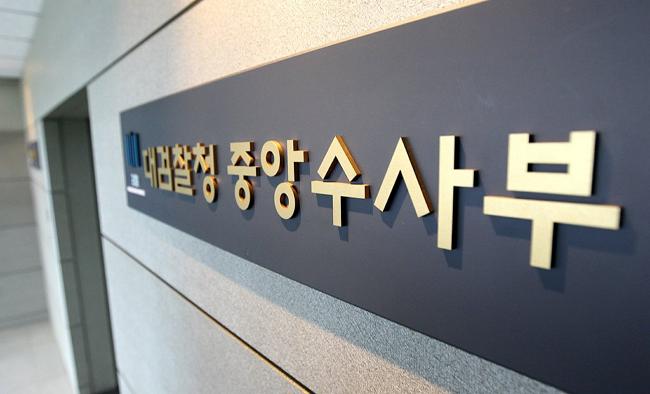 Prosecutor General Kim Joon-gyu convened an emergency executive meeting amid signs of conflict between the political sphere and the prosecution over the National Assembly’s agreement to abolish the Central Investigation Department's investigative functions. The photo shows the entrance to the Central Investigation Department of the Supreme Prosecutors' Office in Seocho-dong, Seoul, on the afternoon of June 6, 2011. [Photo = Yonhap News]
[Q. Is the CIO the same type of organization as the old Central Investigation Department of the Supreme Prosecutors' Office?]
They are not entirely the same.
The old Central Investigation Department of the Supreme Prosecutors' Office broadly investigated and indicted not only corruption involving high-ranking officials and politicians but also large-scale economic crimes by major corporations and financial institutions.
The jurisdiction of the CIO is limited to crimes related to the duties of high-ranking public officials and related offenses. It cannot independently investigate embezzlement or breach of trust by general business people without a link to a high-ranking official.
Their organizational status also differs. The Central Investigation Department was an internal organization under the Supreme Prosecutors' Office, subject to the Prosecutor General’s command, whereas the CIO is a separate agency independent of the prosecution.
However, if both direct investigations and direct supplementary investigations by Public Prosecution Office prosecutors are prohibited, the CIO remains the only permanent agency in the high-ranking official domain that holds the power to initiate investigations, compulsory investigative powers, and some direct indictment powers.
This is why some argue that even though the jurisdiction and organizational status are different, the nature of the CIO as an "independent Central Investigation Department" could become more pronounced when looking solely at its investigative functions regarding power-related crimes by high-ranking officials.
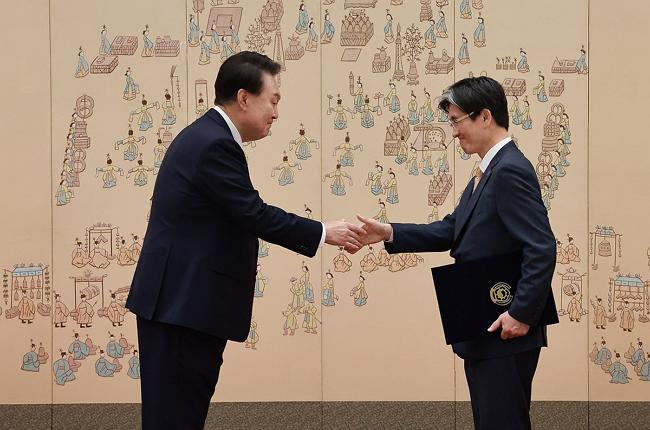 President Yoon Suk Yeol is seen taking a commemorative photo after presenting an appointment letter to Oh Dong-woon, the Chief of the CIO, on May 22, 2024. Although the President makes the final appointment of the CIO Chief, law prohibits the President and the Presidential Office from giving instructions or interfering in specific cases during the term. [Photo = Yonhap News][Q. Is the CIO Chief under the command of the President?]
Under the law, the President cannot interfere in specific cases of the CIO.
The President and Presidential Office officials must not request work reports or document submissions from the CIO, nor can they issue instructions, discuss, or offer opinions regarding specific cases.
The term of the CIO Chief is a single three-year term. The President cannot dismiss the Chief at will just because they are unhappy with the direction of an investigation. Their status and independence in performing their duties after taking office are relatively strongly guaranteed.
However, the appointment process is not entirely separated from political circles.
Once the Candidate Recommendation Committee recommends two candidates, the President nominates one of them, who is then appointed after a confirmation hearing at the National Assembly. Parliamentary consent for the appointment is not required.
If five out of the seven recommendation committee members agree, a recommendation can be made. Even if both members recommended by the opposition party object, a recommendation can proceed through the consensus of the remaining members.
The President's appointing power does not equate to command power over cases. The issue is how to verify potential structural bias in the process of case assignment, initiation, delay, and closure, rather than official instructions.
If a CIO Chief considers the political interests of the regime and quickly initiates investigations into opposition or judicial figures while delaying or downplaying cases involving the core of power, it is difficult to prevent this merely with a provision prohibiting presidential interference.
[Q. If the CIO turns into a pro-regime investigation agency, who stops it?]
The courts, the National Assembly, the system of judicial review for non-indictment (fiscal application), and external investigative agencies serve as control mechanisms.
For the CIO to perform searches, seizures, arrests, or detentions, it must obtain warrants from the court. For cases directly indicted by the CIO, the court judges guilt or innocence. In certain cases, a motion for judicial review can be filed with the Seoul High Court regarding the CIO's non-indictment decisions.
The National Assembly conducts confirmation hearings for the CIO Chief and performs government audits and budget reviews. If there are serious illegal acts, impeachment of the CIO Chief is possible. If members of the CIO commit crimes such as abuse of power or evidence fabrication, they can become the subject of investigations by external agencies.
However, most of these devices are "ex-post facto controls" that operate after a case has started or a decision has been made.
The court can examine the requirements for submitted warrants and the facts of the indictment. However, it is difficult for the court to constantly monitor why the CIO initiated a specific case immediately while leaving others unprocessed for a long time.
Control by the National Assembly can also lose effectiveness if the same party as the President holds a majority of seats. There is also the possibility that the CIO could limit the submission of specific documents or responses on the grounds that an investigation is underway.
What is most difficult to control in terms of CIO power abuse is not just unreasonable indictment, but "selective investigation"—deciding who to investigate and who not to, and which cases to process quickly and which to bury.
[Q. If a CIO investigation is incompetent, can a Public Prosecution Office prosecutor correct it?]
According to the Democratic Party's proposal, Public Prosecution Office prosecutors can request supplementary investigations from the CIO. However, they cannot personally secure evidence or investigate witnesses.
If the CIO investigates a case involving the President, a lawmaker, or a minister and demands an indictment, but the records are insufficient, the Public Prosecution Office must ask the CIO to supplement the investigation again.
If the CIO, in charge of the investigation, deems it sufficiently investigated, while the Public Prosecution Office, responsible for the indictment, deems the evidence insufficient, responsibilities and authorities may clash between the two agencies.
This problem was actually revealed in the case of a high-ranking official at the Board of Audit and Inspection accused of bribery totaling 1.58 billion won.
The CIO investigated the case and demanded an indictment from the prosecution, but the prosecution judged that additional evidence was needed. After controversy over the legal basis and procedure for supplementary investigation, the prosecution indicted only the 290 million won portion, where they considered the evidence relatively clear, and decided not to indict the remaining 1.29 billion won.
Regardless of which agency’s judgment was correct, this is a case showing that if the supplementary procedure between an investigative agency and a prosecutorial agency is unclear, the scope of indictment can change based on power struggles rather than the substance of the crime.
Even if the Public Prosecution Office determines that the CIO did not sufficiently fulfill a request for supplementation, if it cannot supplement it personally, the problem remains: they must either entrust the same CIO with supplementation again or decide on the indictment with incomplete records.
[Q. Who verifies cases directly indicted by the CIO?]
The CIO can personally investigate and indict cases involving judges, prosecutors, and police officers of superintendent rank or higher.
In these cases, there is no procedure for the Public Prosecution Office to separately review the CIO’s investigative records to determine the appropriateness of the indictment. Judgment on investigation and indictment is made within the CIO, and after indictment, the court hears the case.
Unreasonable indictments can be corrected by a court's acquittal. However, controversy remains over whether trial alone is sufficient control, given that the initiation of an investigation, search and seizure, summoning, and the indictment itself can have a significant impact on the subject's political and social status.
Conversely, if the CIO decides not to indict a case involving the core of power or does not process it for a long period, there is no clear external agency to force it in real-time.
This is why some point out that if the prosecution's powers are being separated because the combination of investigation and prosecution increases the risk of power abuse, the same standards should be applied to the CIO's combined powers.
[Q. What is needed to ensure both the independence of the CIO and checks and balances?]
Making the CIO independent from the President is not enough. It must be possible to check arbitrary case selection and dispositions by the CIO Chief and the investigative leadership.
A proposal to mandate an external independent body to review non-indictments or case closures in matters involving the President or Presidential Office staff could be considered.
Contacts between the CIO and the Presidential Office regarding cases should be recorded and preserved, and the National Assembly or an independent oversight body should be able to verify them post-facto.
It is also necessary to discuss a system where cases involving judges, prosecutors, and high-ranking police officers, which are directly indicted by the CIO, must undergo review by an external committee or an independent prosecutorial agency before indictment.
A procedure is also needed to allow complainants and accusers to demand a court’s judgment if the CIO fails to initiate an investigation or delays processing for a long time.
For the nomination of the CIO Chief, one could consider introducing a bipartisan consensus or an enhanced special majority system so that no specific political force can force their choice.
[Q. What is the essence of this controversy?]
Reducing the prosecution's power does not mean that power-related investigations will disappear. The functions previously exercised by the prosecution are being redistributed among the police, the Serious Crimes Investigation Agency, the Public Prosecution Office, and the CIO.
If direct supplementary investigations by Public Prosecution Office prosecutors are prohibited while the CIO retains the power to initiate investigations, compulsory investigative powers, and some direct indictment powers for high-ranking officials in the legislative, judicial, and executive branches, we must ask: Is the separation of investigation and prosecution a universal principle of criminal justice, or a principle selectively applied only to the prosecution?
If the CIO is an agency necessary to investigate corruption among high-ranking officials, external control mechanisms commensurate with its power must be designed alongside it.
If the investigative function is stripped from the Public Prosecution Office while the CIO's combination of investigation and restricted indictment is left intact, the question after "prosecutor reform" can no longer be limited to how to reduce the prosecution's power.
What we must ask now is: "Who will control the double-edged sword held by the CIO?"

 Iranian Foreign Ministry: "Continuing Message Exchanges with the U.S. and Activities of Mediating Countries"
Esmaeil Baghaei, Spokesperson for the Iranian Ministry of Foreign Affairs [Xinhua, Yonhap News file photo]Esmaeil Baghaei, spokesperson for the Iranian Ministry of Foreign Affairs, stated on the 26th
Iranian Foreign Ministry: "Continuing Message Exchanges with the U.S. and Activities of Mediating Countries"
Esmaeil Baghaei, Spokesperson for the Iranian Ministry of Foreign Affairs [Xinhua, Yonhap News file photo]Esmaeil Baghaei, spokesperson for the Iranian Ministry of Foreign Affairs, stated on the 26th
 President Yoon: "Do You Really Think You Are Safe from a Special Counsel?"... Final Statement Video Released
President Yoon Suk Yeol rebuking the special prosecutor on the 24th. [Court Video / Subtitled GIF from @birds_justice X account] A video capturing the live footage of President Yoon Suk Yeol’s final
President Yoon: "Do You Really Think You Are Safe from a Special Counsel?"... Final Statement Video Released
President Yoon Suk Yeol rebuking the special prosecutor on the 24th. [Court Video / Subtitled GIF from @birds_justice X account] A video capturing the live footage of President Yoon Suk Yeol’s final
 President Yoon, regarding the first-instance ruling on the Public Official Election Act: “An excessive political verdict that distorts the facts… We will appeal immediately.”
The first-instance sentencing hearing for President Yoon Suk Yeol regarding violations of the Public Official Election Act is being broadcast live at Seoul Station on the 27th. [Photo=Yonhap News]Pres
President Yoon, regarding the first-instance ruling on the Public Official Election Act: “An excessive political verdict that distorts the facts… We will appeal immediately.”
The first-instance sentencing hearing for President Yoon Suk Yeol regarding violations of the Public Official Election Act is being broadcast live at Seoul Station on the 27th. [Photo=Yonhap News]Pres
 WSJ: "SK Hynix ADR Premium Is a Sign of AI Trading Overheat"
Advertisement for SK Hynix ADR listing in New York's Times Square [Reuters=Yonhap News file photo]The Wall Street Journal (WSJ) has pointed out that the price of SK Hynix’s American Depositary Recei
WSJ: "SK Hynix ADR Premium Is a Sign of AI Trading Overheat"
Advertisement for SK Hynix ADR listing in New York's Times Square [Reuters=Yonhap News file photo]The Wall Street Journal (WSJ) has pointed out that the price of SK Hynix’s American Depositary Recei
 'Godfather of Japanese Mystery Novels' Keigo Higashino Passes Away After Battle with Cancer at 68
Famous Japanese mystery novelist Keigo Higashino [AFP=Yonhap News]It has been belatedly reported that Keigo Higashino, the "godfather of Japanese mystery novels" and author of bestsellers such as "The
'Godfather of Japanese Mystery Novels' Keigo Higashino Passes Away After Battle with Cancer at 68
Famous Japanese mystery novelist Keigo Higashino [AFP=Yonhap News]It has been belatedly reported that Keigo Higashino, the "godfather of Japanese mystery novels" and author of bestsellers such as "The
 [Park Pil-kyu Security Column] To the Ignorant Trying to Clothe a Beast in Sheep's Clothing
Rep. Kim Byung-joo of the Democratic Party of Korea [Photo=Yonhap News]“The Air Force Academy doesn't teach you how to fly a plane!” “The Army, Navy, and Air Force academies are exactly the
[Park Pil-kyu Security Column] To the Ignorant Trying to Clothe a Beast in Sheep's Clothing
Rep. Kim Byung-joo of the Democratic Party of Korea [Photo=Yonhap News]“The Air Force Academy doesn't teach you how to fly a plane!” “The Army, Navy, and Air Force academies are exactly the
 [Issue Diagnosis] Two Effects of the Election Petition Review
 [Photo] Evidence of Election Fraud Flooding U.S. Media… Trump Had 2.7 Million Votes Stolen
 [Video] U.S. Semiquincentennial Air Show... 'Art in the Sky' streaks across New York
 [Editorial Cartoon] A Draconian Law That Undermines Freedom of Expression

 List
List









