
U.S. Trade Representative Jamieson Greer announced on the 23rd (local time) the finalization of tariffs ranging from 10% to 12.5% on 60 of the United States' top trading partners. The decision, based on Section 301 of the Trade Act, addresses the issue of imports produced through forced labor and covers 99.4% of total U.S. imports.
The USTR confirmed a 10% tariff for trading partners that have committed to implementing a ban on imports made with forced labor, and a 12.5% tariff for those that have not.
South Korea, along with Japan, has effectively been subjected to the 12.5% tariff rate.
Although the USTR had signaled plans for such tariffs early last month, the timeline had remained somewhat uncertain after Representative Greer stated during a Senate Finance Committee hearing on the morning of the 22nd that he was "not focused on a specific schedule."
The U.S. 10% temporary import surcharge was originally set to expire on the 24th, and the Trump administration had yet to finalize the announcement timing for the Section 301 tariffs intended to succeed it.
However, the final tariff rates were confirmed today following procedures that included collecting rebuttal comments from the affected countries.
With this, a new tariff structure has been introduced to replace the "10% global tariff," which had been in effect following the Supreme Court's ruling against reciprocal tariffs last February, just ahead of its expiration.
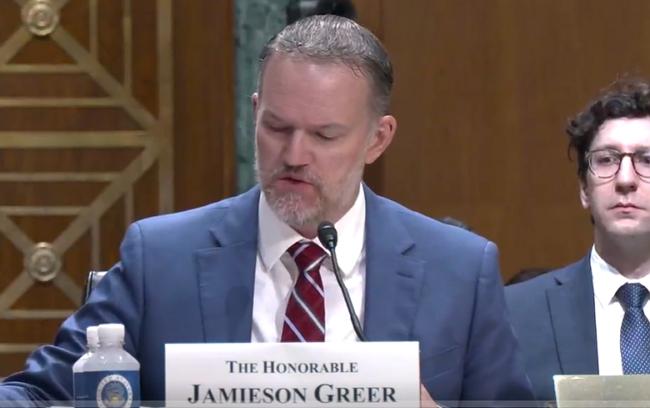 U.S. Trade Representative Jamieson Greer speaks at the Senate Finance Committee hearing on the "2026 Presidential Trade Policy Agenda" held at the Dirksen Senate Office Building in Washington on the 22nd (local time). [Capture from U.S. Senate Finance Committee video]
The administration explained that the measure aims to eradicate forced labor (modern-day slavery) from global supply chains and protect fair market competition within the United States.
While the tariffs apply to most imports, the following are exempt: ▲ informational materials, donated goods, and personal effects; ▲ products and parts already subject to Section 232 of the Trade Expansion Act (such as steel and aluminum); and ▲ certain raw materials and essential products where a supply shortage in the U.S. could cause widespread economic disruption.
The USTR previously launched separate investigations in March, alleging that countries were burdening U.S. trade through structural overproduction and the import of goods produced via forced labor.
Section 301 of the Trade Act grants the administration the authority to respond to unfair or discriminatory practices and policies of foreign governments, including through the imposition of tariffs. South Korea was included in the scope of both investigations.
Last February, the U.S. Supreme Court ruled that the reciprocal tariffs imposed by the Trump administration under the International Emergency Economic Powers Act (IEEPA) were unlawful.
Following this, the Trump administration imposed a 10% global tariff on countries worldwide under Section 122 of the Trade Act; however, as this was only permitted for a maximum of 150 days, the deadline was set for midnight on the 24th.
The structure essentially involves the Section 122 global tariffs filling the void left by the invalidation of the reciprocal tariffs, only to be replaced by Section 301 tariffs as the global tariff term concludes.
Most importantly, this measure reflects the Trump administration’s intent to cut off products utilizing Chinese raw materials or components from the U.S. supply chain.
This action is designed not merely for the U.S. to confront China alone, but to compel 60 trading partners around the world to either "sever supply chains that utilize forced labor—as China does—if they wish to sell goods in the U.S. market, or enact their own domestic bans on Chinese imports."
What do you think of this article?

 Iranian Foreign Ministry: "Continuing Message Exchanges with the U.S. and Activities of Mediating Countries"
Esmaeil Baghaei, Spokesperson for the Iranian Ministry of Foreign Affairs [Xinhua, Yonhap News file photo]Esmaeil Baghaei, spokesperson for the Iranian Ministry of Foreign Affairs, stated on the 26th
Iranian Foreign Ministry: "Continuing Message Exchanges with the U.S. and Activities of Mediating Countries"
Esmaeil Baghaei, Spokesperson for the Iranian Ministry of Foreign Affairs [Xinhua, Yonhap News file photo]Esmaeil Baghaei, spokesperson for the Iranian Ministry of Foreign Affairs, stated on the 26th
 President Yoon: "Do You Really Think You Are Safe from a Special Counsel?"... Final Statement Video Released
President Yoon Suk Yeol rebuking the special prosecutor on the 24th. [Court Video / Subtitled GIF from @birds_justice X account] A video capturing the live footage of President Yoon Suk Yeol’s final
President Yoon: "Do You Really Think You Are Safe from a Special Counsel?"... Final Statement Video Released
President Yoon Suk Yeol rebuking the special prosecutor on the 24th. [Court Video / Subtitled GIF from @birds_justice X account] A video capturing the live footage of President Yoon Suk Yeol’s final
 President Yoon, regarding the first-instance ruling on the Public Official Election Act: “An excessive political verdict that distorts the facts… We will appeal immediately.”
The first-instance sentencing hearing for President Yoon Suk Yeol regarding violations of the Public Official Election Act is being broadcast live at Seoul Station on the 27th. [Photo=Yonhap News]Pres
President Yoon, regarding the first-instance ruling on the Public Official Election Act: “An excessive political verdict that distorts the facts… We will appeal immediately.”
The first-instance sentencing hearing for President Yoon Suk Yeol regarding violations of the Public Official Election Act is being broadcast live at Seoul Station on the 27th. [Photo=Yonhap News]Pres
 WSJ: "SK Hynix ADR Premium Is a Sign of AI Trading Overheat"
Advertisement for SK Hynix ADR listing in New York's Times Square [Reuters=Yonhap News file photo]The Wall Street Journal (WSJ) has pointed out that the price of SK Hynix’s American Depositary Recei
WSJ: "SK Hynix ADR Premium Is a Sign of AI Trading Overheat"
Advertisement for SK Hynix ADR listing in New York's Times Square [Reuters=Yonhap News file photo]The Wall Street Journal (WSJ) has pointed out that the price of SK Hynix’s American Depositary Recei
 'Godfather of Japanese Mystery Novels' Keigo Higashino Passes Away After Battle with Cancer at 68
Famous Japanese mystery novelist Keigo Higashino [AFP=Yonhap News]It has been belatedly reported that Keigo Higashino, the "godfather of Japanese mystery novels" and author of bestsellers such as "The
'Godfather of Japanese Mystery Novels' Keigo Higashino Passes Away After Battle with Cancer at 68
Famous Japanese mystery novelist Keigo Higashino [AFP=Yonhap News]It has been belatedly reported that Keigo Higashino, the "godfather of Japanese mystery novels" and author of bestsellers such as "The
 [Park Pil-kyu Security Column] To the Ignorant Trying to Clothe a Beast in Sheep's Clothing
Rep. Kim Byung-joo of the Democratic Party of Korea [Photo=Yonhap News]“The Air Force Academy doesn't teach you how to fly a plane!” “The Army, Navy, and Air Force academies are exactly the
[Park Pil-kyu Security Column] To the Ignorant Trying to Clothe a Beast in Sheep's Clothing
Rep. Kim Byung-joo of the Democratic Party of Korea [Photo=Yonhap News]“The Air Force Academy doesn't teach you how to fly a plane!” “The Army, Navy, and Air Force academies are exactly the
 [Issue Diagnosis] Two Effects of the Election Petition Review
 [Photo] Evidence of Election Fraud Flooding U.S. Media… Trump Had 2.7 Million Votes Stolen
 [Video] U.S. Semiquincentennial Air Show... 'Art in the Sky' streaks across New York
 [Editorial Cartoon] A Draconian Law That Undermines Freedom of Expression

 List
List









