- ‘CIA Confidential Report’ and the Lee Gwang-ro Investigation Team’s report in a single volume
- By Kwang-ro Lee and the Central Intelligence Agency, Tunamis, 20,000 KRW
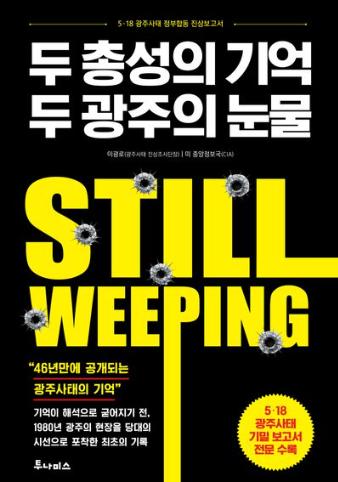
For a long time, memories of the May 18 Gwangju Democratization Movement remained scattered, failing to converge into a single, unified meaning. The new book, "Memories of Two Gunshots, Tears of Two Gwangjus," brings together two documents that lie at the heart of these complex memories into a single volume.
Part 1 contains the original text of the "Report on the Truth of the Gwangju Incident," compiled by a joint government investigation team led by Major General Lee Gwang-ro.
In 1980, President Choi Kyu-hah ordered General Lee Gwang-ro to investigate the full scope of the Gwangju incident. General Lee formed an investigation team and surveyed 18 regions, including Gwangju, Mokpo, and Naju, over seven days from June 5 to June 11, 1980.
“The list of those to be held accountable, uncovered by General Lee Gwang-ro, was clear: Combat Education & Training Commander Yoon Heung-jung, 31st Division Commander Jeong Ung, and Jeonnam Provincial Police Agency Chief Ahn Byung-ha. From the perspective of the report, these individuals were at the center of command responsibility, erroneous operational directives, failed initial police responses, and command vacuums. Furthermore, certain police commanders were held responsible for desertion, loss of weapons, abandonment of equipment, and concealment of arms. However, the recommendations were not implemented. Although the responsibility was laid out on paper, it could not cross the threshold of reality.” - From the Preface
What if President Choi Kyu-hah had punished these individuals according to the joint investigation team’s recommendations? Perhaps Gwangju would not have remained such a subject of intense controversy for so long.
Part 2 features translated and compiled declassified CIA documents, including: the CIA Situation Reports from May 24 and 27, 1980; the NIC Warning Agenda from June 1980; an analysis of anti-Chun Doo-hwan forces from 1983; a report on the rise of anti-American incidents in 1985; an analysis of the radicalization of the South Korean dissident movement in 1987; and a document on the prospects for South Korea after the 1988 Olympics.
These documents demonstrate that U.S. intelligence agencies viewed Gwangju not merely as a regional disturbance, but in connection with the legitimacy of the Chun Doo-hwan regime, the political role of the South Korean military, the spread of anti-American sentiment, the potential for North Korean propaganda and provocations, and the long-term burdens on U.S.-ROK relations.
The CIA documents provide a perspective different from that of domestic reports surrounding Gwangju. While the Lee Gwang-ro investigation report focused on on-site surveys and internal accountability of public power, the CIA documents analyze how South Korean politics would sway after Gwangju, how the theory of U.S. responsibility and anti-Americanism would spread, and how North Korea might attempt to exploit the chaos in the South, all within a long-term security framework.
"Memories of Two Gunshots, Tears of Two Gwangjus" does not simply repeat one side of the memory. It presents the original texts, translations, casualty statistics, status of weapon losses, lists of those to be held accountable, and CIA intelligence assessments together, leaving the final judgment to the reader. If the debate surrounding the memory of Gwangju is still ongoing, this book serves as a record that simultaneously provides the primary materials that should serve as the starting point for that debate and the external perspectives of foreign intelligence agencies.
What do you think of this article?

 Iranian Foreign Ministry: "Continuing Message Exchanges with the U.S. and Activities of Mediating Countries"
Esmaeil Baghaei, Spokesperson for the Iranian Ministry of Foreign Affairs [Xinhua, Yonhap News file photo]Esmaeil Baghaei, spokesperson for the Iranian Ministry of Foreign Affairs, stated on the 26th
Iranian Foreign Ministry: "Continuing Message Exchanges with the U.S. and Activities of Mediating Countries"
Esmaeil Baghaei, Spokesperson for the Iranian Ministry of Foreign Affairs [Xinhua, Yonhap News file photo]Esmaeil Baghaei, spokesperson for the Iranian Ministry of Foreign Affairs, stated on the 26th
 President Yoon: "Do You Really Think You Are Safe from a Special Counsel?"... Final Statement Video Released
President Yoon Suk Yeol rebuking the special prosecutor on the 24th. [Court Video / Subtitled GIF from @birds_justice X account] A video capturing the live footage of President Yoon Suk Yeol’s final
President Yoon: "Do You Really Think You Are Safe from a Special Counsel?"... Final Statement Video Released
President Yoon Suk Yeol rebuking the special prosecutor on the 24th. [Court Video / Subtitled GIF from @birds_justice X account] A video capturing the live footage of President Yoon Suk Yeol’s final
 President Yoon, regarding the first-instance ruling on the Public Official Election Act: “An excessive political verdict that distorts the facts… We will appeal immediately.”
The first-instance sentencing hearing for President Yoon Suk Yeol regarding violations of the Public Official Election Act is being broadcast live at Seoul Station on the 27th. [Photo=Yonhap News]Pres
President Yoon, regarding the first-instance ruling on the Public Official Election Act: “An excessive political verdict that distorts the facts… We will appeal immediately.”
The first-instance sentencing hearing for President Yoon Suk Yeol regarding violations of the Public Official Election Act is being broadcast live at Seoul Station on the 27th. [Photo=Yonhap News]Pres
 WSJ: "SK Hynix ADR Premium Is a Sign of AI Trading Overheat"
Advertisement for SK Hynix ADR listing in New York's Times Square [Reuters=Yonhap News file photo]The Wall Street Journal (WSJ) has pointed out that the price of SK Hynix’s American Depositary Recei
WSJ: "SK Hynix ADR Premium Is a Sign of AI Trading Overheat"
Advertisement for SK Hynix ADR listing in New York's Times Square [Reuters=Yonhap News file photo]The Wall Street Journal (WSJ) has pointed out that the price of SK Hynix’s American Depositary Recei
 'Godfather of Japanese Mystery Novels' Keigo Higashino Passes Away After Battle with Cancer at 68
Famous Japanese mystery novelist Keigo Higashino [AFP=Yonhap News]It has been belatedly reported that Keigo Higashino, the "godfather of Japanese mystery novels" and author of bestsellers such as "The
'Godfather of Japanese Mystery Novels' Keigo Higashino Passes Away After Battle with Cancer at 68
Famous Japanese mystery novelist Keigo Higashino [AFP=Yonhap News]It has been belatedly reported that Keigo Higashino, the "godfather of Japanese mystery novels" and author of bestsellers such as "The
 [Park Pil-kyu Security Column] To the Ignorant Trying to Clothe a Beast in Sheep's Clothing
Rep. Kim Byung-joo of the Democratic Party of Korea [Photo=Yonhap News]“The Air Force Academy doesn't teach you how to fly a plane!” “The Army, Navy, and Air Force academies are exactly the
[Park Pil-kyu Security Column] To the Ignorant Trying to Clothe a Beast in Sheep's Clothing
Rep. Kim Byung-joo of the Democratic Party of Korea [Photo=Yonhap News]“The Air Force Academy doesn't teach you how to fly a plane!” “The Army, Navy, and Air Force academies are exactly the
 [Issue Diagnosis] Two Effects of the Election Petition Review
 [Photo] Evidence of Election Fraud Flooding U.S. Media… Trump Had 2.7 Million Votes Stolen
 [Video] U.S. Semiquincentennial Air Show... 'Art in the Sky' streaks across New York
 [Editorial Cartoon] A Draconian Law That Undermines Freedom of Expression

 List
List









