
A city in northern Iraq housing U.S. troops was attacked by a drone carrying explosives. Additionally, air raid sirens wailed across Bahrain on the 24th (local time), just hours after the U.S. military announced the completion of its 13th consecutive night of airstrikes against Iran.
The conflict has intensified over the past week as the U.S. has focused its airstrikes on Iran, while Tehran has retaliated by attacking vessels in the Strait of Hormuz and targeting U.S. assets and allies within the region.
The Iran-backed Houthi rebels further increased the pressure this week by attacking two Saudi oil tankers in the Red Sea, effectively carrying out their threat to block alternative oil transit routes in the region.
Recent clashes highlight the lack of a clear path to ending the war with Iran. The Iranian Health Ministry reported that 3,434 people have died since the conflict began, a figure that stands in contrast to the 18 U.S. service members killed.
The U.S. and Israel launched attacks against Iran on February 28 with the goal of preventing it from acquiring nuclear weapons. However, the conflict has increasingly been viewed as a battle for control over the Strait of Hormuz, as Iran has chosen a strategy of attempting to force concessions by inflicting damage on the global economy.
Whenever the focus turns to the opening of the Strait of Hormuz, the Trump administration has reiterated that the dismantling of Iran's nuclear ambitions is the core essence of the conflict.
According to security officials in northern Iraq, the U.S.-led coalition shot down five explosive-laden drones over Erbil on Friday. No injuries or damage were reported.
An Associated Press reporter heard at least seven explosions in the city, the capital of Iraq’s semi-autonomous Kurdish region, and observed at least four plumes of black smoke rising from or near the city's airport base where U.S. troops are stationed.
The state-run Iraqi News Agency, citing the airport director, reported that flights at the airport continued to operate normally.
The Iranian Revolutionary Guard Corps (IRGC) warned residents of neighboring countries to stay away from bases housing U.S. troops. The IRGC claimed it had attacked a U.S. base in Udairi, Kuwait, setting fire to and completely destroying three ammunition and storage warehouses, and damaged a surveillance tower of the U.S. Navy’s 5th Fleet stationed in Bahrain.
Bahrain stated that it intercepted and shot down Iranian aerial attacks on Friday, but did not mention any human casualties or material damage.
The Jordanian military stated that it shot down seven Iranian missiles and six drones on Friday.
Semi-official news agencies Fars and ISNA reported that U.S. airstrikes hit an IRGC naval base in northern Iran. Explosions were also reported overnight from U.S. strikes in Qeshm Island—a hub for Iranian naval assets, including unmanned boats capable of attacking ships in the Strait of Hormuz—as well as in Isfahan province, home to major Iranian air bases and nuclear facilities.
Additional airstrikes reportedly hit Khuzestan province in southwestern Iran and Fars province in the south.
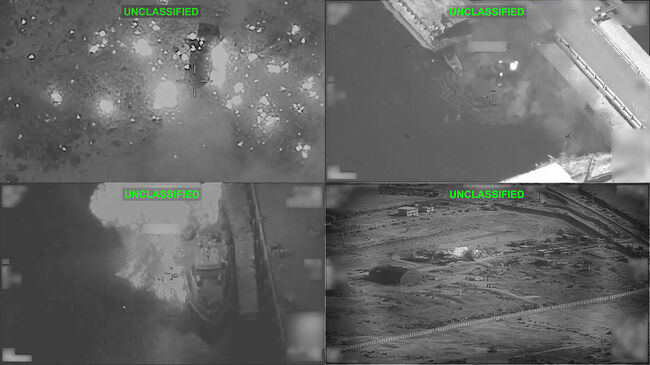
U.S. Central Command announced on Thursday, the 23rd, at 9:20 p.m. (EST) that it had "completed its 13th consecutive night of airstrikes against Iranian military targets." Central Command stated, "By targeting Iranian military command centers, drone storage facilities, communications networks, coastal surveillance facilities, and maritime capabilities, we have further degraded Iran's threat to commercial and merchant vessels transiting the Strait of Hormuz."
It also explained that "despite recent attacks by the Iranian Revolutionary Guard Corps, international waterways remain open, and merchant ships are navigating the strait freely with U.S. military support."
Currently, more than 50,000 U.S. troops are operating throughout the Middle East.
Iran's ability to effectively blockade the strait translates into an ability to cause chaos in the global economy, leverage that Tehran believes will give it significant negotiating power in any potential talks.
The Houthi rebels, an Iranian proxy, sought to further enhance that leverage by attacking two Saudi oil tankers in the Red Sea on Thursday. The Houthis stated that they had turned back ten ships on Thursday.
This increased the risk to vessels passing through another key route for Middle Eastern oil transport and caused international oil prices to spike instantly.
However, it appears things are not going according to Iran's plan.
Brent crude, the international benchmark, topped $100 per barrel in the wake of the attacks but fell back to around $97 on Friday. According to the American Automobile Association (AAA), the average price of gasoline in the U.S. rose slightly from $4.091 per gallon on Thursday the 23rd to $4.105 on Friday the 24th.
The attacks turned the Houthi threat to block Saudi-linked vessels into reality. Located at the southern tip of the Arabian Peninsula, this strait connects the Red Sea to the Gulf of Aden and handles about 12% of global trade, including one-quarter of all global container traffic.
For Saudi Arabia, which has been rerouting millions of barrels of oil per day to the port of Yanbu on the Red Sea coast to bypass the Strait of Hormuz, this passage has become more critical than ever.
President Donald Trump has threatened "massive military retaliation" if the Houthi rebels continue their attacks on vessels.
President Trump also warned Iran regarding the ship attacks, stating via social media on Thursday that the U.S. would use seized Iranian sanction funds to pay for the repair of war-damaged ships.
The frozen Iranian funds held by the U.S. are reportedly valued at approximately $100 billion.
To date, there have been no public signs of progress in any diplomatic efforts.
Iranian Foreign Minister Abbas Araghchi stated that discussions with China and Russia are ongoing, referring to the two nations as "friends." He vowed that Iran would "not bow to American tyranny."
In an interview with the semi-official Tasnim news agency, he said, "We will not be intimidated by threats, nor will we succumb to pressure."
U.S. NNP = CEO Reporter Hong Seong-gu / NNP Special Correspondent info@newsandpost.com

 Iranian Foreign Ministry: "Continuing Message Exchanges with the U.S. and Activities of Mediating Countries"
Esmaeil Baghaei, Spokesperson for the Iranian Ministry of Foreign Affairs [Xinhua, Yonhap News file photo]Esmaeil Baghaei, spokesperson for the Iranian Ministry of Foreign Affairs, stated on the 26th
Iranian Foreign Ministry: "Continuing Message Exchanges with the U.S. and Activities of Mediating Countries"
Esmaeil Baghaei, Spokesperson for the Iranian Ministry of Foreign Affairs [Xinhua, Yonhap News file photo]Esmaeil Baghaei, spokesperson for the Iranian Ministry of Foreign Affairs, stated on the 26th
 President Yoon: "Do You Really Think You Are Safe from a Special Counsel?"... Final Statement Video Released
President Yoon Suk Yeol rebuking the special prosecutor on the 24th. [Court Video / Subtitled GIF from @birds_justice X account] A video capturing the live footage of President Yoon Suk Yeol’s final
President Yoon: "Do You Really Think You Are Safe from a Special Counsel?"... Final Statement Video Released
President Yoon Suk Yeol rebuking the special prosecutor on the 24th. [Court Video / Subtitled GIF from @birds_justice X account] A video capturing the live footage of President Yoon Suk Yeol’s final
 President Yoon, regarding the first-instance ruling on the Public Official Election Act: “An excessive political verdict that distorts the facts… We will appeal immediately.”
The first-instance sentencing hearing for President Yoon Suk Yeol regarding violations of the Public Official Election Act is being broadcast live at Seoul Station on the 27th. [Photo=Yonhap News]Pres
President Yoon, regarding the first-instance ruling on the Public Official Election Act: “An excessive political verdict that distorts the facts… We will appeal immediately.”
The first-instance sentencing hearing for President Yoon Suk Yeol regarding violations of the Public Official Election Act is being broadcast live at Seoul Station on the 27th. [Photo=Yonhap News]Pres
 WSJ: "SK Hynix ADR Premium Is a Sign of AI Trading Overheat"
Advertisement for SK Hynix ADR listing in New York's Times Square [Reuters=Yonhap News file photo]The Wall Street Journal (WSJ) has pointed out that the price of SK Hynix’s American Depositary Recei
WSJ: "SK Hynix ADR Premium Is a Sign of AI Trading Overheat"
Advertisement for SK Hynix ADR listing in New York's Times Square [Reuters=Yonhap News file photo]The Wall Street Journal (WSJ) has pointed out that the price of SK Hynix’s American Depositary Recei
 'Godfather of Japanese Mystery Novels' Keigo Higashino Passes Away After Battle with Cancer at 68
Famous Japanese mystery novelist Keigo Higashino [AFP=Yonhap News]It has been belatedly reported that Keigo Higashino, the "godfather of Japanese mystery novels" and author of bestsellers such as "The
'Godfather of Japanese Mystery Novels' Keigo Higashino Passes Away After Battle with Cancer at 68
Famous Japanese mystery novelist Keigo Higashino [AFP=Yonhap News]It has been belatedly reported that Keigo Higashino, the "godfather of Japanese mystery novels" and author of bestsellers such as "The
 [Park Pil-kyu Security Column] To the Ignorant Trying to Clothe a Beast in Sheep's Clothing
Rep. Kim Byung-joo of the Democratic Party of Korea [Photo=Yonhap News]“The Air Force Academy doesn't teach you how to fly a plane!” “The Army, Navy, and Air Force academies are exactly the
[Park Pil-kyu Security Column] To the Ignorant Trying to Clothe a Beast in Sheep's Clothing
Rep. Kim Byung-joo of the Democratic Party of Korea [Photo=Yonhap News]“The Air Force Academy doesn't teach you how to fly a plane!” “The Army, Navy, and Air Force academies are exactly the
 [Issue Diagnosis] Two Effects of the Election Petition Review
 [Photo] Evidence of Election Fraud Flooding U.S. Media… Trump Had 2.7 Million Votes Stolen
 [Video] U.S. Semiquincentennial Air Show... 'Art in the Sky' streaks across New York
 [Editorial Cartoon] A Draconian Law That Undermines Freedom of Expression

 List
List









