 Iranian missiles fired toward U.S. military facilities in the Middle East [AFP=Yonhap News file photo]
The exchange of fire between the United States and Iran, which had reignited military tensions in the Middle East, has entered a lull after two weeks.
While the reason for the cessation of hostilities is attributed to ongoing back-channel diplomatic efforts, it remains uncertain whether this pause will lead to a ceasefire or an end to the conflict, given the significant gap in perceptions between the two sides observed during the repeated cycle of military clashes and negotiations.
The U.S. military conducted intense strikes against Iranian military targets for 13 consecutive days, from the 11th to the 23rd, following the resumption of attacks on civilian vessels passing through the Strait of Hormuz by Iran’s Islamic Revolutionary Guard Corps (IRGC).
In response, Iran launched retaliatory strikes using ballistic missiles and drones against U.S. military bases located in allied nations across the Middle East.
This renewed military confrontation, which occurred after the de facto expiration of a memorandum of understanding (MOU) on a ceasefire, triggered instability in the Middle East and a sharp rise in international oil prices. Four U.S. service members were also killed in Iran’s retaliatory attacks.
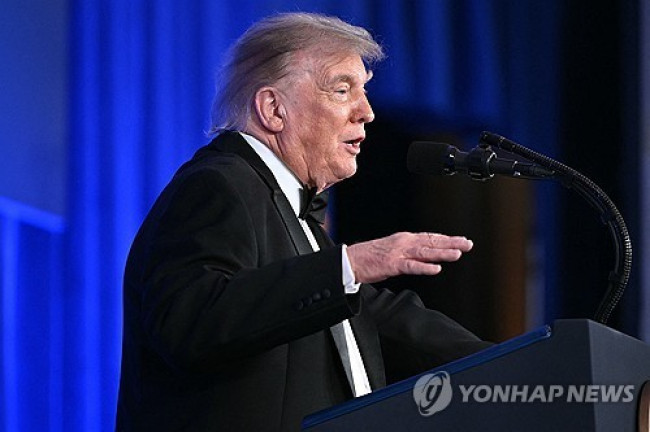 U.S. President Donald Trump [AFP=Yonhap News]
U.S. President Donald Trump ordered a halt to airstrikes against Iran on the 24th. He had been briefed on the military's strike plans that day but did not grant approval.
The reason cited was that back-channel talks with Iran were underway. Speaking to reporters at the White House, he mentioned that "serious talks" were taking place, and later that evening, he told the White House Correspondents' Association (WHCA), "I am very willing to listen."
Mike Waltz, the U.S. Ambassador to the United Nations, appeared on NBC on the 26th (local time) and stated, "What the President is doing right now is, as we've seen, giving some space for dialogue," adding, "Negotiations are ongoing. They are happening at all levels, from working-level officials to the highest levels of government."
Iran also announced that it had completely halted retaliatory attacks as the U.S. ceased its airstrikes.
Mohammad Akraminia, an Iranian military spokesperson, said that day, "The U.S. attacks continued until the night before last, but they have stopped for the past two days. Since our military strategy is fundamentally aimed at retaliation, we have also suspended our retaliatory operations."
Talks are also underway regarding the safety of civilian maritime transit in the Strait of Hormuz, the issue that sparked the 13-day exchange of fire.
According to Iran's state-run IRIB broadcasting, Iranian Foreign Ministry spokesperson Esmaeil Baghaei stated that deputy foreign minister-level talks were held several times in Tehran on the 24th and 25th to discuss common principles and operational mechanisms for managing maritime safety between Iran and Oman, describing the meetings as "very productive and having made meaningful progress."
Previously, the U.S. online news outlet Axios reported that President Trump’s order to halt airstrikes was issued just hours after an Omani negotiating team arrived in Iran to discuss the reopening of the Strait of Hormuz.
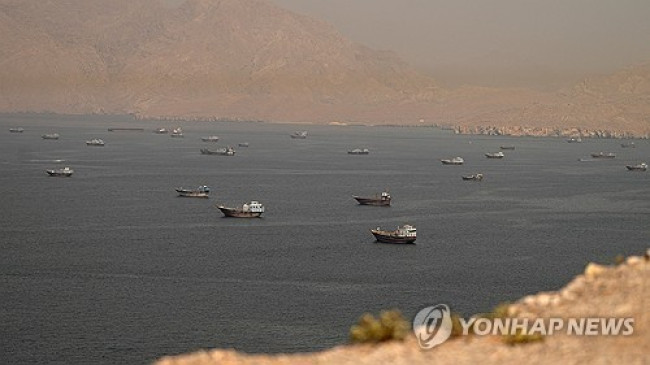 Ships in the Strait of Hormuz [Reuters=Yonhap News file photo]
If the U.S.-Iran military confrontation remains halted through today, it will mark the third consecutive day of a lull in hostilities.
The question remains whether the dialogue the Trump administration claims is currently underway will continue, and whether this phase will lead to the re-enactment of a ceasefire MOU or a complete end to the war.
In fact, there is a possibility that both sides are merely catching their breath before resuming an exchange of airstrikes.
President Trump has previously stated that if no agreement is reached this time, he will take immediate military action.
Furthermore, reports have surfaced that one reason the U.S. military halted the airstrikes is the rapid depletion of its defensive missiles capable of intercepting Iranian retaliatory strikes; therefore, the U.S. could resume strikes at any time once its inventory is replenished.
Even if an agreement is reached between Oman and Iran regarding the Strait of Hormuz, President Trump may not be satisfied with it.
Oman is a U.S. ally that shares territorial waters in the Strait of Hormuz with Iran. Since the outbreak of the war, Iran has been attempting, through negotiations with Oman, to impose toll-like fees on vessels passing through the strait. It is highly unlikely that the Trump administration would tolerate such an outcome if it were to materialize.
A high-ranking Iranian source also told Reuters on the same day that the U.S. suspension of airstrikes is viewed with "more skepticism than optimism," adding, "The prevailing view is that this is a tactical decision rather than a sincere gesture," reflecting deep distrust toward the U.S.
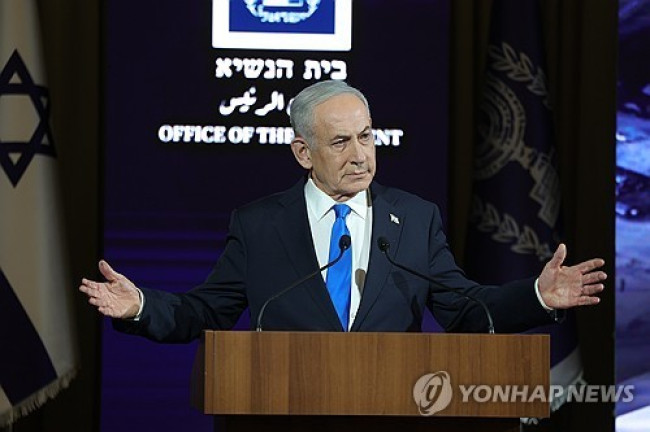 Israeli Prime Minister Benjamin Netanyahu [EPA=Yonhap News file photo]In an interview with Fox News that day, Israeli Prime Minister Benjamin Netanyahu—whose country is another party to the war—reiterated the need for a stronger offensive against Iran, stating that conditions for ending the war require that "the Iranian regime must either change, or be weakened enough to realize for itself that its nuclear program must stop and its course must change."
Regarding the U.S. decision to hold off on attacks, Prime Minister Netanyahu remarked, "If he (Trump) can do it (a peace deal) without a fierce military confrontation, that's fine."
Prime Minister Netanyahu, who is reportedly keen on continuing the war to extend his long-term rule ahead of the Israeli general election in October, is scheduled to visit the U.S. on the 27th and hold a meeting with President Trump at the White House on the 28th.
This meeting could also serve as a watershed moment in determining whether the current lull will continue or if military clashes will erupt again.

 Iranian Foreign Ministry: "Continuing Message Exchanges with the U.S. and Activities of Mediating Countries"
Esmaeil Baghaei, Spokesperson for the Iranian Ministry of Foreign Affairs [Xinhua, Yonhap News file photo]Esmaeil Baghaei, spokesperson for the Iranian Ministry of Foreign Affairs, stated on the 26th
Iranian Foreign Ministry: "Continuing Message Exchanges with the U.S. and Activities of Mediating Countries"
Esmaeil Baghaei, Spokesperson for the Iranian Ministry of Foreign Affairs [Xinhua, Yonhap News file photo]Esmaeil Baghaei, spokesperson for the Iranian Ministry of Foreign Affairs, stated on the 26th
 President Yoon: "Do You Really Think You Are Safe from a Special Counsel?"... Final Statement Video Released
President Yoon Suk Yeol rebuking the special prosecutor on the 24th. [Court Video / Subtitled GIF from @birds_justice X account] A video capturing the live footage of President Yoon Suk Yeol’s final
President Yoon: "Do You Really Think You Are Safe from a Special Counsel?"... Final Statement Video Released
President Yoon Suk Yeol rebuking the special prosecutor on the 24th. [Court Video / Subtitled GIF from @birds_justice X account] A video capturing the live footage of President Yoon Suk Yeol’s final
 President Yoon, regarding the first-instance ruling on the Public Official Election Act: “An excessive political verdict that distorts the facts… We will appeal immediately.”
The first-instance sentencing hearing for President Yoon Suk Yeol regarding violations of the Public Official Election Act is being broadcast live at Seoul Station on the 27th. [Photo=Yonhap News]Pres
President Yoon, regarding the first-instance ruling on the Public Official Election Act: “An excessive political verdict that distorts the facts… We will appeal immediately.”
The first-instance sentencing hearing for President Yoon Suk Yeol regarding violations of the Public Official Election Act is being broadcast live at Seoul Station on the 27th. [Photo=Yonhap News]Pres
 WSJ: "SK Hynix ADR Premium Is a Sign of AI Trading Overheat"
Advertisement for SK Hynix ADR listing in New York's Times Square [Reuters=Yonhap News file photo]The Wall Street Journal (WSJ) has pointed out that the price of SK Hynix’s American Depositary Recei
WSJ: "SK Hynix ADR Premium Is a Sign of AI Trading Overheat"
Advertisement for SK Hynix ADR listing in New York's Times Square [Reuters=Yonhap News file photo]The Wall Street Journal (WSJ) has pointed out that the price of SK Hynix’s American Depositary Recei
 'Godfather of Japanese Mystery Novels' Keigo Higashino Passes Away After Battle with Cancer at 68
Famous Japanese mystery novelist Keigo Higashino [AFP=Yonhap News]It has been belatedly reported that Keigo Higashino, the "godfather of Japanese mystery novels" and author of bestsellers such as "The
'Godfather of Japanese Mystery Novels' Keigo Higashino Passes Away After Battle with Cancer at 68
Famous Japanese mystery novelist Keigo Higashino [AFP=Yonhap News]It has been belatedly reported that Keigo Higashino, the "godfather of Japanese mystery novels" and author of bestsellers such as "The
 [Park Pil-kyu Security Column] To the Ignorant Trying to Clothe a Beast in Sheep's Clothing
Rep. Kim Byung-joo of the Democratic Party of Korea [Photo=Yonhap News]“The Air Force Academy doesn't teach you how to fly a plane!” “The Army, Navy, and Air Force academies are exactly the
[Park Pil-kyu Security Column] To the Ignorant Trying to Clothe a Beast in Sheep's Clothing
Rep. Kim Byung-joo of the Democratic Party of Korea [Photo=Yonhap News]“The Air Force Academy doesn't teach you how to fly a plane!” “The Army, Navy, and Air Force academies are exactly the
 [Issue Diagnosis] Two Effects of the Election Petition Review
 [Photo] Evidence of Election Fraud Flooding U.S. Media… Trump Had 2.7 Million Votes Stolen
 [Video] U.S. Semiquincentennial Air Show... 'Art in the Sky' streaks across New York
 [Editorial Cartoon] A Draconian Law That Undermines Freedom of Expression

 List
List









