 Seo Young-kyo, Chair of the Legislation and Judiciary Committee, strikes the gavel at a plenary session held at the National Assembly on the 27th. On this day, the committee tabled four special counsel bills related to the ballot shortage incident during the June 3 local elections. [Photo=Yonhap News] On the 27th, the National Assembly's Legislation and Judiciary Committee began deliberations on four so-called "special counsel bills on election fraud." However, none of the bills include the two core areas of suspicion that a special counsel must investigate as independent subjects of investigation.
These include the suspicions of computerized manipulation of voter counts and turnout rates that emerged after the bills were proposed, the "number matching" allegations, and the entire early voting process, from the issuance of ballots to the management of integrated voter lists and ballot boxes.
The bills tabled before the committee include those proposed by Reps. Baek Hye-ryun and Kim Eun-hye, the Democratic Party’s official proposal led by Rep. Han Byung-do, and the People Power Party’s official proposal led by Rep. Yoo Sang-bum. The Legislation and Judiciary Committee plans to refer these to a subcommittee for consolidated deliberation.
While the ruling and opposition parties have agreed on a method to recommend special counsel candidates through a citizen recommendation committee, they still need to further negotiate the scope of the investigation, the size of the personnel, and the duration of the investigation.
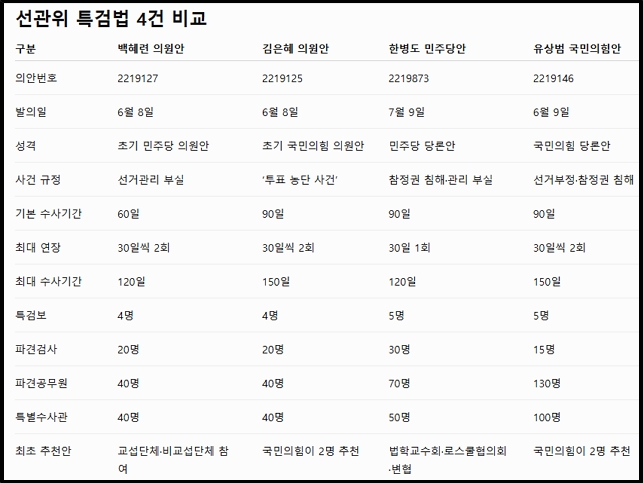 Source: Original text, reasons for proposal, and key contents of the bills disclosed by the Ministry of Government Legislation's Citizen Participation Legislation Center, linked to the National Assembly's Legislative Information System. The recommendation method is based on the original proposals.
As shown in the table, the four bills differ in personnel, duration, and recommendation methods. However, what will determine the effectiveness of the special counsel is not the number of investigators, but rather what is included in the investigation clauses of the final consolidated bill.
Scope of investigation for the 4 bills
The Baek Hye-ryun bill focuses on: △ the cause of the ballot shortage and the reduction in print volume, △ budget execution for printing and distribution, △ response on election day, and △ potential cover-ups and destruction of evidence.
The Kim Eun-hye bill mandates investigation into: △ the circumstances behind preparing fewer ballots than the number of voters, △ the decision to continue voting and counting despite the ballot shortage, △ the removal and transport of ballot boxes, △ the use of police force against citizens, and △ potential cover-ups and obstruction of the investigation.
The Han Byung-do bill covers: △ the process of lowering the minimum printing threshold for main election ballots from 60% to 50%, △ the circumstances behind the Secretary-General’s final approval, △ the reporting and command chain between the central and regional election commissions, △ the illegality of extending voting hours and proceeding with counting, △ dereliction of duty and abuse of power, and △ potential cover-ups.
The Yoo Sang-bum bill includes: △ infringement of suffrage, △ allegations of proceeding with counting without data preservation, △ damage to ballot box seals and procedures for removal, transport, and opening, △ discovery of ballots from other regions, △ abnormal counting data, △ possibility of duplicate voting, △ inaccuracies in the voter list, △ discrepancies between the budget and actual printing/supply volume, and even suspicions of identical or similar electoral fraud.
While the Democratic Party's bill is structured to hold the election management process accountable administratively and criminally, the People Power Party's bill is structured to verify the entire electoral process from voting to counting.
However, even in the broadest bill, the Yoo Sang-bum bill, the suspicions of computerized manipulation of voter counts and turnout rates and the entire early voting process are not explicitly stated as independent subjects of investigation. This is because all four bills originated from the ballot shortage incident on the main voting day of the June 3 local elections.
First gap... 'Computerized manipulation suspicions' that emerged after the bills were proposed
The joint investigation team of police and prosecutors is looking into circumstances where some election commission staff failed to correct input errors in voter counts according to established procedures, instead adjusting figures at other polling stations to make the overall totals match.
According to the "History of Corrected Voter Count Reports by Time" received by Rep. Kim Eun-hye's office from the National Election Commission, 72 correction reports were made across 56 district/city/county election commissions nationwide on election day. The joint investigation team is examining the circumstances in which excessive input figures in some regions were distributed and reflected in other polling stations, and the possibility of instructions from higher-level officials.
Whether individual changes were normal corrections of simple input errors or part of a systematic computerized manipulation or cover-up involving false entries must be determined through investigation.
Voter counts and turnout rates are foundational data that link the number of ballots issued, the number of ballots cast, and the final counting results. If an input error is discovered, it must be corrected according to authorized procedures while preserving the original values and change history.
However, the four current bills do not specifically mention: △ false input of voter counts and turnout rates, △ modification or deletion without due process, △ distributed adjustments using other polling stations, △ instructions or collusion for computerized manipulation, or △ suspected concealment or destruction of original data and change history.
There is room to include these under "abnormal counting data" or "suspicions of identical or similar electoral fraud" in the Yoo Sang-bum bill. However, voter counts and turnout rates by time are statistics generated during the voting management stage rather than counting data. It is difficult to conclude that these suspicions are naturally included as subjects of investigation simply through umbrella clauses.
As previously pointed out by the Hanmi Ilbo in "[Issue Diagnosis] Election Commission 'Computerized Manipulation' Suspicions... The Scope of the Special Counsel Bill Determines Success or Failure," if only the act of false input is investigated, it may end with the punishment of a few employees who participated in the so-called "number matching."
To uncover the reality of the computerized manipulation suspicions, it is necessary to secure: △ the original election network database, △ initial input values, △ logs of entry, modification, and deletion, △ access accounts and approval history, △ backup data, and △ identical or similar cases in other regions. One must verify whether the same method was repeated in multiple regions to determine if it was individual misconduct or a result of instructions from superiors or systemic practice.
Although new investigative issues have emerged since the bills were proposed, none of the bills include these actions as independent subjects of investigation. If this is not explicitly stated in the final consolidated bill, jurisdictional disputes may arise after the special counsel is launched regarding whether the servers and electronic information are directly related to the ballot shortage incident.
Second gap... Where is the entire early voting process?
The operational structure of early voting differs from main voting. While main voting ballots are printed in advance and distributed to each polling station, early voting ballots are printed on-site from an issuing machine after identity verification and checking the integrated voter list.
Ballots from voters within the jurisdiction are placed in early voting boxes and transferred to the competent election commission for storage. Ballots from voters outside the jurisdiction are placed in return envelopes, sealed, and moved through the postal network to the election commission governing the voter's address.
Therefore, to verify early voting, it is necessary to cross-reference: △ issuance records from ballot printing machines, △ access to the integrated voter list and markings of whether voting occurred, △ the actual number of ballots issued, △ classification of voters within and outside the jurisdiction, △ sealing, transport, storage, and opening of ballot boxes, and △ records of issuance, receipt, and transport of return envelopes as a single flow.
The Yoo Sang-bum bill includes the possibility of duplicate voting, inaccuracies in the voter list, damage to ballot box seals, and the discovery of ballots from other regions. However, there is no independent investigation item that mandates verifying the connection between the issuance machines, the integrated voter list, the boxes for local/non-local voters, and the movement records of return envelopes.
Specifying early voting as a subject of investigation does not mean presuming that the entire early voting process is fraudulent. It means verifying the suspicion and facts by using the computerized, issuance, storage, and return systems—which differ from those of main voting—as raw data.
'2 million vulnerable voters' and postal returns must also be checked
The Hanmi Ilbo reported in "[Investigation] Era of 2 Million Vulnerable Voters... Election Commission Has No Statistics" that simply adding up approximately 1.24 million dementia patients over 65 and 685,522 patients with severe mental illnesses other than dementia results in about 1.92 million people.
This is a simple sum of different statistics and is not the confirmed number of voters with duplicates removed. The core of the report is that there are no election statistics to determine how many among these patients are actual eligible voters, how they voted, how much they participated in residence/facility voting, and whose help they received.
If the special counsel examines election management outside polling stations, it is also necessary to check: △ residence voting reports and list preparation, △ receipt, marking, and return of ballots by facility residents, △ intervention and legality of voting assistants, and △ records of handover and transport of return envelopes.
The Korea Post also participates in the return of early voting ballots from outside jurisdictions. Therefore, it is necessary to cross-reference: △ mail receipt, △ transport to central sorting offices and logistics facilities, △ departure and arrival times, △ quantity handed over/received at each stage, and △ delivery and election commission handover records with election commission data.
Including the Korea Post as a subject of investigation does not mean designating the entire agency as a target of criminal suspicion. It is to verify whether the actual path of the external early voting ballots and the quantity at each stage match.
Is the one-line 'cognized related case' clause sufficient?
Each bill contains a comprehensive clause allowing for the investigation of related cases discovered during the investigation process. The Yoo Sang-bum bill even includes identical or similar electoral fraud suspicions raised nationwide or discovered during the investigation.
However, relying solely on comprehensive cognition clauses can lead to disputes over how relevant a new case is to the original subject of investigation defined by law.
If the special counsel bill centers on the ballot shortage, disputes are inevitable over whether it can investigate: △ suspicions of computerized manipulation in regions without ballot shortages, △ early voting issuance records, △ integrated voter list access data, and △ records of external early voting returns.
To secure the original data to verify the connection, one must first have the authority to investigate that data. Writing the investigation subject clauses of the special counsel bill specifically can reduce jurisdictional disputes during the search-and-seizure and data submission stages.
Han Sang-dae: "A Special Counsel Bill is a law that defines the authority and scope to verify suspicions"
Former Prosecutor General Han Sang-dae (legal advisor to this paper) said in a phone call with the Hanmi Ilbo, "A special counsel bill is not a law that presumes suspicions are guilty, but a law that defines the authority and scope to verify those suspicions," adding, "Once computerized manipulation and early voting management are raised as core issues, if they are not explicitly specified as subjects of investigation, jurisdictional debates could break out even after the special counsel is launched."
Park Joo-hyun, a lawyer specializing in defamation and election litigation, emphasized, "It is necessary to specifically mention the acts of inputting, modifying, or deleting voter counts and turnout rates, the election network originals and change history, early voting issuance and integrated voter list records, and the management process of local/non-local ballot boxes in the bill," adding, "One should not block the scope of the investigation if the goal is to uncover whether the suspicions are true or not."
He continued, "The Korea Post should also be included as a subject of investigation for early voting." His point is that one can only verify the entire path of the ballots if the receipt, transport, and handover process of the external early voting return envelopes are checked.
What the Legislation and Judiciary Committee needs to compromise on is not just the number of assistant counsel and dispatched prosecutors. If 'computerized manipulation suspicions' and 'the entire early voting process' are not explicitly stated as independent subjects of investigation in the final consolidated bill, it could end up as a 'half-measure special counsel' that misses the core issues despite deploying hundreds of personnel.

 Iranian Foreign Ministry: "Continuing Message Exchanges with the U.S. and Activities of Mediating Countries"
Esmaeil Baghaei, Spokesperson for the Iranian Ministry of Foreign Affairs [Xinhua, Yonhap News file photo]Esmaeil Baghaei, spokesperson for the Iranian Ministry of Foreign Affairs, stated on the 26th
Iranian Foreign Ministry: "Continuing Message Exchanges with the U.S. and Activities of Mediating Countries"
Esmaeil Baghaei, Spokesperson for the Iranian Ministry of Foreign Affairs [Xinhua, Yonhap News file photo]Esmaeil Baghaei, spokesperson for the Iranian Ministry of Foreign Affairs, stated on the 26th
 President Yoon: "Do You Really Think You Are Safe from a Special Counsel?"... Final Statement Video Released
President Yoon Suk Yeol rebuking the special prosecutor on the 24th. [Court Video / Subtitled GIF from @birds_justice X account] A video capturing the live footage of President Yoon Suk Yeol’s final
President Yoon: "Do You Really Think You Are Safe from a Special Counsel?"... Final Statement Video Released
President Yoon Suk Yeol rebuking the special prosecutor on the 24th. [Court Video / Subtitled GIF from @birds_justice X account] A video capturing the live footage of President Yoon Suk Yeol’s final
 President Yoon, regarding the first-instance ruling on the Public Official Election Act: “An excessive political verdict that distorts the facts… We will appeal immediately.”
The first-instance sentencing hearing for President Yoon Suk Yeol regarding violations of the Public Official Election Act is being broadcast live at Seoul Station on the 27th. [Photo=Yonhap News]Pres
President Yoon, regarding the first-instance ruling on the Public Official Election Act: “An excessive political verdict that distorts the facts… We will appeal immediately.”
The first-instance sentencing hearing for President Yoon Suk Yeol regarding violations of the Public Official Election Act is being broadcast live at Seoul Station on the 27th. [Photo=Yonhap News]Pres
 WSJ: "SK Hynix ADR Premium Is a Sign of AI Trading Overheat"
Advertisement for SK Hynix ADR listing in New York's Times Square [Reuters=Yonhap News file photo]The Wall Street Journal (WSJ) has pointed out that the price of SK Hynix’s American Depositary Recei
WSJ: "SK Hynix ADR Premium Is a Sign of AI Trading Overheat"
Advertisement for SK Hynix ADR listing in New York's Times Square [Reuters=Yonhap News file photo]The Wall Street Journal (WSJ) has pointed out that the price of SK Hynix’s American Depositary Recei
 'Godfather of Japanese Mystery Novels' Keigo Higashino Passes Away After Battle with Cancer at 68
Famous Japanese mystery novelist Keigo Higashino [AFP=Yonhap News]It has been belatedly reported that Keigo Higashino, the "godfather of Japanese mystery novels" and author of bestsellers such as "The
'Godfather of Japanese Mystery Novels' Keigo Higashino Passes Away After Battle with Cancer at 68
Famous Japanese mystery novelist Keigo Higashino [AFP=Yonhap News]It has been belatedly reported that Keigo Higashino, the "godfather of Japanese mystery novels" and author of bestsellers such as "The
 [Park Pil-kyu Security Column] To the Ignorant Trying to Clothe a Beast in Sheep's Clothing
Rep. Kim Byung-joo of the Democratic Party of Korea [Photo=Yonhap News]“The Air Force Academy doesn't teach you how to fly a plane!” “The Army, Navy, and Air Force academies are exactly the
[Park Pil-kyu Security Column] To the Ignorant Trying to Clothe a Beast in Sheep's Clothing
Rep. Kim Byung-joo of the Democratic Party of Korea [Photo=Yonhap News]“The Air Force Academy doesn't teach you how to fly a plane!” “The Army, Navy, and Air Force academies are exactly the
 [Issue Diagnosis] Two Effects of the Election Petition Review
 [Photo] Evidence of Election Fraud Flooding U.S. Media… Trump Had 2.7 Million Votes Stolen
 [Video] U.S. Semiquincentennial Air Show... 'Art in the Sky' streaks across New York
 [Editorial Cartoon] A Draconian Law That Undermines Freedom of Expression

 List
List









