BoK: "Proportion of Marginal Firms Unable to Cover Interest Payments Highest in 14 Years"
"80% of Vulnerable Self-Employed Borrowers Continue to Default"... Financial Stability Report
 [Yonhap News photo]
The proportion of marginal firms struggling to even cover their loan interest payments has reached its highest point in 14 years, the Bank of Korea (BoK) announced on the 25th.
A trend of prolonged loan delinquencies among self-employed individuals was also observed.
With delinquency rates among vulnerable borrowers soaring, the percentage of vulnerable self-employed borrowers who remained in default in the second quarter, following the first quarter, was close to 80%.
◇ Proportion of Marginal Firms Rises Despite Overall Performance Improvement... "Structural Factors"
According to the 'Financial Stability Situation' report released by the Bank of Korea today, as of the end of last year, the proportion of marginal firms whose interest coverage ratio remained below 1 for three consecutive years stood at 17.1% among all externally audited companies, an increase of 0.7 percentage points (p) from the previous year.
This is the highest level recorded since 2010.
An interest coverage ratio below 1 means that the company's earnings over the year were insufficient to cover its loan interest payments.
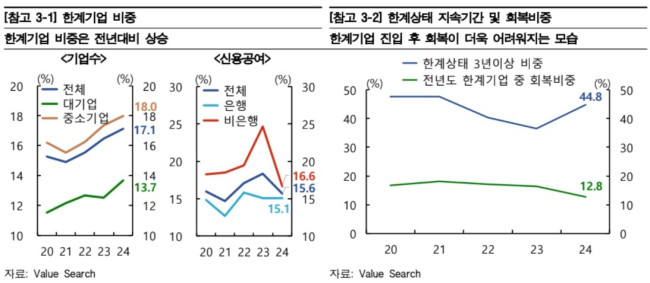
By firm size, the proportion of marginal small and medium-sized enterprises increased from 17.4% in 2023 to 18.0% last year, a rise of 0.6%p, while for large enterprises, it rose from 12.5% to 13.7%, a jump of 1.2%p.
The proportion of firms in a marginal state for three or more years also expanded from 36.5% in 2023 to 44.8% last year.
Conversely, the proportion of firms that transitioned from a marginal state to a normal state within a year decreased from 16.3% in 2023 to 12.8% last year, indicating increasing difficulty in recovery.
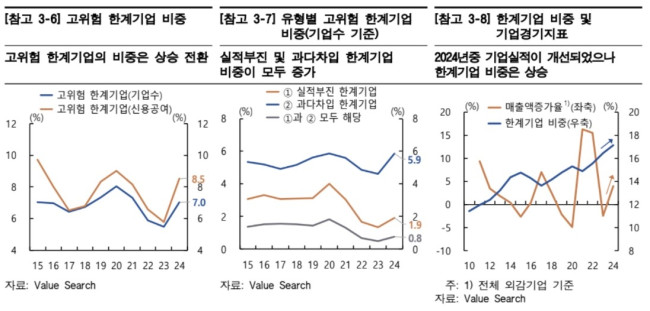
The proportion of high-risk marginal firms, with a high potential for insolvency due to poor performance and excessive borrowing, also increased from 5.5% in 2023 to 7.0% last year.
By industry, the proportion of marginal firms was highest in real estate (39.4%) and accommodation and food services (28.8%).
Compared to 2023, significant increases were seen in real estate (34.5%→39.4%), information and communication (17.3%→20.8%), petrochemicals (10.1%→11.1%), and electrical and electronics (14.2%→15.4%).
In particular, the proportion of marginal firms based on credit exposure significantly increased in the petrochemical and electrical/electronics sectors, which are experiencing global oversupply issues.
The BoK stated, "The proportion of marginal firms rose despite an overall improvement in corporate performance last year," adding, "This is presumed to be the result of structural factors, not just cyclical ones."
◇ Vulnerable Self-Employed Borrowers Aged 70 and Over, Three Times Higher Than Those in Their 20s and 30s
The proportion of vulnerable self-employed borrowers has been on the rise since the second half of 2022, reaching 14.2% by the number of borrowers and 12.2% by loan volume at the end of the second quarter of this year.
In contrast, the proportion of vulnerable household borrowers has remained relatively stable since 2021. At the end of the second quarter of this year, the proportion was relatively low at 7.0% by the number of borrowers and 5.2% by loan volume.
Vulnerable borrowers refer to low-income or low-credit individuals with multiple loans.
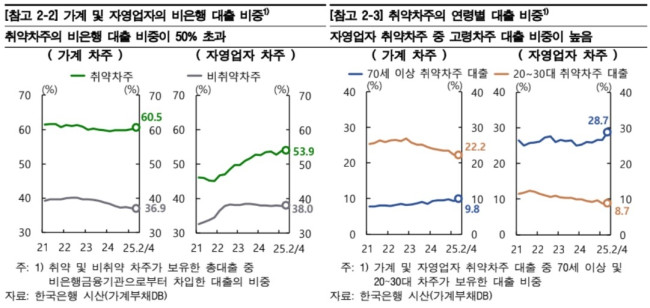
The proportion of non-bank loans among vulnerable self-employed borrowers has continued to rise since 2022, jumping from 45.1% at the end of 2021 to 53.9% at the end of the second quarter of this year.
The proportion of elderly borrowers aged 70 and over was notably high.
Among vulnerable self-employed borrowers, the loan share of elderly borrowers was 28.7% at the end of the second quarter of this year, more than three times higher than that of borrowers in their 20s and 30s (8.7%).
This contrasts with vulnerable household borrowers, where the proportion of elderly borrowers was 9.8%, less than half that of those in their 20s and 30s (22.2%).
At the end of the second quarter of this year, the delinquency rate for vulnerable borrowers was 10.48% for households and 11.34% for self-employed individuals. Among vulnerable borrowers, the proportion of those in delinquency was 20.1% for households and 25.6% for self-employed individuals.
Both the delinquency entry rate, which is the rate of newly defaulting on loan repayments, and the delinquency continuation rate, which is the rate of maintaining a delinquent status, showed an upward trend.
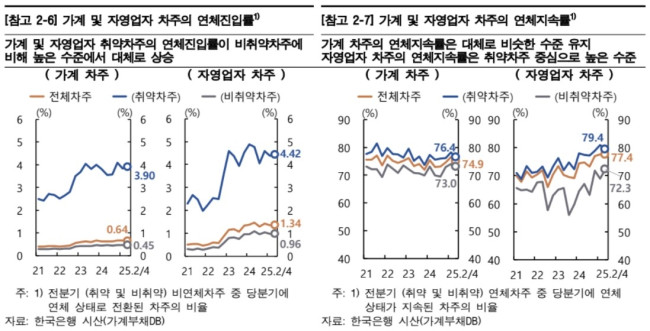
The delinquency entry rate for vulnerable household and self-employed borrowers, which was around 2.5% in 2021, rose to 3.90% and 4.42% respectively at the end of the second quarter of this year.
While the delinquency continuation rate for vulnerable household borrowers decreased from 75.6% at the end of the first quarter of 2021 to 74.9% at the end of the second quarter of this year, it significantly increased for self-employed borrowers, particularly among vulnerable borrowers (71.0%→79.4%).
The BoK stated, "Defaults among vulnerable borrowers can quickly spread across various financial sectors," and emphasized the need to "strengthen credit risk management, such as preemptively increasing the provisioning of loan loss reserves." Yonhap News

 Iranian Foreign Ministry: "Continuing Message Exchanges with the U.S. and Activities of Mediating Countries"
Esmaeil Baghaei, Spokesperson for the Iranian Ministry of Foreign Affairs [Xinhua, Yonhap News file photo]Esmaeil Baghaei, spokesperson for the Iranian Ministry of Foreign Affairs, stated on the 26th
Iranian Foreign Ministry: "Continuing Message Exchanges with the U.S. and Activities of Mediating Countries"
Esmaeil Baghaei, Spokesperson for the Iranian Ministry of Foreign Affairs [Xinhua, Yonhap News file photo]Esmaeil Baghaei, spokesperson for the Iranian Ministry of Foreign Affairs, stated on the 26th
 President Yoon: "Do You Really Think You Are Safe from a Special Counsel?"... Final Statement Video Released
President Yoon Suk Yeol rebuking the special prosecutor on the 24th. [Court Video / Subtitled GIF from @birds_justice X account] A video capturing the live footage of President Yoon Suk Yeol’s final
President Yoon: "Do You Really Think You Are Safe from a Special Counsel?"... Final Statement Video Released
President Yoon Suk Yeol rebuking the special prosecutor on the 24th. [Court Video / Subtitled GIF from @birds_justice X account] A video capturing the live footage of President Yoon Suk Yeol’s final
 President Yoon, regarding the first-instance ruling on the Public Official Election Act: “An excessive political verdict that distorts the facts… We will appeal immediately.”
The first-instance sentencing hearing for President Yoon Suk Yeol regarding violations of the Public Official Election Act is being broadcast live at Seoul Station on the 27th. [Photo=Yonhap News]Pres
President Yoon, regarding the first-instance ruling on the Public Official Election Act: “An excessive political verdict that distorts the facts… We will appeal immediately.”
The first-instance sentencing hearing for President Yoon Suk Yeol regarding violations of the Public Official Election Act is being broadcast live at Seoul Station on the 27th. [Photo=Yonhap News]Pres
 WSJ: "SK Hynix ADR Premium Is a Sign of AI Trading Overheat"
Advertisement for SK Hynix ADR listing in New York's Times Square [Reuters=Yonhap News file photo]The Wall Street Journal (WSJ) has pointed out that the price of SK Hynix’s American Depositary Recei
WSJ: "SK Hynix ADR Premium Is a Sign of AI Trading Overheat"
Advertisement for SK Hynix ADR listing in New York's Times Square [Reuters=Yonhap News file photo]The Wall Street Journal (WSJ) has pointed out that the price of SK Hynix’s American Depositary Recei
 'Godfather of Japanese Mystery Novels' Keigo Higashino Passes Away After Battle with Cancer at 68
Famous Japanese mystery novelist Keigo Higashino [AFP=Yonhap News]It has been belatedly reported that Keigo Higashino, the "godfather of Japanese mystery novels" and author of bestsellers such as "The
'Godfather of Japanese Mystery Novels' Keigo Higashino Passes Away After Battle with Cancer at 68
Famous Japanese mystery novelist Keigo Higashino [AFP=Yonhap News]It has been belatedly reported that Keigo Higashino, the "godfather of Japanese mystery novels" and author of bestsellers such as "The
 [Park Pil-kyu Security Column] To the Ignorant Trying to Clothe a Beast in Sheep's Clothing
Rep. Kim Byung-joo of the Democratic Party of Korea [Photo=Yonhap News]“The Air Force Academy doesn't teach you how to fly a plane!” “The Army, Navy, and Air Force academies are exactly the
[Park Pil-kyu Security Column] To the Ignorant Trying to Clothe a Beast in Sheep's Clothing
Rep. Kim Byung-joo of the Democratic Party of Korea [Photo=Yonhap News]“The Air Force Academy doesn't teach you how to fly a plane!” “The Army, Navy, and Air Force academies are exactly the
 [Issue Diagnosis] Two Effects of the Election Petition Review
 [Photo] Evidence of Election Fraud Flooding U.S. Media… Trump Had 2.7 Million Votes Stolen
 [Video] U.S. Semiquincentennial Air Show... 'Art in the Sky' streaks across New York
 [Editorial Cartoon] A Draconian Law That Undermines Freedom of Expression

 List
List









