 Vehicles for export stacked at Pyeongtaek Port. Yonhap News.
Anxiety is spreading within South Korea's automotive industry as the announcement of the 'Joint Fact Sheet,' detailing the results of the South Korea-U.S. customs and security negotiations, is delayed beyond expectations.
While details of the customs negotiations have been largely agreed upon, concerns are cautiously emerging that the effective date for the tariff reduction, which still leaves the industry burdened with a high 25% tariff, might be set unfavorably for South Korea.
According to industry sources on the 11th, South Korea and the U.S. were expected to release the Fact Sheet shortly after the summit between President Lee Jae-myung and President Donald Trump held in Gyeongju on the 29th of last month.
At the time, Presidential Chief of Staff Kim Yong-beom stated in a briefing immediately after the meeting, "The detailed agreement between the two countries is almost finalized," and added, "The Fact Sheet, combining tariffs and security, will take about two to three days."
However, nearly two weeks have passed since the summit without the Fact Sheet being released, and the domestic industry continues to be subject to the 25% tariff on automotive exports to the U.S.
The industry's fatigue is exacerbated by the fact that the tariff reduction for automobiles has not materialized for over three months since its initial agreement in July.
An official from a finished vehicle manufacturer stated, "There were high expectations as the government's efforts led to a favorable conclusion in the tariff negotiations," adding, "However, the delayed finalization is increasing the burden on the industry, so we are closely monitoring the situation."
For the domestic industry, which exports over 100,000 units to the U.S. monthly, the longer the tariff reduction is postponed, the more costs snowball.
South Korea exported 1,432,713 vehicles to the U.S. last year, and in the cumulative third quarter of this year, exports reached 1,004,354 units. Arithmetically, nearly 4,000 units are subject to high tariffs daily.
Hyundai Motor and Kia's tariff costs for the third quarter of this year were 1.8212 trillion won and 1.2340 trillion won, respectively. Consequently, Hyundai Motor's third-quarter operating profit decreased by 29.2% compared to last year, and Kia's decreased by 49.2%.
The industry is urging for a swift tariff reduction, emphasizing that even if the reduction is applied this month, it will take time to be reflected in performance after local sales, necessitating an immediate decrease in tariffs.
Kia's Head of Finance, Kim Seung-jun, stated during the third-quarter earnings conference call, "Even if it is applied retroactively to November 1st, the existing inventory has already paid the 25% tariff," and projected, "The tariff impact in the fourth quarter will not be significantly different from the third quarter, and its full effect will be seen next year."
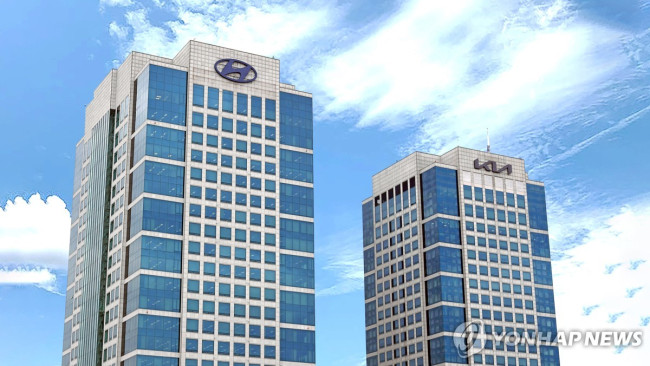 Hyundai Motor and Kia Headquarters. Provided by Hyundai Motor Group.
Concerns are also cautiously being raised that the effective date for the tariff reduction might be later than November 1st.
Minister of Trade, Industry and Energy Kim Jung-kwan stated at a Cabinet meeting on the 4th, "Regarding automotive tariffs, we will negotiate for them to take effect retroactively from the first day of the month in which the bill related to the U.S. investment fund is submitted."
If the procedures proceed as explained by Minister Kim, the date on which the U.S. government reduces the 25% tariff on Korean cars to 15% will be applied retroactively to the 1st of this month.
However, there are concerns that the U.S. side might insist on the signing of the Memorandum of Understanding (MOU) as the effective date for the tariff reduction.
Professor Kim Pil-soo of Daelim University commented, "For finished vehicle manufacturers, every day represents a significant loss, and it goes without saying for parts suppliers," adding, "While it may not be easy to set the tariff reduction date to August 7th, the date of reciprocal tariff imposition, November 1st must be secured."
Yonhap News

 Iranian Foreign Ministry: "Continuing Message Exchanges with the U.S. and Activities of Mediating Countries"
Esmaeil Baghaei, Spokesperson for the Iranian Ministry of Foreign Affairs [Xinhua, Yonhap News file photo]Esmaeil Baghaei, spokesperson for the Iranian Ministry of Foreign Affairs, stated on the 26th
Iranian Foreign Ministry: "Continuing Message Exchanges with the U.S. and Activities of Mediating Countries"
Esmaeil Baghaei, Spokesperson for the Iranian Ministry of Foreign Affairs [Xinhua, Yonhap News file photo]Esmaeil Baghaei, spokesperson for the Iranian Ministry of Foreign Affairs, stated on the 26th
 President Yoon: "Do You Really Think You Are Safe from a Special Counsel?"... Final Statement Video Released
President Yoon Suk Yeol rebuking the special prosecutor on the 24th. [Court Video / Subtitled GIF from @birds_justice X account] A video capturing the live footage of President Yoon Suk Yeol’s final
President Yoon: "Do You Really Think You Are Safe from a Special Counsel?"... Final Statement Video Released
President Yoon Suk Yeol rebuking the special prosecutor on the 24th. [Court Video / Subtitled GIF from @birds_justice X account] A video capturing the live footage of President Yoon Suk Yeol’s final
 President Yoon, regarding the first-instance ruling on the Public Official Election Act: “An excessive political verdict that distorts the facts… We will appeal immediately.”
The first-instance sentencing hearing for President Yoon Suk Yeol regarding violations of the Public Official Election Act is being broadcast live at Seoul Station on the 27th. [Photo=Yonhap News]Pres
President Yoon, regarding the first-instance ruling on the Public Official Election Act: “An excessive political verdict that distorts the facts… We will appeal immediately.”
The first-instance sentencing hearing for President Yoon Suk Yeol regarding violations of the Public Official Election Act is being broadcast live at Seoul Station on the 27th. [Photo=Yonhap News]Pres
 WSJ: "SK Hynix ADR Premium Is a Sign of AI Trading Overheat"
Advertisement for SK Hynix ADR listing in New York's Times Square [Reuters=Yonhap News file photo]The Wall Street Journal (WSJ) has pointed out that the price of SK Hynix’s American Depositary Recei
WSJ: "SK Hynix ADR Premium Is a Sign of AI Trading Overheat"
Advertisement for SK Hynix ADR listing in New York's Times Square [Reuters=Yonhap News file photo]The Wall Street Journal (WSJ) has pointed out that the price of SK Hynix’s American Depositary Recei
 'Godfather of Japanese Mystery Novels' Keigo Higashino Passes Away After Battle with Cancer at 68
Famous Japanese mystery novelist Keigo Higashino [AFP=Yonhap News]It has been belatedly reported that Keigo Higashino, the "godfather of Japanese mystery novels" and author of bestsellers such as "The
'Godfather of Japanese Mystery Novels' Keigo Higashino Passes Away After Battle with Cancer at 68
Famous Japanese mystery novelist Keigo Higashino [AFP=Yonhap News]It has been belatedly reported that Keigo Higashino, the "godfather of Japanese mystery novels" and author of bestsellers such as "The
 [Park Pil-kyu Security Column] To the Ignorant Trying to Clothe a Beast in Sheep's Clothing
Rep. Kim Byung-joo of the Democratic Party of Korea [Photo=Yonhap News]“The Air Force Academy doesn't teach you how to fly a plane!” “The Army, Navy, and Air Force academies are exactly the
[Park Pil-kyu Security Column] To the Ignorant Trying to Clothe a Beast in Sheep's Clothing
Rep. Kim Byung-joo of the Democratic Party of Korea [Photo=Yonhap News]“The Air Force Academy doesn't teach you how to fly a plane!” “The Army, Navy, and Air Force academies are exactly the
 [Issue Diagnosis] Two Effects of the Election Petition Review
 [Photo] Evidence of Election Fraud Flooding U.S. Media… Trump Had 2.7 Million Votes Stolen
 [Video] U.S. Semiquincentennial Air Show... 'Art in the Sky' streaks across New York
 [Editorial Cartoon] A Draconian Law That Undermines Freedom of Expression

 List
List









