 Hanwha Philippines Shipyard. Yonhap News.
Experts believe that the U.S. suspension of measures targeting the Chinese shipbuilding industry, such as port entry fees, as part of a trade agreement with China will negatively impact efforts to rebuild the U.S. shipbuilding sector through cooperation with South Korea.
James Kim, Director of the Korea Program at the Stimson Center, a U.S. think tank, assessed on Dec. 12 (local time) at a seminar hosted by the Korea Economic Institute (KEI) that the U.S. decision to suspend enforcement of measures aimed at China's shipbuilding industry is "not helpful" for South Korea-U.S. shipbuilding cooperation.
Kim emphasized the "importance of demand" for vessels to be built through South Korea-U.S. cooperation, pointing out that if the need for shipping companies to build ships in South Korea or the U.S. decreases, they are more likely to place orders with China, which has a competitive advantage in price.
The U.S. had implemented a series of measures against China, including port entry fees for Chinese-made vessels starting Oct. 14, viewing China's growing dominance in the maritime, logistics, and shipbuilding industries due to its unfair policies and practices.
These measures were expected to serve as an incentive for shipping companies to order South Korean-made vessels or vessels to be built in the U.S. through investment cooperation, instead of Chinese-made vessels which they had chosen for their price competitiveness. However, the U.S. recently postponed the implementation of these measures for one year as part of a U.S.-China summit agreement.
Kim stressed the long-term nature of shipyard investments and vessel construction, which take years, and highlighted the importance of sustained demand for vessels to be built in the U.S. and the durability of government support policies.
"The long-term impact on the industry itself is more important than what the suspension of port entry fees means in the short term. This creates uncertainty," he said.
"Companies will have more difficulty figuring out how to proceed with their businesses, and may hesitate to make large investments in the short term, choosing to wait and see how things unfold," he predicted. "If there is no certainty that these measures will be maintained, there will be more delays (in investment)."
He also noted the higher costs of building ships in the U.S. compared to South Korea and argued that if the U.S. government truly wants to build ships in the U.S., it should allow tariff exemptions on the steel required for shipbuilding.
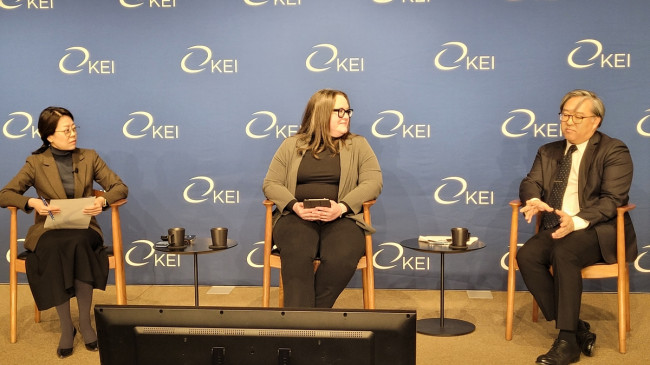 Experts speak at a seminar on South Korea-U.S. shipbuilding cooperation hosted by the Korea Economic Institute (KEI) in Washington D.C. on Dec. 12 (local time). From left, Ellen Kim, Director of Academic Affairs at KEI; Dr. Lydia Rol; and James Kim, Director of the Korea Program at the Stimson Center. 2025.11.12
Yonhap News
What do you think of this article?

 Iranian Foreign Ministry: "Continuing Message Exchanges with the U.S. and Activities of Mediating Countries"
Esmaeil Baghaei, Spokesperson for the Iranian Ministry of Foreign Affairs [Xinhua, Yonhap News file photo]Esmaeil Baghaei, spokesperson for the Iranian Ministry of Foreign Affairs, stated on the 26th
Iranian Foreign Ministry: "Continuing Message Exchanges with the U.S. and Activities of Mediating Countries"
Esmaeil Baghaei, Spokesperson for the Iranian Ministry of Foreign Affairs [Xinhua, Yonhap News file photo]Esmaeil Baghaei, spokesperson for the Iranian Ministry of Foreign Affairs, stated on the 26th
 President Yoon: "Do You Really Think You Are Safe from a Special Counsel?"... Final Statement Video Released
President Yoon Suk Yeol rebuking the special prosecutor on the 24th. [Court Video / Subtitled GIF from @birds_justice X account] A video capturing the live footage of President Yoon Suk Yeol’s final
President Yoon: "Do You Really Think You Are Safe from a Special Counsel?"... Final Statement Video Released
President Yoon Suk Yeol rebuking the special prosecutor on the 24th. [Court Video / Subtitled GIF from @birds_justice X account] A video capturing the live footage of President Yoon Suk Yeol’s final
 President Yoon, regarding the first-instance ruling on the Public Official Election Act: “An excessive political verdict that distorts the facts… We will appeal immediately.”
The first-instance sentencing hearing for President Yoon Suk Yeol regarding violations of the Public Official Election Act is being broadcast live at Seoul Station on the 27th. [Photo=Yonhap News]Pres
President Yoon, regarding the first-instance ruling on the Public Official Election Act: “An excessive political verdict that distorts the facts… We will appeal immediately.”
The first-instance sentencing hearing for President Yoon Suk Yeol regarding violations of the Public Official Election Act is being broadcast live at Seoul Station on the 27th. [Photo=Yonhap News]Pres
 WSJ: "SK Hynix ADR Premium Is a Sign of AI Trading Overheat"
Advertisement for SK Hynix ADR listing in New York's Times Square [Reuters=Yonhap News file photo]The Wall Street Journal (WSJ) has pointed out that the price of SK Hynix’s American Depositary Recei
WSJ: "SK Hynix ADR Premium Is a Sign of AI Trading Overheat"
Advertisement for SK Hynix ADR listing in New York's Times Square [Reuters=Yonhap News file photo]The Wall Street Journal (WSJ) has pointed out that the price of SK Hynix’s American Depositary Recei
 'Godfather of Japanese Mystery Novels' Keigo Higashino Passes Away After Battle with Cancer at 68
Famous Japanese mystery novelist Keigo Higashino [AFP=Yonhap News]It has been belatedly reported that Keigo Higashino, the "godfather of Japanese mystery novels" and author of bestsellers such as "The
'Godfather of Japanese Mystery Novels' Keigo Higashino Passes Away After Battle with Cancer at 68
Famous Japanese mystery novelist Keigo Higashino [AFP=Yonhap News]It has been belatedly reported that Keigo Higashino, the "godfather of Japanese mystery novels" and author of bestsellers such as "The
 [Park Pil-kyu Security Column] To the Ignorant Trying to Clothe a Beast in Sheep's Clothing
Rep. Kim Byung-joo of the Democratic Party of Korea [Photo=Yonhap News]“The Air Force Academy doesn't teach you how to fly a plane!” “The Army, Navy, and Air Force academies are exactly the
[Park Pil-kyu Security Column] To the Ignorant Trying to Clothe a Beast in Sheep's Clothing
Rep. Kim Byung-joo of the Democratic Party of Korea [Photo=Yonhap News]“The Air Force Academy doesn't teach you how to fly a plane!” “The Army, Navy, and Air Force academies are exactly the
 [Issue Diagnosis] Two Effects of the Election Petition Review
 [Photo] Evidence of Election Fraud Flooding U.S. Media… Trump Had 2.7 Million Votes Stolen
 [Video] U.S. Semiquincentennial Air Show... 'Art in the Sky' streaks across New York
 [Editorial Cartoon] A Draconian Law That Undermines Freedom of Expression

 List
List









