 People's Power Party lawmakers requesting speaking time. Yonhap News
The "Rebellion Trial Division" (Special Rebellion Court) establishment bill, which will exclusively handle rebellion cases involving former President Yoon Suk-yeol and others in relation to the December 3rd martial law incident, has passed the plenary session of the National Assembly's Legislation and Judiciary Committee.
A bill to establish a new crime of "law distortion" (amendment to the Criminal Act), which can punish judges and prosecutors who intentionally distort laws or manipulate facts during trials or investigations, and an amendment to the Act on the Corruption Investigation Office for High-ranking Officials (CIO Act) to expand the CIO's investigative scope were also passed by the committee, respectively.
The Legislation and Judiciary Committee passed these bills at its plenary session on the 3rd, led by the Democratic Party of Korea.
The People Power Party strongly opposed the bill's voting and left the meeting room just before the vote.
The "Special Act on the Establishment of a Dedicated Court for the December 3rd Yoon Suk-yeol Emergency Martial Law and Protection of Whistleblowers" mandates the establishment of at least two dedicated rebellion trial divisions for both the first and appellate instances. It also establishes a new provision for the appointment of rebellion warrant judges.
The committee for recommending judges for the rebellion trial divisions and warrant judges will consist of a total of nine members recommended by the Chief Justice of the Constitutional Court, the Minister of Justice, and the Judges' Association.
Within two weeks of its formation, the recommendation committee will recommend twice the number of candidates for warrant judges and dedicated trial judges as their respective quotas, and the Chief Justice of the Supreme Court will make the final appointments.
Furthermore, while the Criminal Procedure Act stipulates a maximum detention period of six months for defendants, the special act allows for the extension of the detention period to one year for rebellion and foreign exchange-related crimes.
The special act also includes provisions restricting the pardon, restoration of rights, and sentence reduction for those convicted of rebellion.
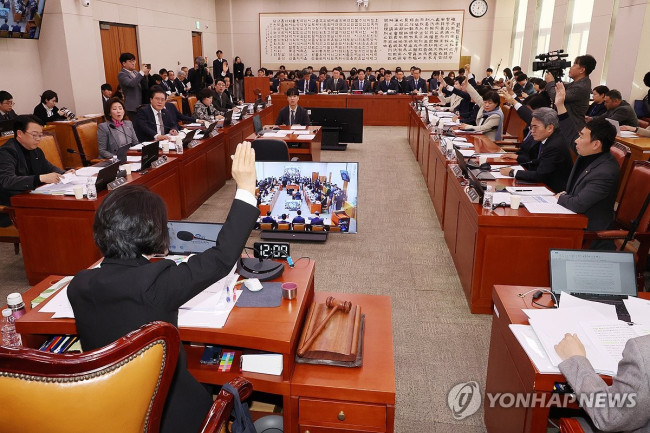 Legislation and Judiciary Committee members raising hands to vote. Yonhap News
The amendment to the Criminal Act passed by the Legislation and Judiciary Committee establishes the crime of law distortion and expands the scope of espionage charges.
In the case of law distortion, judges, prosecutors, or individuals working in investigative agencies who distort laws for unjust purposes or apply laws by significantly misjudging facts can be punished with imprisonment for up to 10 years or disqualification for up to 10 years.
The scope of the crime of espionage under the Criminal Act has been expanded from "enemy states" to "foreign countries or organizations equivalent thereto." Those who detect, collect, leak, deliver, or mediate state secrets for a foreign country or an equivalent organization, or aid and abet such acts, will be punished for espionage.
Previously, under the current law, espionage charges only applied to those who engaged in espionage or aided and abetted an "enemy state," or leaked military secrets to an enemy state. However, with the changing international landscape, the need to prevent the outflow of state secrets regardless of adversarial relationships has increased.
The amendment to the CIO Act expands the CIO's investigative scope to allow it to investigate all crimes committed by the Chief Justice of the Supreme Court and Supreme Court Justices, the Prosecutor General, judges, and prosecutors.
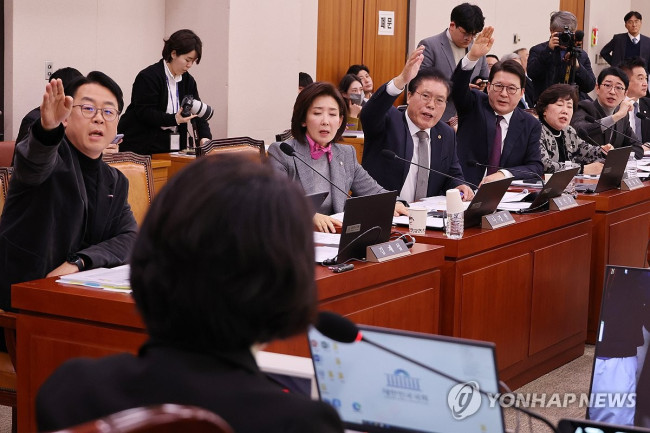 People's Power Party lawmakers requesting speaking time. Yonhap News
Earlier, the People Power Party strongly opposed the establishment of the rebellion trial division bill and the law distortion crime, even requesting the formation of a special committee for agenda adjustment. However, they were outvoted by the overwhelming majority of the ruling coalition.
The special committee for agenda adjustment is an organization established when consensus adjustment is needed on an agenda item where there is a conflict of opinion between the ruling and opposition parties. It can review bills for up to 90 days, but if more than four out of six committee members agree, the bill can be referred to the standing committee and voted on immediately.
The agenda adjustment committee is composed of three members from the Democratic Party, one from the Cho Kuk Innovation Party, and two from the People Power Party.
People Power Party lawmaker Na Kyung-won stated that the establishment of the rebellion trial division bill, when referred to the agenda adjustment committee, is "simply to select judges who are not liked," adding that it "not only violates the principle of random assignment in the judiciary but also infringes upon the separation of powers by taking away cases already being tried and assigning them to other judges."
In response, Democratic Party lawmaker Jeon Hyun-hee cited the court's rejection of an arrest warrant for People Power Party lawmaker Chu Kyong-ho, stating, "The judiciary is acting as a shield for rebellion forces. The National Assembly can no longer stand idly by."
The Democratic Party is pushing for the bills that passed the Legislation and Judiciary Committee today to be processed in a plenary session this month.
Yonhap News

 Iranian Foreign Ministry: "Continuing Message Exchanges with the U.S. and Activities of Mediating Countries"
Esmaeil Baghaei, Spokesperson for the Iranian Ministry of Foreign Affairs [Xinhua, Yonhap News file photo]Esmaeil Baghaei, spokesperson for the Iranian Ministry of Foreign Affairs, stated on the 26th
Iranian Foreign Ministry: "Continuing Message Exchanges with the U.S. and Activities of Mediating Countries"
Esmaeil Baghaei, Spokesperson for the Iranian Ministry of Foreign Affairs [Xinhua, Yonhap News file photo]Esmaeil Baghaei, spokesperson for the Iranian Ministry of Foreign Affairs, stated on the 26th
 President Yoon: "Do You Think You Are Safe from the Special Counsel?"... Final Statement Video Released
President Yoon Suk Yeol rebuking the special prosecutor on the 24th. [Court video / @birds_justice X account subtitle GIF] A video of President Yoon Suk Yeol's closing statement at his trial rega
President Yoon: "Do You Think You Are Safe from the Special Counsel?"... Final Statement Video Released
President Yoon Suk Yeol rebuking the special prosecutor on the 24th. [Court video / @birds_justice X account subtitle GIF] A video of President Yoon Suk Yeol's closing statement at his trial rega
 President Yoon, regarding the first-instance ruling on the Public Official Election Act: “An excessive political verdict that distorts the facts… We will appeal immediately.”
The first-instance sentencing hearing for President Yoon Suk Yeol regarding violations of the Public Official Election Act is being broadcast live at Seoul Station on the 27th. [Photo=Yonhap News]Pres
President Yoon, regarding the first-instance ruling on the Public Official Election Act: “An excessive political verdict that distorts the facts… We will appeal immediately.”
The first-instance sentencing hearing for President Yoon Suk Yeol regarding violations of the Public Official Election Act is being broadcast live at Seoul Station on the 27th. [Photo=Yonhap News]Pres
 WSJ: "SK Hynix ADR Premium Is a Sign of AI Trading Overheat"
Advertisement for SK Hynix ADR listing in New York's Times Square [Reuters=Yonhap News file photo]The Wall Street Journal (WSJ) has pointed out that the price of SK Hynix’s American Depositary Recei
WSJ: "SK Hynix ADR Premium Is a Sign of AI Trading Overheat"
Advertisement for SK Hynix ADR listing in New York's Times Square [Reuters=Yonhap News file photo]The Wall Street Journal (WSJ) has pointed out that the price of SK Hynix’s American Depositary Recei
 'Godfather of Japanese Mystery Novels' Keigo Higashino Passes Away After Battle with Cancer at 68
Famous Japanese mystery novelist Keigo Higashino [AFP=Yonhap News]It has been belatedly reported that Keigo Higashino, the "godfather of Japanese mystery novels" and author of bestsellers such as "The
'Godfather of Japanese Mystery Novels' Keigo Higashino Passes Away After Battle with Cancer at 68
Famous Japanese mystery novelist Keigo Higashino [AFP=Yonhap News]It has been belatedly reported that Keigo Higashino, the "godfather of Japanese mystery novels" and author of bestsellers such as "The
 [Park Pil-kyu Security Column] To the Ignorant Trying to Clothe a Beast in Sheep's Clothing
Rep. Kim Byung-joo of the Democratic Party of Korea [Photo=Yonhap News]“The Air Force Academy doesn't teach you how to fly a plane!” “The Army, Navy, and Air Force academies are exactly the
[Park Pil-kyu Security Column] To the Ignorant Trying to Clothe a Beast in Sheep's Clothing
Rep. Kim Byung-joo of the Democratic Party of Korea [Photo=Yonhap News]“The Air Force Academy doesn't teach you how to fly a plane!” “The Army, Navy, and Air Force academies are exactly the
 [Issue Diagnosis] Two Effects of the Election Petition Review
 [Photo] Evidence of Election Fraud Flooding U.S. Media… Trump Had 2.7 Million Votes Stolen
 [Video] U.S. Semiquincentennial Air Show... 'Art in the Sky' streaks across New York
 [Editorial Cartoon] A Draconian Law That Undermines Freedom of Expression

 List
List








