 Provided by the Korea Employers Federation.
A survey found that a majority of foreign companies investing in Korea evaluate the country's labor-management relations as confrontational.
The Korea Employers Federation (KEF) announced on the 27th that a survey conducted by pollster Monorich through its request, surveying 439 foreign-invested companies (FIEs) with 100 or more employees, revealed that 57.0% of respondents stated that the Korean labor market is confrontational. Only 7.0% of FIEs viewed it favorably.
When asked to rate the labor-management cooperation level in other countries on a scale of 100, assuming Korea's level is 100, FIEs responded with 122.0 for the United States, 120.8 for Germany, 115.0 for Japan, and 83.8 for China. This suggests that all three developed countries, excluding China, are superior to Korea in terms of labor-management cooperation.
Regarding the rigidity of the Korean labor market, 64.0% of respondent companies evaluated it as rigid, citing labor regulations among other factors. Only 2.0% described it as flexible.
Assuming Korea's labor regulation level is 100, these companies rated the United States at 87.4, Germany at 90.8, Japan at 95.2, and China at 111.2, indicating that Korea is considered to have relatively strict labor regulations compared to all countries except China.
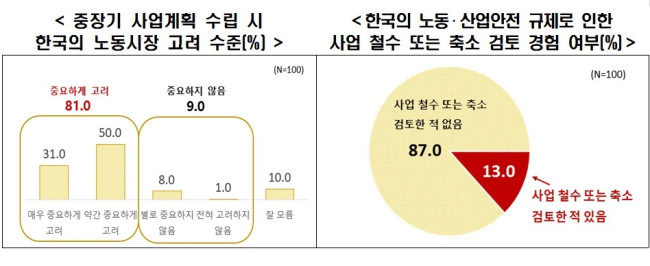
Eight out of ten FIEs (81.0%) stated that they significantly consider the Korean labor market environment, including labor-management relations and labor regulations, when establishing mid-to-long-term business plans.
Among these, 13.0% said they have considered withdrawing or scaling back their operations in Korea due to strengthened regulations such as working hour restrictions and the Serious Accidents Punishment Act.
The KEF pointed out, "Considering that the business closure rate for foreign-invested companies this year is 3.2%, 13.0% is a significant figure," and added, "Excessive labor regulations can act as a barrier to attracting foreign investment."
 Provided by the Korea Employers Federation.
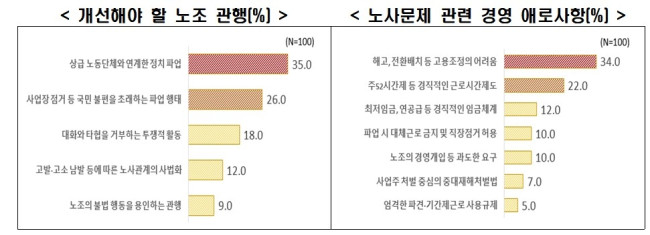
Among the labor union practices in Korea, FIEs identified 'political strikes linked with upper-level unions' (35.0%) as the most urgent area for improvement.
This was followed by 'strike behaviors causing public inconvenience, such as occupying workplaces' (26.0%) and 'combative activities refusing dialogue and compromise' (18.0%).
The most significant difficulty FIEs experience regarding labor issues in Korea was found to be 'difficulties in employment adjustments such as dismissals and reassignments' (34.0%).
This was followed by 'rigid working hour systems such as the 52-hour workweek' (22.0%) and 'rigid wage systems including minimum wage and seniority-based pay' (12.0%).
Regarding areas that labor and management should improve to establish cooperative labor-management relations, answers included 'establishing a sense of community between labor and management' (35.0%) and 'improving the perception of unions prioritizing struggle' (22.0%).
For labor-related improvement tasks that the National Assembly and the government should prioritize to vitalize foreign investment, 'enhancing labor flexibility through deregulation of working hours, dismissals, etc.' (28.0%) was the most requested.
Lee Sang-ho, head of the KEF's Economic and Industrial Department, stated, "Korea's confrontational labor-management relations and rigid labor market regulations place a significant burden on the workforce management of foreign-invested companies, acting as major factors that diminish our country's investment attractiveness."
 Provided by the Korea Employers Federation
Yonhap News

 Iranian Foreign Ministry: "Continuing Message Exchanges with the U.S. and Activities of Mediating Countries"
Esmaeil Baghaei, Spokesperson for the Iranian Ministry of Foreign Affairs [Xinhua, Yonhap News file photo]Esmaeil Baghaei, spokesperson for the Iranian Ministry of Foreign Affairs, stated on the 26th
Iranian Foreign Ministry: "Continuing Message Exchanges with the U.S. and Activities of Mediating Countries"
Esmaeil Baghaei, Spokesperson for the Iranian Ministry of Foreign Affairs [Xinhua, Yonhap News file photo]Esmaeil Baghaei, spokesperson for the Iranian Ministry of Foreign Affairs, stated on the 26th
 President Yoon: "Do You Really Think You Are Safe from a Special Counsel?"... Final Statement Video Released
President Yoon Suk Yeol rebuking the special prosecutor on the 24th. [Court Video / Subtitled GIF from @birds_justice X account] A video capturing the live footage of President Yoon Suk Yeol’s final
President Yoon: "Do You Really Think You Are Safe from a Special Counsel?"... Final Statement Video Released
President Yoon Suk Yeol rebuking the special prosecutor on the 24th. [Court Video / Subtitled GIF from @birds_justice X account] A video capturing the live footage of President Yoon Suk Yeol’s final
 President Yoon, regarding the first-instance ruling on the Public Official Election Act: “An excessive political verdict that distorts the facts… We will appeal immediately.”
The first-instance sentencing hearing for President Yoon Suk Yeol regarding violations of the Public Official Election Act is being broadcast live at Seoul Station on the 27th. [Photo=Yonhap News]Pres
President Yoon, regarding the first-instance ruling on the Public Official Election Act: “An excessive political verdict that distorts the facts… We will appeal immediately.”
The first-instance sentencing hearing for President Yoon Suk Yeol regarding violations of the Public Official Election Act is being broadcast live at Seoul Station on the 27th. [Photo=Yonhap News]Pres
 WSJ: "SK Hynix ADR Premium Is a Sign of AI Trading Overheat"
Advertisement for SK Hynix ADR listing in New York's Times Square [Reuters=Yonhap News file photo]The Wall Street Journal (WSJ) has pointed out that the price of SK Hynix’s American Depositary Recei
WSJ: "SK Hynix ADR Premium Is a Sign of AI Trading Overheat"
Advertisement for SK Hynix ADR listing in New York's Times Square [Reuters=Yonhap News file photo]The Wall Street Journal (WSJ) has pointed out that the price of SK Hynix’s American Depositary Recei
 'Godfather of Japanese Mystery Novels' Keigo Higashino Passes Away After Battle with Cancer at 68
Famous Japanese mystery novelist Keigo Higashino [AFP=Yonhap News]It has been belatedly reported that Keigo Higashino, the "godfather of Japanese mystery novels" and author of bestsellers such as "The
'Godfather of Japanese Mystery Novels' Keigo Higashino Passes Away After Battle with Cancer at 68
Famous Japanese mystery novelist Keigo Higashino [AFP=Yonhap News]It has been belatedly reported that Keigo Higashino, the "godfather of Japanese mystery novels" and author of bestsellers such as "The
 [Park Pil-kyu Security Column] To the Ignorant Trying to Clothe a Beast in Sheep's Clothing
Rep. Kim Byung-joo of the Democratic Party of Korea [Photo=Yonhap News]“The Air Force Academy doesn't teach you how to fly a plane!” “The Army, Navy, and Air Force academies are exactly the
[Park Pil-kyu Security Column] To the Ignorant Trying to Clothe a Beast in Sheep's Clothing
Rep. Kim Byung-joo of the Democratic Party of Korea [Photo=Yonhap News]“The Air Force Academy doesn't teach you how to fly a plane!” “The Army, Navy, and Air Force academies are exactly the
 [Issue Diagnosis] Two Effects of the Election Petition Review
 [Photo] Evidence of Election Fraud Flooding U.S. Media… Trump Had 2.7 Million Votes Stolen
 [Video] U.S. Semiquincentennial Air Show... 'Art in the Sky' streaks across New York
 [Editorial Cartoon] A Draconian Law That Undermines Freedom of Expression

 List
List









