 Chrysanthemums placed in front of a concrete embankment [Yonhap News]
A recent audit has revealed that the concrete embankment, identified as a key cause of the December 29th Jeju Air passenger jet accident at Muan Airport two years ago, was installed without thorough review to reduce construction costs.
The Board of Audit and Inspection announced the results of its audit on aviation safety vulnerabilities on the 10th.
Through this audit, the Board of Audit and Inspection identified 30 issues, including 3 disciplinary actions, in four areas: navigation safety facilities, maintenance, personnel, and air traffic control, and notified the Ministry of Land, Infrastructure and Transport and other relevant parties.
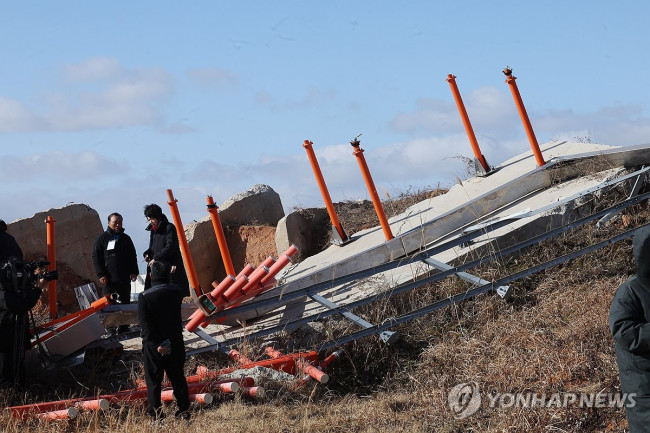 A collapsed concrete embankment [Yonhap News file photo]
◇ Embankment installed to cut costs... Reinforcement work also carried out
According to the Board of Audit and Inspection, a localizer is a navigation safety facility that emits radio waves to indicate the center line of an aircraft runway.
The localizer is positioned at the end of the overrun area, a zone established beyond the runway to reduce damage to landing aircraft. To ensure smooth radio wave transmission, its position needs to be slightly higher than the uppermost part of the runway.
For example, at Incheon Airport, the runway is flat, and there is only a slight slope from the end of the runway to the localizer, so a high embankment was not necessary to raise the localizer's position.
However, some provincial airports, such as Muan Airport, retained a slope close to the original terrain in the runway and overrun area. This was done to reduce the volume of earthworks and cut construction costs.
Consequently, a foundation structure had to be built to position the localizer higher than the uppermost part of the runway, resulting in the creation of a concrete foundation and embankment.
Specifically, at Muan Airport, the Ministry of Land, Infrastructure and Transport installed the concrete embankment without a vulnerability assessment in June 2003. Despite a request for improvement from the Korea Airports Corporation (KAC) in 2007, no corrective action was taken.
Based on these issues, the Board of Audit and Inspection inspected whether the localizer foundation structures at 36 locations in 15 domestic airports were installed in compliance with standards.
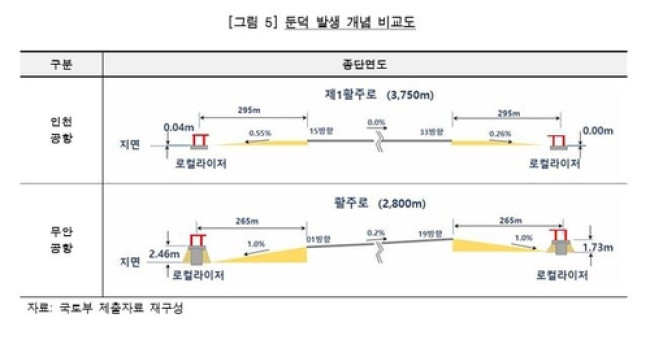 Conceptual diagram of embankment formation [Screenshot from Board of Audit and Inspection report]
As a result, it was confirmed that 14 localizer structures at 8 airports, including Muan Airport, were incorrectly installed with structures that are difficult to break, such as reinforced concrete foundations, without thorough review. In addition to Muan Airport, some structures at Gimhae, Yeosu, Sacheon, Gwangju, Pohang, Jeju, and Gimpo airports were included.
Furthermore, KAC carried out reinforcement work on 7 localizer foundation structures at 5 airports, including Muan Airport, as part of the navigation safety facility modernization project from 2019 to 2024.
In this process, the construction personnel at Muan Airport verbally approved concrete reinforcement without any review, allowing the construction company to install facilities that did not ensure structural integrity (fragile structures).
The Board of Audit and Inspection also pointed out that the Ministry of Land, Infrastructure and Transport, despite announcing an aviation safety innovation plan to improve localizer issues in January of the previous year, following the Jeju Air incident, excluded some lightweight steel structures at airports like Yeosu from the improvement targets without expert review.
An official from the Board of Audit and Inspection explained, "When a lot of the terrain is preserved to save construction costs, it allows for significant slopes, which create drops. To withstand wind and typhoons, strong foundation structures are installed, which appears to have become a major threat leading to aviation accidents."
In addition, although the Ministry of Land, Infrastructure and Transport established domestic standards for navigation safety facilities in 2009, referencing International Civil Aviation Organization (ICAO) standards, they were abolished after only three years without thorough review, following the recommendation of the relevant department to abolish them.
Furthermore, the Busan Regional Aviation Administration conducted an inadequate inspection of the Multi-Lateral Measurement Detection System (MLAT) purchased for aircraft control at Muan and Uljin Airports in 2020, despite confirming its performance deficiencies during the trial operation period, and subsequently ruled it as acceptable.
As a result, it was unable to be utilized in the field due to not meeting the standards as of June of the previous year.
 Cover page of the audit report [Screenshot of report cover]
◇ Deficiencies in aircraft maintenance and personnel management... Ministry of Land, Infrastructure and Transport plans comprehensive improvements in aviation sector
Deficiencies were also identified in aircraft maintenance.
A review by the Board of Audit and Inspection of investigations into aviation safety incidents caused by failures and defects of the most frequently installed engine model in Korean airlines over the past five years revealed that the Ministry of Land, Infrastructure and Transport investigated only two cases, neglecting the remaining 57.
Among the 57 uninvestigated cases, two involved significant engine failures or defects, and despite an internal assessment that an investigation was necessary with engine replacement, they were left unaddressed.
Additionally, issues of delayed introduction of safety equipment were repeated, such as equipment mandated for all aircraft since 2020 in overseas standards not being reflected in domestic standards and therefore not being installed on Korean aircraft.
Problems also existed in the personnel management of pilots and air traffic controllers.
Despite pilot error accounting for the highest proportion (49%) of aviation accidents over the past 15 years, and accidents due to mental health issues such as pilot depression occurring repeatedly overseas, the Ministry of Land, Infrastructure and Transport only received self-reported questionnaires from pilots and controllers and did not adequately verify the facts.
According to a review by the Board of Audit and Inspection using data from the National Health Insurance Service, 62 pilots received medical treatment for mental illnesses such as depression but were cleared for physical examinations without informing aviation medical examiners, and subsequently operated flights 10,297 times between 2022 and 2024. Furthermore, 35 air traffic controllers concealed severe mental illnesses that would have disqualified them from physical examinations and worked for 23,744 days since 2022.
The Board of Audit and Inspection also reported that pilot training programs for abnormal situations such as belly landings were inadequate, and there were issues with the management and supervision of English proficiency qualifications.
There was even a case where a pilot forged an expired English proficiency certificate and submitted it to an airline, operating international flights 110 times.
The Board of Audit and Inspection further added that during bird strike risk assessments at airports like Muan, numerous birds with a high probability of collision were omitted, and at some airports, there were no instances of bird activity information, necessary for pilots, being disseminated.
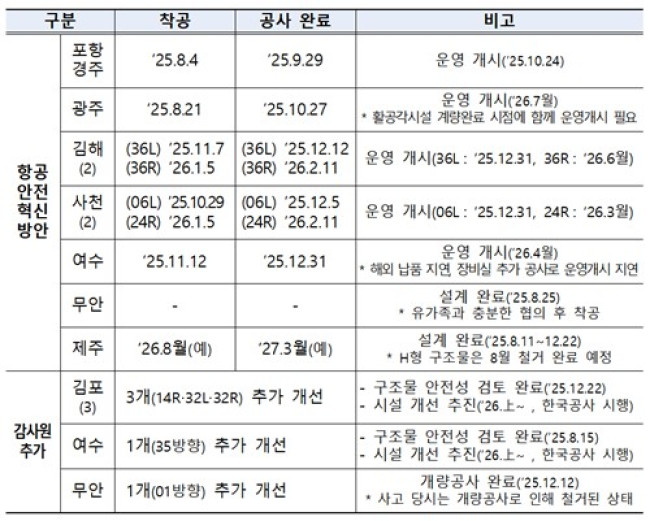 Status of Azimuth Facilities Requiring Improvement (As of March 2026) [Provided by the Ministry of Land, Infrastructure and Transport]
The Ministry of Land, Infrastructure and Transport stated on this day that it humbly accepts the audit results and plans to take firm action regarding the identified issues.
The ministry explained that it is carrying out follow-up measures to the audit findings, such as improving azimuth facilities and strengthening bird strike prevention activities, to prevent recurrence of the December 29th passenger jet incident.
Regarding issues with pilot and air traffic controller personnel management, including aviation English proficiency and aviation medical examinations, the ministry added that administrative actions such as immediate suspension from duty and prosecution have been taken for violations of laws by pilots and controllers, and additional investigations and institutional improvements will be promptly pursued.
The Ministry of Land, Infrastructure and Transport stated, "Along with the follow-up measures from this audit, we plan to comprehensively innovate the aviation safety system to secure aviation safety and restore public trust by flawlessly implementing the aviation safety innovation plan prepared last year."

 Iranian Foreign Ministry: "Continuing Message Exchanges with the U.S. and Activities of Mediating Countries"
Esmaeil Baghaei, Spokesperson for the Iranian Ministry of Foreign Affairs [Xinhua, Yonhap News file photo]Esmaeil Baghaei, spokesperson for the Iranian Ministry of Foreign Affairs, stated on the 26th
Iranian Foreign Ministry: "Continuing Message Exchanges with the U.S. and Activities of Mediating Countries"
Esmaeil Baghaei, Spokesperson for the Iranian Ministry of Foreign Affairs [Xinhua, Yonhap News file photo]Esmaeil Baghaei, spokesperson for the Iranian Ministry of Foreign Affairs, stated on the 26th
 President Yoon: "Do You Really Think You Are Safe from a Special Counsel?"... Final Statement Video Released
President Yoon Suk Yeol rebuking the special prosecutor on the 24th. [Court Video / Subtitled GIF from @birds_justice X account] A video capturing the live footage of President Yoon Suk Yeol’s final
President Yoon: "Do You Really Think You Are Safe from a Special Counsel?"... Final Statement Video Released
President Yoon Suk Yeol rebuking the special prosecutor on the 24th. [Court Video / Subtitled GIF from @birds_justice X account] A video capturing the live footage of President Yoon Suk Yeol’s final
 President Yoon, regarding the first-instance ruling on the Public Official Election Act: “An excessive political verdict that distorts the facts… We will appeal immediately.”
The first-instance sentencing hearing for President Yoon Suk Yeol regarding violations of the Public Official Election Act is being broadcast live at Seoul Station on the 27th. [Photo=Yonhap News]Pres
President Yoon, regarding the first-instance ruling on the Public Official Election Act: “An excessive political verdict that distorts the facts… We will appeal immediately.”
The first-instance sentencing hearing for President Yoon Suk Yeol regarding violations of the Public Official Election Act is being broadcast live at Seoul Station on the 27th. [Photo=Yonhap News]Pres
 WSJ: "SK Hynix ADR Premium Is a Sign of AI Trading Overheat"
Advertisement for SK Hynix ADR listing in New York's Times Square [Reuters=Yonhap News file photo]The Wall Street Journal (WSJ) has pointed out that the price of SK Hynix’s American Depositary Recei
WSJ: "SK Hynix ADR Premium Is a Sign of AI Trading Overheat"
Advertisement for SK Hynix ADR listing in New York's Times Square [Reuters=Yonhap News file photo]The Wall Street Journal (WSJ) has pointed out that the price of SK Hynix’s American Depositary Recei
 'Godfather of Japanese Mystery Novels' Keigo Higashino Passes Away After Battle with Cancer at 68
Famous Japanese mystery novelist Keigo Higashino [AFP=Yonhap News]It has been belatedly reported that Keigo Higashino, the "godfather of Japanese mystery novels" and author of bestsellers such as "The
'Godfather of Japanese Mystery Novels' Keigo Higashino Passes Away After Battle with Cancer at 68
Famous Japanese mystery novelist Keigo Higashino [AFP=Yonhap News]It has been belatedly reported that Keigo Higashino, the "godfather of Japanese mystery novels" and author of bestsellers such as "The
 [Park Pil-kyu Security Column] To the Ignorant Trying to Clothe a Beast in Sheep's Clothing
Rep. Kim Byung-joo of the Democratic Party of Korea [Photo=Yonhap News]“The Air Force Academy doesn't teach you how to fly a plane!” “The Army, Navy, and Air Force academies are exactly the
[Park Pil-kyu Security Column] To the Ignorant Trying to Clothe a Beast in Sheep's Clothing
Rep. Kim Byung-joo of the Democratic Party of Korea [Photo=Yonhap News]“The Air Force Academy doesn't teach you how to fly a plane!” “The Army, Navy, and Air Force academies are exactly the
 [Issue Diagnosis] Two Effects of the Election Petition Review
 [Photo] Evidence of Election Fraud Flooding U.S. Media… Trump Had 2.7 Million Votes Stolen
 [Video] U.S. Semiquincentennial Air Show... 'Art in the Sky' streaks across New York
 [Editorial Cartoon] A Draconian Law That Undermines Freedom of Expression

 List
List










