The official prices of apartments in Seoul have risen by double digits this year, reaching the highest annual increase in five years, driven by the sharp rise in apartment prices in Gangnam and along the Han River belt last year.
In some autonomous districts in Seoul, including Gangnam 3-gu (Seocho, Gangnam, and Songpa districts), the official price increase rate is as high as the 20% range, and some high-priced apartments are expected to see their property tax increase by more than 50%.
 [Yonhap News]
The Ministry of Land, Infrastructure and Transport announced on the 17th that it will proceed with the process of owner review and opinion gathering for approximately 15.85 million officially priced residential units, surveyed and appraised as of January 1st this year, for 20 days from March 18th to April 6th.
The Ministry explained that the official prices this year are based on the same realization rate (69%) as last year, reflecting only the changes in individual market prices throughout last year. It is calculated by multiplying the market price as of January 1st by the realization rate of 69%.
Nationwide, the official prices of residential units have increased by an average of 9.16% compared to last year. This rate of increase significantly exceeds last year's (3.65%) and 2024's (1.52%), and is the highest since 2022 (17.20%).
The steep rise in average official prices reflects the increase in prices of high-priced apartments in some areas of Seoul.
Seoul saw an 18.67% increase compared to last year, the only metropolitan city to surpass the national average. This is more than double the rate of increase last year (7.86%).
Although the realization rate remained unchanged, the official prices calculated significantly exceeded not only the annual Seoul apartment sales price increase rate (8.98%) as of Korea Real Estate Board data, but also the actual transaction price increase rate (13.49%) last year.
The rate of increase in Seoul is the highest since 2021 (19.91%), when the real estate market was booming, and the third highest since the introduction of the official pricing system for residential units in 2005. The highest rate of increase on record was 28.40% in 2007, during the period when prices in the 'Bubble Seven' (Gangnam, Seocho, Songpa, Mokdong (Yangcheon), Bundang, Pyeongchon, Yongin) areas surged.
Within Seoul, the official price increase rate in Gangnam 3-gu, which is densely populated with high-priced apartments, was 24.7%, significantly exceeding the Seoul average. Gangnam-gu rose by 26.05%, Songpa-gu by 25.49%, and Seocho-gu by 22.07% respectively.
Along with Gangnam 3-gu, the official prices in the eight autonomous districts along the Han River belt (Seongdong, Yangcheon, Yongsan, Dongjak, Gangdong, Gwangjin, Mapo, Yeongdeungpo), where housing prices rose significantly last year, also increased by 23.13%, showing a rate of increase close to that of Gangnam 3-gu.
Seongdong-gu had the highest rate of increase in Seoul at 29.04%, followed by Yangcheon-gu (24.08%), Yongsan-gu (23.63%), Dongjak-gu (22.94%), Gangdong-gu (22.58%), Gwangjin-gu (22.20%), Mapo-gu (21.36%), and Yeongdeungpo-gu (18.91%), most of which recorded high increases of over 20%.
In contrast, the remaining 14 autonomous districts, excluding these areas, had an average increase rate of 6.93%, showing a significant gap. Outer areas such as Dobong-gu (2.07%), Gangbuk-gu (2.89%), Geumcheon-gu (2.80%), and Jungnang-gu (3.29%) are expected to have similar property tax burdens as last year due to low official price fluctuations.
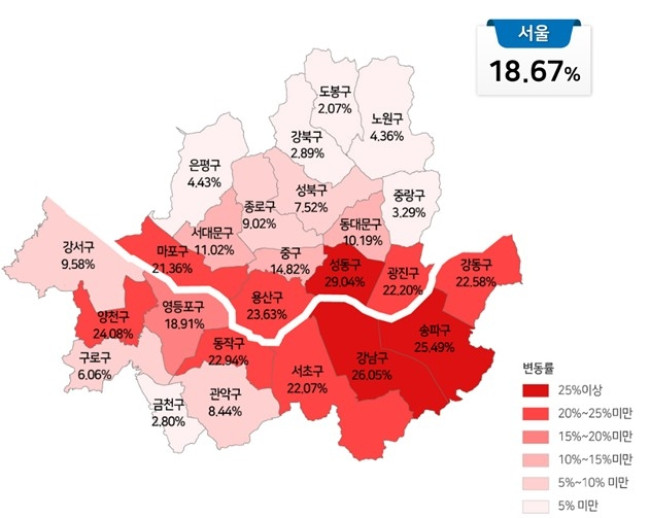 Seoul Autonomous District Residential Unit Official Price Change Rate Status [Provided by the Ministry of Land, Infrastructure and Transport]
The official prices in areas outside of Seoul increased by 3.37%, highlighting a clear gap between Seoul and other regions.
Looking at the top five regions with the highest increase rates, the second-ranked Gyeonggi (6.38%) was about 12 percentage points lower than Seoul, followed by Sejong (6.29%), Ulsan (5.22%), and Jeonbuk (4.32%). Jeju (1.76%↓), Gwangju (1.25%↓), Daejeon (1.12%↓), Daegu (0.76%↓), Chungnam (0.53%↓), Gangwon (0.45%↓), Jeonnam (0.24%↓), and Incheon (0.10%↓) saw their official prices decrease compared to last year.
The number of residential units nationwide with an official price exceeding 1.2 billion KRW (based on a single-household, single-homeowner), which is subject to the comprehensive real estate tax, was 487,362 units, an increase of approximately 53.3% (169,364 units) from last year (317,998 units). Of these, about 85.1% (414,896 units) were identified as homes in Seoul.
In Seoul, Gangnam-gu had the largest number of residential units exceeding 1.2 billion KRW in official price (99,372 units), followed by Songpa-gu (75,902 units), Seocho-gu (69,773 units), Yangcheon-gu (28,919 units), and Seongdong-gu (25,839 units).
In Songpa-gu, the number of homes exceeding 1.2 billion KRW increased by 18,821 units compared to last year. Gangdong-gu (increase of 16,362 units), Seongdong-gu (15,378 units), Gangnam-gu (15,327 units), and Yangcheon-gu (13,801 units) also saw significant increases.
Conversely, Gangbuk-gu, Dobong-gu, Nowon-gu, Geumcheon-gu, and Gwanak-gu had no homes exceeding 1.2 billion KRW.
Owners of apartments in Gangnam and along the Han River belt in Seoul, where official prices have surged by over 20%, are expected to see their property taxes, calculated based on these prices, increase by 40-50% compared to last year.
The official prices for this year can be viewed from March 18th on the Real Estate Official Price Information website (www.realtyprice.kr) and at the civil service offices of the city, county, and district governments where the respective housing units are located. Anyone with opinions can submit their opinions to the Real Estate Official Price Information website or in writing to the civil service offices of the relevant city, county, or district governments, or to the branches of Korea Real Estate Board by April 6th.
The Ministry of Land, Infrastructure and Transport plans to finalize and officially announce the official prices of residential units on April 30th, after going through the opinion gathering process and deliberation by the Central Real Estate Price Deliberation Committee. Subsequently, after receiving and reviewing appeals until May 29th, they will be adjusted and officially announced on June 26th.

 Iranian Foreign Ministry: "Continuing Message Exchanges with the U.S. and Activities of Mediating Countries"
Esmaeil Baghaei, Spokesperson for the Iranian Ministry of Foreign Affairs [Xinhua, Yonhap News file photo]Esmaeil Baghaei, spokesperson for the Iranian Ministry of Foreign Affairs, stated on the 26th
Iranian Foreign Ministry: "Continuing Message Exchanges with the U.S. and Activities of Mediating Countries"
Esmaeil Baghaei, Spokesperson for the Iranian Ministry of Foreign Affairs [Xinhua, Yonhap News file photo]Esmaeil Baghaei, spokesperson for the Iranian Ministry of Foreign Affairs, stated on the 26th
 President Yoon: "Do You Really Think You Are Safe from a Special Counsel?"... Final Statement Video Released
President Yoon Suk Yeol rebuking the special prosecutor on the 24th. [Court Video / Subtitled GIF from @birds_justice X account] A video capturing the live footage of President Yoon Suk Yeol’s final
President Yoon: "Do You Really Think You Are Safe from a Special Counsel?"... Final Statement Video Released
President Yoon Suk Yeol rebuking the special prosecutor on the 24th. [Court Video / Subtitled GIF from @birds_justice X account] A video capturing the live footage of President Yoon Suk Yeol’s final
 President Yoon, regarding the first-instance ruling on the Public Official Election Act: “An excessive political verdict that distorts the facts… We will appeal immediately.”
The first-instance sentencing hearing for President Yoon Suk Yeol regarding violations of the Public Official Election Act is being broadcast live at Seoul Station on the 27th. [Photo=Yonhap News]Pres
President Yoon, regarding the first-instance ruling on the Public Official Election Act: “An excessive political verdict that distorts the facts… We will appeal immediately.”
The first-instance sentencing hearing for President Yoon Suk Yeol regarding violations of the Public Official Election Act is being broadcast live at Seoul Station on the 27th. [Photo=Yonhap News]Pres
 WSJ: "SK Hynix ADR Premium Is a Sign of AI Trading Overheat"
Advertisement for SK Hynix ADR listing in New York's Times Square [Reuters=Yonhap News file photo]The Wall Street Journal (WSJ) has pointed out that the price of SK Hynix’s American Depositary Recei
WSJ: "SK Hynix ADR Premium Is a Sign of AI Trading Overheat"
Advertisement for SK Hynix ADR listing in New York's Times Square [Reuters=Yonhap News file photo]The Wall Street Journal (WSJ) has pointed out that the price of SK Hynix’s American Depositary Recei
 'Godfather of Japanese Mystery Novels' Keigo Higashino Passes Away After Battle with Cancer at 68
Famous Japanese mystery novelist Keigo Higashino [AFP=Yonhap News]It has been belatedly reported that Keigo Higashino, the "godfather of Japanese mystery novels" and author of bestsellers such as "The
'Godfather of Japanese Mystery Novels' Keigo Higashino Passes Away After Battle with Cancer at 68
Famous Japanese mystery novelist Keigo Higashino [AFP=Yonhap News]It has been belatedly reported that Keigo Higashino, the "godfather of Japanese mystery novels" and author of bestsellers such as "The
 [Park Pil-kyu Security Column] To the Ignorant Trying to Clothe a Beast in Sheep's Clothing
Rep. Kim Byung-joo of the Democratic Party of Korea [Photo=Yonhap News]“The Air Force Academy doesn't teach you how to fly a plane!” “The Army, Navy, and Air Force academies are exactly the
[Park Pil-kyu Security Column] To the Ignorant Trying to Clothe a Beast in Sheep's Clothing
Rep. Kim Byung-joo of the Democratic Party of Korea [Photo=Yonhap News]“The Air Force Academy doesn't teach you how to fly a plane!” “The Army, Navy, and Air Force academies are exactly the
 [Issue Diagnosis] Two Effects of the Election Petition Review
 [Photo] Evidence of Election Fraud Flooding U.S. Media… Trump Had 2.7 Million Votes Stolen
 [Video] U.S. Semiquincentennial Air Show... 'Art in the Sky' streaks across New York
 [Editorial Cartoon] A Draconian Law That Undermines Freedom of Expression

 List
List










