 Apartment in Seoul [Yonhap News file photo]
As the reinstatement of heavy capital gains tax on multiple homeowners approaches, real estate taxation, including the long-term holding special deduction (Jangteukgongje) for housing capital gains tax, is heading towards a turning point.
According to the Ministry of Economy and Finance and other relevant ministries, the government will end the four-year suspension of heavy capital gains tax for multiple homeowners, which was in effect from May 10, 2022, to May 9 of this year, and will resume the heavy taxation starting from the 10th.
When selling a house in a regulated area, a 20 percentage point (p) increase will be applied to the basic tax rate (6-45%) for those owning two homes, and a 30 percentage point increase for those owning three or more homes.
This is a resumption of the heavy taxation in line with the originally scheduled end of the suspension. Nevertheless, it is drawing attention as it is the first change to major real estate tax policies since the inauguration of President Lee Jae-myung.
President Lee has emphasized the role of finance in real estate policy, stating, "Regardless of what happens, taxation is the last resort. In terms of war, taxes are like nuclear bombs," keeping his distance from the issue.
Amidst this, relevant ministries are comprehensively reviewing various ways to reform the tax system to normalize the housing market and curb real estate speculation, as mentioned by President Lee through Cabinet meetings and X (formerly Twitter).
The long-term holding special deduction (Jangteukgongje) for housing capital gains tax is cited as a prime candidate for reform.
Article 95 of the Income Tax Act stipulates a deduction of 6% to 30% based on the holding period when taxing profits from selling real estate held for three years or more. For example, if a non-residential property held for more than 15 years is sold, 30% of the capital gains is excluded from taxation.
For the capital gains of a single-homeowner, this law allows for a combined deduction of 12% to 40% of the capital gains based on the holding period, plus 8% to 40% based on the residency period (two years or more).
For instance, if a single-family home held and resided in for over 10 years is sold, the holding period deduction rate of 40% and the residency period deduction rate of 40% are applied together, making 80% of the capital gains tax-exempt.
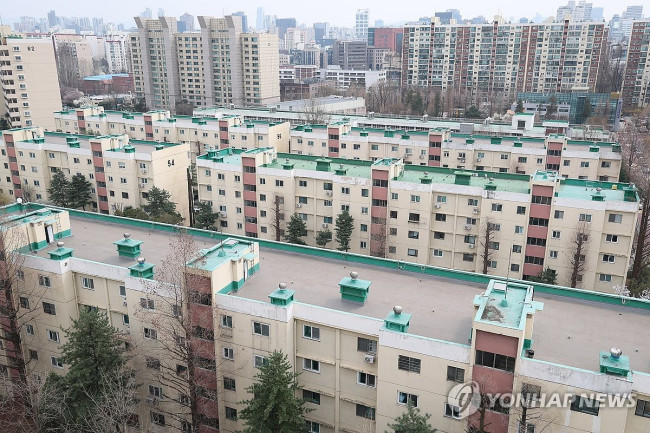 An apartment complex in Gangnam [Yonhap News file photo]
Criticism that the Jangteukgongje distorts the housing market is providing a reason for reviewing its reform.
Earlier, President Lee Jae-myung posted on X (formerly Twitter) saying, "Is it a tax bomb to normalize the abnormality of giving tax cuts for speculating on a house you won't even live in for a long time?" He added, "To properly protect the housing of single-homeowners, it would be right to reduce the deduction for non-residential holding periods and increase the deduction for residential holding periods accordingly."
President Lee also pointed out, "Why should we give a large tax cut on money earned from selling a house bought for profit, not for living, just because it was owned for a long time?"
This is interpreted as questioning the rationality of the current system, which provides a deduction of up to 40% for non-residential properties. There are also criticisms that the benefits of Jangteukgongje are skewed.
In its recent analysis titled 'Analysis of Statistical Data on Advance Reporting of Capital Gains Tax on High-Priced Homes and the Long-Term Holding Special Deduction,' the Nara Sarim Research Institute analyzed the National Tax Service's statistics on advance reporting of capital gains tax on high-priced homes and commented, "98.0% of Jangteukgongje amounts are attributed to the Seoul Metropolitan Area, and Seoul alone accounts for 90.0%," adding, "A significant portion of capital gains from high-priced real estate is being excluded from taxation through Jangteukgongje."
Bills to reform Jangteukgongje have already been introduced.
An amendment to the Income Tax Act, proposed by independent lawmaker Choi Hyuk-jin on the 27th of last month, aims to shift Jangteukgongje towards actual residency by eliminating deductions for non-residents and applying deduction rates of 16% to 80% only to single-family homes held for three years or more and resided in for two years or more.
An amendment to the Income Tax Act proposed by lawmaker Yoon Jong-oh of the Progressive Party on the 8th of the same month plans to abolish Jangteukgongje and switch to a tax credit system with a lifelong tax reduction limit of 200 million won per person.
However, it is uncertain whether these bills will proceed as they are, as they were not developed through official consultation with the government and tax authorities.
Attention is also focused on how the government will respond regarding holding taxes.
In March, President Lee shared an article on X comparing holding taxes in major foreign cities with those in Korea, remarking, "I was also curious."
At the time, the Blue House cautioned against overinterpretation, stating, "There is no change in the fact that holding taxes are the last matter to be reviewed."
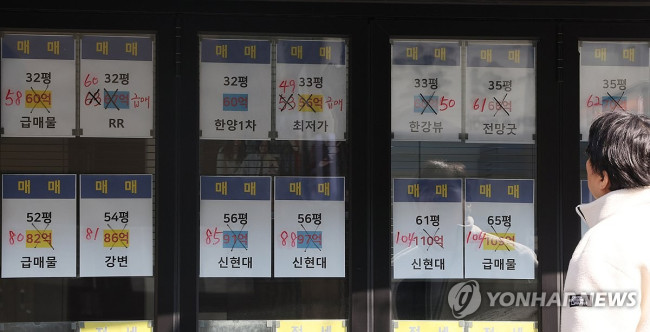 Real estate listings at a brokerage [Yonhap News file photo]
However, in the first plenary meeting of the National Economic Advisory Council presided over by President Lee on April 9, he mentioned the need to consider "a direction of imposing a significant holding burden" on non-business real estate held by corporations, which can be interpreted as an interest in reforming holding taxes.
On the 18th of last month, he wrote on X, "Except for legitimate holdings such as a single-family home for actual residency or a single-family home temporarily vacant due to work or other reasons, if the holding burden for investment and speculative real estate is strengthened to the level of developed countries, the longer one holds, the greater the loss will be." He added, "If the holding burden is normalized, the current excessively high real estate prices will inevitably be normalized."
Some suggest the possibility of amending the comprehensive real estate holding tax (Jongbuse) that was eased during the Yoon Suk-yeol administration.
It is known that relevant authorities are comprehensively reviewing real estate tax reforms, including measures to reduce or gradually abolish deductions for non-residents as pointed out by President Lee.
However, the government appears to be refraining from engaging in public discussions for now, considering the need to observe the effects of the resumed heavy capital gains tax and to determine the overall direction of real estate policy, as well as the concern of unnecessary controversy ahead of the local elections on the 3rd of next month.
A government official commented regarding real estate tax reform, "Nothing has been concretely decided yet, and we are in the stage of examining methods and timing."
Specific policy directions are expected to emerge in conjunction with tax reforms anticipated around July.

 Iranian Foreign Ministry: "Continuing Message Exchanges with the U.S. and Activities of Mediating Countries"
Esmaeil Baghaei, Spokesperson for the Iranian Ministry of Foreign Affairs [Xinhua, Yonhap News file photo]Esmaeil Baghaei, spokesperson for the Iranian Ministry of Foreign Affairs, stated on the 26th
Iranian Foreign Ministry: "Continuing Message Exchanges with the U.S. and Activities of Mediating Countries"
Esmaeil Baghaei, Spokesperson for the Iranian Ministry of Foreign Affairs [Xinhua, Yonhap News file photo]Esmaeil Baghaei, spokesperson for the Iranian Ministry of Foreign Affairs, stated on the 26th
 President Yoon: "Do You Really Think You Are Safe from a Special Counsel?"... Final Statement Video Released
President Yoon Suk Yeol rebuking the special prosecutor on the 24th. [Court Video / Subtitled GIF from @birds_justice X account] A video capturing the live footage of President Yoon Suk Yeol’s final
President Yoon: "Do You Really Think You Are Safe from a Special Counsel?"... Final Statement Video Released
President Yoon Suk Yeol rebuking the special prosecutor on the 24th. [Court Video / Subtitled GIF from @birds_justice X account] A video capturing the live footage of President Yoon Suk Yeol’s final
 President Yoon, regarding the first-instance ruling on the Public Official Election Act: “An excessive political verdict that distorts the facts… We will appeal immediately.”
The first-instance sentencing hearing for President Yoon Suk Yeol regarding violations of the Public Official Election Act is being broadcast live at Seoul Station on the 27th. [Photo=Yonhap News]Pres
President Yoon, regarding the first-instance ruling on the Public Official Election Act: “An excessive political verdict that distorts the facts… We will appeal immediately.”
The first-instance sentencing hearing for President Yoon Suk Yeol regarding violations of the Public Official Election Act is being broadcast live at Seoul Station on the 27th. [Photo=Yonhap News]Pres
 WSJ: "SK Hynix ADR Premium Is a Sign of AI Trading Overheat"
Advertisement for SK Hynix ADR listing in New York's Times Square [Reuters=Yonhap News file photo]The Wall Street Journal (WSJ) has pointed out that the price of SK Hynix’s American Depositary Recei
WSJ: "SK Hynix ADR Premium Is a Sign of AI Trading Overheat"
Advertisement for SK Hynix ADR listing in New York's Times Square [Reuters=Yonhap News file photo]The Wall Street Journal (WSJ) has pointed out that the price of SK Hynix’s American Depositary Recei
 'Godfather of Japanese Mystery Novels' Keigo Higashino Passes Away After Battle with Cancer at 68
Famous Japanese mystery novelist Keigo Higashino [AFP=Yonhap News]It has been belatedly reported that Keigo Higashino, the "godfather of Japanese mystery novels" and author of bestsellers such as "The
'Godfather of Japanese Mystery Novels' Keigo Higashino Passes Away After Battle with Cancer at 68
Famous Japanese mystery novelist Keigo Higashino [AFP=Yonhap News]It has been belatedly reported that Keigo Higashino, the "godfather of Japanese mystery novels" and author of bestsellers such as "The
 [Park Pil-kyu Security Column] To the Ignorant Trying to Clothe a Beast in Sheep's Clothing
Rep. Kim Byung-joo of the Democratic Party of Korea [Photo=Yonhap News]“The Air Force Academy doesn't teach you how to fly a plane!” “The Army, Navy, and Air Force academies are exactly the
[Park Pil-kyu Security Column] To the Ignorant Trying to Clothe a Beast in Sheep's Clothing
Rep. Kim Byung-joo of the Democratic Party of Korea [Photo=Yonhap News]“The Air Force Academy doesn't teach you how to fly a plane!” “The Army, Navy, and Air Force academies are exactly the
 [Issue Diagnosis] Two Effects of the Election Petition Review
 [Photo] Evidence of Election Fraud Flooding U.S. Media… Trump Had 2.7 Million Votes Stolen
 [Video] U.S. Semiquincentennial Air Show... 'Art in the Sky' streaks across New York
 [Editorial Cartoon] A Draconian Law That Undermines Freedom of Expression

 List
List









