- Deepfake for Employment and Supply Chain Infiltration... North Korea's Hacking Methods Becoming More Sophisticated
- NIS "New types of attacks, such as remote smartphone initialization, confirmed"
 National Cybersecurity Center Report [Provided by the National Intelligence Service National Cybersecurity Center]
North Korea reportedly stole over 2 trillion won worth of virtual assets last year, the largest amount ever.
◇ North Korea's Hacking Evolves: Penetrating Document Management Solutions & Using Deepfakes for Employment
On the 10th, the National Intelligence Service's National Cybersecurity Center (NCSC) released its annual report detailing cybersecurity threats and response activities from the past year.
North Korea is engaged in technological theft and large-scale financial asset theft across various sectors, including defense and information technology (IT).
North Korean organizations exploited vulnerabilities in three domestic document management solutions to create administrator accounts and steal data.
The sensitive data leaked in this process is reported to range from at least 700 to up to 2.6 million cases.
The North Korean hacking group Andariel infiltrated the IT maintenance systems of infrastructure networks, seized over 20 servers, and stole core materials such as blueprints.
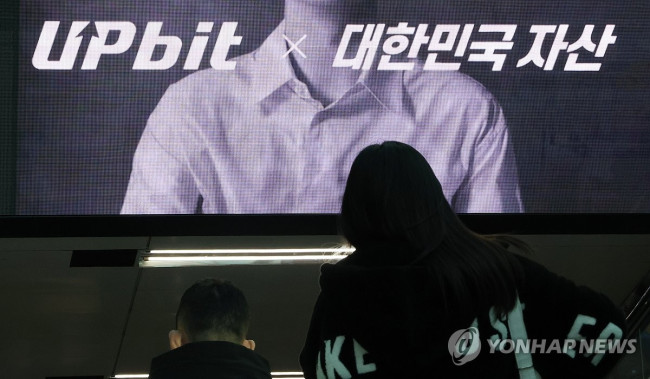 Lazarus, a hacking group under North Korea's Reconnaissance General Bureau, is strongly suspected of being behind the 44.5 billion won virtual asset hacking incident at Upbit, South Korea's largest virtual asset exchange. The photo shows an Upbit advertisement displayed in a Seoul subway station on the 28th. [Yonhap News Agency]
In particular, attack methods have been identified where hackers infiltrate open-source supply chains or use video interviews employing deepfakes to impersonate individuals and gain fraudulent employment at overseas IT companies.
Furthermore, unprecedented tactics have emerged, such as remotely resetting smartphones to neutralize security responses.
Through these techniques, North Korea is estimated to have stolen over 2 trillion won in virtual assets last year alone.
◇ Government Pursues Cyber119 and Post-Quantum Cryptography, Kicking Off N2SF Framework
In response to these threats, the government launched Cyber119, a nationwide response organization, in August 2024.
This organization divides the country into five regions, including the metropolitan and Yeongnam areas, and deploys over 130 experts from 46 institutions to enable initial response to large-scale hacking or network paralysis incidents.
The government has also implemented the National Network Security Framework (N2SF), which applies differential security controls based on data criticality—classified as confidential, sensitive, or public—thereby laying the groundwork for safely utilizing new technologies such as generative AI and cloud in the public sector.
Preparations are also accelerating in the future security domains of space and quantum technology.
Cybersecurity guidelines for space systems have been established, and four types of Korean post-quantum cryptography have been finalized to prepare for the threat of quantum computers.
The government is currently pursuing a comprehensive roadmap to transition the national cryptographic system to post-quantum cryptography by 2035.
The National Cybersecurity Center stated, "The large-scale personal information leaks and government network paralysis incidents experienced last year demonstrate that cyber threats can directly lead to physical damage," and added, "We will continue to proactively respond to threats utilizing AI and new technologies to build a digital environment that citizens can trust."
What do you think of this article?

 Iranian Foreign Ministry: "Continuing Message Exchanges with the U.S. and Activities of Mediating Countries"
Esmaeil Baghaei, Spokesperson for the Iranian Ministry of Foreign Affairs [Xinhua, Yonhap News file photo]Esmaeil Baghaei, spokesperson for the Iranian Ministry of Foreign Affairs, stated on the 26th
Iranian Foreign Ministry: "Continuing Message Exchanges with the U.S. and Activities of Mediating Countries"
Esmaeil Baghaei, Spokesperson for the Iranian Ministry of Foreign Affairs [Xinhua, Yonhap News file photo]Esmaeil Baghaei, spokesperson for the Iranian Ministry of Foreign Affairs, stated on the 26th
 President Yoon: "Do You Really Think You Are Safe from a Special Counsel?"... Final Statement Video Released
President Yoon Suk Yeol rebuking the special prosecutor on the 24th. [Court Video / Subtitled GIF from @birds_justice X account] A video capturing the live footage of President Yoon Suk Yeol’s final
President Yoon: "Do You Really Think You Are Safe from a Special Counsel?"... Final Statement Video Released
President Yoon Suk Yeol rebuking the special prosecutor on the 24th. [Court Video / Subtitled GIF from @birds_justice X account] A video capturing the live footage of President Yoon Suk Yeol’s final
 President Yoon, regarding the first-instance ruling on the Public Official Election Act: “An excessive political verdict that distorts the facts… We will appeal immediately.”
The first-instance sentencing hearing for President Yoon Suk Yeol regarding violations of the Public Official Election Act is being broadcast live at Seoul Station on the 27th. [Photo=Yonhap News]Pres
President Yoon, regarding the first-instance ruling on the Public Official Election Act: “An excessive political verdict that distorts the facts… We will appeal immediately.”
The first-instance sentencing hearing for President Yoon Suk Yeol regarding violations of the Public Official Election Act is being broadcast live at Seoul Station on the 27th. [Photo=Yonhap News]Pres
 WSJ: "SK Hynix ADR Premium Is a Sign of AI Trading Overheat"
Advertisement for SK Hynix ADR listing in New York's Times Square [Reuters=Yonhap News file photo]The Wall Street Journal (WSJ) has pointed out that the price of SK Hynix’s American Depositary Recei
WSJ: "SK Hynix ADR Premium Is a Sign of AI Trading Overheat"
Advertisement for SK Hynix ADR listing in New York's Times Square [Reuters=Yonhap News file photo]The Wall Street Journal (WSJ) has pointed out that the price of SK Hynix’s American Depositary Recei
 'Godfather of Japanese Mystery Novels' Keigo Higashino Passes Away After Battle with Cancer at 68
Famous Japanese mystery novelist Keigo Higashino [AFP=Yonhap News]It has been belatedly reported that Keigo Higashino, the "godfather of Japanese mystery novels" and author of bestsellers such as "The
'Godfather of Japanese Mystery Novels' Keigo Higashino Passes Away After Battle with Cancer at 68
Famous Japanese mystery novelist Keigo Higashino [AFP=Yonhap News]It has been belatedly reported that Keigo Higashino, the "godfather of Japanese mystery novels" and author of bestsellers such as "The
 [Park Pil-kyu Security Column] To the Ignorant Trying to Clothe a Beast in Sheep's Clothing
Rep. Kim Byung-joo of the Democratic Party of Korea [Photo=Yonhap News]“The Air Force Academy doesn't teach you how to fly a plane!” “The Army, Navy, and Air Force academies are exactly the
[Park Pil-kyu Security Column] To the Ignorant Trying to Clothe a Beast in Sheep's Clothing
Rep. Kim Byung-joo of the Democratic Party of Korea [Photo=Yonhap News]“The Air Force Academy doesn't teach you how to fly a plane!” “The Army, Navy, and Air Force academies are exactly the
 [Issue Diagnosis] Two Effects of the Election Petition Review
 [Photo] Evidence of Election Fraud Flooding U.S. Media… Trump Had 2.7 Million Votes Stolen
 [Video] U.S. Semiquincentennial Air Show... 'Art in the Sky' streaks across New York
 [Editorial Cartoon] A Draconian Law That Undermines Freedom of Expression

 List
List









