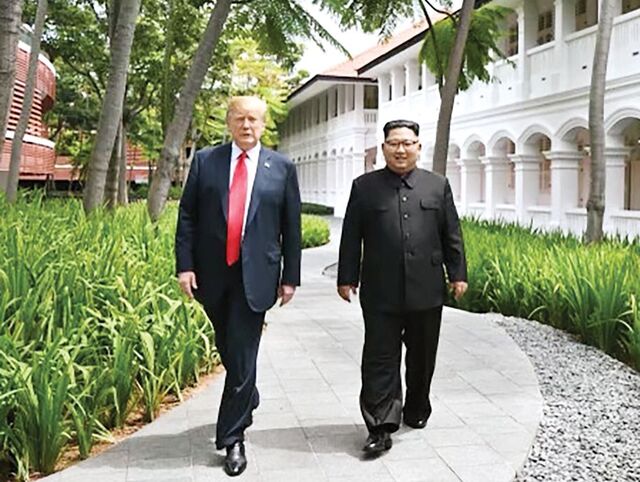
 On June 12, 2018, U.S. President Donald Trump walks with Kim Jong Un in the garden of the Capella Hotel, the venue for the first North Korea-U.S. summit in Singapore. President Trump posted the photo on social media on the 13th (local time) without any further explanation. [Photo Credit=Truth Social]
On the 19th (local time), U.S. political columnist Jean Cummings questioned on Facebook what Trump's critics had been doing while Trump was bringing Iran to its knees.
Regarding the "U.S.-Iran interim Memorandum of Understanding (MOU)" signed by U.S. President Donald Trump, she reiterated, "This document is not a final peace agreement. It is a memorandum of understanding created to finalize the remaining technical details and implementation procedures within 60 days after the U.S. and Iran have already reached a provisional agreement on broad terms."
In other words, it is closer to a document in the final negotiation phase before reaching a final agreement, rather than a starting point for ending the war.
She then explained the document: "If Iran complies with opening the Strait of Hormuz, freezing its nuclear program, and accepting inspections of its nuclear facilities, the U.S. will provide phased sanctions relief and asset unfreezing."
However, she stated emphatically that since Iran is a country that can break the agreement and provoke again at any time, the situation could change entirely depending on Iran's actions over the next 60 days.
"The core is clear. Iran must reaffirm its stance to abandon nuclear weapons, highly enriched uranium must be diluted on-site, and IAEA inspections must be accepted. If Iran properly implements this agreement, the U.S. can offer a reconstruction program for cities worth approximately $300 billion."
Jean Cummings commented that there is much noisy talk about this within the Democratic Party as well as some segments of the Republican Party, asking, "President Trump is the only one who has actually accomplished what no one else has been able to do for 47 years. What have you all been doing during that time?"
She also revealed that the amount of investment attracted by the U.S. to date is approximately $19.4 trillion (29.6646 trillion won), which is the highest level of investment attraction in U.S. history, and no other country in human history has ever received such a scale of investment.
Jean Cummings emphasized Trump's statement, "I hold all the cards," and pointed out that the only hope is for Iran to properly implement the negotiations and behave like a normal country.
She concluded his writing with the words, "President Trump has blocked Iran's nuclear program, something no one has been able to do before. Next is North Korea."
The following is the full text of Jean Cummings' Facebook post.
Trump Brought Iran to Its Knees - What Have the Critics Been Doing All This Time?
President Trump, attending the G7 summit in Évian-les-Bains, eastern France, on June 12, 2026, signed the U.S.-Iran interim Memorandum of Understanding (MOU) in his capacity as president during a dinner with President Emmanuel Macron at the Palace of Versailles on the evening of the 17th, U.S. Eastern Time.
This document is not a final peace agreement. It is a memorandum of understanding created to finalize the remaining technical details and implementation procedures within 60 days after the U.S. and Iran have already reached a provisional agreement on broad terms. In other words, it is closer to a document in the final negotiation phase before reaching a final agreement, rather than a starting point for ending the war.
According to Vice President Pence's explanation, the memorandum was digitally signed by the negotiating teams on Sunday, June 14, U.S. Eastern Time. At that point, the main terms of the agreement had already been finalized. However, immediately after the signing, the Iranian side requested that the contents of the document not be immediately disclosed to the U.S. negotiating team.
Vice President Pence conveyed to the Iranian side that the U.S. public has the right to know the contents of the agreement and therefore it should be disclosed immediately. However, the Iranian side, perhaps due to internal circumstances, requested to delay the disclosure until Friday, June 19. The U.S. negotiating team initially accepted this.
However, the situation changed between Monday and Tuesday.
While President Trump was attending the G7 summit, several foreign leaders spoke directly with the Iranian side and encouraged the disclosure of the agreement. Ultimately, Iran agreed to the disclosure. As a result, President Trump signed the U.S.-Iran memorandum of understanding in his capacity as president at the Versailles Palace dinner, placing the agreement within official diplomatic procedures.
This memorandum is centered around 14 articles agreed upon by the U.S. and Iran, which include the temporary cessation of a four-month military operation initiated by President Trump in February.
The core of the 14 articles for the White House's congressional report, known as the Islamabad Memorandum of Understanding, is as follows:
[1] The United States and Iran shall cease all military actions.
[2] Both countries shall respect each other's sovereignty and territory and refrain from interfering in internal affairs.
[3] Negotiate a final peace agreement within 60 days.
[4] The United States shall phase out the maritime blockade.
[5] Iran shall immediately reopen the Strait of Hormuz and guarantee the passage of merchant vessels.
[6] The United States and regional countries shall promote Iran's reconstruction and economic development programs, with a scale reportedly at least $300 billion.
[7] Maintain a ceasefire on all fronts, including Lebanon.
[8] Iran shall reaffirm that it will not develop or possess nuclear weapons.
[9] Issues concerning the nuclear program and enriched uranium processing shall be negotiated separately under IAEA supervision.
[10] Iran shall freeze its nuclear program at its current level until the final agreement.
[11] The United States shall not impose new sanctions.
[12] The United States shall phase out the frozen assets of Iran.
[13] Both countries shall establish implementation monitoring mechanisms.
[14] Upon the signing of a final agreement, a plan to guarantee it through a UN Security Council resolution shall be pursued.
In essence, if Iran complies with opening the Strait of Hormuz, freezing its nuclear program, and accepting inspections of its nuclear facilities, the U.S. will provide phased sanctions relief and asset unfreezing. However, Iran is a country that can break the agreement and provoke again at any time. Therefore, the outcome could change entirely depending on Iran's actions over the next 60 days.
The core is clear. Iran must reaffirm its stance to abandon nuclear weapons, highly enriched uranium must be diluted on-site, and IAEA inspections must be accepted.
If Iran properly implements this agreement, the U.S. can offer a reconstruction program for cities worth approximately $300 billion.
There is much noisy talk about this within the Democratic Party as well as some segments of the Republican Party.
"We shouldn't release Iran's frozen assets," "We shouldn't ease oil sanctions," "Why help with a $300 billion reconstruction program?" "Why dilute uranium within Iran instead of exporting it?" Various useless criticisms are being poured out. Hardliners in the vein of Lindsey Graham are also criticizing Trump for making too many concessions to Iran.
However, I want to ask them:
What have you all been doing regarding the Iran issue?
Nothing.
You've only talked behind people's backs, judged, and pointed fingers. But President Trump is the only one who has actually accomplished what no one else has been able to do for 47 years.
As Vice President Pence and the White House explained, the war must end first.
Do you want the United States to completely annihilate the entire country of Iran from the face of the earth?
The United States is a democratic country. Even if the other party is a nation that has committed evil acts, while extremist forces and nuclear facilities should be eliminated, we cannot proceed by completely destroying an entire nation.
What is important now is to bring the Iranian leadership to the negotiating table and create a structure where the United States can seize and control Iran's internal nuclear facilities and nuclear materials. Pressuring, persuading, and pushing Iran until the end to comply with the agreement is a wiser strategy.
To subdue an opponent, one needs not only a whip but also a carrot.
If you only push relentlessly, the opponent will resist more viciously, and the weak will ultimately be destroyed. That is not the way Trump wants it.
Trump's genuine desire is for Iran to be rebuilt as a normal country, not a mad state that massacres its citizens and threatens its neighbors with nuclear weapons.
The Trump administration's goal is to end the war quickly, normalize oil supply, and for the U.S. to control Iran's nuclear program so that it can no longer develop nuclear weapons. This is because it is absolutely unacceptable for world peace for extremist terrorist groups to possess nuclear weapons.
If Iran were to possess nuclear weapons, Asian countries importing oil through the Strait of Hormuz would constantly live under the threat of Iran's nuclear blackmail and maritime blockade.
Countries like South Korea, Japan, Taiwan, and India would have to entrust their energy security to Iran's whims, and ultimately pay political and economic costs by being subservient to Iran over a single oil transport route.
When the Strait of Hormuz was temporarily blocked this time, the first thing Lee Jae-myung did was what? He didn't pressure Iran; he offered money to Iran. Yet, a South Korean oil tanker was attacked by Iran. This is the reality that South Korea will face if Iran obtains nuclear weapons.
A situation where Iran controls the oil transport route, and the South Korean government cannot even be protected after paying money. If such a country also possesses nuclear weapons, South Korea becomes a nation that entrusts its energy security to Iran's blackmail. The thought of living like this is terrifying just to imagine.
President Trump did not initiate Operation Epic Fury from the beginning to completely destroy Iran. The goal was to eliminate Iran's nuclear facilities, prevent extremist forces from massacring civilians any further, stop them from threatening neighboring countries, and open a path for Iran to return to being a normal country.
Those who talk behind people's backs should at least shut their mouths if they cannot help when President Trump has achieved this much success in something no one else has accomplished.
Yet, they sit behind and offer unsolicited advice, using this incident to entertain their supporters. They just repeatedly say things like "we shouldn't give this to Iran," and "we shouldn't give that to Iran."
President Trump also knows that this will not be resolved easily overnight. He also knows that Iran may not properly implement the terms of the memorandum. However, negotiation is about giving the other party an opportunity while simultaneously cornering them until the end.
The current process is a step toward the final stage.
If Trump were a dictator like Hitler, as some Korean media outlets claim, he could have ended it with a single nuclear missile. However, the U.S. is not proposing negotiations because it lacks the power to completely collapse Iran. It is merely giving them an opportunity to implement the agreement to avoid mutual destruction.
What if they don't implement it? We can simply pick up the stick and hit them again. All time is on Trump's side.
At this point, what is most important is not the 14 articles themselves, but the nuclear negotiations that will take place over the next 60 days. The actual outcome will be determined by how the uranium enrichment and stockpile are handled.
The U.S. has been in a de facto adversarial relationship with Iran for nearly 47 years since the 1979 Iranian Revolution and the U.S. embassy hostage crisis in Iran. At that time, 52 Americans were held hostage for 444 days. However, over all those years, no president other than President Trump has addressed the Iran issue so directly.
Carter failed to resolve the hostage crisis, Reagan became embroiled in the Iran-Contra affair, and Bush fought the Gulf War but did not directly deal with Iran.
Clinton only pressured with sanctions, and George W. Bush designated Iran as part of the "Axis of Evil" but was tied down in Iraq.
Obama's nuclear deal, on the other hand, resulted in Iran being able to continue its nuclear development. Biden also only condemned Iran's nuclear program, proxies, and sanctions verbally but did nothing. It was all talk.
Despite imposing numerous sanctions on Iran over the past 47 years, no president has been able to bring the Iranian regime to its knees or fundamentally overturn the nuclear issue.
However, President Trump attacked Iran's nuclear facilities and effectively paralyzed Iran's military infrastructure. On top of that, he strongly pressured Iran's oil exports and financial resources, bringing Iran to the negotiating table.
While a final agreement has not yet been reached, it is clear that Trump is the only president who is directly confronting the Iran issue in a way that the previous seven presidents never even attempted.
Yet, who are the people spewing words like "disappointed in Trump" and "we should never lift sanctions on Iran" at this point? Could they be suffering from amnesia? Or did they never even consider looking into this operation from the beginning?
What have the critics been doing?
For decades, Iran has continued its nuclear development, expanded its influence across the Middle East, and survived despite U.S. sanctions. They spoke tough words, but in reality, no one brought Iran to the negotiating table or forced it to yield through military or economic pressure.
The current G7 summit clearly illustrates the reality. World leaders revolved around Trump at this summit. President Trump is not simply the President of the United States anymore. He is the leader at the highest and most powerful position on the global stage.
Trump chairs the Board of Peace, which involves 35 countries. Including observer states, about 48-50 countries are connected to this framework.
This organization is a new international peace cooperation body being promoted under President Trump's initiative. While it was launched in the short term for reconstruction and stabilization in the Gaza Strip, it will expand its role to other conflict zones in the long term.
Discussions on dispatching troops for peacekeeping activities in major conflict zones and multinational intervention will inevitably be discussed within this framework.
To this extent, world leaders, while publicly criticizing Trump due to domestic politics and public opinion, actually compete to meet with the absolute power, Trump. They try to get at least one photo with Trump wherever he is and line up to have even a brief conversation.
Regardless of what criticisms are made against Trump domestically, the actions of world leaders who meet him directly show the truth. Therefore, by observing the actual actions of world leaders, one can easily understand the extent of Trump's influence in international politics.
In this regard, many of those who are raising their voices against Trump regarding the Iran issue are not criticizing him because they have the power to stop him. They are merely criticizing for the sake of criticism, to increase their presence, rally their supporters, and gain political attention.
We must face reality.
Currently, Trump is the only one who can simultaneously mobilize military, economic, and diplomatic power against Iran to exert this level of pressure, bring them to the negotiating table, and achieve results. Whether you like him or not, Trump is the one who is actually moving the flow of the current Iran issue. That is the reality unfolding on the international political stage.
Currently, oil prices have fallen to $70 per barrel. The Dow Jones Industrial Average has reached an all-time high, and Iran has signed the agreement. And Trump finished all of this before his dinner with Macron.
For reference, the dinner at the Palace of Versailles was scheduled at a time when President Trump was supposed to depart France. Macron, who had often criticized Trump, personally invited him, and Trump delayed his return to attend.
Macron kept Trump in check at the White House but invited him to the most splendid palace at the G7. This is how European leaders deal with Trump. They criticize him publicly, treat him with utmost hospitality when necessary, and pretend to be close friends.
Macron's behavior bears a strange resemblance to Lee Jae-myung.
Lee Jae-myung, while creating public opinion critical of Trump through the media and political circles domestically, humbles himself to an almost servile degree to get face time with Trump when they meet. It is petty and shameful to see him boast about a simple White House souvenir fountain pen as a great diplomatic achievement.
To that extent, the entire world is now desperate to become a part of President Trump.
The most impressive leader at this summit was UAE President Sheikh Mohamed bin Zayed Al Nahyan. He did not make a fuss and did not raise his voice. He spoke in a very low and calm voice, prompting President Trump to remark with a laugh, "Someone this wealthy doesn't need to raise their voice. True confidence comes from quietness."
The scale of investment from Gulf countries in the U.S. is overwhelming. Qatar pledged economic cooperation worth $1.2 trillion, and the UAE presented a framework for a $1.4 trillion investment in the U.S. over 10 years. President Trump commented on this, saying, "They have boarded the U.S.-centric economic order."
The total investment attracted by the U.S. to date, once new figures are reflected, will be around $19.4 trillion. This is the highest level of investment attraction in U.S. history, and no other country in human history has ever received such a scale of investment.
Trump said about the MOU with Iran:
"I will release that document. I will probably hold a press conference and read every word myself. So the press can report accurately. Because it is a very important document."
"It's different from Obama. Obama's JCPOA was the worst deal that could have destroyed the Middle East. It was a path for Iran to nuclear weapons. But my deal is a wall against nuclear weapons. The Obama administration paid a huge amount of money for such a deal, but we paid nothing."
All the G7 leaders came for one reason: the Iran issue. They want this agreement to be signed immediately for the sake of their own economies. But Trump has no need to rush. Trump has already obtained almost everything he wanted.
90% of Iran's missiles have been destroyed, and 85% of its military defense facilities have been dismantled to the point of being unable to rearm. Iran no longer has a navy, air force, or air defense system.
Most importantly, they have no nuclear weapons. And they will not be able to build them in the future. Iran will need an enormous amount of funds to build nuclear weapons again. However, Iran cannot secure such vast sums of money unless the U.S. releases its assets.
Iran has now become a country that can no longer possess nuclear weapons.
Their uranium is buried deep underground. Three nuclear facilities, caves, tunnels, and secret facilities have all collapsed, and centrifuges have been completely destroyed. Furthermore, all nuclear scientists have died. Iran can no longer even access its nuclear facilities, and only the U.S. can.
Once the U.S. enters and completely processes Iran's internal uranium and nuclear-related materials, Iran can then receive sanctions relief. However, the U.S. does not necessarily have to provide sanctions relief to Iran.
All the cards are in Trump's hands. Iran has now promised to let the U.S. enter and handle the nuclear issue. Yet, Trump has no reason to rush even this.
President Trump said:
"We are watching everything with cosmic surveillance cameras. We see and know who goes there. So, in fact, no one can go."
The Strait of Hormuz will reopen on Friday. The reason the Strait of Hormuz was not open until now was because the U.S. had blockaded it.
However, the war is now over. Oil is flowing again, and ships have already begun to move. With the resumption of oil supply, oil prices are rapidly declining.
Inflation?
Despite fighting such a war, inflation within the U.S. was lower than under Biden. It fluctuated briefly but is quickly stabilizing again. Why was it able to recover so quickly? Because the U.S. economy's fundamental strength has become so robust since Trump's second term.
Economists who claim the U.S. economy will collapse are still looking at past examples and repeating talk of dollar collapse, Great Depression in the U.S., and default. But reality is different. U.S. employment is strong, companies are making huge profits, and factories are being built everywhere. Repeating talk of collapse even after looking at these figures is not analysis. They are merely repeating broken prophecies.
What is most important now is that Iran can no longer possess nuclear weapons. Obama's agreement document was 159 pages long. However, that agreement opened the door for Iran to build nuclear weapons, and money was even poured into it.
Trump's agreement document is less than 2 pages long. However, that short document has eliminated Iran's nuclear program and completely destroyed Iran's military capabilities.
Among the media, how many reporters actually read Obama's 159-page agreement? The trash media, which praised it as a genius agreement without understanding its content, is still spewing false reports as if Trump failed in his Iran operation.
If Iran causes problems again, Trump can simply blockade Iran again. If they still don't listen, he can bomb them again. Trump has no urgency at all right now.
Trump is creating a new world order. Allies who do not cooperate with Trump will pay the price.
President Trump proposed to Israel to step back from the Hezbollah issue and let Syria handle Hezbollah. At the same time, he warned Iran that without controlling Hezbollah, there would be no sanctions relief. This measure also suppresses the anti-Trump hardliners within Israel who want to prolong the war.
Truly an amazing strategist.
Trump said, "We hold all the cards." This means that if Iran does not keep its promise, he can resume bombing at any time.
However, President Trump hopes that Iran will now implement the agreement, surrender, and behave like a normal country with its new leadership and people.
If Iran can do so, Trump will help Iran rebuild gloriously again.
But if they resist to the end, then a hellish price will be paid by Iran.
The full text of the memorandum of understanding will also be released soon. President Trump has blocked Iran's nuclear program, something no one has been able to do before.
Next is North Korea.

 Iranian Foreign Ministry: "Continuing Message Exchanges with the U.S. and Activities of Mediating Countries"
Esmaeil Baghaei, Spokesperson for the Iranian Ministry of Foreign Affairs [Xinhua, Yonhap News file photo]Esmaeil Baghaei, spokesperson for the Iranian Ministry of Foreign Affairs, stated on the 26th
Iranian Foreign Ministry: "Continuing Message Exchanges with the U.S. and Activities of Mediating Countries"
Esmaeil Baghaei, Spokesperson for the Iranian Ministry of Foreign Affairs [Xinhua, Yonhap News file photo]Esmaeil Baghaei, spokesperson for the Iranian Ministry of Foreign Affairs, stated on the 26th
 President Yoon: "Do You Think You Are Safe from the Special Counsel?"... Final Statement Video Released
President Yoon Suk Yeol rebuking the special prosecutor on the 24th. [Court video / @birds_justice X account subtitle GIF] A video of President Yoon Suk Yeol's closing statement at his trial rega
President Yoon: "Do You Think You Are Safe from the Special Counsel?"... Final Statement Video Released
President Yoon Suk Yeol rebuking the special prosecutor on the 24th. [Court video / @birds_justice X account subtitle GIF] A video of President Yoon Suk Yeol's closing statement at his trial rega
 President Yoon, regarding the first-instance ruling on the Public Official Election Act: “An excessive political verdict that distorts the facts… We will appeal immediately.”
The first-instance sentencing hearing for President Yoon Suk Yeol regarding violations of the Public Official Election Act is being broadcast live at Seoul Station on the 27th. [Photo=Yonhap News]Pres
President Yoon, regarding the first-instance ruling on the Public Official Election Act: “An excessive political verdict that distorts the facts… We will appeal immediately.”
The first-instance sentencing hearing for President Yoon Suk Yeol regarding violations of the Public Official Election Act is being broadcast live at Seoul Station on the 27th. [Photo=Yonhap News]Pres
 WSJ: "SK Hynix ADR Premium Is a Sign of AI Trading Overheat"
Advertisement for SK Hynix ADR listing in New York's Times Square [Reuters=Yonhap News file photo]The Wall Street Journal (WSJ) has pointed out that the price of SK Hynix’s American Depositary Recei
WSJ: "SK Hynix ADR Premium Is a Sign of AI Trading Overheat"
Advertisement for SK Hynix ADR listing in New York's Times Square [Reuters=Yonhap News file photo]The Wall Street Journal (WSJ) has pointed out that the price of SK Hynix’s American Depositary Recei
 'Godfather of Japanese Mystery Novels' Keigo Higashino Passes Away After Battle with Cancer at 68
Famous Japanese mystery novelist Keigo Higashino [AFP=Yonhap News]It has been belatedly reported that Keigo Higashino, the "godfather of Japanese mystery novels" and author of bestsellers such as "The
'Godfather of Japanese Mystery Novels' Keigo Higashino Passes Away After Battle with Cancer at 68
Famous Japanese mystery novelist Keigo Higashino [AFP=Yonhap News]It has been belatedly reported that Keigo Higashino, the "godfather of Japanese mystery novels" and author of bestsellers such as "The
 [Park Pil-kyu Security Column] To the Ignorant Trying to Clothe a Beast in Sheep's Clothing
Rep. Kim Byung-joo of the Democratic Party of Korea [Photo=Yonhap News]“The Air Force Academy doesn't teach you how to fly a plane!” “The Army, Navy, and Air Force academies are exactly the
[Park Pil-kyu Security Column] To the Ignorant Trying to Clothe a Beast in Sheep's Clothing
Rep. Kim Byung-joo of the Democratic Party of Korea [Photo=Yonhap News]“The Air Force Academy doesn't teach you how to fly a plane!” “The Army, Navy, and Air Force academies are exactly the
 [Issue Diagnosis] Two Effects of the Election Petition Review
 [Photo] Evidence of Election Fraud Flooding U.S. Media… Trump Had 2.7 Million Votes Stolen
 [Video] U.S. Semiquincentennial Air Show... 'Art in the Sky' streaks across New York
 [Editorial Cartoon] A Draconian Law That Undermines Freedom of Expression

 List
List










