Hanmin High School, located in Paju, Gyeonggi Province. It was established in 2014 as a general private high school to provide educational stability for the children of military personnel, who move frequently. [Photo = Hanmin High School]
It is a strange country. Successful schools should be supported, and troubled schools should be reformed. This is common sense, even to an elementary school student. Yet, the Republic of Korea is currently moving in the opposite direction. There is an insistence on converting Hanmin High School, established for the children of military personnel, into a public school.
Why? The government speaks of "public accountability" and "operational stability." However, the public is asking a different question: What exactly was wrong with Hanmin High School?
Hanmin High School is not a failed institution. On the contrary, it is a rare success story. Established to support children who struggle to maintain their studies due to their parents' frequent reassignments, it has achieved top-tier university admission results nationwide despite its short history. It has consistently produced excellent talent for Seoul National University, medical, dental, and pharmacy programs, science and technology specialized universities like KAIST, as well as the Army, Navy, and Air Force academies.
If that is the case, the state's duty is clear: to learn from this success and foster further development. Instead, the government is choosing the exact opposite path. It intends to change the operational framework.
Policies always entail costs. Therefore, the public has the right to ask, "How will changing the current system result in something better than what we have now?" The government has yet to provide an answer that satisfies the public.
Even more noteworthy is the consistency of policy logic. The school remains the same, yet the assessment of it has shifted. This leads the public to wonder if it is the school that has changed, or the criteria of the policy itself.
Hanmin High School was created for military families serving in various parts of the country. However, there are claims that the current nationwide enrollment and educational system can be maintained even after conversion to a public school.
The public cannot help but ask again: Is that actually possible under current laws and regulations? If it is, it is the responsibility of the government promoting this policy to explain the legal basis; if it is impossible, it must explain what exactly they intend to change and how.
Even more difficult to understand is the change in attitude among the officials driving this policy. The August issue of Monthly Chosun reported that while Minister of National Defense Ahn Gyu-back previously sympathized with the purpose of Hanmin High School’s establishment, he has come to view it as "the foundation for a second '12/3 rebellion'" since taking office. If this report is true, the public is compelled to ask even deeper questions.
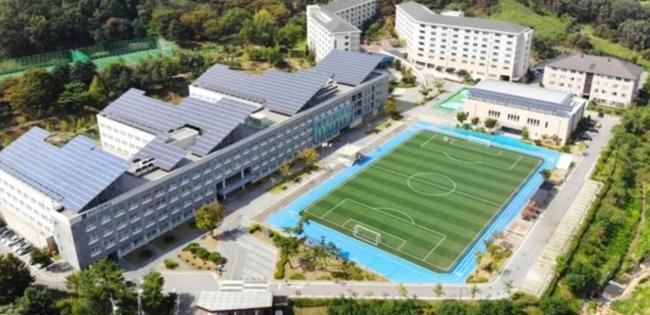 Hanmin High School, located in Paju, Gyeonggi Province. It was established in 2014 as a general private high school to provide educational stability for the children of military personnel, who move frequently. [Photo = Hanmin High School]
Has the school changed? Or has the political lens through which the school is viewed changed? This is not a trivial question.
Some media outlets, including Monthly Chosun, are raising doubts about whether political motives are behind this push for publicization. Such concerns should not be dismissed as mere political maneuvering. The government must respond to the public’s questions with objective grounds and logic.
It is only natural for the public to question why, in a situation where livelihood issues are piling up, the government is pushing for the publicization of Hanmin High School—an institution that should serve as a national asset—after having already transferred the NIS’s anti-communist investigative authority to the police, dismantled the Defense Security Support Command, and disparaged the Korea Military Academy.
Democracy does not fear questions. Rather, democracy weakens when questions are suppressed.
The reason for public suspicion is simple: they are trying to fix a model that has already been proven successful. If the government truly wants to strengthen education for military children, it should first explain how it plans to enhance the existing strengths. Instead, the first thing they have presented is a change in the operational structure.
Policies are evaluated by their results, not their justifications. If Hanmin High School is faithfully fulfilling its purpose of educating military children, any change that could undermine that mission must be subjected to even stricter scrutiny.
A nation must not just pay lip service to respecting its military; it demonstrates sincerity by how it protects the educational environment for their children.
The government should not ask the public to "just trust us"; it must prove "why the change is necessary." That is the duty of those driving policy in a democratic nation.
The school has not changed; the administration has. Thus, rather than suspecting the school, the public must first ask why the policy standards have shifted.
Power becomes healthy when it is questioned, and the public preserves its freedom when it asks questions. That is the most basic principle that liberal democracy has taught us.
The Hanmin High School controversy is no longer just about the existence of a single school. It is a litmus test showing what the state intends to protect—and what it intends to change. And so, the public asks: Who is actually afraid of Hanmin High School?

◆ Jung Sung-hong
Chairman, Hanmi Ilbo
Former National Intelligence Service Official

 [Special Feature: Cho Woo-seok] ③ Investigate Hong Seok-hyun and Hong Jung-do first, as they keep stinking
Individual creditors of JTBC are holding a protest in front of the Presidential Office, demanding the return of their retirement funds. [Photo=Yonhap News]The crisis at JoongAng Group, which is on the
[Special Feature: Cho Woo-seok] ③ Investigate Hong Seok-hyun and Hong Jung-do first, as they keep stinking
Individual creditors of JTBC are holding a protest in front of the Presidential Office, demanding the return of their retirement funds. [Photo=Yonhap News]The crisis at JoongAng Group, which is on the
 [Breaking News] Trump administration urges total cancellation of 250,000 Chinese student visas… Concerns over Chinese espionage and election interference
U.S. President Donald Trump [Photo=White House]Voices are growing louder within the United States, particularly among the Republican Party, calling for the total cancellation and suspension of visas f
[Breaking News] Trump administration urges total cancellation of 250,000 Chinese student visas… Concerns over Chinese espionage and election interference
U.S. President Donald Trump [Photo=White House]Voices are growing louder within the United States, particularly among the Republican Party, calling for the total cancellation and suspension of visas f
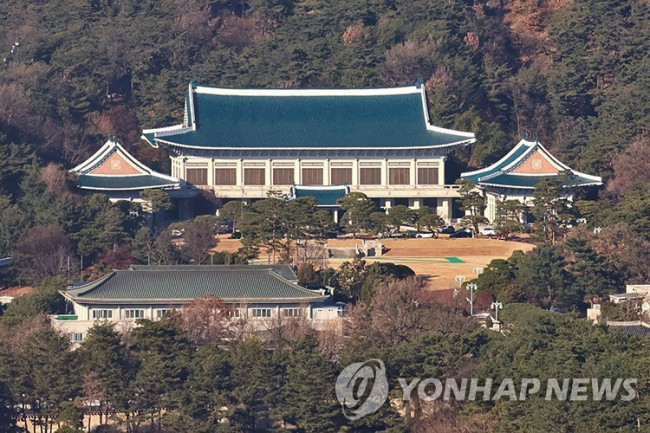 Blue House: "We will respect any conclusion on the right to request supplementary investigations... A prompt decision is needed to minimize confusion."
The Blue House [Photo by Lee Jung-hoon] 2025.12.8Regarding the issue of the prosecution's supplementary investigative authority, the Blue House stated on the 21st, "The decision on whether to abolish
Blue House: "We will respect any conclusion on the right to request supplementary investigations... A prompt decision is needed to minimize confusion."
The Blue House [Photo by Lee Jung-hoon] 2025.12.8Regarding the issue of the prosecution's supplementary investigative authority, the Blue House stated on the 21st, "The decision on whether to abolish
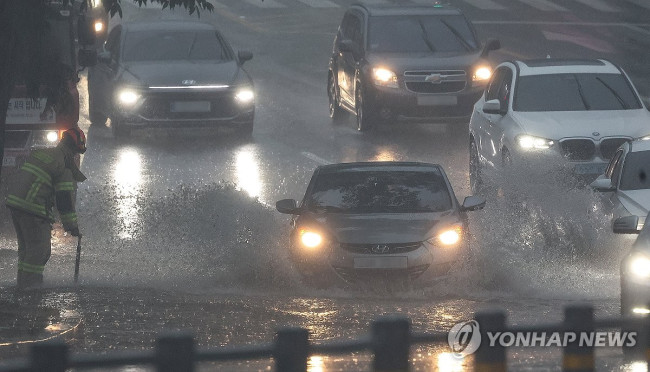 Heavy rainfall overnight triggers flood of damage reports in Asan and Cheonan… 8 rescued
Road flooded by heavy rain [Yonhap News file photo]As of the early hours of the 22nd, heavy rainfall has caused consecutive damage in the Asan and Cheonan areas of South Chungcheong Province, includin
Heavy rainfall overnight triggers flood of damage reports in Asan and Cheonan… 8 rescued
Road flooded by heavy rain [Yonhap News file photo]As of the early hours of the 22nd, heavy rainfall has caused consecutive damage in the Asan and Cheonan areas of South Chungcheong Province, includin
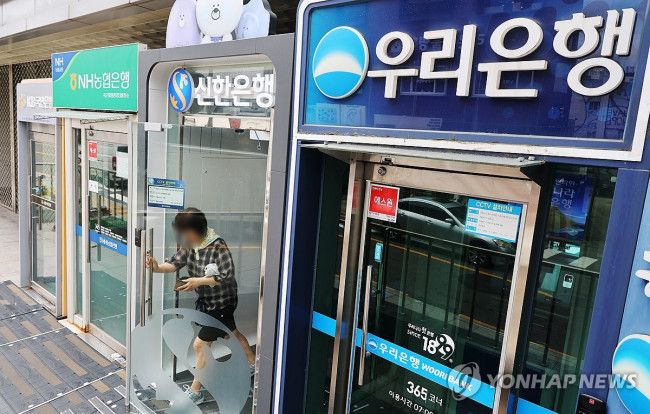 Due to 'Debt-to-Invest' Trend, Major 5 Banks Exceed Other Loan Targets by 2.4 Trillion Won… Tightening Mortgage Loans
An automated teller machine (ATM) at a commercial bank in Seoul on the 19th. [Yonhap News] It has been found that "other loans" at the five major commercial banks (KB Kookmin, Shinhan, Hana, Woor
Due to 'Debt-to-Invest' Trend, Major 5 Banks Exceed Other Loan Targets by 2.4 Trillion Won… Tightening Mortgage Loans
An automated teller machine (ATM) at a commercial bank in Seoul on the 19th. [Yonhap News] It has been found that "other loans" at the five major commercial banks (KB Kookmin, Shinhan, Hana, Woor
 [Exhibition] Lee Jung-a Solo Exhibition ‘Palimpsest of Multiple Perceptions’ Held at Gallery Naeil
Gallery Naeil in Jongno-gu, Seoul, will host artist Lee Jung-ah's solo exhibition, "Palimpsest of Multiple Perceptions," from the 24th of this month to August 5th. Artist Lee Jung-ah has co
[Exhibition] Lee Jung-a Solo Exhibition ‘Palimpsest of Multiple Perceptions’ Held at Gallery Naeil
Gallery Naeil in Jongno-gu, Seoul, will host artist Lee Jung-ah's solo exhibition, "Palimpsest of Multiple Perceptions," from the 24th of this month to August 5th. Artist Lee Jung-ah has co
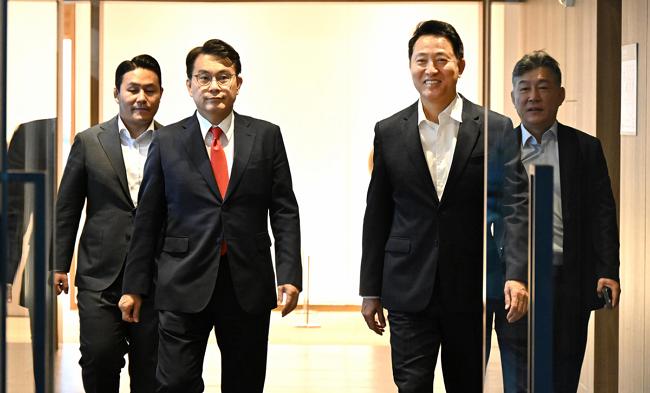 [Editorial] “Do they think party members are pushovers?”… Oh Se-hoon and Yoon Sang-hyun disregard party member sovereignty
Seoul Mayor Oh Se-hoon (second from right) and People Power Party lawmaker Yoon Sang-hyun (second from left) are seen leaving after a breakfast meeting at Seoul City Hall in Jung-gu, Seoul, on the 21s
[Editorial] “Do they think party members are pushovers?”… Oh Se-hoon and Yoon Sang-hyun disregard party member sovereignty
Seoul Mayor Oh Se-hoon (second from right) and People Power Party lawmaker Yoon Sang-hyun (second from left) are seen leaving after a breakfast meeting at Seoul City Hall in Jung-gu, Seoul, on the 21s
 [Photo] Evidence of Election Fraud Flooding U.S. Media… Trump Had 2.7 Million Votes Stolen
 [Video] U.S. Semiquincentennial Air Show... 'Art in the Sky' streaks across New York
 [Editorial Cartoon] A Draconian Law That Undermines Freedom of Expression

 List
List