 Central Election Commission [Yonhap News Photo]
It has been revealed that the National Election Commission has failed to collect 23.6 billion won in election expenses that should have been recovered from candidates who violated election laws, leaving the funds uncollected.
Of this amount, 3.5 billion won has effectively become irrecoverable due to the expiration of the statute of limitations.
◇ 23.6 Billion Won Uncollected Out of 27.3 Billion Won in Return Orders... 23 Cases of Arrears Over 10 Years Old
According to data submitted by the office of Rep. Chae Hyun-il of the Democratic Party of Korea to the National Election Commission, as of January 31 of this year, 86 individuals had outstanding election expense reimbursements and deposit returns, totaling 23.66115 billion won.
The total amount ordered for return from these individuals was 27.35421 billion won, meaning 86.5% of the funds to be recovered have yet to be collected.
Election expense reimbursement is a system where the state reimburses part or all of a candidate's election campaign costs if they secure a certain percentage of votes.
Candidates who receive over 10% of the vote are reimbursed half of their election expenses, and those who receive over 15% are reimbursed the full amount.
Furthermore, if a candidate is convicted of an election offense, such as violating the Public Official Election Act, and the ruling that invalidates their election is finalized, they must return all deposits and reimbursed expenses within 30 days.
However, in reality, there were a significant number of long-term arrears cases, with return orders issued over 10 years ago still outstanding.
As of 2015, there were 23 cases with outstanding return amounts despite return orders being issued, totaling 11.29081 billion won. This accounts for 47.7% of the total uncollected amount.
For instance, former Seoul Superintendent of Education Kwak No-hyun received a return order for election expenses in October 2012 following a ruling that invalidated his election. However, 3.14301 billion won out of the ordered 3.53749 billion won remains unreturned.
Due to these long-term arrears, the discussion around the so-called "Kwak No-hyun Prevention Act," which would restrict re-nomination for candidates with unreturned election expenses, emerged when he ran again in the 2024 superintendent by-election.
In a phone call with Yonhap News, former Superintendent Kwak stated, "I have repaid about 400 million won so far through monthly pension garnishments," adding, "I am continuing to make repayments."
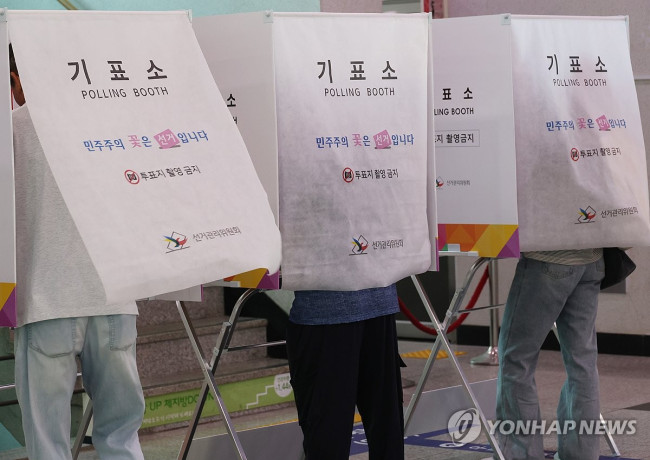 Voters casting ballots [Yonhap News Photo]
◇ Challenges in Recovery Due to Distributed Responsibility... Legislative Improvements Stalled
The problem lies in the repeated cases where recovery is not made for extended periods even after return orders are issued.
While tax authorities are responsible for collecting returned election expenses according to procedures, the National Election Commission also has an obligation to manage its receivables, including filing lawsuits to prevent the statute of limitations from expiring.
However, the unreturned funds for which the statute of limitations has already expired due to the absence of such measures amount to 3.574 billion won. A five-year statute of limitations applies to election expense return claims under the National Finance Act.
The National Election Commission explained that it has been filing lawsuits to extend the statute of limitations since 2019, and since then, there have been 3 cases with expired statutes of limitations, amounting to 198 million won.
This implies that most cases occurred before 2019. There is currently one ongoing lawsuit to extend the statute of limitations.
The National Election Commission added, "After issuing return orders, we delegate the collection to the tax office, but unreturned funds arise when there are no assets to seize," and "With new candidates becoming subject to return each election, unreturned funds are accumulating."
In fact, the National Election Commission has proposed to the National Assembly systems such as deferring election expense reimbursement for candidates indicted or charged with election offenses. Amendments to the Public Official Election Act, including extending the statute of limitations for return claims, have also been proposed but have never passed.
Jang Young-soo, an emeritus professor at Korea University School of Law, stated, "Currently, the recovery tasks are dispersed among various institutions such as the National Election Commission and the National Tax Service, making it unclear who is actually responsible." He added, "The authority responsible for recovery and the processing deadline should be clearly defined by law, and practical sanctions, such as restricting the right to be elected for those who do not return election expenses, should be considered."

 Iranian Foreign Ministry: "Continuing Message Exchanges with the U.S. and Activities of Mediating Countries"
Esmaeil Baghaei, Spokesperson for the Iranian Ministry of Foreign Affairs [Xinhua, Yonhap News file photo]Esmaeil Baghaei, spokesperson for the Iranian Ministry of Foreign Affairs, stated on the 26th
Iranian Foreign Ministry: "Continuing Message Exchanges with the U.S. and Activities of Mediating Countries"
Esmaeil Baghaei, Spokesperson for the Iranian Ministry of Foreign Affairs [Xinhua, Yonhap News file photo]Esmaeil Baghaei, spokesperson for the Iranian Ministry of Foreign Affairs, stated on the 26th
 President Yoon: "Do You Think You Are Safe from the Special Counsel?"... Final Statement Video Released
President Yoon Suk Yeol rebuking the special prosecutor on the 24th. [Court video / @birds_justice X account subtitle GIF] A video of President Yoon Suk Yeol's closing statement at his trial rega
President Yoon: "Do You Think You Are Safe from the Special Counsel?"... Final Statement Video Released
President Yoon Suk Yeol rebuking the special prosecutor on the 24th. [Court video / @birds_justice X account subtitle GIF] A video of President Yoon Suk Yeol's closing statement at his trial rega
 President Yoon, regarding the first-instance ruling on the Public Official Election Act: “An excessive political verdict that distorts the facts… We will appeal immediately.”
The first-instance sentencing hearing for President Yoon Suk Yeol regarding violations of the Public Official Election Act is being broadcast live at Seoul Station on the 27th. [Photo=Yonhap News]Pres
President Yoon, regarding the first-instance ruling on the Public Official Election Act: “An excessive political verdict that distorts the facts… We will appeal immediately.”
The first-instance sentencing hearing for President Yoon Suk Yeol regarding violations of the Public Official Election Act is being broadcast live at Seoul Station on the 27th. [Photo=Yonhap News]Pres
 WSJ: "SK Hynix ADR Premium Is a Sign of AI Trading Overheat"
Advertisement for SK Hynix ADR listing in New York's Times Square [Reuters=Yonhap News file photo]The Wall Street Journal (WSJ) has pointed out that the price of SK Hynix’s American Depositary Recei
WSJ: "SK Hynix ADR Premium Is a Sign of AI Trading Overheat"
Advertisement for SK Hynix ADR listing in New York's Times Square [Reuters=Yonhap News file photo]The Wall Street Journal (WSJ) has pointed out that the price of SK Hynix’s American Depositary Recei
 'Godfather of Japanese Mystery Novels' Keigo Higashino Passes Away After Battle with Cancer at 68
Famous Japanese mystery novelist Keigo Higashino [AFP=Yonhap News]It has been belatedly reported that Keigo Higashino, the "godfather of Japanese mystery novels" and author of bestsellers such as "The
'Godfather of Japanese Mystery Novels' Keigo Higashino Passes Away After Battle with Cancer at 68
Famous Japanese mystery novelist Keigo Higashino [AFP=Yonhap News]It has been belatedly reported that Keigo Higashino, the "godfather of Japanese mystery novels" and author of bestsellers such as "The
 [Park Pil-kyu Security Column] To the Ignorant Trying to Clothe a Beast in Sheep's Clothing
Rep. Kim Byung-joo of the Democratic Party of Korea [Photo=Yonhap News]“The Air Force Academy doesn't teach you how to fly a plane!” “The Army, Navy, and Air Force academies are exactly the
[Park Pil-kyu Security Column] To the Ignorant Trying to Clothe a Beast in Sheep's Clothing
Rep. Kim Byung-joo of the Democratic Party of Korea [Photo=Yonhap News]“The Air Force Academy doesn't teach you how to fly a plane!” “The Army, Navy, and Air Force academies are exactly the
 [Issue Diagnosis] Two Effects of the Election Petition Review
 [Photo] Evidence of Election Fraud Flooding U.S. Media… Trump Had 2.7 Million Votes Stolen
 [Video] U.S. Semiquincentennial Air Show... 'Art in the Sky' streaks across New York
 [Editorial Cartoon] A Draconian Law That Undermines Freedom of Expression

 List
List









