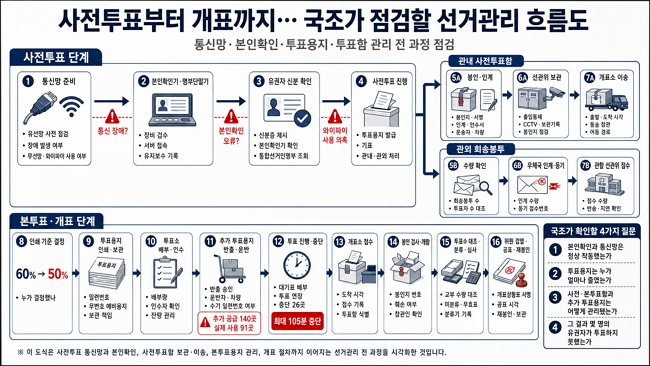
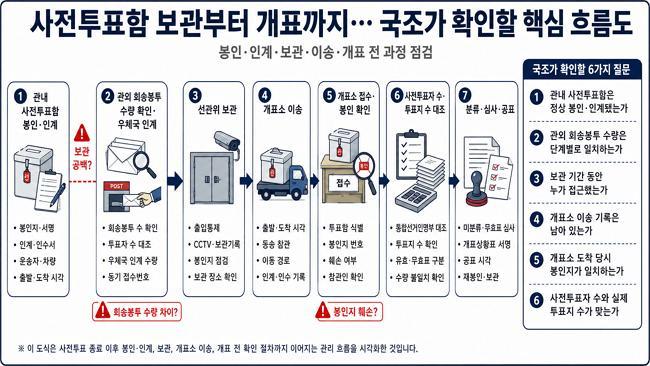
What to Check from the Storage of Early Voting Ballot Boxes to the Counting Process The verification of the ballot counting should not begin when the ballot boxes arrive at the counting station. It must start by checking how the ballot boxes and return envelopes were handed over, stored, and transported after early voting concluded. If the records do not connect the period from the end of early voting to the counting, it is difficult to assess the appropriateness of management based solely on the final counting figures.
① Sealing and Handover of In-District Early Voting Ballot Boxes After in-district early voting ends, the ballot box slot and lock are sealed in the presence of early voting observers, and the early voting management officer and observers sign the seals before handing them over to the district/city/county Election Commission. The Special Committee for National Investigation must verify the following data. * Time of early voting end * Time of ballot box sealing * Seal number and signatories * Time of departure from polling station and arrival at Election Commission * Transporter and vehicle number * Accompanying observers and police officers * Original handover/receipt form * Sealing status at departure and arrival In particular, it is necessary to confirm whether the transportation route changed or if there were unplanned stops during the movement from the polling station to the Election Commission's storage location, using vehicle operation records and video data. ② Handover of Return Envelopes for Out-of-District Early Voting The procedure for out-of-district early voting differs from that for in-district early voting. After early voting ends, the ballot box is opened in the presence of observers, the number of return envelopes is counted, and then handed over to the postal service for registered mail delivery. The items to be checked are as follows: * Number of out-of-district early voters on the integrated voter roll * Number of return envelopes from the ballot box * Quantity handed over to the post office * Time of registered mail dispatch and tracking number * Observer accompanying to the post office * Final quantity received by the Election Commission for the respective constituency * Number of returned, delayed, or undelivered envelopes * Number of return envelopes actually opened during counting The following figures must be compared by constituency. > Number of out-of-district early voters > = Number of return envelopes handed over to the post office > = Quantity received by the constituency Election Commission > = Number of return envelopes for counting If there are discrepancies, it must be clarified at which stage and for what reason the quantities changed. ③ Storage Process at the Election Commission When receiving in-district early voting ballot boxes, the district/city/county Election Commission must confirm the sealing status in the presence of party-appointed committee members and store them properly. The Special Committee for National Investigation must check the following. * Condition of the seal upon receipt of the ballot box * Participation of party-appointed committee members * Storage location and period * List of authorized personnel for access to the storage room * Records of door opening/closing and access * Records of seal inspection during storage * Original CCTV footage of the storage location and any blind spots, if available * Occurrence of power outages, equipment failures, or access control anomalies * Final confirmation record before transport to the counting station Early voting ballot boxes are stored for a certain period until the regular voting day. Therefore, it is necessary to confirm not only that the seals at the time of initial sealing and arrival at the counting station are the same, but also who had access to the storage area during the interim storage period and who actually entered. ④ Transportation from Storage to Counting Station On the day of counting, the early voting ballot boxes are transported again from the Election Commission's storage facility to the counting station. This second transportation process must also be verified with separate handover/receipt records. * Departure time from storage location * Person who confirmed seals before departure * Transport vehicle and driver * Accompanying Election Commission members, observers, and police * Route and arrival time * Recipient at the counting station * Seal numbers at departure and arrival * Receipt log for ballot boxes at the counting station The first transportation from the early voting station to the Election Commission and the second transportation from the Election Commission to the counting station should not be bundled together. The responsible persons and records for each segment must be checked separately. ⑤ Receipt at Counting Station and Seal Verification At the counting station, it is necessary to confirm which early voting station's ballot box arrived and at what time, and then open the box after examining the seal in the presence of counting observers. If the seal is damaged or the signature/number does not match, photographs, objections, and committee decisions and their outcomes must be retained. ⑥ Comparison of Early Voter Numbers and Ballot Paper Counts After opening the ballot boxes, the number of ballot papers from the boxes must be compared with the number of early voters. For in-district early voting, the following figures are checked. > Number of in-district early voters on the integrated voter roll > = Number of ballot papers from the ballot box > = Valid votes + Invalid votes For out-of-district early voting, the number of received return envelopes, the number of envelopes excluded from opening, and the actual number of ballot papers must be compared separately. ⑦ Sorting, Examination, and Tallying, and Announcement of Results The input quantity of the ballot sorting machine, the quantity sorted by candidate, and the number of unsorted and re-sorted ballots must be checked, and the process of judging unsorted and questionable invalid ballots must also be recorded. The results must be announced after examination and tallying, verification by Election Commission members, and signing/stamping of the counting status report. The time of electronic data entry, the time of official announcement, and any revisions to the counting status report must also be checked. The key questions that this national investigation must address regarding the early voting and counting process are as follows: * Were the in-district early voting ballot boxes sealed and normally handed over? * Who accessed the storage location during the storage period? * Do the out-of-district early voting return envelope counts match at each stage? * Are there records of transportation from the storage location to the counting station? * Did the seals at the time of arrival at the counting station match the original seals? * Do the number of early voters and the actual number of ballot papers match precisely? Counting verification that excludes the storage and transportation of early voting ballot boxes is only half complete. The national investigation must not only observe the opening of ballot boxes but also connect and verify the entire process from the moment early voting ends until the ballot boxes are opened at the counting station.
| 
 Iranian Foreign Ministry: "Continuing Message Exchanges with the U.S. and Activities of Mediating Countries"
Esmaeil Baghaei, Spokesperson for the Iranian Ministry of Foreign Affairs [Xinhua, Yonhap News file photo]Esmaeil Baghaei, spokesperson for the Iranian Ministry of Foreign Affairs, stated on the 26th
Iranian Foreign Ministry: "Continuing Message Exchanges with the U.S. and Activities of Mediating Countries"
Esmaeil Baghaei, Spokesperson for the Iranian Ministry of Foreign Affairs [Xinhua, Yonhap News file photo]Esmaeil Baghaei, spokesperson for the Iranian Ministry of Foreign Affairs, stated on the 26th
 President Yoon: "Do You Think You Are Safe from the Special Counsel?"... Final Statement Video Released
President Yoon Suk Yeol rebuking the special prosecutor on the 24th. [Court video / @birds_justice X account subtitle GIF] A video of President Yoon Suk Yeol's closing statement at his trial rega
President Yoon: "Do You Think You Are Safe from the Special Counsel?"... Final Statement Video Released
President Yoon Suk Yeol rebuking the special prosecutor on the 24th. [Court video / @birds_justice X account subtitle GIF] A video of President Yoon Suk Yeol's closing statement at his trial rega
 President Yoon, regarding the first-instance ruling on the Public Official Election Act: “An excessive political verdict that distorts the facts… We will appeal immediately.”
The first-instance sentencing hearing for President Yoon Suk Yeol regarding violations of the Public Official Election Act is being broadcast live at Seoul Station on the 27th. [Photo=Yonhap News]Pres
President Yoon, regarding the first-instance ruling on the Public Official Election Act: “An excessive political verdict that distorts the facts… We will appeal immediately.”
The first-instance sentencing hearing for President Yoon Suk Yeol regarding violations of the Public Official Election Act is being broadcast live at Seoul Station on the 27th. [Photo=Yonhap News]Pres
 WSJ: "SK Hynix ADR Premium Is a Sign of AI Trading Overheat"
Advertisement for SK Hynix ADR listing in New York's Times Square [Reuters=Yonhap News file photo]The Wall Street Journal (WSJ) has pointed out that the price of SK Hynix’s American Depositary Recei
WSJ: "SK Hynix ADR Premium Is a Sign of AI Trading Overheat"
Advertisement for SK Hynix ADR listing in New York's Times Square [Reuters=Yonhap News file photo]The Wall Street Journal (WSJ) has pointed out that the price of SK Hynix’s American Depositary Recei
 'Godfather of Japanese Mystery Novels' Keigo Higashino Passes Away After Battle with Cancer at 68
Famous Japanese mystery novelist Keigo Higashino [AFP=Yonhap News]It has been belatedly reported that Keigo Higashino, the "godfather of Japanese mystery novels" and author of bestsellers such as "The
'Godfather of Japanese Mystery Novels' Keigo Higashino Passes Away After Battle with Cancer at 68
Famous Japanese mystery novelist Keigo Higashino [AFP=Yonhap News]It has been belatedly reported that Keigo Higashino, the "godfather of Japanese mystery novels" and author of bestsellers such as "The
 [Park Pil-kyu Security Column] To the Ignorant Trying to Clothe a Beast in Sheep's Clothing
Rep. Kim Byung-joo of the Democratic Party of Korea [Photo=Yonhap News]“The Air Force Academy doesn't teach you how to fly a plane!” “The Army, Navy, and Air Force academies are exactly the
[Park Pil-kyu Security Column] To the Ignorant Trying to Clothe a Beast in Sheep's Clothing
Rep. Kim Byung-joo of the Democratic Party of Korea [Photo=Yonhap News]“The Air Force Academy doesn't teach you how to fly a plane!” “The Army, Navy, and Air Force academies are exactly the
 [Issue Diagnosis] Two Effects of the Election Petition Review
 [Photo] Evidence of Election Fraud Flooding U.S. Media… Trump Had 2.7 Million Votes Stolen
 [Video] U.S. Semiquincentennial Air Show... 'Art in the Sky' streaks across New York
 [Editorial Cartoon] A Draconian Law That Undermines Freedom of Expression

 List
List