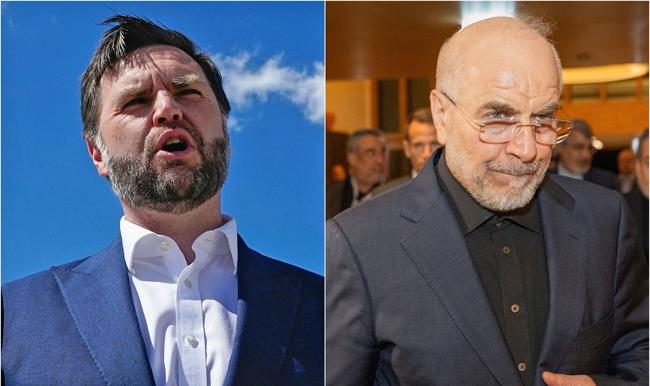
 U.S. Vice President Vance (left) departs for Switzerland on the 20th (local time), and Iranian Parliament Speaker Ghalibaf arrives at the negotiation venue in Switzerland on the 21st (local time). [AP=Yonhap News. Reproduction and database prohibited]
The ceasefire memorandum of understanding (MOU) between the United States and Iran has encountered its first crisis since its early stages of implementation.
The Khatam al-Anbiya Central Headquarters, which commands the Iranian military, announced on the 20th that it would re-blockade the Strait of Hormuz, claiming that the United States and Israel had violated the MOU. Iran specifically raised concerns about Israel's continued airstrikes in Lebanon targeting the pro-Iranian Hezbollah militant group.
This issue directly challenges a core provision of the "Islamabad MOU," which was signed on June 17th and went into effect on the 18th. The MOU is structured as an exchange: the U.S. lifts its naval blockade of Iranian ports, and Iran guarantees safe passage for merchant ships through the Strait of Hormuz.
The U.S. agreed to completely lift the naval blockade within 30 days, and Iran agreed to ensure safe and free passage through the Strait of Hormuz for 60 days. However, Iran's declaration of a re-blockade just two days into implementation has shaken the most sensitive axis of the MOU.
Declaration of Re-blockade, But Ships Continued to Move
In response to Iran's declaration of a re-blockade, the U.S. did not immediately offer strong criticism but instead emphasized that "actual transit continues."
U.S. Central Command, which oversees U.S. military operations in the Middle East, stated that Iran does not control the Strait of Hormuz and that ship traffic continues. Central Command also explained that U.S. forces are maintaining vigilance on the ground to ensure compliance with, implementation of, and effectiveness of the agreement.
This point is crucial. Iran increased pressure by "declaring a blockade," but the U.S. did not immediately escalate it into a military confrontation. Instead, by highlighting the fact that passage through the strait was being maintained, the U.S. aimed to reduce market anxiety and preserve negotiation momentum.
Indeed, the Strait of Hormuz is a critical route for the global transport of crude oil and liquefied natural gas. If Iran's declaration were to translate into an actual physical blockade, international oil prices, maritime insurance, and shipping operations would inevitably be thrown into disarray.
Despite this, both sides maintained a dialogue.
The U.S. delegation headed to Switzerland. Middle East Special Envoy Steve Wittekoff and Jared Kushner arrived first, and Vice President JD Vance also departed for Switzerland for negotiations. Before his departure, Vance told reporters that he expected to hold talks for "about two days" and expressed hope for progress on the nuclear issue and the Lebanon ceasefire.
The Iranian delegation also arrived in Switzerland.
Mohammad Bagher Ghalibaf, Speaker of the Iranian Parliament, led the delegation. Pakistan's Foreign Ministry also confirmed on the 21st that a face-to-face working-level meeting between the two countries would be held in Switzerland. This first working-level meeting, which had been postponed once, was set to take place again immediately after the re-blockade declaration.
Main Negotiations or Violation Check?
However, the fact that both sides are sitting at the same negotiation table does not mean that main negotiations will begin immediately.
The Iranian Foreign Ministry stated that the purpose of this meeting is not to initiate main negotiations but to review the MOU violations and strongly demand implementation from the U.S. side.
Iran maintains that it can only begin nuclear negotiations after the U.S. actually implements economic and maritime provisions, such as lifting the naval blockade, exempting oil exports from sanctions, and allowing the use of frozen assets.
The U.S. has different priorities.
The U.S. views the limitation of Iran's nuclear program, the processing of highly enriched uranium, the restoration of International Atomic Energy Agency inspections, and a definitive ceasefire on the Lebanon front as key agenda items. This is why Vice President Vance mentioned the nuclear issue and the Lebanon ceasefire simultaneously before his departure.
Ultimately, the first point of contention at the Swiss talks will be "who implements first."
The U.S. is demanding concrete details on nuclear and security measures, while Iran seeks to confirm economic compensation and the lifting of the naval blockade first. If this dispute over the order of operations is not resolved, the 60-day deadline for a final agreement is likely to stall from the outset.
The Lebanon Front is the Weak Link in the MOU
The weakest link in the MOU is Lebanon.
The agreement stipulates that military operations must cease on all fronts, including Lebanon, but Israel is not a direct party to the MOU.
If Israel continues its military operations against Hezbollah, Iran can characterize this as a violation of the agreement by the U.S. and Israel. Conversely, if Iran cannot control Hezbollah, the U.S. could deem Iran's implementation of the MOU to be incomplete.
While Vice President Vance stated that "the situation is improving," he also said it is an issue that requires continuous management to ensure the safety and stability of both Israel and Lebanon.
This implies that the U.S. does not view the Lebanon front as a mere secondary variable. If the Lebanon ceasefire falters, the negotiations on Hormuz and the nuclear issue could also be shaken.
Trump's Remarks on 'Hormuz Tolls' as a New Variable
U.S. President Trump stated that there would be no tolls on the Strait of Hormuz during the 60-day ceasefire period, and no tolls would be imposed even after the 60 days.
However, he added that if a final agreement is not reached, the U.S. might impose tolls to recoup the costs of its "guardian angel" services provided to Middle Eastern countries.
These remarks convey a two-pronged message.
One is a warning that Iran will not be permitted to impose tolls on the Strait of Hormuz or use control of the strait as a bargaining chip.
The other is that if the final agreement fails, the U.S. could introduce new pressure tactics based on maritime security costs.
Given that the U.S. has publicly mentioned the possibility of imposing tolls on international straits, this could become another point of contention in future negotiations.
The U.S. and Iran have signed a document to stop the war. However, four key issues remain unresolved: the Strait of Hormuz, the Lebanon ceasefire, the nuclear issue, and the lifting of sanctions.
Iran's declaration of a re-blockade has shown that the MOU is not the completion of the ceasefire but merely the starting line for implementation.
Nevertheless, the fact that both sides agreed to attend the Swiss talks is a significant signal. While grounds for returning to war are accumulating, it indicates that they are not yet ready to abandon the negotiation table.
The working-level meeting in Switzerland on the 21st is expected to be the first test to determine whether the U.S. and Iran can overcome the MOU violation controversy and move on to substantive nuclear and sanctions negotiations.
Key Timeline of U.S.-Iran War and MOU Implementation February 28 U.S. and Israel launch airstrikes targeting Iran's nuclear and military facilities and command centers. Iran retaliates with missile and drone attacks on Israeli and U.S. military bases in the Gulf region. March Iran restricts passage through the Strait of Hormuz, leading to a sharp decline in merchant and oil tanker traffic. This disrupts crude oil and LNG exports from the Gulf region and causes a surge in international oil prices. April 8 Mediated by Pakistan, the U.S. and Iran agree to a two-week ceasefire. Discussions begin on a final peace agreement and the resumption of passage through the Strait of Hormuz. April 13 The U.S. initiates a naval blockade, intercepting vessels entering and leaving Iranian ports. April 17 Iran temporarily reopens the Strait of Hormuz but warns of a potential re-closure if the U.S. naval blockade continues. May 28 Both sides approach a tentative agreement framework to extend the ceasefire for 60 days and lift maritime passage restrictions. June 17 U.S. President Trump and Iranian President Masoud Pezeshkian sign the 14-point Islamabad MOU. June 18 The White House submits the full text of the MOU to Congress. The 60-day deadline for final negotiations begins. Partial passage through the Strait of Hormuz resumes. June 19 The first follow-up talks scheduled in Switzerland are postponed. Clashes continue between Israel and Hezbollah on the Lebanon front. June 20 Iran's Khatam al-Anbiya Central Headquarters declares a re-blockade of the Strait of Hormuz, alleging violations of the MOU by the U.S. and Israel. U.S. Central Command counters that Iran does not control the strait and that ship traffic continues. June 21 The U.S. and Iran are scheduled to hold face-to-face working-level talks in Switzerland. The U.S. demands progress on the nuclear issue and the Lebanon ceasefire, while Iran calls for a review of MOU violations and prior U.S. implementation. |

 Iranian Foreign Ministry: "Continuing Message Exchanges with the U.S. and Activities of Mediating Countries"
Esmaeil Baghaei, Spokesperson for the Iranian Ministry of Foreign Affairs [Xinhua, Yonhap News file photo]Esmaeil Baghaei, spokesperson for the Iranian Ministry of Foreign Affairs, stated on the 26th
Iranian Foreign Ministry: "Continuing Message Exchanges with the U.S. and Activities of Mediating Countries"
Esmaeil Baghaei, Spokesperson for the Iranian Ministry of Foreign Affairs [Xinhua, Yonhap News file photo]Esmaeil Baghaei, spokesperson for the Iranian Ministry of Foreign Affairs, stated on the 26th
 President Yoon: "Do You Think You Are Safe from the Special Counsel?"... Final Statement Video Released
President Yoon Suk Yeol rebuking the special prosecutor on the 24th. [Court video / @birds_justice X account subtitle GIF] A video of President Yoon Suk Yeol's closing statement at his trial rega
President Yoon: "Do You Think You Are Safe from the Special Counsel?"... Final Statement Video Released
President Yoon Suk Yeol rebuking the special prosecutor on the 24th. [Court video / @birds_justice X account subtitle GIF] A video of President Yoon Suk Yeol's closing statement at his trial rega
 President Yoon, regarding the first-instance ruling on the Public Official Election Act: “An excessive political verdict that distorts the facts… We will appeal immediately.”
The first-instance sentencing hearing for President Yoon Suk Yeol regarding violations of the Public Official Election Act is being broadcast live at Seoul Station on the 27th. [Photo=Yonhap News]Pres
President Yoon, regarding the first-instance ruling on the Public Official Election Act: “An excessive political verdict that distorts the facts… We will appeal immediately.”
The first-instance sentencing hearing for President Yoon Suk Yeol regarding violations of the Public Official Election Act is being broadcast live at Seoul Station on the 27th. [Photo=Yonhap News]Pres
 WSJ: "SK Hynix ADR Premium Is a Sign of AI Trading Overheat"
Advertisement for SK Hynix ADR listing in New York's Times Square [Reuters=Yonhap News file photo]The Wall Street Journal (WSJ) has pointed out that the price of SK Hynix’s American Depositary Recei
WSJ: "SK Hynix ADR Premium Is a Sign of AI Trading Overheat"
Advertisement for SK Hynix ADR listing in New York's Times Square [Reuters=Yonhap News file photo]The Wall Street Journal (WSJ) has pointed out that the price of SK Hynix’s American Depositary Recei
 'Godfather of Japanese Mystery Novels' Keigo Higashino Passes Away After Battle with Cancer at 68
Famous Japanese mystery novelist Keigo Higashino [AFP=Yonhap News]It has been belatedly reported that Keigo Higashino, the "godfather of Japanese mystery novels" and author of bestsellers such as "The
'Godfather of Japanese Mystery Novels' Keigo Higashino Passes Away After Battle with Cancer at 68
Famous Japanese mystery novelist Keigo Higashino [AFP=Yonhap News]It has been belatedly reported that Keigo Higashino, the "godfather of Japanese mystery novels" and author of bestsellers such as "The
 [Park Pil-kyu Security Column] To the Ignorant Trying to Clothe a Beast in Sheep's Clothing
Rep. Kim Byung-joo of the Democratic Party of Korea [Photo=Yonhap News]“The Air Force Academy doesn't teach you how to fly a plane!” “The Army, Navy, and Air Force academies are exactly the
[Park Pil-kyu Security Column] To the Ignorant Trying to Clothe a Beast in Sheep's Clothing
Rep. Kim Byung-joo of the Democratic Party of Korea [Photo=Yonhap News]“The Air Force Academy doesn't teach you how to fly a plane!” “The Army, Navy, and Air Force academies are exactly the
 [Issue Diagnosis] Two Effects of the Election Petition Review
 [Photo] Evidence of Election Fraud Flooding U.S. Media… Trump Had 2.7 Million Votes Stolen
 [Video] U.S. Semiquincentennial Air Show... 'Art in the Sky' streaks across New York
 [Editorial Cartoon] A Draconian Law That Undermines Freedom of Expression

 List
List









