Despite a 30% drop in international oil prices over the past month due to a ceasefire agreement between the U.S. and Iran, domestic gas station prices remain stubbornly in the 2,000 won range.
With a lag of nearly three weeks for international oil price drops to be reflected in domestic prices, and Iran considering imposing transit fees on the Strait of Hormuz, it is expected to take a considerable amount of time for domestic oil prices to return to pre-war levels.
 The HMM's ultra-large crude carrier (VLCC) 'Universal Winner', the first Korean vessel to leave the Strait of Hormuz after the Middle East conflict, arrived off the coast of Ulsan on the 10th to unload crude oil and is approaching a buoy, a floating oil unloading facility. [Yonhap News]
According to OilNet, the Korea National Oil Corporation's oil price information system, the price of Dubai crude oil on the Singapore spot market, which South Korea mainly imports, plummeted by 30.9% from $106.60 per barrel on May 20 to $73.61 on June 19, a period of one month.
This marks a significant return to pre-war levels for oil prices, which had briefly approached $170 per barrel (closing price) amidst the conflict between the U.S., Israel, and Iran. Just before the outbreak of the war, the price of Dubai crude was around $70 per barrel.
In contrast, the retail price of gasoline at domestic gas stations remained almost unchanged, from 2,011 won in the third week of May to 2,009 won in the third week of June.
If the Middle East conflict, which recently caused a surge in oil prices, effectively reaches a conclusion and the Strait of Hormuz reopens, domestic gas station prices are highly likely to eventually normalize.
However, it is anticipated that it will take a considerable amount of time for consumers to feel the stabilization of fuel prices.
According to the refining industry, it takes approximately one week for international oil price fluctuations to be reflected in refiners' supply prices, followed by an additional one to two weeks for them to be reflected in gas station retail prices.
This means that the recent drop in international oil prices may only be reflected in final consumer prices around early to mid-July, at the earliest, approximately three weeks from now.
The impact of the government's implemented price cap policy also significantly contributed to the recent international oil price drop not being fully transmitted to domestic prices over the past month.
If the surge in international oil prices had been fully reflected, domestic oil prices would have risen further. However, as the government has controlled these prices through policy, a phenomenon occurs where a sharp drop in international oil prices is not proportionally reflected domestically.
An industry official stated, "As the recent downward trend in international oil prices continues, it will eventually have a positive impact on the stabilization of domestic oil prices. However, variables such as exchange rates and international refined oil prices remain, making it difficult to predict future price levels."
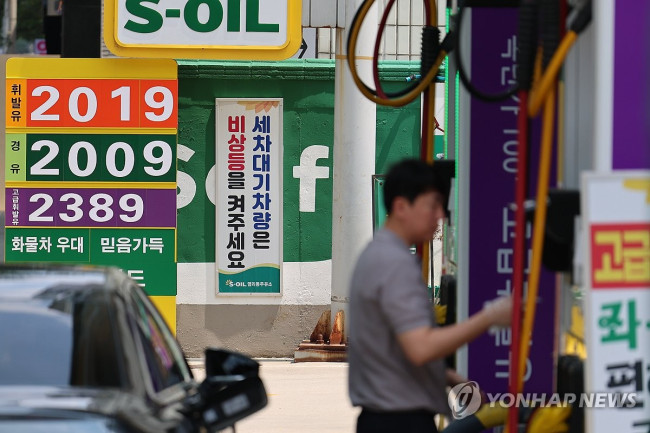 Gas station in Seoul [Yonhap News Archive Photo]
Domestic gasoline and diesel prices have maintained high levels around 2,000 won since late February, following the Middle East conflict, and throughout April.
Notably, the nationwide average gasoline price at gas stations surpassed the 2,000 won mark on April 17th for the first time in about three years since the Russia-Ukraine war.
Another industry official commented, "Even if a ceasefire agreement is reached and the price cap policy ends, it will be difficult for prices to immediately return to the pre-war levels of January-February this year. This is because international refined oil prices remain high, and taxes and distribution margins are added, which may limit the extent of price reduction that consumers can experience."
He added, "Even after a ceasefire agreement, uncertainties remain in the Middle East region, such as clashes between Israel and Hezbollah, so the possibility of increased volatility in international oil prices cannot be ruled out."
The potential imposition of transit fees by Iran on the Strait of Hormuz could also act as a factor delaying the normalization of domestic oil prices.
South Korea's heavy reliance on the Middle East for its oil supply, with approximately 70% of its crude oil imports coming from the region last year, makes it sensitive to variables concerning the Middle East and the Strait of Hormuz.
The Memorandum of Understanding (MOU) for a ceasefire between the U.S. and Iran includes a clause stating that no fees will be imposed on vessels applying for passage through the Strait of Hormuz for the next 60 days. However, Iran is reportedly planning to collect 'insurance fees,' a form of transit fee, from vessels transiting the strait.
The Strait of Hormuz is a critical transport route, through which approximately 20% of the world's maritime crude oil trade passes. The imposition of transit fees could lead to an increase in crude oil transportation costs.
If transit fees are actually implemented, they could offset the effect of falling international oil prices.
This is because even if the Strait of Hormuz reopens, increased transportation costs for crude oil may lead to a smaller price difference with other crude oil import sources than initially expected. Consequently, there are concerns that further reductions in domestic gas station prices may be limited if the downward trend in international oil prices slows.

 Iranian Foreign Ministry: "Continuing Message Exchanges with the U.S. and Activities of Mediating Countries"
Esmaeil Baghaei, Spokesperson for the Iranian Ministry of Foreign Affairs [Xinhua, Yonhap News file photo]Esmaeil Baghaei, spokesperson for the Iranian Ministry of Foreign Affairs, stated on the 26th
Iranian Foreign Ministry: "Continuing Message Exchanges with the U.S. and Activities of Mediating Countries"
Esmaeil Baghaei, Spokesperson for the Iranian Ministry of Foreign Affairs [Xinhua, Yonhap News file photo]Esmaeil Baghaei, spokesperson for the Iranian Ministry of Foreign Affairs, stated on the 26th
 President Yoon: "Do You Think You Are Safe from the Special Counsel?"... Final Statement Video Released
President Yoon Suk Yeol rebuking the special prosecutor on the 24th. [Court video / @birds_justice X account subtitle GIF] A video of President Yoon Suk Yeol's closing statement at his trial rega
President Yoon: "Do You Think You Are Safe from the Special Counsel?"... Final Statement Video Released
President Yoon Suk Yeol rebuking the special prosecutor on the 24th. [Court video / @birds_justice X account subtitle GIF] A video of President Yoon Suk Yeol's closing statement at his trial rega
 President Yoon, regarding the first-instance ruling on the Public Official Election Act: “An excessive political verdict that distorts the facts… We will appeal immediately.”
The first-instance sentencing hearing for President Yoon Suk Yeol regarding violations of the Public Official Election Act is being broadcast live at Seoul Station on the 27th. [Photo=Yonhap News]Pres
President Yoon, regarding the first-instance ruling on the Public Official Election Act: “An excessive political verdict that distorts the facts… We will appeal immediately.”
The first-instance sentencing hearing for President Yoon Suk Yeol regarding violations of the Public Official Election Act is being broadcast live at Seoul Station on the 27th. [Photo=Yonhap News]Pres
 WSJ: "SK Hynix ADR Premium Is a Sign of AI Trading Overheat"
Advertisement for SK Hynix ADR listing in New York's Times Square [Reuters=Yonhap News file photo]The Wall Street Journal (WSJ) has pointed out that the price of SK Hynix’s American Depositary Recei
WSJ: "SK Hynix ADR Premium Is a Sign of AI Trading Overheat"
Advertisement for SK Hynix ADR listing in New York's Times Square [Reuters=Yonhap News file photo]The Wall Street Journal (WSJ) has pointed out that the price of SK Hynix’s American Depositary Recei
 'Godfather of Japanese Mystery Novels' Keigo Higashino Passes Away After Battle with Cancer at 68
Famous Japanese mystery novelist Keigo Higashino [AFP=Yonhap News]It has been belatedly reported that Keigo Higashino, the "godfather of Japanese mystery novels" and author of bestsellers such as "The
'Godfather of Japanese Mystery Novels' Keigo Higashino Passes Away After Battle with Cancer at 68
Famous Japanese mystery novelist Keigo Higashino [AFP=Yonhap News]It has been belatedly reported that Keigo Higashino, the "godfather of Japanese mystery novels" and author of bestsellers such as "The
 [Park Pil-kyu Security Column] To the Ignorant Trying to Clothe a Beast in Sheep's Clothing
Rep. Kim Byung-joo of the Democratic Party of Korea [Photo=Yonhap News]“The Air Force Academy doesn't teach you how to fly a plane!” “The Army, Navy, and Air Force academies are exactly the
[Park Pil-kyu Security Column] To the Ignorant Trying to Clothe a Beast in Sheep's Clothing
Rep. Kim Byung-joo of the Democratic Party of Korea [Photo=Yonhap News]“The Air Force Academy doesn't teach you how to fly a plane!” “The Army, Navy, and Air Force academies are exactly the
 [Issue Diagnosis] Two Effects of the Election Petition Review
 [Photo] Evidence of Election Fraud Flooding U.S. Media… Trump Had 2.7 Million Votes Stolen
 [Video] U.S. Semiquincentennial Air Show... 'Art in the Sky' streaks across New York
 [Editorial Cartoon] A Draconian Law That Undermines Freedom of Expression

 List
List









