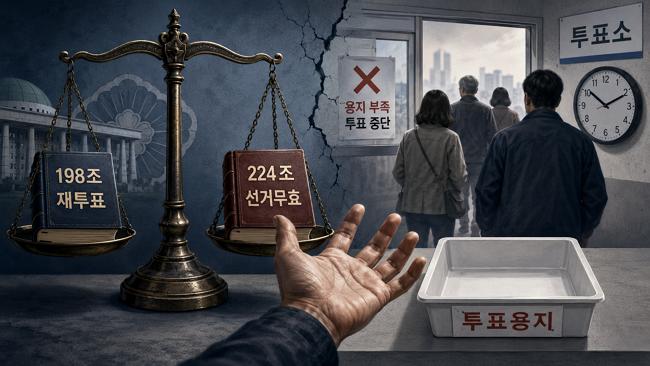
 An image illustrating the legal issues of the Article 198 (re-voting) and Article 224 (election invalidation) of the Public Official Election Act, concerning a situation where voters were denied the opportunity to vote due to a shortage of ballots. The core issue of this incident is not simply about the impact on election results, but whether the state guaranteed the opportunity to vote itself. [Photo = Hanmi Ilbo Graphic]The shortage of ballots during the June 3rd local elections cannot be dismissed as a mere administrative error. Voters arrived at polling stations only to be unable to receive ballots, some polling stations suspended voting, and there were even reports of waiting voters leaving the scene. In some areas, voting continued late into the time when vote counting was already underway, raising further concerns.
Amidst this situation, some in the political and legal circles are stating that "a re-election is difficult under current law." This is because the Supreme Court has narrowly interpreted Article 224 of the Public Official Election Act to mean "when it is recognized to have affected the election results" as a change in the winner or loser of the election.
However, this argument is only half true. It is true that, based on existing precedents, the threshold for a re-election or re-voting is high. But it is hasty to judge this incident solely by the legal principle of Article 224 concerning the change in election outcomes. This case is not about miscounting votes after the election has concluded; it is about whether the state election management authority guaranteed voters the opportunity to vote in the first place.
It's Not That There Are No Provisions for Re-election
First, it must be confirmed that the Public Official Election Act clearly provides for re-election and re-voting systems.
Article 195 of the Public Official Election Act stipulates that a re-election shall be held if there is a ruling or decision for the total invalidation of an election. Article 197 states that if a ruling or decision for the partial invalidation of an election becomes final, a re-election shall be held in the invalidated polling districts, and then the winner shall be determined again.
Article 198 stipulates that re-voting shall be held in cases where voting in a polling district could not be conducted due to natural disasters or other unavoidable circumstances, or in cases of loss or destruction of ballot boxes. However, the second paragraph of the same Article allows for the determination of a winner without re-voting if it is recognized that the re-voting would not affect the election results of the constituency.
Article 224 is a provision that, even in the case of election litigation where there has been a violation of election regulations, allows for a ruling or judgment of total or partial election invalidation or candidate invalidation only when it is recognized to have affected the election results.
Therefore, the statement "a re-election is difficult under current law" is incorrect if it implies "there is no procedure for re-election." The law provides for procedures for total re-election, partial re-election, and re-voting. The real issue is how to interpret the threshold of "having affected the election results."
This Incident Should Be Reviewed Under Article 198 First
Bringing this incident directly to the issue of Article 224 narrows the legal framework excessively.
Article 224 is a limiting provision applied when determining the final validity or invalidity in election invalidation or candidate invalidation lawsuits. In contrast, Article 198 deals with cases where voting itself could not be conducted, as a provision for re-voting.
If voters were unable to vote due to a shortage of ballots, the first thing to consider is whether it falls under Article 198's provision of "when voting could not be conducted in a polling district due to other unavoidable circumstances." Just because a polling station was open does not mean that voting was conducted for all voters. Voting is considered to have been conducted only when a voter, after identity verification, receives a ballot and can mark it.
If voting was suspended for a certain period due to a lack of ballots, and waiting voters left without voting, then for at least that period and for those voters, voting was not conducted. This is why this incident must be viewed as a problem of "loss of opportunity to vote," not just a procedural defect.
Of course, Article 198 is not a provision with a low threshold either. The second paragraph of the same article stipulates that re-voting may not be held if it is recognized that it would not affect the election results. In other words, Article 198 also requires an assessment of the impact on the results.
However, there is a crucial difference here. Article 198 establishes re-voting as the principle in paragraph 1 and provides an exception for omitting re-voting in paragraph 2. On the other hand, Article 224 is a provision that limits the determination of invalidity in election litigation. Even though the expression "affecting the election results" is used in both, their legal functions are different.
Supreme Court Precedents on Article 224 Cannot Be Directly Applied to Article 198
The Supreme Court has hitherto interpreted "when it is recognized to have affected the election results" in Article 224 as cases where it is recognized that a different outcome might have occurred regarding the winner or loser of the election.
Under this legal principle, even if there are violations of election management or procedural defects, it is difficult for them to lead to election invalidation if they do not have the potential to change the winner or loser of the election. This is the basis for some in the legal profession saying that "a re-election is difficult under current law."
However, it is difficult to directly apply this precedent to Article 198.
The "impact on results" in Article 224 is closer to an affirmative requirement for recognizing election invalidity. Conversely, the "impact on results" in Article 198, paragraph 2, is an exceptional requirement for omitting re-voting. The structure is different. If the grounds in Article 198, paragraph 1, are recognized, re-voting is the principle, and paragraph 2 allows for omitting re-voting only when it is recognized that there is no concern of affecting the election results.
Therefore, in a case under Article 198, the question is not "Did the petitioner prove the possibility of a change in the winner or loser?" Rather, it should first be asked, "Were there grounds for not conducting the vote?" Then, it should be determined, "Can the election commission responsibly recognize that there is no concern of affecting the election results, even without re-voting?"
In this regard, Article 198 is a separate area of review where the principle of focusing on the winner or loser from the precedents of Article 224 cannot be directly transplanted.
While a court may refer to the precedents of Article 224 when interpreting the same phrase "election results," that is merely supplementary legal knowledge and cannot be a direct basis for overturning the principle of re-voting and the structure of omitting re-voting in Article 198.
Existing Precedents and This Incident Are Different in Nature
The nature of the cases handled by existing Supreme Court precedents and this incident are also different.
Existing precedents generally dealt with cases where elections were conducted normally, and issues arose concerning violations in election campaigning, vote counting procedures, ballot box management, claims of computer manipulation, or the neglect of third-party illegal acts. In many cases, the election proceeded, and the question was whether subsequent procedural defects or illegal acts affected the election results.
In contrast, this incident is a case where the state election management authority failed to adequately prepare and supply ballots, thereby preventing voters from exercising their right to vote. The issue is not how votes were counted, but whether votes could be cast.
Therefore, even when citing existing precedents, they should not be directly linked to the conclusion of this incident. Rather, existing precedents should be cited as a standard for distinguishing this incident.
Elections are not simply an act of counting. It is a series of processes that guarantee equal and substantive voting opportunities for citizens who have the right to vote, and determine the winner by counting their intentions through lawful procedures. If the guarantee of voting opportunity, an initial part of the process, has collapsed, the problem extends beyond simply calculating the winner and loser.
The Burden of Proof Cannot Be Placed Solely on Voters
Another important issue in this incident is the burden of proof.
In existing election invalidation lawsuits, the legal principle has been applied that the party claiming election invalidation must specifically assert and prove the subject, timing, method, and impact on results of the violation of election regulations. However, it is difficult to apply the same standard to this incident.
Voters who left the polling station due to a shortage of ballots are likely not to have been recorded in official records. It is practically difficult to identify, after the fact, all those who arrived at the polling station but could not vote, those who waited for a long time and left due to their livelihoods, or those who did not learn of the resumption of voting late.
Moreover, the entities responsible for creating and preserving these records are not the voters, but the election commission. If the burden of proving damages is shifted to the petitioners and voters because of the absence of records resulting from the election commission's management failure, it amounts to transferring the disadvantage of management failure to the victims.
In this case, the first thing to confirm is not "Did the plaintiff prove an impact on the winner or loser?" but rather, "Did the election commission properly record the voting suspension period, the number of waiting individuals, the number of departing voters, the time of additional ballot dispatch, the on-site guidance, the time of voting resumption, and whether vote counting overlapped with voting?"
If the data to ascertain the scale of the damage lies within the election commission's purview, then securing and verifying that data through a parliamentary inquiry and special investigation should come first.
Can 'Impact on Election Results' Be Interpreted Solely as a Change in Winner/Loser?
Both Article 198 and Article 224 set 'impact on election results' as a threshold. However, the question is whether this 'impact' can always be interpreted solely as the possibility of a change in the winner or loser of the election.
The outcome of the election is the final product. However, election results are not solely formed by the sum of numbers. The legality of the process by which those numbers were formed, whether all voters were given equal opportunity to vote, and whether the voting and vote-counting procedures were managed reliably are also constituents of the legitimacy of the election results.
If this incident were limited to temporary confusion at some polling stations, the legal principle of impact on the winner/loser from existing precedents would likely apply. However, if a parliamentary inquiry and special investigation reveal systemic illegal acts throughout election management, beyond the shortage of ballots, such as issues with identity verification procedures, ballot issuance records, early voting management, ballot box storage/transportation, voting during vote counting, restrictions on observation rights, and the absence of records of affected voters, the situation would change.
In that case, this incident would not be a simple matter of a few votes being short. It would become a question of whether the election management system guaranteed the free and equal voting opportunities of the electorate. It might become difficult for the court to narrowly interpret "impact on election results" solely as the possibility of a change in the winner or loser, as it has done in the past.
Elections are not justified by their outcome alone. If the procedure collapses, the credibility of the outcome is also shaken.
Fact Check Verdict: Half True
The statement "a re-election is difficult under current law" is half true.
It is true that current Supreme Court precedents have narrowly interpreted "impact on election results" in Article 224 of the Public Official Election Act as the possibility of a change in the winner or loser of the election. Based solely on this standard, the threshold for re-election or re-voting is high.
However, it is inappropriate to judge this incident from the outset solely by the legal principle of Article 224 concerning the winner/loser outcome. If voters could not vote due to a shortage of ballots, the first step should be to review whether it falls under the re-voting provisions of Article 198, i.e., "when voting could not be conducted due to other unavoidable circumstances."
Furthermore, the precedents of Article 224 cannot be directly applied to Article 198. Article 224 is a provision that limits the determination of invalidity in election litigation, while Article 198 is a provision that anticipates re-voting when voting could not be conducted. Article 198 establishes re-voting as the principle and allows for omitting re-voting only when it is recognized that there is no concern of affecting the election results. Therefore, in a case under Article 198, the key is not whether the petitioner has proven the possibility of a change in the winner/loser, but whether there were grounds for not conducting the vote and whether it can be deemed that there is no concern of affecting the results to justify the omission of re-voting.
Moreover, even if both Article 198 and Article 224 have the threshold of "impact on results," their meaning is not always fixed as solely an impact on the winner/loser. If a parliamentary inquiry and special investigation confirm systemic illegal acts in election management, beyond the denial of suffrage, it will be difficult for the Supreme Court to interpret "impact on election results" solely in terms of simple vote differences and the possibility of changing the winner/loser, as it has done previously.
Ultimately, the conclusion of this fact-check is clear.
The reason why a re-election is difficult is not because the law lacks procedures. It is because existing precedents have narrowly interpreted the impact on results with a focus on the winner/loser. However, this incident is different from the cases that existing precedents have presupposed. Due to the failure of the state election management authority, voters' opportunity to vote was forfeited, and the data to ascertain the scale of the damage should have been possessed or preserved by the election commission.
Therefore, the statement "a re-election is difficult under current law" is correct based on existing precedents, but it is insufficient to explain the legal nature of this incident. What is needed now is not an interpretation that prematurely closes off the possibility of re-election, but a re-examination of the applicability of Article 198 and the meaning of "impact on results" under Article 224 through a parliamentary inquiry and special investigation.

 Iranian Foreign Ministry: "Continuing Message Exchanges with the U.S. and Activities of Mediating Countries"
Esmaeil Baghaei, Spokesperson for the Iranian Ministry of Foreign Affairs [Xinhua, Yonhap News file photo]Esmaeil Baghaei, spokesperson for the Iranian Ministry of Foreign Affairs, stated on the 26th
Iranian Foreign Ministry: "Continuing Message Exchanges with the U.S. and Activities of Mediating Countries"
Esmaeil Baghaei, Spokesperson for the Iranian Ministry of Foreign Affairs [Xinhua, Yonhap News file photo]Esmaeil Baghaei, spokesperson for the Iranian Ministry of Foreign Affairs, stated on the 26th
 President Yoon: "Do You Think You Are Safe from the Special Counsel?"... Final Statement Video Released
President Yoon Suk Yeol rebuking the special prosecutor on the 24th. [Court video / @birds_justice X account subtitle GIF] A video of President Yoon Suk Yeol's closing statement at his trial rega
President Yoon: "Do You Think You Are Safe from the Special Counsel?"... Final Statement Video Released
President Yoon Suk Yeol rebuking the special prosecutor on the 24th. [Court video / @birds_justice X account subtitle GIF] A video of President Yoon Suk Yeol's closing statement at his trial rega
 President Yoon, regarding the first-instance ruling on the Public Official Election Act: “An excessive political verdict that distorts the facts… We will appeal immediately.”
The first-instance sentencing hearing for President Yoon Suk Yeol regarding violations of the Public Official Election Act is being broadcast live at Seoul Station on the 27th. [Photo=Yonhap News]Pres
President Yoon, regarding the first-instance ruling on the Public Official Election Act: “An excessive political verdict that distorts the facts… We will appeal immediately.”
The first-instance sentencing hearing for President Yoon Suk Yeol regarding violations of the Public Official Election Act is being broadcast live at Seoul Station on the 27th. [Photo=Yonhap News]Pres
 WSJ: "SK Hynix ADR Premium Is a Sign of AI Trading Overheat"
Advertisement for SK Hynix ADR listing in New York's Times Square [Reuters=Yonhap News file photo]The Wall Street Journal (WSJ) has pointed out that the price of SK Hynix’s American Depositary Recei
WSJ: "SK Hynix ADR Premium Is a Sign of AI Trading Overheat"
Advertisement for SK Hynix ADR listing in New York's Times Square [Reuters=Yonhap News file photo]The Wall Street Journal (WSJ) has pointed out that the price of SK Hynix’s American Depositary Recei
 'Godfather of Japanese Mystery Novels' Keigo Higashino Passes Away After Battle with Cancer at 68
Famous Japanese mystery novelist Keigo Higashino [AFP=Yonhap News]It has been belatedly reported that Keigo Higashino, the "godfather of Japanese mystery novels" and author of bestsellers such as "The
'Godfather of Japanese Mystery Novels' Keigo Higashino Passes Away After Battle with Cancer at 68
Famous Japanese mystery novelist Keigo Higashino [AFP=Yonhap News]It has been belatedly reported that Keigo Higashino, the "godfather of Japanese mystery novels" and author of bestsellers such as "The
 [Park Pil-kyu Security Column] To the Ignorant Trying to Clothe a Beast in Sheep's Clothing
Rep. Kim Byung-joo of the Democratic Party of Korea [Photo=Yonhap News]“The Air Force Academy doesn't teach you how to fly a plane!” “The Army, Navy, and Air Force academies are exactly the
[Park Pil-kyu Security Column] To the Ignorant Trying to Clothe a Beast in Sheep's Clothing
Rep. Kim Byung-joo of the Democratic Party of Korea [Photo=Yonhap News]“The Air Force Academy doesn't teach you how to fly a plane!” “The Army, Navy, and Air Force academies are exactly the
 [Issue Diagnosis] Two Effects of the Election Petition Review
 [Photo] Evidence of Election Fraud Flooding U.S. Media… Trump Had 2.7 Million Votes Stolen
 [Video] U.S. Semiquincentennial Air Show... 'Art in the Sky' streaks across New York
 [Editorial Cartoon] A Draconian Law That Undermines Freedom of Expression

 List
List









