 Shocking suspected cases of election fraud that shook the fairness of the June 3rd local elections have been confirmed. [Photo=Yonhap News]
Shocking suspected cases of election fraud that shook the fairness of the June 3rd local elections have been confirmed. The Anti-Fraud and Corruption Prevention Center (AFCPC) received reports of fraud in 49 different cases, and numerous calls and emails were also received by , suggesting that the level of fraud was more severe than in previous elections.
① One Set of Advance Voting Ballot Printers Added on the Day
The first report to the AFCPC was received on May 29th, the day of early voting. A text message from a whistleblower stated, "One set of advance voting ballot printers, which was not present during the mock test observation, was added on the day of early voting."
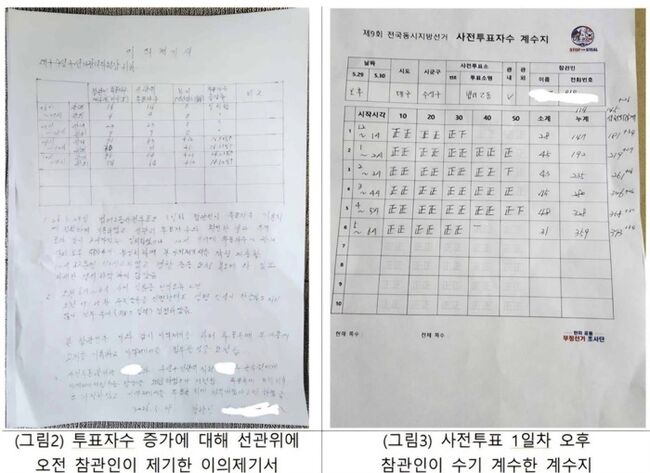
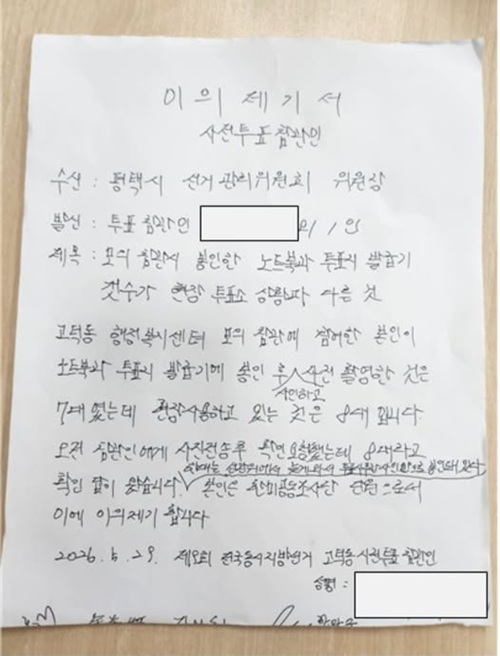 An objection letter stating that one set of advance voting ballot printers was added on the day. [Photo=AFCPC]
According to the whistleblower, a mock test was conducted at the early voting polling station in Godeok-dong, Pyeongtaek-si, Gyeonggi Province, the day before, and poll observers and early voting managers affixed seals to a total of 7 sets of ballot printers (laptops and printers). However, on May 29th, the first day of early voting, 8 sets of printers were in operation at the polling station, one more than planned.
When an observer asked for the reason, the early voting manager replied, "Because the Election Commission sent one set late." The observer submitted an objection letter including the fact that the Election Commission delivered one set late as requested by the election manager.
The AFCPC stated, "It is a serious problem that a printer not subjected to a mock test was deployed. We cannot know if that printer is functioning properly, and it is a very concerning situation as we do not know what operations were performed on the unsealed printer overnight."
② Prevention of Sealing Sticker Signature Photography
The second case involved being prevented from photographing the sealing stickers. According to a whistleblower, on May 29th, the first day of early voting, around 8 AM at the early voting polling station in Socho-myeon, Wonju-si, Gangwon Province, the election manager prevented an observer from taking a photo after signing the sealing sticker.
If the sealing sticker is not photographed, the signatures cannot be compared later. Why did the election manager prevent the observer's legitimate activity? In previous elections, discrepancies in sealing sticker signatures have led to debates about fraudulent elections. The principle of photographing sealing stickers must be adhered to.
③ Prevention of Voter Count
The third reported case also came from Wonju, Gangwon Province. On May 29th, the first day of early voting, around 8 AM at the early voting polling station in Haenggu-dong, Wonju, Gangwon Province, an observer was prevented by the election manager from counting the number of voters.
④ Refusal to Accept Objection Forms
The fourth case involved the refusal to accept objection forms. On May 29th, the first day of early voting, around 7:40 AM, at the early voting polling station in Naeson 1-dong, Uiwang-si, Gyeonggi Province, an observer requested the election manager's personal seal on a document, but was refused.
When they then tried to submit an objection form for this, it was also refused. Furthermore, when they asked to convey instructions to voters to fold their ballots before inserting them, they were instead warned.
⑤ Covering of CCTV Cameras
The fifth case reported that the CCTV cameras at the polling station were covered. On May 29th, the first day of early voting, around 8 AM, in the same Uiwang-si, Gyeonggi Province. This time, at the Naeson 2-dong early voting polling station, an observer noticed that the CCTV was covered. When they attempted to submit an objection form regarding this, the election manager refused to accept it.
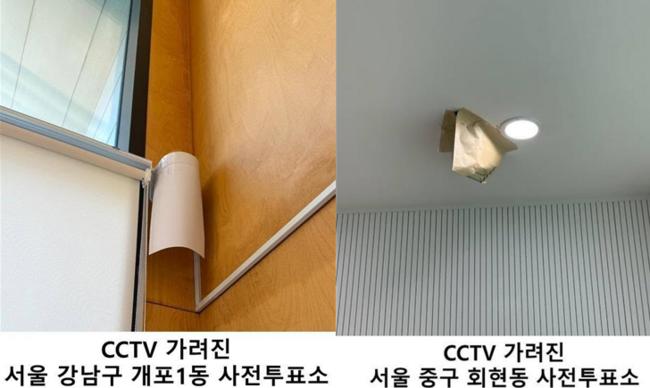
The election manager also refused to accept two other objection forms besides the one regarding the CCTV. An objection form was submitted regarding the refusal of the election manager's personal seal, but it was rejected, and an objection form was submitted regarding the refusal of a random test of sealing stickers, but it was also rejected.
In conclusion, the election manager at the Naeson 2-dong polling station refused to accept a total of three objection forms.
Meanwhile, covering CCTV cameras was also reported in Hoehyeon-dong, Jung-gu, Seoul, and Gaepo 1-dong, Gangnam-gu.
⑥ Suspected Cases of Duplicate Voting
The sixth case involves suspected duplicate voting. Several instances of duplicate voters were captured at the Jakjeonseo-un Administration Welfare Center in Gyeyang-gu, Incheon. A man voted around 12:30 PM and then voted again around 2 PM. A woman voted around 1 PM and then voted again around 2 PM. also received a report from the Gyeongbuk region about a person suspected of duplicate voting.
Unfortunately, it is impossible to compare the faces of duplicate voters before and after. This is because it is difficult to photograph all voters. However, photos of two individuals suspected of duplicate voting, with parts of their faces obscured, have been publicly available on the Facebook page of Hwang Kyo-ahn, leader of the Liberty and Innovation Party, for over two weeks. Since there has been no rebuttal from the individuals, the suspicion of duplicate voting is strengthening.
⑦ "Is the Cho Kuk Innovation Party 10 Votes?"
The eighth case is rather absurd. On May 29th, around 1:50 PM, at the early voting polling station in Paengseong-eup, Pyeongtaek-si, Gyeonggi Province, two men, estimated to be in their 50s, entered the polling station and immediately said to a female observer from the Cho Kuk Innovation Party, "We came all the way from Ulsan to Pyeongtaek just to vote," and "We'll cast 10 votes here (Pyeongtaek)."
The female observer, with a bewildered expression, told them, "You shouldn't say such things here." The voters who made these remarks voted using mobile identification. The voter who made the statement was wearing a white windbreaker with three vertical blue stripes in the center, approximately 163cm tall, and the other person was wearing plain clothing.
Another male observer from the Cho Kuk Innovation Party was speaking with a strong Ulsan dialect. The whistleblower expressed concern that forces from Ulsan might have come in large numbers to Pyeongtaek to ensure Cho Kuk's election. The AFCPC asked, "The Democratic Party of Korea promoted '3 votes,' but is the Cho Kuk Innovation Party '10 votes'?" and "Does this mean that specific identification can be programmed to issue multiple ballot papers?"
They added, "This is not impossible, as early voting is a system completely and exclusively controlled and processed by the National Election Commission. The central server confirms the identity of the elector and issues ballot papers with the election manager's stamp printed on them. The polling station managers and staff only act as extensions of the NEC server. No matter how many people are involved, organized computer manipulation cannot be detected."
Furthermore, the AFCPC questioned, "Can the results of an election conducted with a voting system that lacks an elector roster, discards and destroys the perforated serial number pieces of ballot papers, and does not disclose the computer server in case of litigation, be trusted?"
⑧ Advance Vote Count Inflated by up to 10%
The transparency of early voting is the core of fair elections. However, significant discrepancies were found between the numbers directly counted and recorded by observers and the official data announced by the Election Commission at various in-district early voting polling stations on the first day of early voting.
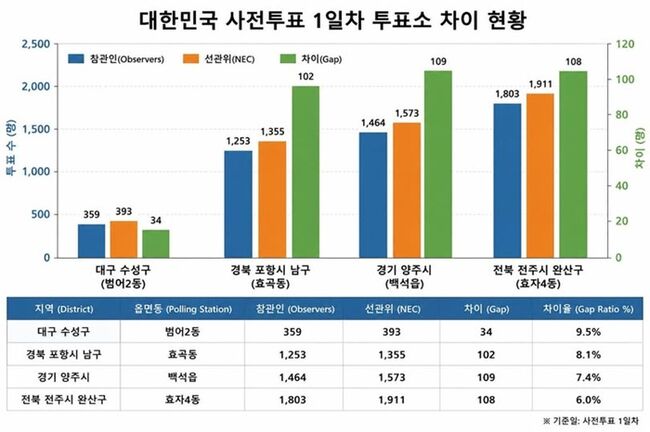 A chart comparing the number of advance voters announced by the Election Commission and the manual counts by observers by time period shows that the number of voters announced by the Election Commission is higher. [Graph=AFCPC]
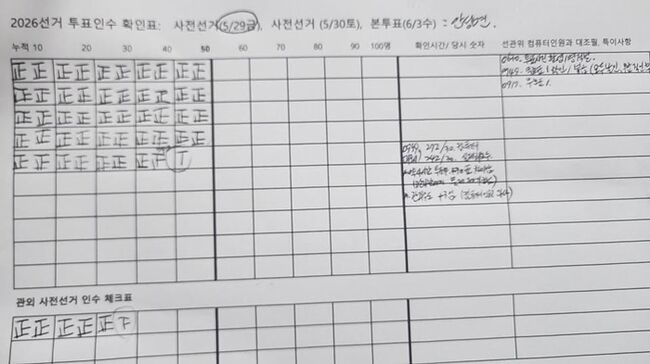 A tally sheet of voters counted by poll observers using the '正' character. [Photo=AFCPC]
On May 29th, the first day of early voting, at 10 AM, the number of voters counted by an observer at the early voting polling station in Anseong-myeon, Muju-gun, Jeonbuk Province, was 242. However, the number of voters announced by the Election Commission was 272, an increase of 30. One or two people might be counted incorrectly, but could it be possible to miss counting over 30 people out of fewer than 300 voters, which is more than 10%?
On the same day, May 29th, a similar case to Muju, Jeonbuk, was reported at the early voting polling station in Beomeo 2-dong, Suseong-gu, Daegu. The total number of in-district early voters counted manually by poll observers in the morning and afternoon was 359. However, the number officially announced by the Election Commission was 393. This represents an increase of 34 voters, or 9.5%.
A chart comparing the number of advance voters announced by the Election Commission and the manual counts by observers by time period shows that the number of voters announced by the Election Commission is higher. The difference exceeded 25% between 9 AM and 11 AM.
Observers sit for 6 hours and record the counts on tally sheets by hand. In the case of Muju, as well as Daegu, two people sat for 12 hours and counted 359 people. If one or two errors can occur, then a discrepancy of 34 and a difference of 9.5% is too significant to be dismissed as a simple administrative error or oversight.
In an election where the outcome can be decided by even a single vote, if such a discrepancy occurs at one polling station, can we completely trust other early voting polling stations nationwide?
Indeed, in Hyogok-dong, Nam-gu, Pohang-si, Gyeongbuk Province, the number of voters counted by the observer was 1253, but the Election Commission announced it as 1355. This is an increase of a staggering 102 people, or 8.1%.
In Baekseok-eup, Yangju-si, Gyeonggi Province, the number of voters counted by the observer was 1464, but the Election Commission announced it as 1573. This is an increase of 109 people, or 7.4%.
In Hyoja 4-dong, Wansan-gu, Jeonju-si, Jeonbuk Province, the observer count was 1803. However, the Election Commission announced it as 1911. This is an increase of 108 people, or 6.0%.
If it were a simple mechanical error or administrative oversight, the numbers should appear randomly. However, in all the cases shown in the graph, the Election Commission's data is unilaterally inflated, suggesting the possibility of structural data distortion.
The most concerning aspect is the lack of transparency in the digital computer system. Given that early voting relies on digital equipment such as laptops, central servers, and ballot printers, discrepancies between physical voters and computer records during real-time communication are a fatal flaw that can shake the legitimacy of the entire election outcome.
The simultaneous discrepancies in voter counts occurring at polling stations nationwide demonstrate how fragile the current election management system is. The Election Commission should not rely solely on computer networks; it must establish robust mutual verification mechanisms, such as comparing with physical paper registers. In elections, the most important value, the flower of democracy, is not 'convenience' but 'accuracy and reliability'.
The AFCPC stated, "In the election field, the manual counting by observers uses the most basic yet reliable 'human eyes.' When computer systems or mechanical counts err or lose credibility, this manual record is the last bastion of verification. The fact that the number coming through the Election Commission's computer network is larger than the actual number of voters counted before the observers' eyes is proof of a fatal system defect or fraud."
They further stated, "The Election Commission must not hide behind machines and computer data but must clearly explain through physical evidence why the actual measured values, processed by the observers' hands, differ so greatly from the official announcements. It is essential to transparently disclose computer log records to explain this abnormal numerical difference, as well as to thoroughly investigate the cause and introduce transparent verification procedures to overcome the recurring distrust in early voting and ensure election fairness."
By Reporter Lim Yo-hee

 Iranian Foreign Ministry: "Continuing Message Exchanges with the U.S. and Activities of Mediating Countries"
Esmaeil Baghaei, Spokesperson for the Iranian Ministry of Foreign Affairs [Xinhua, Yonhap News file photo]Esmaeil Baghaei, spokesperson for the Iranian Ministry of Foreign Affairs, stated on the 26th
Iranian Foreign Ministry: "Continuing Message Exchanges with the U.S. and Activities of Mediating Countries"
Esmaeil Baghaei, Spokesperson for the Iranian Ministry of Foreign Affairs [Xinhua, Yonhap News file photo]Esmaeil Baghaei, spokesperson for the Iranian Ministry of Foreign Affairs, stated on the 26th
 President Yoon: "Do You Think You Are Safe from the Special Counsel?"... Final Statement Video Released
President Yoon Suk Yeol rebuking the special prosecutor on the 24th. [Court video / @birds_justice X account subtitle GIF] A video of President Yoon Suk Yeol's closing statement at his trial rega
President Yoon: "Do You Think You Are Safe from the Special Counsel?"... Final Statement Video Released
President Yoon Suk Yeol rebuking the special prosecutor on the 24th. [Court video / @birds_justice X account subtitle GIF] A video of President Yoon Suk Yeol's closing statement at his trial rega
 President Yoon, regarding the first-instance ruling on the Public Official Election Act: “An excessive political verdict that distorts the facts… We will appeal immediately.”
The first-instance sentencing hearing for President Yoon Suk Yeol regarding violations of the Public Official Election Act is being broadcast live at Seoul Station on the 27th. [Photo=Yonhap News]Pres
President Yoon, regarding the first-instance ruling on the Public Official Election Act: “An excessive political verdict that distorts the facts… We will appeal immediately.”
The first-instance sentencing hearing for President Yoon Suk Yeol regarding violations of the Public Official Election Act is being broadcast live at Seoul Station on the 27th. [Photo=Yonhap News]Pres
 WSJ: "SK Hynix ADR Premium Is a Sign of AI Trading Overheat"
Advertisement for SK Hynix ADR listing in New York's Times Square [Reuters=Yonhap News file photo]The Wall Street Journal (WSJ) has pointed out that the price of SK Hynix’s American Depositary Recei
WSJ: "SK Hynix ADR Premium Is a Sign of AI Trading Overheat"
Advertisement for SK Hynix ADR listing in New York's Times Square [Reuters=Yonhap News file photo]The Wall Street Journal (WSJ) has pointed out that the price of SK Hynix’s American Depositary Recei
 'Godfather of Japanese Mystery Novels' Keigo Higashino Passes Away After Battle with Cancer at 68
Famous Japanese mystery novelist Keigo Higashino [AFP=Yonhap News]It has been belatedly reported that Keigo Higashino, the "godfather of Japanese mystery novels" and author of bestsellers such as "The
'Godfather of Japanese Mystery Novels' Keigo Higashino Passes Away After Battle with Cancer at 68
Famous Japanese mystery novelist Keigo Higashino [AFP=Yonhap News]It has been belatedly reported that Keigo Higashino, the "godfather of Japanese mystery novels" and author of bestsellers such as "The
 [Park Pil-kyu Security Column] To the Ignorant Trying to Clothe a Beast in Sheep's Clothing
Rep. Kim Byung-joo of the Democratic Party of Korea [Photo=Yonhap News]“The Air Force Academy doesn't teach you how to fly a plane!” “The Army, Navy, and Air Force academies are exactly the
[Park Pil-kyu Security Column] To the Ignorant Trying to Clothe a Beast in Sheep's Clothing
Rep. Kim Byung-joo of the Democratic Party of Korea [Photo=Yonhap News]“The Air Force Academy doesn't teach you how to fly a plane!” “The Army, Navy, and Air Force academies are exactly the
 [Issue Diagnosis] Two Effects of the Election Petition Review
 [Photo] Evidence of Election Fraud Flooding U.S. Media… Trump Had 2.7 Million Votes Stolen
 [Video] U.S. Semiquincentennial Air Show... 'Art in the Sky' streaks across New York
 [Editorial Cartoon] A Draconian Law That Undermines Freedom of Expression

 List
List










