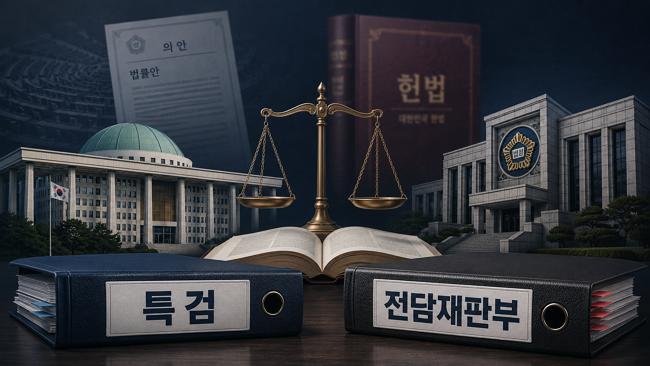
 Image symbolizing the need for a special prosecutor and dedicated court panels within the existing judicial system to investigate the criminal responsibility for the June 3rd disenfranchisement incident, separate from discussions on constitutional amendment for the Election Commission's structural reform. [Photo=Hanmi Ilbo Graphic]Table of Contents
① Parliamentary Inquiry Without Witnesses is a 'Red Bean Paste Bun Without Red Bean Paste'
② The Full Picture of Election Management on June 3rd That the Parliamentary Inquiry Must Uncover
③ Constitutional Amendment is a Long-Term Task; The Law on Panels for Sedition Cases Should Be Applied
On the 19th, Lee Jae-myung suggested the possibility of a one-point constitutional amendment, stating the need for external oversight and checks on the Election Commission in relation to the ballot shortage during the June 3rd local elections. He indicated that if the ruling and opposition parties agreed, a one-point constitutional amendment concerning the Election Commission could be pursued, and if necessary, it could even be proposed by the President.
Lee explained that because the Election Commission is established as an independent constitutional body, attempting to create oversight and control mechanisms solely through legislation could lead to a decision of unconstitutionality. To fundamentally alter the composition of the Election Commission, the method of electing its chairperson, and its external audit and accountability structure, discussions on constitutional amendment might be necessary.
However, the long-term structural reform of the Election Commission and the investigation of criminal responsibility for the June 3rd local election disenfranchisement incident are separate issues.
While a constitutional amendment might be necessary for the reform of the Election Commission's organization, it is not necessary to wait for a constitutional amendment to establish a special prosecutor to investigate the incident and dedicated court panels to adjudicate the cases. This is because the National Assembly has already enacted a special law establishing warrant judges and multiple dedicated panels within the existing court system for cases of sedition, foreign invasion, and rebellion, without requiring a constitutional amendment.
Constitutional Amendment for Structural Reform, Special Prosecutor for Accountability
A parliamentary inquiry can investigate who lowered the ballot printing standard from 60% to 50%, when the possibility of a shortage was recognized, how the ballots were transported, and whether vote counting began before voting ended.
It is also the role of a parliamentary inquiry to summon witnesses such as the Election Commission employee who testified about Wi-Fi usage, ballot transporters, voters who were unable to vote, and observers who witnessed the vote-counting process, and to receive sworn testimonies.
However, the Special Committee for Parliamentary Inquiry lacks the authority for searches and seizures, digital forensics, securing communication records, investigating suspects, and prosecution. The means to forcibly secure evidence are also limited if witnesses answer "I don't remember" or if the Election Commission and equipment companies refuse to submit data.
Therefore, if criminal charges such as dereliction of duty, false reporting, or destruction of evidence are confirmed during the parliamentary inquiry, it should immediately lead to a special prosecutor's investigation.
If Lee Jae-myung acknowledges the severity of the Election Commission's issues to the extent of mentioning a constitutional amendment, there is no reason to oppose the special prosecutor, which can be implemented without a constitutional amendment. A constitutional amendment is institutional reform to change the future oversight and checks and balances of the Election Commission, while a special prosecutor is an investigative procedure to hold those responsible for an already occurred incident accountable.
Legislative Precedent of the Law on Panels for Sedition Cases
The "Special Act on Criminal Procedure for Crimes of Sedition, Foreign Invasion, and Rebellion," which took effect in January 2026, did not establish separate special tribunals outside the court system.
This law designates separate judges to handle warrants for cases of sedition, foreign invasion, and rebellion, and establishes at least two dedicated panels in the Seoul Central District Court and the Seoul High Court. Each panel is composed of three judges serving as equal members.
The composition of the panels does not involve the National Assembly or political parties selecting specific judges. Instead, the judicial conference of the relevant court establishes the composition criteria, the office allocation committee drafts specific office allocation plans, and the court president appoints judges after deliberation and approval by the judicial conference.
The National Assembly only sets the legal basis and principles for the composition of the dedicated panels, leaving the actual selection of judges to the internal procedures of the existing courts.
This legislative structure can be applied to the 'June 3rd disenfranchisement incident'.
A plausible approach is to enact a special law, tentatively titled the "Special Prosecutor Appointment and Criminal Procedure Special Act for the Investigation of the June 3rd Local Election Disenfranchisement Incident," which would simultaneously stipulate provisions for a special prosecutor, warrant judges, dedicated panels for disenfranchisement cases, whistleblower protection, and evidence preservation procedures.
If dedicated panels are established within the existing court system rather than outside the court system as special tribunals, there is no reason why a constitutional amendment should be a prerequisite for establishing these dedicated panels.
Even with existing debates surrounding the constitutionality of the law on panels for sedition cases, the fact remains that a legislative precedent has already been established for establishing dedicated panels within existing courts through legislation under the current constitutional framework.
Scope of Special Prosecutor's Investigation Must Be Specified in Law
While utilizing the standing special prosecutor system is an option, the scope of the investigation for this case is broad, encompassing the command structure of election commissions nationwide, election equipment, and the management of ballots and ballot boxes. Therefore, an individual special prosecutor law that specifically defines the subjects of investigation and the obligation for data preservation would be more appropriate.
The scope of the special prosecutor's investigation should include the following:
• The decision-making process for lowering the ballot printing standard from 60% to 50%
• Actions taken or not taken to report or address the possibility of a ballot shortage when it was recognized
• The process of printing, transporting, and using unnumbered and supplementary ballots
• The process of sealing, transporting, storing, and opening ballot boxes
• Whether there were communication network failures during early voting and whether wireless access was used
• Access records for voter identification devices and the integrated voter register
• Whether numerical data was altered and if false or minimized reports were made
• Deletion of relevant data and destruction of evidence
• Perjury and obstruction of investigation confirmed during the parliamentary inquiry
• Investigations into suspicions raised during the investigation of related cases
Witness testimonies, documents, videos, and digital data secured by the Special Committee for Parliamentary Inquiry should be immediately transferred to the special prosecutor.
Evidence Preservation is Paramount
The special law must stipulate the obligation to preserve evidence from before the investigation begins, to prevent its disappearance.
The deletion and destruction of server logs for voter identification devices and the integrated voter register, communication records (wired and wireless), remote access logs by maintenance companies, electronic approval documents and their revision histories, internal chat logs and text messages, ledgers for ballot printing, issuance, and returns, records of ballot box transport, reception, and opening, and CCTV footage and police evidence videos must be prohibited.
If any data has been deleted or modified, the special prosecutor must recover it through forensics and determine who accessed the data, when, and with what authority.
Similar to how the Special Act on Criminal Procedure for Sedition prohibits adverse measures such as dismissal or disciplinary action against whistleblowers, the same protective measures must be provided to internal whistleblowers in the June 3rd case. The risk of reassignment, disciplinary action, or dismissal must be eliminated for current Election Commission employees to testify about internal directives and records.
Scope of Dedicated Panel Application Must Also Be Clarified
To avoid controversy over the creation of a panel disadvantageous to a specific defendant after the fact, the scope of application of the special law must be clearly defined.
It is reasonable to stipulate that the dedicated panels should, in principle, apply to cases prosecuted by the special prosecutor after the special law takes effect. If cases already indicted by the general prosecution and pending trial are transferred to a new panel, it could lead to greater controversy surrounding panel changes and case assignments.
The panels must be composed through objective procedures within the court, such as judicial conferences and office allocation committees, rather than through the recommendation of judges by the National Assembly or political parties. The National Assembly should legislate only the establishment of dedicated panels and the principle of concentrated review, and should not interfere with the actual selection of judges.
Criminal Trial and Re-election Judgments Must Be Distinguished
The establishment of a special prosecutor and dedicated panels does not automatically determine a re-election.
The special prosecutor will investigate the criminal charges against officials of the Election Commission and related organizations, and the dedicated panels will determine the criminal responsibility of the indicted defendants. The validity of the election itself and whether a re-election is necessary should be determined through election appeal and litigation procedures under the Public Official Election Act.
While these two procedures should be distinct, the evidence must be connected. If the special prosecutor's investigation confirms the scale of voters who could not vote, violations of election management regulations, and defects in the management of ballots and ballot boxes, such related data should be made available for submission in ongoing election litigation.
The recognition of criminal responsibility does not necessarily invalidate the entire election. Conversely, if it is difficult to prove that a particular action affected the election outcome, it does not absolve individuals of responsibility for dereliction of duty or false reporting.
Constitutional Amendment Debate Should Not Delay Special Prosecutor Investigation
Discussions on constitutional amendment to change the Election Commission's constitutional status and external control structure may be necessary. However, the drafting of a constitutional amendment, its approval by the National Assembly, and a national referendum require significant political consensus and time.
During this period, digital records may be deleted, CCTV retention periods may expire, and the memories of witnesses may fade. The debate over constitutional amendment should not become an excuse to delay evidence gathering and the determination of criminal responsibility for this incident.
In the case of sedition, warrant judges and dedicated panels were established due to the crime's national significance. If so, the same principle can be applied to incidents where citizens were unable to vote due to the failure of a national institution's election management.
The Special Committee for Parliamentary Inquiry should bring witnesses and responsible parties to testify to ascertain the facts, and based on those findings, recommend the enactment of an individual special prosecutor law. The National Assembly should establish dedicated panels for disenfranchisement cases within the existing court system, applying the structure of the Law on Panels for Sedition Cases.
Constitutional amendment is a long-term task to change the future of the Election Commission. The special prosecutor and dedicated panels are current tasks to hold those responsible for the already occurred disenfranchisement incident accountable.
There is no reason to wait for a constitutional amendment. By applying the structure of the Law on Panels for Sedition Cases, it is possible to legislate for a special prosecutor and dedicated panels for disenfranchisement cases within the current constitutional framework.

 Iranian Foreign Ministry: "Continuing Message Exchanges with the U.S. and Activities of Mediating Countries"
Esmaeil Baghaei, Spokesperson for the Iranian Ministry of Foreign Affairs [Xinhua, Yonhap News file photo]Esmaeil Baghaei, spokesperson for the Iranian Ministry of Foreign Affairs, stated on the 26th
Iranian Foreign Ministry: "Continuing Message Exchanges with the U.S. and Activities of Mediating Countries"
Esmaeil Baghaei, Spokesperson for the Iranian Ministry of Foreign Affairs [Xinhua, Yonhap News file photo]Esmaeil Baghaei, spokesperson for the Iranian Ministry of Foreign Affairs, stated on the 26th
 President Yoon: "Do You Think You Are Safe from the Special Counsel?"... Final Statement Video Released
President Yoon Suk Yeol rebuking the special prosecutor on the 24th. [Court video / @birds_justice X account subtitle GIF] A video of President Yoon Suk Yeol's closing statement at his trial rega
President Yoon: "Do You Think You Are Safe from the Special Counsel?"... Final Statement Video Released
President Yoon Suk Yeol rebuking the special prosecutor on the 24th. [Court video / @birds_justice X account subtitle GIF] A video of President Yoon Suk Yeol's closing statement at his trial rega
 President Yoon, regarding the first-instance ruling on the Public Official Election Act: “An excessive political verdict that distorts the facts… We will appeal immediately.”
The first-instance sentencing hearing for President Yoon Suk Yeol regarding violations of the Public Official Election Act is being broadcast live at Seoul Station on the 27th. [Photo=Yonhap News]Pres
President Yoon, regarding the first-instance ruling on the Public Official Election Act: “An excessive political verdict that distorts the facts… We will appeal immediately.”
The first-instance sentencing hearing for President Yoon Suk Yeol regarding violations of the Public Official Election Act is being broadcast live at Seoul Station on the 27th. [Photo=Yonhap News]Pres
 WSJ: "SK Hynix ADR Premium Is a Sign of AI Trading Overheat"
Advertisement for SK Hynix ADR listing in New York's Times Square [Reuters=Yonhap News file photo]The Wall Street Journal (WSJ) has pointed out that the price of SK Hynix’s American Depositary Recei
WSJ: "SK Hynix ADR Premium Is a Sign of AI Trading Overheat"
Advertisement for SK Hynix ADR listing in New York's Times Square [Reuters=Yonhap News file photo]The Wall Street Journal (WSJ) has pointed out that the price of SK Hynix’s American Depositary Recei
 'Godfather of Japanese Mystery Novels' Keigo Higashino Passes Away After Battle with Cancer at 68
Famous Japanese mystery novelist Keigo Higashino [AFP=Yonhap News]It has been belatedly reported that Keigo Higashino, the "godfather of Japanese mystery novels" and author of bestsellers such as "The
'Godfather of Japanese Mystery Novels' Keigo Higashino Passes Away After Battle with Cancer at 68
Famous Japanese mystery novelist Keigo Higashino [AFP=Yonhap News]It has been belatedly reported that Keigo Higashino, the "godfather of Japanese mystery novels" and author of bestsellers such as "The
 [Park Pil-kyu Security Column] To the Ignorant Trying to Clothe a Beast in Sheep's Clothing
Rep. Kim Byung-joo of the Democratic Party of Korea [Photo=Yonhap News]“The Air Force Academy doesn't teach you how to fly a plane!” “The Army, Navy, and Air Force academies are exactly the
[Park Pil-kyu Security Column] To the Ignorant Trying to Clothe a Beast in Sheep's Clothing
Rep. Kim Byung-joo of the Democratic Party of Korea [Photo=Yonhap News]“The Air Force Academy doesn't teach you how to fly a plane!” “The Army, Navy, and Air Force academies are exactly the
 [Issue Diagnosis] Two Effects of the Election Petition Review
 [Photo] Evidence of Election Fraud Flooding U.S. Media… Trump Had 2.7 Million Votes Stolen
 [Video] U.S. Semiquincentennial Air Show... 'Art in the Sky' streaks across New York
 [Editorial Cartoon] A Draconian Law That Undermines Freedom of Expression

 List
List