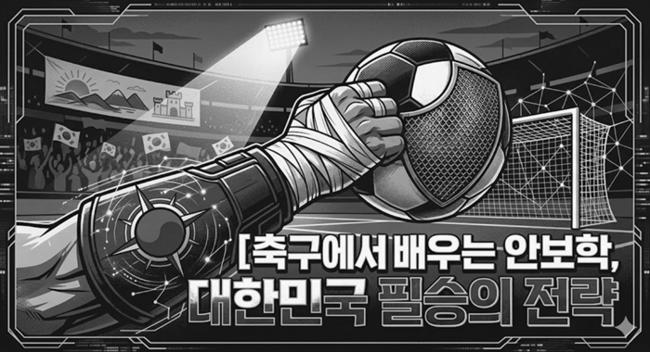
 2026 FIFA World Cup Group A match: South Korea vs. Czech Republic. [Reuters=Yonhap News]If traditional security was the 'art of guns and swords' that deterred enemy provocations, today's security is a total war of all citizens in their daily lives. Security is no longer solely the domain of soldiers or the political epics of rulers. Security has become a 'shield of survival' for all of us, and an 'essential commodity for people's livelihoods,' directly linked to the prices on our family dinner tables and the jobs of our youth.
We aim to compile an introductory overview of 'Football Security Studies' by seeking security concepts and principles that, like in soccer where a single mistake decides the outcome, cannot be recovered once breached.
1. Principles of Victory in Soccer and the Three Principles of Security
A resolute will and mental fortitude towards victory are the most fundamental elements that determine success or failure in both soccer and security. Analyzing victorious warriors shows that units that overcame adverse conditions through mental strength emerged as the ultimate winners. Analyzing scenes of successful shots in international matches and the factors behind a winning team's victory reveals that, beyond tactical skill in soccer, the coach's motivational leadership, mental strength, and team unity were hidden factors.
There are commonalities between the factors for victory in soccer and the principles of national security. Because the ball is round, the outcome of a match is only known at the end. In soccer, the team that scores more goals by moving the ball through connected passes wins. The principles of security can be summarized as 'protecting the lives of the people, maintaining the nation, and preventing war'.
However, the current security policy of the Ministry of National Defense has chosen a path directly opposite to common sense, reaching a point where not only the lives of citizens but even those of soldiers cannot be guaranteed. The hasty dissolution of the military counterintelligence command has created an intelligence vacuum, acting against the maintenance of national continuity. The premature push for the transfer of wartime operational control is fracturing the solidarity of the ROK-US alliance, and extreme conflict is being endured by attempting to close down the Korea Military Academy, a sacred site of national defense.
2. Connected Passes in Soccer and Strategic Alliance with Allies
Victory in soccer stems not from brilliant individual skills but from organized defense where all players move as one, flawless ball handling, and accurate passing. Modern security is completed through organic information sharing and strategic alliance with allied nations.
There are no nations in the world that can maintain security alone. As seen in the Middle East conflict in the Strait of Hormuz, complex crises are overcome through organic and 'strategic passes' with allies. The excessive push for the transfer of wartime operational control is a self-inflicted wound that severs these 'passing plays' between allies, undermining alliance trust. It is like an attacker losing direction and charging into their own goal, or catching a ball that should be headed with one's hands.
In the recent cabinet reshuffle, a retired lieutenant general, 'Kang Geon-jak,' was appointed as the First Deputy Director of the National Security Office. While he may be tasked with the early completion of wartime operational control, it is hoped that he will exercise courage and wise judgment, closely coordinating with allies and keeping national interests in mind when formulating South Korea's security policy, and that he will stand firm against what is wrong.
The Ministry of National Defense and the Ministry of Unification should speak with one voice on North Korea's denuclearization, yet the Ministry of Unification advocates for a nuclear freeze. The Minister of National Defense and the Minister of Unification, who have caused numerous problems, were not included in this cabinet reshuffle. The background that shields those pursuing security policies in opposite directions is truly suspicious.
3. Mobile Soccer and Overcoming China's Unrestricted Warfare and Positional Warfare
Mobile soccer involves maneuvering into gaps and shooting when the opponent's defensive wall is thick. Security, too, must strike at the enemy's weak points and asymmetrical areas. Our security requires strategic maneuvers to break through China's unrestricted warfare and Gramsci's positional warfare. We must precisely target the enemy's vulnerabilities through data-based, real-time response systems and psychological warfare that uses AI to instantly block false information, thereby disrupting them.
Taiwan's Ministry of National Defense has announced a plan to invest approximately 9 trillion Korean won over six years, from 2026 to 2031, to acquire a large number of drones and unmanned surface vessels. We too must leverage our overwhelming lead in drone semiconductor and AI technology as an asymmetrical lever to neutralize the enemy's strategic intentions, and achieve victory by breaking through enemy positional warfare with agile, technology and data-centric mobile security.
4. The 12th Player in Soccer: The Supporters and Ensuring Military Political Neutrality by Minimizing Political Interference
Just as a coach's personal tactics and excessive instructions can harm victory, the nation's and the military's discipline collapse when rulers use security as a political card or a tool for partisan disputes. In soccer, to win, the coach must ignore pressure from outside the field to intervene and must select players based purely on skill and employ tactics suited to the day's conditions.
The commander-in-chief must pursue security policies solely for national survival and war prevention. Just as a soccer coach employs indirect tactics by looking for new directions and flanks when a direct attack is not working, if peace policies do not work, new security policies must be enacted.
The supporters are the 12th player in soccer. In security policy, public support is the primary consideration for policy implementation. In soccer, victory is achieved when united around the coach who protects the players and thinks only of victory. If the public cannot trust the security policies and national systems currently being pursued by the government, changing them is the people's politics that respects sovereignty.
We have recognized through the Middle East conflict that security affects even individual lives. Now, we must choose and support rulers and political parties that pledge and practice clear security policies based on national survival and national interests.
We are reminded of the importance of security policy through the Mexico match, lost due to a single mistake. We wish for a flawless victory in the match against South Africa on the 25th. We pray for the protection of liberal South Korea by overcoming today's security crisis through a total security effort centered on national interests.
◆ Park Pil-kyu, Member
Editorial Member, The Hankyoreh
ROK Military Academy, Class of '40'

 Trump pressures for rate cut again ahead of FOMC... "Should be the lowest in the world"
U.S. President Donald Trump. [Photo = The White House] U.S. President Donald Trump once again pressured the Federal Reserve, the U.S. central bank, to lower interest rates on the 27th (local time
Trump pressures for rate cut again ahead of FOMC... "Should be the lowest in the world"
U.S. President Donald Trump. [Photo = The White House] U.S. President Donald Trump once again pressured the Federal Reserve, the U.S. central bank, to lower interest rates on the 27th (local time
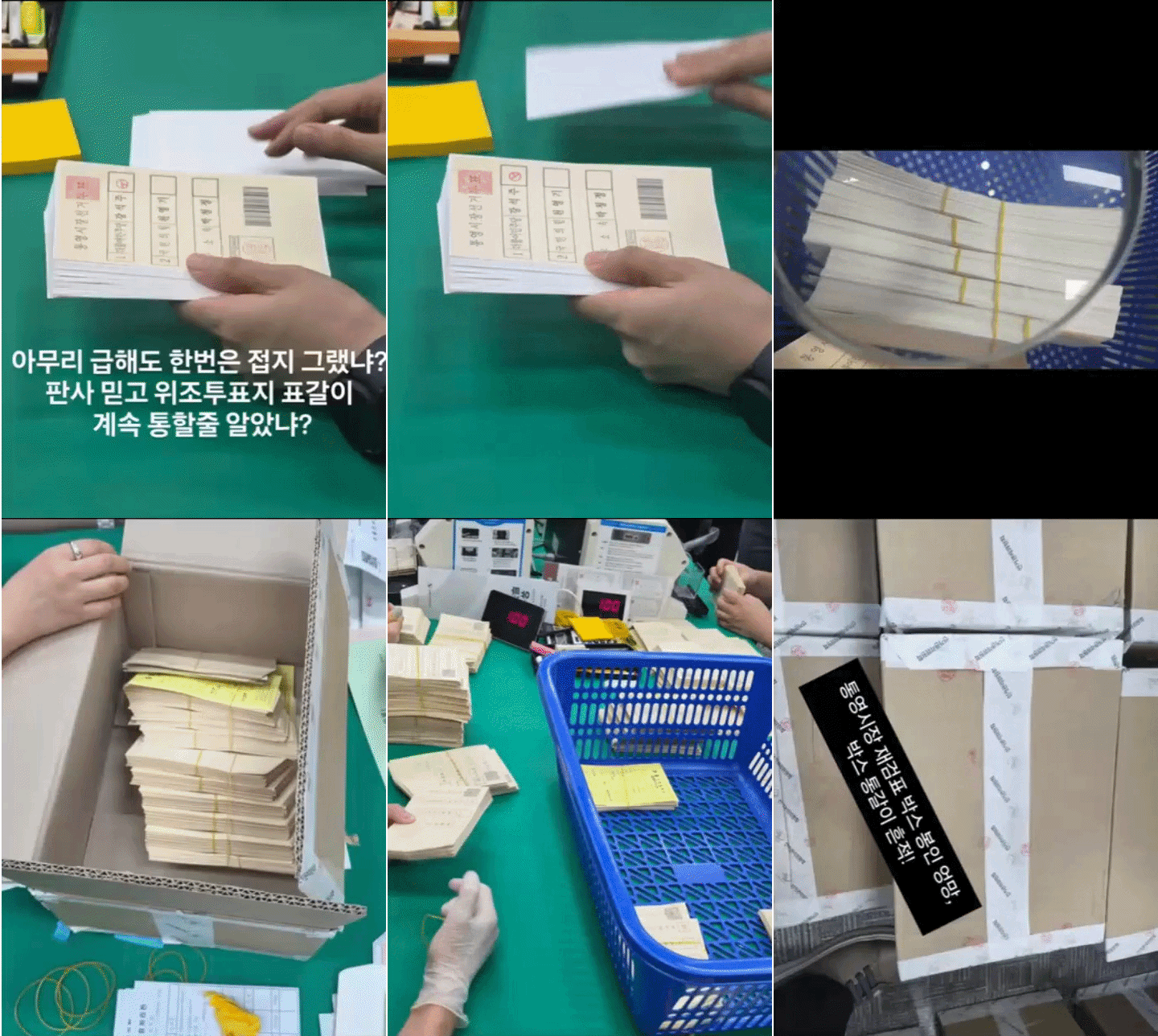 “Ignoring crisp ballots and damaged seals”… Tongyeong mayoral recount concludes with ‘no change in outcome,’ leaving suspicions and public outrage behind
Suspected counterfeit ballots discovered in Tongyeong [GIF from social media of Representative Hwang Kyo-ahn / Attorney Park Joo-hyun]During a recount of the Tongyeong mayoral election in South Gyeong
“Ignoring crisp ballots and damaged seals”… Tongyeong mayoral recount concludes with ‘no change in outcome,’ leaving suspicions and public outrage behind
Suspected counterfeit ballots discovered in Tongyeong [GIF from social media of Representative Hwang Kyo-ahn / Attorney Park Joo-hyun]During a recount of the Tongyeong mayoral election in South Gyeong
 President Yoon, regarding the first-instance ruling on the Public Official Election Act: “An excessive political verdict that distorts the facts… We will appeal immediately.”
The first-instance sentencing hearing for President Yoon Suk Yeol regarding violations of the Public Official Election Act is being broadcast live at Seoul Station on the 27th. [Photo=Yonhap News]Pres
President Yoon, regarding the first-instance ruling on the Public Official Election Act: “An excessive political verdict that distorts the facts… We will appeal immediately.”
The first-instance sentencing hearing for President Yoon Suk Yeol regarding violations of the Public Official Election Act is being broadcast live at Seoul Station on the 27th. [Photo=Yonhap News]Pres
 WSJ: "SK Hynix ADR Premium Is a Sign of AI Trading Overheat"
Advertisement for SK Hynix ADR listing in New York's Times Square [Reuters=Yonhap News file photo]The Wall Street Journal (WSJ) has pointed out that the price of SK Hynix’s American Depositary Recei
WSJ: "SK Hynix ADR Premium Is a Sign of AI Trading Overheat"
Advertisement for SK Hynix ADR listing in New York's Times Square [Reuters=Yonhap News file photo]The Wall Street Journal (WSJ) has pointed out that the price of SK Hynix’s American Depositary Recei
 'Godfather of Japanese Mystery Novels' Keigo Higashino Passes Away After Battle with Cancer at 68
Famous Japanese mystery novelist Keigo Higashino [AFP=Yonhap News]It has been belatedly reported that Keigo Higashino, the "godfather of Japanese mystery novels" and author of bestsellers such as "The
'Godfather of Japanese Mystery Novels' Keigo Higashino Passes Away After Battle with Cancer at 68
Famous Japanese mystery novelist Keigo Higashino [AFP=Yonhap News]It has been belatedly reported that Keigo Higashino, the "godfather of Japanese mystery novels" and author of bestsellers such as "The
 [Park Pil-kyu Security Column] To the Ignorant Trying to Clothe a Beast in Sheep's Clothing
Rep. Kim Byung-joo of the Democratic Party of Korea [Photo=Yonhap News]“The Air Force Academy doesn't teach you how to fly a plane!” “The Army, Navy, and Air Force academies are exactly the
[Park Pil-kyu Security Column] To the Ignorant Trying to Clothe a Beast in Sheep's Clothing
Rep. Kim Byung-joo of the Democratic Party of Korea [Photo=Yonhap News]“The Air Force Academy doesn't teach you how to fly a plane!” “The Army, Navy, and Air Force academies are exactly the
 [Issue Diagnosis] Two Effects of the Election Petition Review
 [Photo] Evidence of Election Fraud Flooding U.S. Media… Trump Had 2.7 Million Votes Stolen
 [Video] U.S. Semiquincentennial Air Show... 'Art in the Sky' streaks across New York
 [Editorial Cartoon] A Draconian Law That Undermines Freedom of Expression

 List
List









