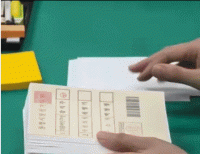
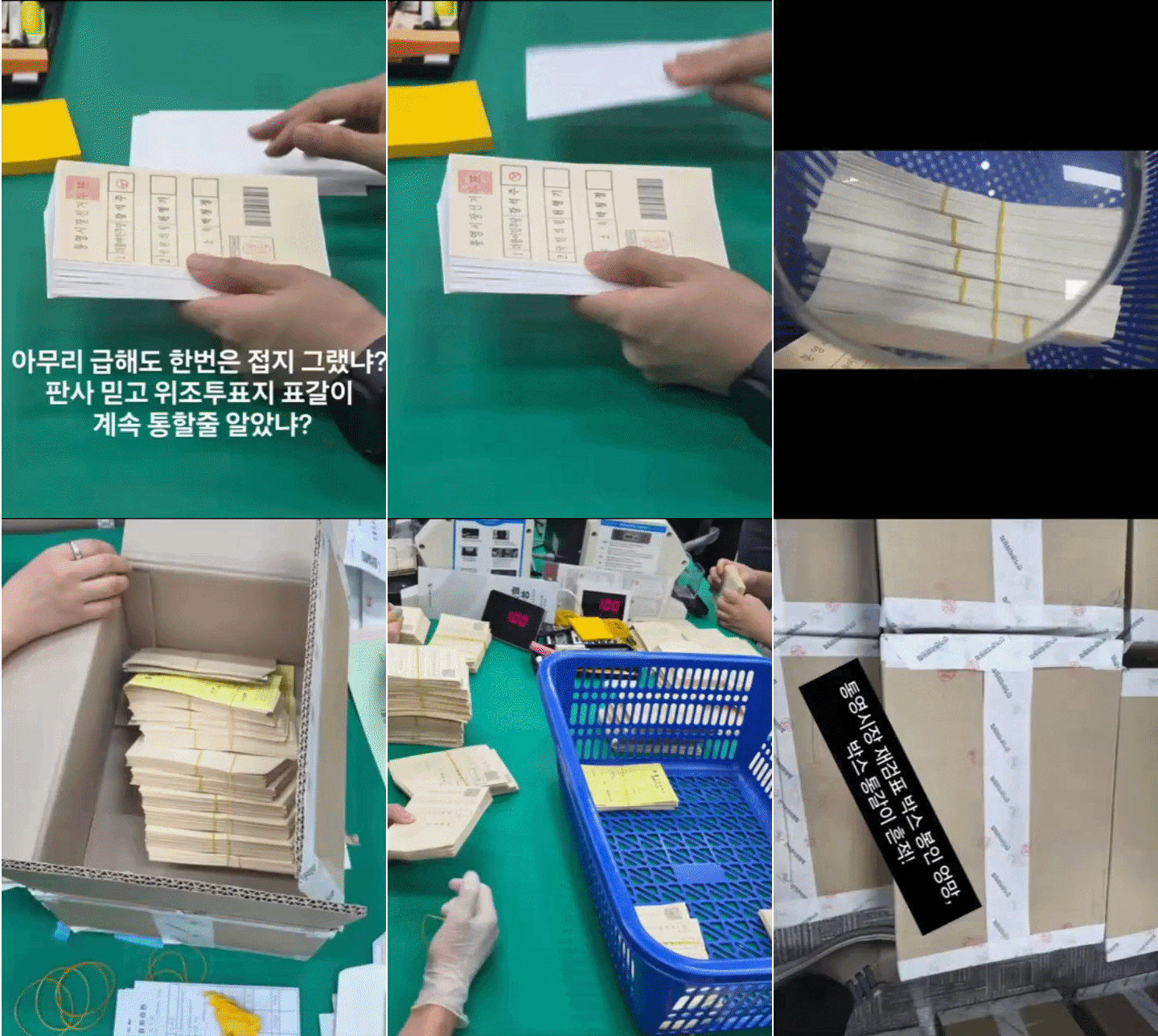
 Suspected counterfeit ballots discovered in Tongyeong [GIF from social media of Representative Hwang Kyo-ahn / Attorney Park Joo-hyun]
During a recount of the Tongyeong mayoral election in South Gyeongsang Province, which was decided by a margin of just 44 votes in the June 3 local elections, numerous instances of damaged ballot box seals and suspected counterfeit ballots were discovered. Despite strong objections from the plaintiff’s side, the National Election Commission (NEC) declared early on the 28th that "there is no change in the election outcome" and rushed to conclude the process without clearly addressing the allegations, sparking significant controversy. Criticism is mounting that this was a "blind recount" that disregarded election integrity and procedural fairness.
Crisp early voting ballots and margin inconsistencies... 'Counterfeit' allegations erupt on-site
The recount, which began at 3:30 PM on the 27th—an hour and a half behind schedule—in the main conference room on the 6th floor of the South Gyeongsang Provincial Election Commission, faced serious disruptions from the start. This was because the legal team and observers representing the petitioner, former Tongyeong Mayor Cheon Young-gi, discovered a massive number of irregularities while opening the storage boxes for early voting ballots, making them difficult to accept as legitimate ballots.
According to the plaintiff, many early voting ballots from regions such as Bongpyeong-dong, Misu-dong, and Yongnam-dong showed significant discrepancies in left and right margins or failed to meet standard specifications. Given that Epson inkjet printers used for issuing early voting ballots should maintain consistent margins, these inexplicable errors were found in succession.
Specifically, of the first 301 ballots checked immediately after opening the local early voting ballot box, only two showed signs of being folded. In Bongpyeong-dong, 52 ballots showed margin inconsistencies, such as the total absence of a right-hand margin. In Misu-dong, 187 out of 700 ballots exhibited the same margin errors. Among the 400 ballots from Guksin-dong, only six had any sign of folding, while 85 out of 100 ballots from Yongnam-dong had mismatched left and right margins.
Furthermore, streaks that could serve as strong evidence of mass printing were found on the sides of many ballots. Hwang Kyo-ahn, leader of the Freedom and Innovation Party, lamented, "Because early voting ballots are output via printers, such streaks cannot appear in the same position on the sides."
Most shockingly, a large number of ballots, including those from the Guksin-dong collection, were discovered in a pristine, "freshly printed" state. Despite being ballots that voters should have folded and inserted into the box, they showed absolutely no crease marks, resembling a brand-new stack of A4 paper.
Differences in ink stains on the back of the ballots were also observed. According to the plaintiff, the stamping mark of the election management official appeared on only one-third of the back of the ballots, while the remaining two-thirds did not show any ink bleed-through. The plaintiff argued, "The lack of ink marks on the back suggests these were not marked by voters but are printed fake ballots," and requested a microscopic inspection from the NEC chairman, which was denied.
Representative Jeon Han-gil, attending as an observer, raised the issue, stating, "If a person marks the ballot, the ink is bound to bleed through to the back. The absence of such marks strongly suggests these are printed, counterfeit ballots."
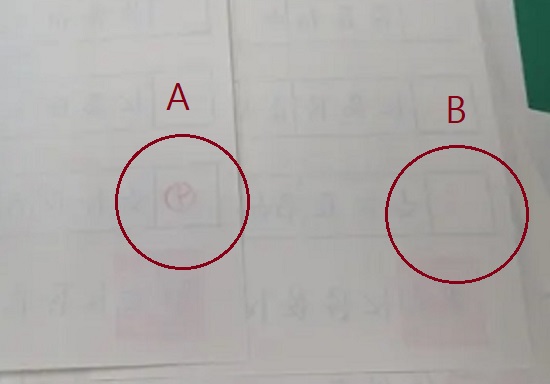 A legitimate ballot with ink bleed-through (A) vs. a suspected counterfeit printed ballot (B) [Source: Attorney Park Joo-hyun's SNS]
Damaged seals and lack of CCTV... NEC ignores demands for precision verification
The management of the ballot storage boxes also fueled controversy. When it was observed that some tape seals were inconsistent, showed signs of being cut with blades, or had improperly stamped official seals, the plaintiff raised suspicions of a "ballot swap," where the entire contents of the storage boxes might have been replaced.
In particular, the process began with intense protests as some ballot boxes were delivered with their lids already open. The plaintiff lodged a strong objection, but the Tongyeong City Election Commission, the defendant in the case, offered a vague explanation that there were no problems with the sealing status.
Representative Hwang pointed out, "We filed an objection after confirming that there was no CCTV installed in the ballot storage area." He added, "An explanation regarding the storage environment and the reason for the damaged seals should have been provided first. If these doubts remain unresolved, the recount results will struggle to gain public trust."
The plaintiff's legal team exercised their legal rights by pointing out the need for physical precision verification using a loupe (microscope), real-time comparison with ballot image files, and the issue of missing CCTV coverage.
However, the NEC remained cold. The commission merely repeated its stance that "there are no procedural issues despite the lack of CCTV," and the chairman rejected demands for video recording and effective verification, escalating the conflict. Furthermore, the commission issued a stern warning to the petitioner's side, stating, "We will remove you if you disrupt the vote counting." The plaintiff’s lawyers and some observers pushed back, arguing, "A recount conducted without clear fact-finding and verification cannot gain public trust."
From 44 votes to 38... A hasty 4:00 AM conclusion leaves only questions
Amidst the fierce objections and disputes from the plaintiff, the recount, which was originally scheduled to end in the early evening, went through repeated delays and was only concluded at 4:00 AM on the 28th.
The recount results showed that out of a total of 69,693 votes, Democratic Party candidate Kang Seok-ju received 33,626 votes, and People Power Party candidate Cheon Young-gi received 33,588 votes, narrowing the gap from 44 to 38 votes. This occurred because six of the 1,030 previously voided votes were belatedly recognized as valid votes for former Mayor Cheon.
Based on this, the South Gyeongsang Provincial Election Commission announced that "there is no change in the election outcome" and reaffirmed Mayor Kang Seok-ju’s victory. It was a hollow conclusion after 12 hours of turmoil and approximately 19.22 million won in recount costs entirely borne by the petitioner.
Controversy over restoring election integrity reignites... Legal and social repercussions expected
While this recount was a legal verification process for a narrow 44-vote margin, the controversy surrounding its fairness is expected to intensify, as both sides remained at an impasse regarding not only the verification methods but also the legitimacy of the ballots themselves.
In particular, the criticism that the NEC neglected scientific and documented verification to merely focus on "matching the numbers," while ignoring decisive evidence such as damaged seals and uncreased early voting ballots, is expected to have significant future repercussions.
Attorney Park Joo-hyun expressed strong outrage, stating, "I cannot understand the behavior of dismissing objections regarding fake ballots and even refusing the submission and real-time comparison of ballot image files. Ignoring clear signs of fake ballots is tantamount to a crime."
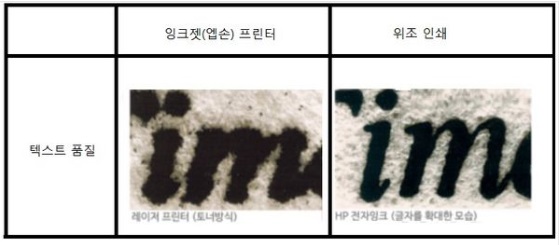 Comparison of inkjet and printing quality [Source: Naver Blog - Chaeum Books]
☞ What is a loupe?
A loupe is a tool used to verify the authenticity of printed materials by checking the halftone dots. It is a type of magnifying glass used by printers. It is used to inspect print quality that cannot be verified with the naked eye. By magnifying the image, one can see the print representation much more precisely.
Genuine early voting ballots are printed using inkjet (Epson) printers. The surface is rough, irregular, and crude.
On the other hand, if a ballot is a counterfeit, the halftone dots are precise and regular.
The print quality between the two is as different as night and day, and experts say it can be easily confirmed using a loupe. A halftone dot is the smallest unit area where ink is applied. By magnifying it, one can distinguish whether the print is rough and crude or smooth. Even without a loupe, seasoned printing experts can often tell the difference.
Although it has been recognized as a tool that can easily distinguish forgery, it is reported that since the recount for former lawmaker Min Kyung-wook in Incheon Yeonsu-eul on June 28, 2021, no court in South Korea has ever permitted the use of a loupe in any subsequent election recounts.

 Trump pressures for rate cut again ahead of FOMC... "Should be the lowest in the world"
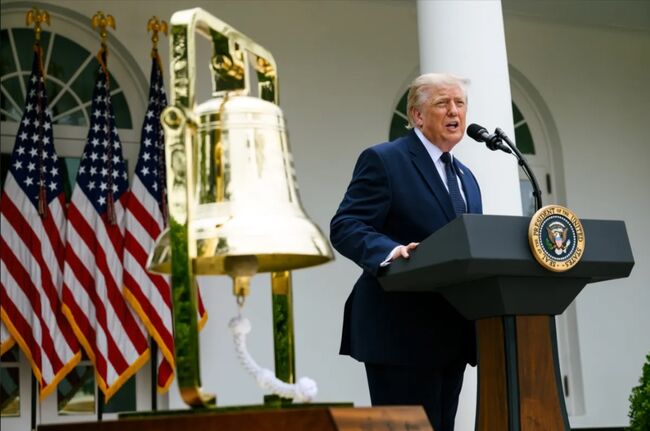
U.S. President Donald Trump. [Photo = The White House] U.S. President Donald Trump once again pressured the Federal Reserve, the U.S. central bank, to lower interest rates on the 27th (local time
Trump pressures for rate cut again ahead of FOMC... "Should be the lowest in the world"
U.S. President Donald Trump. [Photo = The White House] U.S. President Donald Trump once again pressured the Federal Reserve, the U.S. central bank, to lower interest rates on the 27th (local time
 President Yoon, regarding the first-instance ruling on the Public Official Election Act: “An excessive political verdict that distorts the facts… We will appeal immediately.”
The first-instance sentencing hearing for President Yoon Suk Yeol regarding violations of the Public Official Election Act is being broadcast live at Seoul Station on the 27th. [Photo=Yonhap News]Pres
President Yoon, regarding the first-instance ruling on the Public Official Election Act: “An excessive political verdict that distorts the facts… We will appeal immediately.”
The first-instance sentencing hearing for President Yoon Suk Yeol regarding violations of the Public Official Election Act is being broadcast live at Seoul Station on the 27th. [Photo=Yonhap News]Pres
 WSJ: "SK Hynix ADR Premium Is a Sign of AI Trading Overheat"
Advertisement for SK Hynix ADR listing in New York's Times Square [Reuters=Yonhap News file photo]The Wall Street Journal (WSJ) has pointed out that the price of SK Hynix’s American Depositary Recei
WSJ: "SK Hynix ADR Premium Is a Sign of AI Trading Overheat"
Advertisement for SK Hynix ADR listing in New York's Times Square [Reuters=Yonhap News file photo]The Wall Street Journal (WSJ) has pointed out that the price of SK Hynix’s American Depositary Recei
 'Godfather of Japanese Mystery Novels' Keigo Higashino Passes Away After Battle with Cancer at 68
Famous Japanese mystery novelist Keigo Higashino [AFP=Yonhap News]It has been belatedly reported that Keigo Higashino, the "godfather of Japanese mystery novels" and author of bestsellers such as "The
'Godfather of Japanese Mystery Novels' Keigo Higashino Passes Away After Battle with Cancer at 68
Famous Japanese mystery novelist Keigo Higashino [AFP=Yonhap News]It has been belatedly reported that Keigo Higashino, the "godfather of Japanese mystery novels" and author of bestsellers such as "The
 [Park Pil-kyu Security Column] To the Ignorant Trying to Clothe a Beast in Sheep's Clothing
Rep. Kim Byung-joo of the Democratic Party of Korea [Photo=Yonhap News]“The Air Force Academy doesn't teach you how to fly a plane!” “The Army, Navy, and Air Force academies are exactly the
[Park Pil-kyu Security Column] To the Ignorant Trying to Clothe a Beast in Sheep's Clothing
Rep. Kim Byung-joo of the Democratic Party of Korea [Photo=Yonhap News]“The Air Force Academy doesn't teach you how to fly a plane!” “The Army, Navy, and Air Force academies are exactly the
 [Issue Diagnosis] Two Effects of the Election Petition Review
 [Photo] Evidence of Election Fraud Flooding U.S. Media… Trump Had 2.7 Million Votes Stolen
 [Video] U.S. Semiquincentennial Air Show... 'Art in the Sky' streaks across New York
 [Editorial Cartoon] A Draconian Law That Undermines Freedom of Expression

 List
List