 Map centered on the Arctic ⒸNational Snow and Ice Data Center
This coming September, South Korea is set to embark on a critical test voyage to pioneer the Northern Sea Route (NSR).
Amidst instability in the Middle East, disruptions in the Suez Canal have caused global energy supply chain shocks. Meanwhile, the melting of Arctic ice is viewed as both an environmental catastrophe for humanity and a new opportunity that could reshape the landscape of international logistics and resource development.
South Korea's Arctic Test Voyage and a Paradigm Shift in Logistics
This test voyage is not merely a one-time event navigating uncharted waters; it is a proving ground to test the diversification of global supply chains and to gauge South Korea’s position in the upcoming era of multipolar maritime territory.
However, we must objectively consider whether a rosy future awaits at the end of this journey or if it leads into a larger geopolitical vortex. If we fail to confront the technical limitations and the complexities of polar security lurking behind economic expectations, the Arctic Ocean could emerge as an insurmountable obstacle.
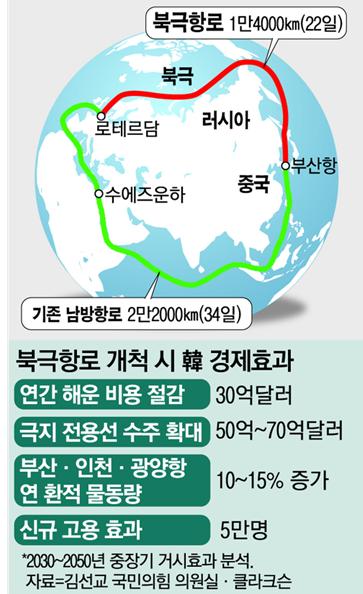
The expectations of the domestic shipping and logistics industry regarding the Northern Sea Route are explosive. Currently, the standard route for ships traveling from South Korea to Europe passes through the South China Sea, the Indian Ocean, and the Suez Canal. However, with the Hormuz Strait effectively blocked by recent tensions involving Iran and the growing uncertainty of the Suez Canal, the Northern Sea Route could become a definitive game changer for the market.
Complex Calculations of Arctic Stakeholders
Yet, the Arctic Ocean is not an ownerless high sea. The interests surrounding these waters are more intricately and sharply intertwined than any other territorial dispute region.
△ The Arctic 8 (Coastal Sovereign States)
The core rights to the Arctic Ocean are held by the eight permanent members of the 'Arctic Council' (Russia, the United States, Canada, Denmark (Greenland), Norway, Sweden, Finland, and Iceland), who share territory or territorial waters with the Arctic Ocean. They are erecting legal and institutional barriers to entry by asserting sovereignty and exclusive economic rights.
△ Key Stakeholders
Among these eight, the core axis of the conflict over practical route control and economic interests is divided between the authoritarian bloc led by Russia and the liberal bloc centered on the United States and Nordic NATO countries.
△ Other Influential Nations and China's Ambitions
Non-coastal states that do not directly touch the Arctic are also eyeing it aggressively. China, in particular, defines itself as a 'near-Arctic state' and has been aggressively investing in Arctic infrastructure, capitalizing on Russia's lack of capital. China’s expansionism—aiming to broaden its influence in the Arctic through the construction of an 'Ice Silk Road'—is turning the Arctic Ocean into yet another theater for U.S.-China hegemonic competition.
The Arctic: A Treasure Trove of Resources
The fundamental reason the Arctic Ocean has become a geopolitical powder keg is its vast natural resources. It is estimated that approximately 30% of the world's undiscovered natural gas and 13% of its oil are located in the Arctic Circle.
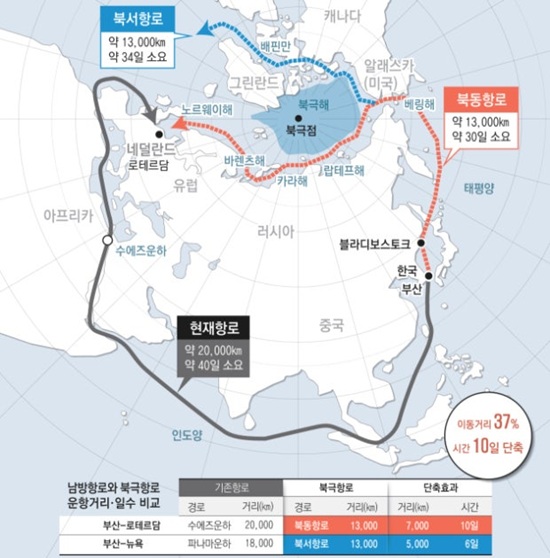 Comparison of distance and duration of Arctic shipping routes.
As the country with the longest coastline along the Arctic Ocean, Russia is leading natural gas (LNG) and oil field development, particularly around the Yamal Peninsula, and is using this as a tool to weaponize resources.
The United States and Canada possess abundant shale oil and mineral resources in Alaska and their northern territories, and they are striving to maintain their security hegemony while balancing environmental protection and resource development.
Denmark and Norway are securing their own economic stakes based on rare earth elements and oil fields around Greenland and continental shelf resources off the Norwegian coast.
The Functional Relationship Between Indigenous Icebreaker Capabilities and Economic Viability
While South Korea operates research icebreakers (such as the Araon), it still has a long way to go in developing independent capabilities for large, high-performance icebreakers or ice-class commercial vessels capable of regular commercial operations in the Arctic. Consequently, the current structure relies absolutely on Russia's icebreaking guide services and related technology.
Technical dependence signifies political dependence. Unless we secure our own independent polar navigation and icebreaker construction capabilities, the Northern Sea Route remains a dangerous pipeline that could be blocked at any time.
The economic viability of icebreaker operations is also dependent on how many months per year the ships can remain operational. If the route can only be used for a few months during the summer when the ice melts, it is difficult to justify the massive construction costs of icebreakers and high insurance premiums.
Geopolitical Risks of Bilateral Korea-Russia Route Operations
In the past, some politicians and scholars proposed bilateral cooperation with Russia to open the Northern Sea Route, and further to connect gas pipelines or railways through North Korea. However, it has become clear that this was an unrealistic and hazardous idea that overlooked the ruthlessness of international politics and national security.
Germany previously relied on inexpensive Russian oil and gas to build the 'Nord Stream' pipeline. Yet, when the Russia-Ukraine war broke out, Russia abruptly cut off energy supplies, strangling Eastern Europe and Germany. It would be a dangerously naive idea to attempt to partner exclusively with Russia after witnessing its unilateral and autocratic control politics.
The current international landscape is one where the U.S.-led liberal bloc is strongly containing Russia and China. Especially with North Korea flaunting its "blood alliance" by sending troops to Russia and China showing intense interest in the Arctic, it is unrealistic for the Republic of Korea to push for cooperation with Russia in the Arctic unilaterally.
Historically, we must remember the 'Triple Intervention' by Russia, Germany, and France, which blocked Japan’s expansion after it took the Liaodong Peninsula following the First Sino-Japanese War. A unilateral move that goes against the currents of international hegemony cannot move forward in the face of pressure from a massive alliance system.
Practical and Desirable Implementation Strategies
South Korea can certainly proceed with the September Arctic test voyage. However, it must abandon the bilateral approach that relies solely on Russia and instead pursue it within the framework of international cooperation, built upon a new security and technology paradigm.
△ Participation in U.S.-led Multilateral Consultative Bodies
South Korea must never act alone in operating the Northern Sea Route. It should participate as a core partner in an 'Arctic Multilateral Consultative Body' comprised of the United States, Europe, Japan, and other like-minded nations. Ensuring freedom of navigation within the framework of international law and the collective security of the liberal bloc is the safest and most certain path.
△ Avoiding Direct Imports of Russian Gas and Establishing Energy Security
To avoid following in Germany's footsteps, energy policies that rely on or directly import Russian oil and gas are never advisable. Energy is not merely a commodity; it is a matter of national sovereignty. We must not commit the folly of entrusting our energy lifeline to a regime where geopolitical risks are constant.
△ Securing Competitive Icebreaker Construction Technology Through Korea-U.S. Joint Development
Our greatest weakness, the lack of icebreaking technology, must be overcome through a technology alliance with friendly nations. We should pursue a 'Korea-U.S. Joint Icebreaker Development and Construction Project,' combining the Republic of Korea’s world-class shipbuilding and manufacturing technology with U.S. polar core technology and security assets.
The U.S. is also in desperate need of a reliable shipbuilding partner to contain Russia and China in the Arctic. Considering this, we must secure independent and competitive next-generation icebreaker capabilities at an early stage.
The Arctic Ocean is a frozen land of opportunity, but it serves only as a cold trap for the unprepared. Only when we advance with the dual pillars of technological self-reliance and multilateral value-based alliances can we emerge as a maritime powerhouse capable of navigating the rough waters of the Arctic.

◆ Dr. Shin Dong-chun
Doctor of Public Administration, Representative of the Freedom Unification National Union. Following his success in the 21st Public Administration Examination, he has held various roles including public service, corporate CEO, university professor, media contributor, author, and president of the Global Aerospace Industry Association.

 Iranian Foreign Ministry: "Continuing Message Exchanges with the U.S. and Activities of Mediating Countries"
Esmaeil Baghaei, Spokesperson for the Iranian Ministry of Foreign Affairs [Xinhua, Yonhap News file photo]Esmaeil Baghaei, spokesperson for the Iranian Ministry of Foreign Affairs, stated on the 26th
Iranian Foreign Ministry: "Continuing Message Exchanges with the U.S. and Activities of Mediating Countries"
Esmaeil Baghaei, Spokesperson for the Iranian Ministry of Foreign Affairs [Xinhua, Yonhap News file photo]Esmaeil Baghaei, spokesperson for the Iranian Ministry of Foreign Affairs, stated on the 26th
 President Yoon: "Do You Think You Are Safe from the Special Counsel?"... Final Statement Video Released
President Yoon Suk Yeol rebuking the special prosecutor on the 24th. [Court video / @birds_justice X account subtitle GIF] A video of President Yoon Suk Yeol's closing statement at his trial rega
President Yoon: "Do You Think You Are Safe from the Special Counsel?"... Final Statement Video Released
President Yoon Suk Yeol rebuking the special prosecutor on the 24th. [Court video / @birds_justice X account subtitle GIF] A video of President Yoon Suk Yeol's closing statement at his trial rega
 President Yoon, regarding the first-instance ruling on the Public Official Election Act: “An excessive political verdict that distorts the facts… We will appeal immediately.”
The first-instance sentencing hearing for President Yoon Suk Yeol regarding violations of the Public Official Election Act is being broadcast live at Seoul Station on the 27th. [Photo=Yonhap News]Pres
President Yoon, regarding the first-instance ruling on the Public Official Election Act: “An excessive political verdict that distorts the facts… We will appeal immediately.”
The first-instance sentencing hearing for President Yoon Suk Yeol regarding violations of the Public Official Election Act is being broadcast live at Seoul Station on the 27th. [Photo=Yonhap News]Pres
 WSJ: "SK Hynix ADR Premium Is a Sign of AI Trading Overheat"
Advertisement for SK Hynix ADR listing in New York's Times Square [Reuters=Yonhap News file photo]The Wall Street Journal (WSJ) has pointed out that the price of SK Hynix’s American Depositary Recei
WSJ: "SK Hynix ADR Premium Is a Sign of AI Trading Overheat"
Advertisement for SK Hynix ADR listing in New York's Times Square [Reuters=Yonhap News file photo]The Wall Street Journal (WSJ) has pointed out that the price of SK Hynix’s American Depositary Recei
 'Godfather of Japanese Mystery Novels' Keigo Higashino Passes Away After Battle with Cancer at 68
Famous Japanese mystery novelist Keigo Higashino [AFP=Yonhap News]It has been belatedly reported that Keigo Higashino, the "godfather of Japanese mystery novels" and author of bestsellers such as "The
'Godfather of Japanese Mystery Novels' Keigo Higashino Passes Away After Battle with Cancer at 68
Famous Japanese mystery novelist Keigo Higashino [AFP=Yonhap News]It has been belatedly reported that Keigo Higashino, the "godfather of Japanese mystery novels" and author of bestsellers such as "The
 [Park Pil-kyu Security Column] To the Ignorant Trying to Clothe a Beast in Sheep's Clothing
Rep. Kim Byung-joo of the Democratic Party of Korea [Photo=Yonhap News]“The Air Force Academy doesn't teach you how to fly a plane!” “The Army, Navy, and Air Force academies are exactly the
[Park Pil-kyu Security Column] To the Ignorant Trying to Clothe a Beast in Sheep's Clothing
Rep. Kim Byung-joo of the Democratic Party of Korea [Photo=Yonhap News]“The Air Force Academy doesn't teach you how to fly a plane!” “The Army, Navy, and Air Force academies are exactly the
 [Issue Diagnosis] Two Effects of the Election Petition Review
 [Photo] Evidence of Election Fraud Flooding U.S. Media… Trump Had 2.7 Million Votes Stolen
 [Video] U.S. Semiquincentennial Air Show... 'Art in the Sky' streaks across New York
 [Editorial Cartoon] A Draconian Law That Undermines Freedom of Expression

 List
List









