 Hwarangdae within the Korea Military Academy [Photo: Army]
Hwarangdae is destined to disappear. Its patriotic function, which has aided national diplomacy, will also pass into history. This is because the current administration is moving towards abolishing the Korea Military Academy by integrating the Army, Navy, and Air Force Academies.
The government plans to establish a new Korea Armed Forces University and integrate the three service academies as colleges. The Korea Military Academy will be relocated to a provincial area, and apartments will be built on the Hwarangdae site.
Since current President Lee Jae-myung announced this directly at the integrated commissioning ceremony of the three service academies on February 20, 2026, it is highly likely to be realized, with his will and responsibility attached.
Setting aside the thoughtless notion of calling "joint operations" between military branches "integrated operations," it is precisely this kind of charlatanistic action that is happening now, and under its shadow, Hwarangdae's fate hangs precariously.
"Hwarangdae (花郞臺)" is the nickname for the Korea Military Academy, located in Nowon-gu, Seoul. In the 1960s-1980s, the area around the Korea Military Academy was often referred to collectively as "Hwarangdae," and the name was widely used by surrounding villages and institutions.
Places that use the name Hwarangdae include: △ Seoul Subway Line 6's "Hwarangdae Station" △ the old station on the Gyeongchun Line, "Old Hwarangdae Station" △ the "Hwarangdae Railway Park," created by transforming the former station building into a tourist attraction △ "Hwarang-ro," a major road passing through Seongbuk-gu and Nowon-gu △ "Hwarangdae Intersection" near Hwarang-ro and Dongil-ro △ "Hwarangdae Post Office" △ "Hwarangdae Military Apartments" △ "Hwarangdae Bus Stop" △ and the "Hwarangdae Area," which encompassed Gongneung-dong and Muk-dong. In military contexts, there are also △ "Hwarangdae Guard Post" and △ "Hwarangdae Rear Gate."
If the Korea Military Academy relocates to a provincial area, the local institutions and attractions that have used the name Hwarangdae will lose their meaning along with Hwarangdae and disappear into history.
Among the many place names of Hwarangdae, there is an imposing building with the inscription "花郞臺" clearly engraved on it. This is the review stand at the Hwarang Parade Ground within the Korea Military Academy.
This Hwarangdae building has a long history of loyal service to the nation. During my cadet days in the 1960s, this review stand was where cadets held their weekly "Special Skills Ceremony" (now the Hwarang Ceremony), consisting of parades and formations. It was also where the school principal and other school headquarters officials would stand during the pre-march ritual for the entire student body.
Every year, during the graduation and commissioning ceremonies for each class, the President of the Republic of Korea, cabinet ministers, and high-ranking military commanders would also ascend this platform. During diplomatic events, heads of state and high-ranking officials from around the world invited by the Republic of Korea would also be honored guests here, reviewing the cadets of the Korea Military Academy. Hwarangdae was indeed the site of the most solemn welcome ceremonies in the country.
It was only after graduating and serving in an agency that I came to truly realize that the review of cadets welcoming foreign dignitaries was an act of diplomacy for the nation's benefit, as I witnessed the fierce diplomatic battles between North and South Korea on the international stage.
Especially during the active diplomacy and military modernization process under President Park Chung-hee's government in the 1960s and 1970s, many foreign heads of state visited the Korea Military Academy. It is known that there were over 100 such visits until the 1980s, after the Korea Military Academy was established in Hwarangdae.
Representative examples of foreign heads of state visiting Hwarangdae during my cadet days include: △ German President Heinrich Lübke in 1967 △ Ethiopian Emperor Haile Selassie I in 1968 △ Gabonese President Omar Bongo in 1969. I recall that some of these visitors returned for a second visit.
Since then, numerous heads of state and prime ministerial-level delegations from various countries have visited the Korea Military Academy.
Notable visitors include: △ Philippine President Marcos △ Thai Royal Family delegation △ Malaysian Prime Ministerial level government delegation △ Indonesian President Suharto △ Zairean President Mobutu △ Jordanian Crown Prince Hassan △ Spanish King Juan Carlos I △ Singaporean Prime Minister Lee Kuan Yew △ Brunei King Hassanal Bolkiah △ Cambodian King Norodom Sihanouk △ Jordanian Crown Prince Abdullah (later King) △ Senegalese President Léopold Sédar Senghor △ Tanzanian President Julius Nyerere △ Cambodian Head of State Norodom Sihanouk △ Envoy of Moroccan King Hassan II. These visits are also recorded.
The visits of foreign heads of state to the Korea Military Academy were part of a total diplomatic effort to gain international recognition of which side, South or North Korea, held legitimacy on the Korean Peninsula. Hwarangdae and the cadets played a significant role in this.
The countries of Southeast Asia and Africa, as part of the Non-Aligned Movement's Third World at the time, exerted strong collective influence on the international diplomatic stage, including the UN. President Omar Bongo of Gabon and government delegations from Malaysia and Indonesia are prime examples.
Middle Eastern countries were crucial resource patrons who could supply vital oil resources to Korea, which was vigorously pursuing its five-year economic development plans.
Meanwhile, German President Lübke was the key figure who provided substantial loans to South Korea when President Park Chung-hee was attempting to develop the nation's economy from scratch, laying a great foundation for Korea's economic growth.
Ethiopian Emperor Haile Selassie was a benefactor who sent elite imperial troops to save the Republic of Korea from imminent destruction during the North Korean invasion of 1950.
The welcoming ceremonies, such as receiving a review at the Hwarangdae parade ground and taking commemorative photos with the cadets, were a form of gratitude, but it likely strengthened the support of those two nations for Korea. This is precisely the role Hwarangdae played.
Those who were cadets during the same era will recall the memory of lining up at Gimpo Airport, regardless of the harsh cold or heat, to welcome the heads of state, prior to the review at Hwarangdae. Participating in such events, just like the review at Hwarangdae, was a meaningful dedication to promoting national interests.
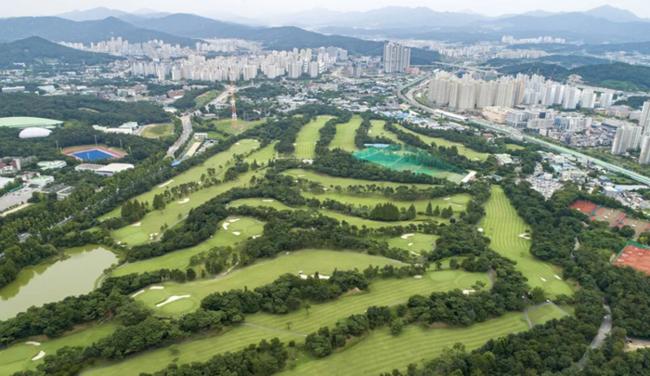 Taereung Golf Course. [Photo: Yonhap News]
Meanwhile, the Taereung Golf Course, adjacent to Hwarangdae, has also contributed to the promotion of national interests, just as much as the overseas state visits at the Hwarang Parade Ground.
Golf diplomacy is a form of informal communication and diplomatic activity where heads of state or high-ranking leaders play golf together outside official meeting venues to build rapport and enhance diplomatic trust and cooperative relationships, thereby supplementing formal diplomacy.
Just as in business golf, it is well-known that golf diplomacy creates a friendly atmosphere between individuals, providing an opportunity to smoothly resolve even serious and difficult issues between them.
When U.S. presidents, including Donald Trump, Eisenhower, and Biden, visited Korea, they not only had informal conversations at Camp David but also visited golf courses. During the presidencies of Park Chung-hee, Chun Doo-hwan, and Roh Tae-woo, golf diplomacy was actively utilized in Korea.
The Taereung Golf Course was the center of this golf diplomacy. Located in Seoul, near the Blue House, and adjacent to the Korea Military Academy, it allowed for close military protection. It was not only ideal for presidents, cabinet ministers, and high-ranking military officials to enjoy their leisure time but also perfectly suited for inviting foreign state guests for diplomatic purposes.
Each course at Taereung Golf Course faces Mount Bulam, the guardian mountain of Hwarangdae. Mount Bulam is where the spirits of the 1st and 2nd class cadets of the Korea Military Academy, who fought against the North Korean invasion during the Korean War, are embedded.
Cadets who were deployed to the Pocheon front and suffered heavy casualties before retreating fought valiantly to halt the enemy's advance from Hill 92, a small hill behind the cadet corps. Although ordered to withdraw, they disobeyed and hid in Mount Bulam, engaging in guerrilla warfare and resisting the enemy to the end. Mount Bulam, imbued with the historical pain and spirit of valor, has become a training ground today for younger cadets to foster courage through mountain running.
With Mount Bulam facing them, officers visiting Taereung Golf Course are reminded of patriotism and loyalty while playing a round.
If Hwarangdae and Taereung Golf Course disappear, the values and virtues of promoting national interests, patriotic devotion, and national security that these two places have offered to Korea will also be lost.
For the national leaders of Korea, who must stake their existence on diplomacy and exports to secure sustainable national growth engines, whether in the past or present, they must never neglect the existence of Hwarangdae and Taereung Golf Course, which are the nation's premier diplomatic assets.
◆ Kim Myung-soo, One Drum
27th graduating class of the Korea Military Academy
Retired Army Major
Former Head of Psychological Warfare Division for North Korea at the Agency for National Security Planning

 Iranian Foreign Ministry: "Continuing Message Exchanges with the U.S. and Activities of Mediating Countries"
Esmaeil Baghaei, Spokesperson for the Iranian Ministry of Foreign Affairs [Xinhua, Yonhap News file photo]Esmaeil Baghaei, spokesperson for the Iranian Ministry of Foreign Affairs, stated on the 26th
Iranian Foreign Ministry: "Continuing Message Exchanges with the U.S. and Activities of Mediating Countries"
Esmaeil Baghaei, Spokesperson for the Iranian Ministry of Foreign Affairs [Xinhua, Yonhap News file photo]Esmaeil Baghaei, spokesperson for the Iranian Ministry of Foreign Affairs, stated on the 26th
 President Yoon: "Do You Think You Are Safe from the Special Counsel?"... Final Statement Video Released
President Yoon Suk Yeol rebuking the special prosecutor on the 24th. [Court video / @birds_justice X account subtitle GIF] A video of President Yoon Suk Yeol's closing statement at his trial rega
President Yoon: "Do You Think You Are Safe from the Special Counsel?"... Final Statement Video Released
President Yoon Suk Yeol rebuking the special prosecutor on the 24th. [Court video / @birds_justice X account subtitle GIF] A video of President Yoon Suk Yeol's closing statement at his trial rega
 President Yoon, regarding the first-instance ruling on the Public Official Election Act: “An excessive political verdict that distorts the facts… We will appeal immediately.”
The first-instance sentencing hearing for President Yoon Suk Yeol regarding violations of the Public Official Election Act is being broadcast live at Seoul Station on the 27th. [Photo=Yonhap News]Pres
President Yoon, regarding the first-instance ruling on the Public Official Election Act: “An excessive political verdict that distorts the facts… We will appeal immediately.”
The first-instance sentencing hearing for President Yoon Suk Yeol regarding violations of the Public Official Election Act is being broadcast live at Seoul Station on the 27th. [Photo=Yonhap News]Pres
 WSJ: "SK Hynix ADR Premium Is a Sign of AI Trading Overheat"
Advertisement for SK Hynix ADR listing in New York's Times Square [Reuters=Yonhap News file photo]The Wall Street Journal (WSJ) has pointed out that the price of SK Hynix’s American Depositary Recei
WSJ: "SK Hynix ADR Premium Is a Sign of AI Trading Overheat"
Advertisement for SK Hynix ADR listing in New York's Times Square [Reuters=Yonhap News file photo]The Wall Street Journal (WSJ) has pointed out that the price of SK Hynix’s American Depositary Recei
 'Godfather of Japanese Mystery Novels' Keigo Higashino Passes Away After Battle with Cancer at 68
Famous Japanese mystery novelist Keigo Higashino [AFP=Yonhap News]It has been belatedly reported that Keigo Higashino, the "godfather of Japanese mystery novels" and author of bestsellers such as "The
'Godfather of Japanese Mystery Novels' Keigo Higashino Passes Away After Battle with Cancer at 68
Famous Japanese mystery novelist Keigo Higashino [AFP=Yonhap News]It has been belatedly reported that Keigo Higashino, the "godfather of Japanese mystery novels" and author of bestsellers such as "The
 [Park Pil-kyu Security Column] To the Ignorant Trying to Clothe a Beast in Sheep's Clothing
Rep. Kim Byung-joo of the Democratic Party of Korea [Photo=Yonhap News]“The Air Force Academy doesn't teach you how to fly a plane!” “The Army, Navy, and Air Force academies are exactly the
[Park Pil-kyu Security Column] To the Ignorant Trying to Clothe a Beast in Sheep's Clothing
Rep. Kim Byung-joo of the Democratic Party of Korea [Photo=Yonhap News]“The Air Force Academy doesn't teach you how to fly a plane!” “The Army, Navy, and Air Force academies are exactly the
 [Issue Diagnosis] Two Effects of the Election Petition Review
 [Photo] Evidence of Election Fraud Flooding U.S. Media… Trump Had 2.7 Million Votes Stolen
 [Video] U.S. Semiquincentennial Air Show... 'Art in the Sky' streaks across New York
 [Editorial Cartoon] A Draconian Law That Undermines Freedom of Expression

 List
List









