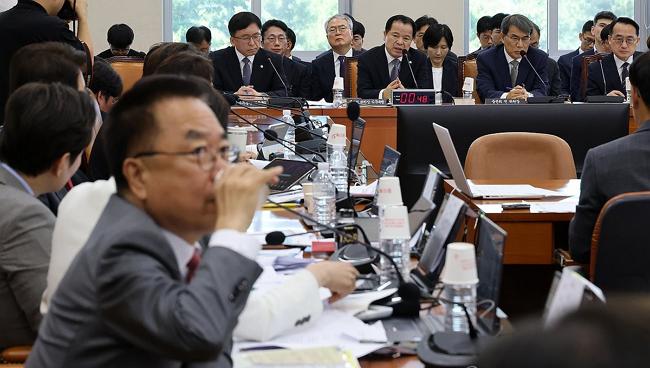
 Wi Chul-hwan, Acting Chairperson of the National Election Commission (NEC), answers lawmakers' questions during the plenary session of the Special Committee on the Parliamentary Investigation into the Infringement of People's Suffrage, including the ballot paper shortage crisis, held at the National Assembly on the 23rd. From the left are Kang Dong-wan, Acting Secretary-General; Wi Chul-hwan, Acting NEC Chairperson; Roh Tae-ak, former NEC Chairperson; and Heo Chul-hoon, former Secretary-General. [Photo=Yonhap News]
There is a clear reason why the first meeting of the special parliamentary investigation committee into the infringement of suffrage has been labeled a failure. Although the investigation has officially begun, critics point out that it has not moved a single step forward in uncovering the truth behind the infringement of voting rights.
There are five main reasons why the first meeting failed to pass: the limitations of its title, controversy over the committee chairperson's credibility, the defensive attitude of the National Election Commission (NEC), issues regarding witnesses and document submissions, and the structural limitations exposed by the differing perspectives between the ruling and opposition parties, as well as a constrained schedule.
A Parliamentary Investigation that Lost Trust from its Title
The first problem is the title. While the official name of this investigation includes "uncovering the truth behind the infringement of people's suffrage," the core issue of "election fraud" was omitted. If citizens went to polling stations only to find no ballots, if voting was suspended at several locations, and if there were even opinions within the NEC to stop the counting of votes, this is not merely a ballot shortage incident—it is a matter that requires an investigation into whether election fraud occurred.
Of course, there may have been opposition from the powerful ruling party. However, the title of a parliamentary investigation is more than just a label. It is the opening statement that defines what will be investigated, the nature of the incident, and the extent to which accountability will be demanded.
The moment the fundamental issue of "election fraud" was excluded from the official title, it became difficult for the investigation to escape criticism that it had started on the wrong foot regarding public trust.
Political Distrust Surrounding the Appointment of the Chairperson
The second problem is the chairperson. While Representative Yoon Sang-hyun’s appointment as chair may have been procedurally sound, a position tasked with thoroughly digging into allegations of suffrage deprivation requires not only procedural neutrality but also political trust.
Yoon’s appointment failed to resolve the political distrust already raised within the conservative base. If voters who perceive this incident as a case of election fraud doubt the chairperson's will or the possibility of a thorough, "end-to-end" investigation, the parliamentary probe is burdened with a "trust deficit" from the very beginning.
For the special investigation committee to transcend being a mere procedural body within the National Assembly and become a forum that resolves public suspicion, it needed to secure strong trust from its very leadership structure.
NEC Responses Prioritize Defense Over Accountability
The third problem is the attitude of the NEC. Wi Chul-hwan, the acting NEC chairperson, initially dismissed calls for a re-election as "irresponsible claims" during the hearing before later retracting his statement and apologizing. Wi is known for his history as a classmate of President Lee Jae-myung from their bar exam and judicial training days, and has even been embroiled in a so-called "dining buddy" controversy.
Seeing such a figure confidently state that a re-election was impossible during a parliamentary hearing regarding the deprivation of suffrage only fueled further distrust among citizens who had expected reflection and accountability.
The response from former NEC Chairperson Roh Tae-ak was also insufficient for restoring trust. While Roh stated he felt a heavy sense of responsibility, he repeatedly claimed he could not remember the decision-making process for lowering the ballot printing threshold from 60% to 50%, or whether he had been briefed in advance.
If the highest-ranking official cannot answer with clear memories or records regarding a decision that directly affected citizens' voting rights, the parliamentary investigation cannot help but appear as a venue for evading responsibility rather than uncovering the truth.
The minutes of the NEC meeting on the dawn after the election also reveal such gaps. According to reports, at the early morning meeting on June 4, the secretariat reported that they "thought 50% was sufficient" for the number of ballots printed on the day of the main election. The ballot printing ratio is not a matter of administrative convenience, but a matter of guaranteeing the right to vote.
If the post-incident explanation is simply that they "thought it was sufficient," the entire decision-making system of the election management body inevitably becomes a subject for investigation.
It is also significant that at the same meeting, an opinion was raised that it would be appropriate to temporarily suspend the counting of votes in the 2nd polling station of Jamsil 7-dong until the central committee could discuss it. This indicates that the gravity of the situation was indeed recognized within the NEC.
Nevertheless, the counting proceeded, and the NEC later framed the situation as one that did not warrant a re-election. The parliamentary investigation needs to verify the legal grounds for this judgment and the decision-making chain, but public questioning alone has clear limitations.
Controversies Over Absence and Document Submission Raise Doubts about Effectiveness
The fourth problem concerns the failure of witnesses to appear and controversies over document submissions. Many NEC commissioners were absent from the very first meeting, and some only appeared late after being criticized by the ruling and opposition parties. The fact that those responsible for election management did not appear on time for an investigation into suffrage infringement itself shattered public confidence.
Furthermore, rumors of a "pre-meeting" regarding witness attendance have surfaced, deepening suspicions that these were not simple absences but pre-coordinated actions. For a parliamentary investigation to work properly, witnesses must attend, documents must be submitted, and those responsible must answer on the record. Yet, what the public witnessed in the first meeting was the exact opposite.
The attitude toward document submission is also problematic. If the NEC claims they do not have key documents requested by the committee members or effectively avoids submission, the investigation will face limitations from the start.
If original meeting minutes, situation logs, field report records, and data regarding the decision to force the continuation of ballot counting are missing or not submitted, it raises the question of how the National Assembly intends to uncover the truth.
Corrections to numbers and timelines also make it difficult to accept the NEC's explanations at face value. During the investigation's briefing, the NEC corrected the time it first recognized the ballot shortage and the number of polling stations that required additional ballot deliveries, contradicting their previous announcements.
If the basic figures and timelines change, the NEC's retrospective announcements become the subject of investigation rather than the conclusion.
Limitations of Differing Views and a Constrained Schedule
The fifth problem lies in the conflicting perspectives of the ruling and opposition committee members and the limitations of the schedule. During the first meeting, both sides criticized the NEC's poor management and insincere attitude. However, they differed in how they defined the nature of the problem and its solution.
While the ruling party focused on structural reform and institutional improvements for the NEC, the opposition party prioritized demanding the resignation of Acting Chairperson Wi Chul-hwan and the necessity of a special counsel.
These differences are not merely political stances. The more the ruling party emphasizes institutional reform, the further the assignment of accountability may be pushed back. Conversely, even if the opposition calls for a special counsel, it is unlikely to lead to a forced investigation without consensus within the committee.
This issue cannot be resolved by NEC institutional reform alone. What must be clarified first is who lowered the ballot printing standards, who reviewed the risks, and at what stage the field reports were delayed or omitted.
The schedule itself is also limiting. The special committee is set to operate for 45 days until August 1. A second agency briefing is scheduled for July 1, a field survey for July 8, and the first and second hearings for July 14 and July 22, respectively.
While parliamentary investigations are meaningful as a process for public verification, there is a prevailing view that this schedule alone is clearly insufficient to quickly secure key evidence and forcefully track the chain of accountability.
The first special investigation committee into the infringement of suffrage has been evaluated as failing to serve as a starting point for uncovering the truth.
With the continued absence of NEC commissioners, controversies over document submissions, missing key records, evasive answers, and differing views between political parties, it has been pointed out that the investigation has not made any progress in uncovering the truth about the infringement of suffrage.
Growing Demands for Simultaneous Parliamentary Investigation and Special Counsel
For this reason, demands to conduct a special counsel investigation alongside the parliamentary probe are gaining momentum. A parliamentary investigation is a process that exposes issues through public questioning and requests for documents. A special counsel, on the other hand, can track the chain of accountability through forced investigations such as search and seizures, digital forensics, securing witness testimonies, and evidence preservation. These two processes are closer to parallel procedures with different roles rather than being mutually exclusive.
The core of the argument for a special counsel lies in the nature of the subject being investigated.
This matter is not limited to mere administrative errors regarding ballot shortages. The entire process of changing printing standards, the review of risks, the reporting system from the field, the process of delivering additional ballots, the procedures for ballot box storage, transport, and counting, and the legal grounds for deciding to force the counting must all be verified.
If discrepancies between retrospective explanations and actual records emerge during this process, it could even trigger investigations into false reporting, dereliction of duty, and the concealment of evidence.
Therefore, the argument that a parallel structure is necessary—where the parliamentary investigation handles public verification and the special counsel handles forced investigations—is gaining traction.
The call for a swift special counsel is not just a partisan demand, but is evolving into a procedural necessity to confirm the reality of the allegations regarding the infringement of suffrage.
If there are no records, there is no accountability. Without accountability, it is difficult to prevent recurrences. That is precisely the limitation shown by the first special parliamentary investigation committee.
#InfringementOfSuffrage #SpecialInvestigationCommittee #ElectionFraud #SpecialCounsel #NEC #BallotShortage #HanmiIlbo

 Iranian Foreign Ministry: "Continuing Message Exchanges with the U.S. and Activities of Mediating Countries"
Esmaeil Baghaei, Spokesperson for the Iranian Ministry of Foreign Affairs [Xinhua, Yonhap News file photo]Esmaeil Baghaei, spokesperson for the Iranian Ministry of Foreign Affairs, stated on the 26th
Iranian Foreign Ministry: "Continuing Message Exchanges with the U.S. and Activities of Mediating Countries"
Esmaeil Baghaei, Spokesperson for the Iranian Ministry of Foreign Affairs [Xinhua, Yonhap News file photo]Esmaeil Baghaei, spokesperson for the Iranian Ministry of Foreign Affairs, stated on the 26th
 President Yoon: "Do You Think You Are Safe from the Special Counsel?"... Final Statement Video Released
President Yoon Suk Yeol rebuking the special prosecutor on the 24th. [Court video / @birds_justice X account subtitle GIF] A video of President Yoon Suk Yeol's closing statement at his trial rega
President Yoon: "Do You Think You Are Safe from the Special Counsel?"... Final Statement Video Released
President Yoon Suk Yeol rebuking the special prosecutor on the 24th. [Court video / @birds_justice X account subtitle GIF] A video of President Yoon Suk Yeol's closing statement at his trial rega
 President Yoon, regarding the first-instance ruling on the Public Official Election Act: “An excessive political verdict that distorts the facts… We will appeal immediately.”
The first-instance sentencing hearing for President Yoon Suk Yeol regarding violations of the Public Official Election Act is being broadcast live at Seoul Station on the 27th. [Photo=Yonhap News]Pres
President Yoon, regarding the first-instance ruling on the Public Official Election Act: “An excessive political verdict that distorts the facts… We will appeal immediately.”
The first-instance sentencing hearing for President Yoon Suk Yeol regarding violations of the Public Official Election Act is being broadcast live at Seoul Station on the 27th. [Photo=Yonhap News]Pres
 WSJ: "SK Hynix ADR Premium Is a Sign of AI Trading Overheat"
Advertisement for SK Hynix ADR listing in New York's Times Square [Reuters=Yonhap News file photo]The Wall Street Journal (WSJ) has pointed out that the price of SK Hynix’s American Depositary Recei
WSJ: "SK Hynix ADR Premium Is a Sign of AI Trading Overheat"
Advertisement for SK Hynix ADR listing in New York's Times Square [Reuters=Yonhap News file photo]The Wall Street Journal (WSJ) has pointed out that the price of SK Hynix’s American Depositary Recei
 'Godfather of Japanese Mystery Novels' Keigo Higashino Passes Away After Battle with Cancer at 68
Famous Japanese mystery novelist Keigo Higashino [AFP=Yonhap News]It has been belatedly reported that Keigo Higashino, the "godfather of Japanese mystery novels" and author of bestsellers such as "The
'Godfather of Japanese Mystery Novels' Keigo Higashino Passes Away After Battle with Cancer at 68
Famous Japanese mystery novelist Keigo Higashino [AFP=Yonhap News]It has been belatedly reported that Keigo Higashino, the "godfather of Japanese mystery novels" and author of bestsellers such as "The
 [Park Pil-kyu Security Column] To the Ignorant Trying to Clothe a Beast in Sheep's Clothing
Rep. Kim Byung-joo of the Democratic Party of Korea [Photo=Yonhap News]“The Air Force Academy doesn't teach you how to fly a plane!” “The Army, Navy, and Air Force academies are exactly the
[Park Pil-kyu Security Column] To the Ignorant Trying to Clothe a Beast in Sheep's Clothing
Rep. Kim Byung-joo of the Democratic Party of Korea [Photo=Yonhap News]“The Air Force Academy doesn't teach you how to fly a plane!” “The Army, Navy, and Air Force academies are exactly the
 [Issue Diagnosis] Two Effects of the Election Petition Review
 [Photo] Evidence of Election Fraud Flooding U.S. Media… Trump Had 2.7 Million Votes Stolen
 [Video] U.S. Semiquincentennial Air Show... 'Art in the Sky' streaks across New York
 [Editorial Cartoon] A Draconian Law That Undermines Freedom of Expression

 List
List









