“Personalized Education: The Problem of Judgment Hidden Within Convenience”
Changing Paths, Not Just Content
If you understand AI education merely as "computers helping with studies," you are missing the point. The AI now entering the educational landscape is different from the online lectures or digital textbooks of the past. Traditional digital education focused on showing pre-made content to students. In contrast, AI-based education analyzes what questions a student asks, which problems they repeatedly get wrong, and which concepts they fail to grasp before moving on. Based on this analysis, it automatically suggests the next explanation, the next problem, and the next learning material.
The first technology behind this structure is the Generative AI conversation engine. When a student asks a question, the AI does not simply list search results; it constructs a natural response in sentence form. A search engine displays multiple sources and leaves the selection to the user. Generative AI, however, synthesizes various materials and learned patterns into a single, cohesive answer. From the student’s perspective, this can feel like an explanation from a teacher or a private tutor. At this point, AI transcends being a mere information tool and begins to assume a form of educational authority.
Learning Analytics Reads a Child’s Weaknesses
The second technology is learning analytics and knowledge tracing. AI educational platforms do not look at accuracy rates alone. They can accumulate data on problem-solving time, patterns of repeated errors, frequency of hints requested, time spent stalling on specific concepts, and review cycles. Through this, AI attempts detailed diagnoses, such as, "The student understands the concept of fractions but gets stuck on conversion to proportional expressions," or "The student can read sentences but is weak with inferential questions."
This is a powerful educational tool. In a reality where it is difficult for teachers to monitor each student closely, AI can quickly identify learning gaps. For students who cannot afford sufficient private tutoring due to economic circumstances, it can function as a personal tutor. This is why AI education is anticipated to be a "technology that reduces the educational divide."
However, this strength carries inherent risks. As a student's learning process is recorded in greater detail, the scope of educational data expands. It is not just simple grade information; data on concentration time, reaction speed, repetitive mistakes, and questioning styles can also be collected. AI education reads the child more thoroughly to better assist them. It is precisely at this point that the boundary between convenience and surveillance becomes blurred.
The Hidden Curriculum Recommendation Algorithm
The third technology is the recommendation algorithm. AI recommends which problems to solve next, which explanations to view, and which materials to read next. In education, these recommendations are not merely features of convenience; they become the learning path itself. One student may be given easier problems, another may receive advanced challenges, and another may be repeatedly shown commentary from a specific viewpoint.
In this process, AI can become an invisible curriculum designer. Even if the formal curriculum is determined by the state or school, the actual learning experience of the student can be dictated by the platform's recommendation structure. Even when learning the same unit, a student's understanding will differ depending on which materials they see first, which explanations they hear repeatedly, and which types of problems they encounter more frequently.
The fourth technology is Retrieval-Augmented Generation (RAG). Instead of answering based only on its pre-trained internal knowledge, this method connects to external sources—such as textbooks, academic papers, news articles, school materials, and web documents—to generate answers. On the surface, it is a technology that improves accuracy. But in education, what matters is *which* materials are connected. Even for the same historical event, the direction of the explanation can change depending on which sources are prioritized. While it appears to be a technical issue, it is actually a matter of material selection, and material selection is, fundamentally, a matter of judgment.
Multimodal AI That Reads the Classroom More Deeply
The fifth technology is Multimodal AI (artificial intelligence capable of processing text, audio, images, etc., simultaneously). Future AI education will not remain at the level of answering text-based questions. It will expand to listening to a student’s verbal questions, reading handwritten solutions, interpreting drawings or graphs, and explaining experimental scenes in videos. Furthermore, some technologies may attempt to estimate concentration or emotional states through a student’s facial expressions, voice tremors, and reaction speeds.
Once it reaches this stage, AI education becomes a system that analyzes not only knowledge transfer but also the student's behaviors and reactions. Under the guise of personalized education, learning data is collected more deeply and broadly. Finding and compensating for a student's weaknesses is useful. However, the questions of how much of a student's reactions should be read, who holds that data, and for what purposes it will be reused remain separate, critical issues.
The core danger of AI education is not just a single wrong answer. The greater danger is that AI can quietly adjust the order in which students encounter knowledge, which explanations they hear repeatedly, and which viewpoints they accept as the natural standard. In education, influence can sometimes operate more powerfully through repetition and arrangement than through explicit coercion.
Transparency is More Important Than Technology Adoption
In particular, subjects such as history, ethics, family, gender, civics, politics, and social conflicts do not end with simple information delivery. While AI may claim to be a "tool that provides facts" in these areas, the actual response is influenced by the selection and arrangement of facts, the intensity of expression, the placement of counterarguments, and the boundaries of value judgment. Therefore, the issue with AI education is not "Is the AI smart?" The more important questions are: "What sources does the AI base its answers on?", "Who set the criteria for that selection?", "Can students and parents know those criteria?", and "Can the teacher control that process?"
Parental agency must also be redefined within this technological structure. In the past, one could understand the rough content of an education by checking textbooks and lesson plans. In AI education, however, a new layer of the platform is created between the official curriculum and the actual learning experience. Even if students take the same course, the supplementary materials, conversational explanations, automatically generated problems, and additional reading recommended by the AI can differ. Even if parents know the school’s general educational direction, it is difficult for them to know the actual learning conversations and recommendation paths their child has shared with the AI.
Therefore, the core principle of the AI education era is not the prohibition of technology. We should use technology, but the boundaries of decision-making authority must be clear. AI educational tools must be able to explain what materials they use as the basis for their answers. Key recommendation paths and learning materials provided to students should be accessible to teachers and parents. For topics involving sensitive value judgments, human review should take precedence over automated recommendations. Furthermore, a student's learning and emotional data should be collected minimally, and uses outside of the original purpose should be restricted.
Judgment by Humans, Assistance by AI
From the perspective of ALO, the conclusion is clear: AI can assist in education, but it must not become the subject of educational judgment. AI can help students find what they don't know more quickly, help teachers discover learning gaps they might have missed, and make repetitive learning more efficient. However, what to teach, which value judgments should be reserved, and when parental notification and consent are needed—these are things that must still be decided by humans.
Education is not just the transfer of knowledge; it is the process of building a framework to understand the world. Therefore, the future of AI education depends more on a clear structure of responsibility than on more sophisticated algorithms. Convenience is important, but in education, convenience does not equate to legitimacy. More important than the technology that answers a student's question the fastest is the structure that can explain the materials and standards from which that answer was derived. Every AI that intervenes in a child's learning must eventually face one question: "Is this technology helping the child learn better, or is it quietly instilling someone else's standards?" When we do not lose sight of this question, AI can become a true collaborator rather than a threat to education.
※ This article was published in the 12th issue of the Weekly Hanmi Ilbo (1st week of June).

 Trump pressures for rate cut again ahead of FOMC... "Should be the lowest in the world"
U.S. President Donald Trump. [Photo = The White House] U.S. President Donald Trump once again pressured the Federal Reserve, the U.S. central bank, to lower interest rates on the 27th (local time
Trump pressures for rate cut again ahead of FOMC... "Should be the lowest in the world"
U.S. President Donald Trump. [Photo = The White House] U.S. President Donald Trump once again pressured the Federal Reserve, the U.S. central bank, to lower interest rates on the 27th (local time
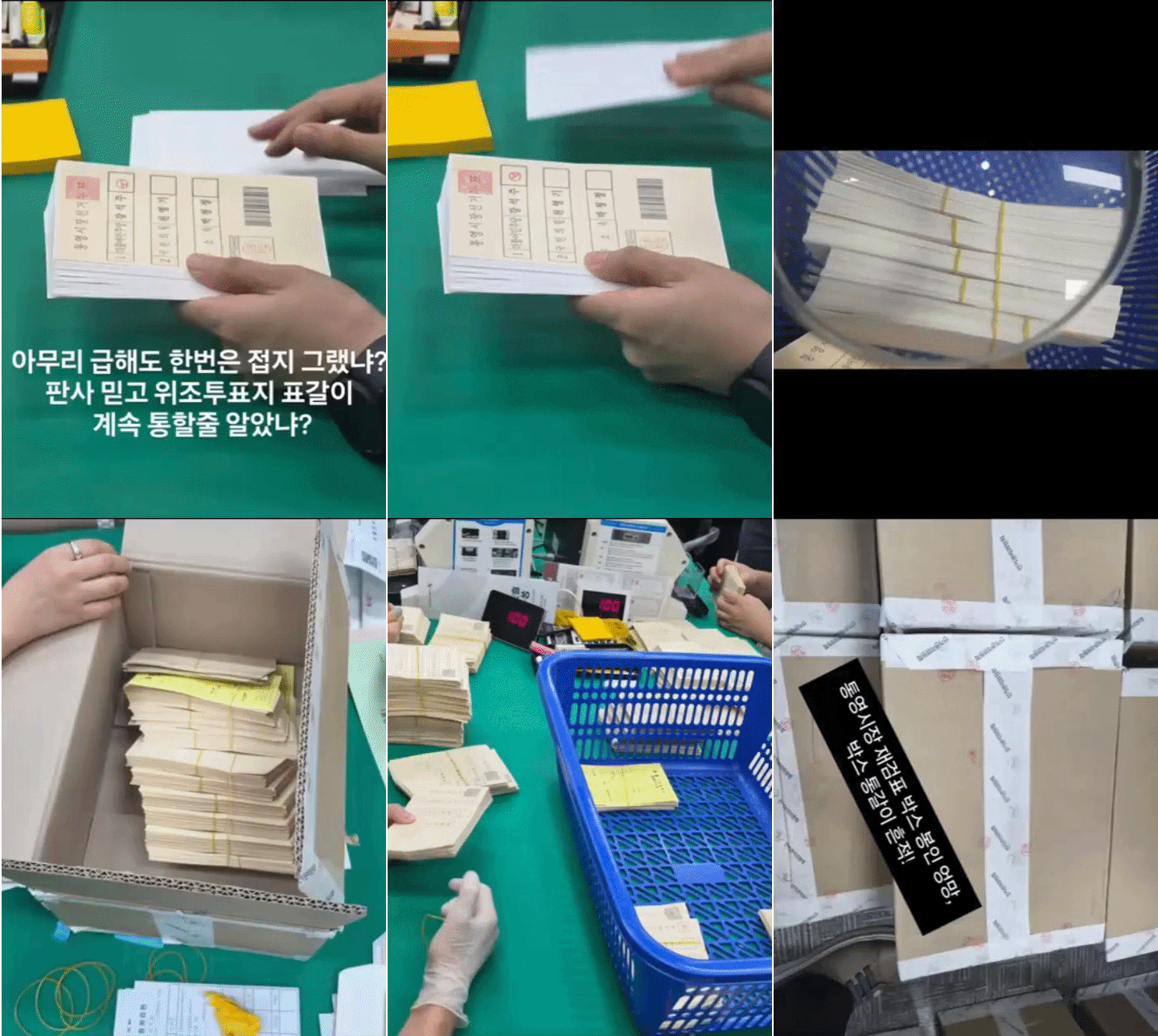 “Ignoring crisp ballots and damaged seals”… Tongyeong mayoral recount concludes with ‘no change in outcome,’ leaving suspicions and public outrage behind
Suspected counterfeit ballots discovered in Tongyeong [GIF from social media of Representative Hwang Kyo-ahn / Attorney Park Joo-hyun]During a recount of the Tongyeong mayoral election in South Gyeong
“Ignoring crisp ballots and damaged seals”… Tongyeong mayoral recount concludes with ‘no change in outcome,’ leaving suspicions and public outrage behind
Suspected counterfeit ballots discovered in Tongyeong [GIF from social media of Representative Hwang Kyo-ahn / Attorney Park Joo-hyun]During a recount of the Tongyeong mayoral election in South Gyeong
 President Yoon, regarding the first-instance ruling on the Public Official Election Act: “An excessive political verdict that distorts the facts… We will appeal immediately.”
The first-instance sentencing hearing for President Yoon Suk Yeol regarding violations of the Public Official Election Act is being broadcast live at Seoul Station on the 27th. [Photo=Yonhap News]Pres
President Yoon, regarding the first-instance ruling on the Public Official Election Act: “An excessive political verdict that distorts the facts… We will appeal immediately.”
The first-instance sentencing hearing for President Yoon Suk Yeol regarding violations of the Public Official Election Act is being broadcast live at Seoul Station on the 27th. [Photo=Yonhap News]Pres
 WSJ: "SK Hynix ADR Premium Is a Sign of AI Trading Overheat"
Advertisement for SK Hynix ADR listing in New York's Times Square [Reuters=Yonhap News file photo]The Wall Street Journal (WSJ) has pointed out that the price of SK Hynix’s American Depositary Recei
WSJ: "SK Hynix ADR Premium Is a Sign of AI Trading Overheat"
Advertisement for SK Hynix ADR listing in New York's Times Square [Reuters=Yonhap News file photo]The Wall Street Journal (WSJ) has pointed out that the price of SK Hynix’s American Depositary Recei
 'Godfather of Japanese Mystery Novels' Keigo Higashino Passes Away After Battle with Cancer at 68
Famous Japanese mystery novelist Keigo Higashino [AFP=Yonhap News]It has been belatedly reported that Keigo Higashino, the "godfather of Japanese mystery novels" and author of bestsellers such as "The
'Godfather of Japanese Mystery Novels' Keigo Higashino Passes Away After Battle with Cancer at 68
Famous Japanese mystery novelist Keigo Higashino [AFP=Yonhap News]It has been belatedly reported that Keigo Higashino, the "godfather of Japanese mystery novels" and author of bestsellers such as "The
 [Park Pil-kyu Security Column] To the Ignorant Trying to Clothe a Beast in Sheep's Clothing
Rep. Kim Byung-joo of the Democratic Party of Korea [Photo=Yonhap News]“The Air Force Academy doesn't teach you how to fly a plane!” “The Army, Navy, and Air Force academies are exactly the
[Park Pil-kyu Security Column] To the Ignorant Trying to Clothe a Beast in Sheep's Clothing
Rep. Kim Byung-joo of the Democratic Party of Korea [Photo=Yonhap News]“The Air Force Academy doesn't teach you how to fly a plane!” “The Army, Navy, and Air Force academies are exactly the
 [Issue Diagnosis] Two Effects of the Election Petition Review
 [Photo] Evidence of Election Fraud Flooding U.S. Media… Trump Had 2.7 Million Votes Stolen
 [Video] U.S. Semiquincentennial Air Show... 'Art in the Sky' streaks across New York
 [Editorial Cartoon] A Draconian Law That Undermines Freedom of Expression

 List
List