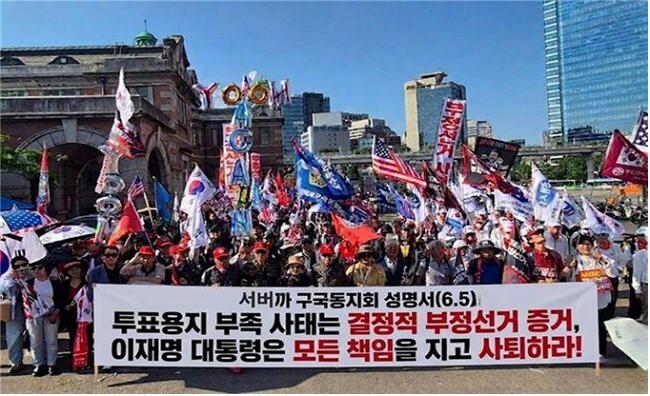
The shortage of ballots during the June 3 local election cannot be dismissed as a simple on-site confusion. In a briefing on the 5th, the National Election Commission (NEC) announced that it had sent additional ballots to 67 out of 14,288 polling stations nationwide. It confirmed that actual shortages occurred in 50 of these locations, and voting was temporarily suspended and then resumed in 22 of them.
The NEC attributed the shortage to reduced printing in anticipation of higher early voting turnout and demand fluctuations across polling stations. However, the NEC is the party involved in this incident. An explanation from the involved party is merely a starting point for investigation, not a conclusion.
From a legal perspective, the first issue is the calculation and distribution of ballots.
Article 151 of the Public Official Election Act stipulates that district, city, and county election commissions must prepare ballots and ballot boxes and send them to the town, township, and neighborhood election commissions by the day before the election. It also requires that party-recommended members be allowed to witness the printing, delivery, and transport of ballots. This signifies that ballots are not merely administrative items but legal instruments enabling citizens to exercise their right to vote. If a voter arriving at a polling station cannot vote on time due to the state’s lack of preparation, the issue at that moment is no longer an administrative error, but a failure to guarantee suffrage.
Even if the NEC argues that it "issued queue tickets," the conclusion remains unchanged. Article 155 of the Public Official Election Act stipulates that voters waiting to cast their ballots at the closing time must be given queue tickets to vote before the polling station is closed. However, this clause is a final safeguard to protect the voting rights of those already waiting. It is not a clause that justifies the circumstances that forced voters to wait due to a lack of ballots. A queue ticket is a retroactive remedial measure to prevent the deprivation of suffrage, not proof that there was no infringement on those rights.
The second issue is documentation.
The NEC must provide records explaining why ballots were printed in reduced quantities, what criteria were used to allocate quantities to each polling station, where backup supplies were stored, when the shortage was detected, and who ordered the additional delivery and when it arrived. These are not optional internal documents. They are essential procedural records that any state agency managing citizens' suffrage must maintain. The difficulty in assigning responsibility is not due to the lack of records; the absence of records is, in itself, the responsibility of the NEC.
The third issue is the transportation of ballot boxes from the Jamsil 7-dong No. 2 polling station.
Article 168 of the Public Official Election Act requires that after voting ends, ballot box slots and locks must be sealed and secured in the presence of election observers. Article 170 specifies that the voting manager must, without delay, transport ballot boxes, keys, voting records, and remaining ballots to the relevant election commission, and that one candidate representative and two escorting police officers may accompany them. Although the legal text uses the expression "may accompany," this is a statutory observation right intended to prevent security gaps during transport. If the NEC moved the ballot boxes without prior notice or re-summoning, the issue is not the type of vehicle used, but whether the chain of custody for the ballot boxes was broken.
Jang Dong-hyeok, a representative of the People Power Party, stated to reporters on the 5th after meeting with Seoul Election Commission officials that the response he received was that "not a single observer was present while the ballot boxes were being transported to the counting center." He further claimed that the Seoul Election Commission explained they had used a kindergarten bus to move the ballot boxes while observers were away, without prior notice. This statement is not mere political rhetoric. It is a factual claim publicly asserted by a party representative following a meeting with NEC officials. For the NEC to deny this, it must provide not just verbal explanations, but records of ballot box transport, observer notification logs, vehicle dispatch records, and site access control logs.
The fourth issue is the right to observe vote counting.
Article 181 of the Public Official Election Act stipulates that district, city, and county election commissions must allow vote-counting observers to witness the counting process inside the counting center. Article 177 states that when opening ballot boxes, the chairman of the election commission must inspect the seals of the ballot boxes in the presence of observers before opening them. In other words, observing the vote count is not a discretionary procedure that the NEC can choose to permit or deny. It is a surveillance mechanism mandated by law. If statutory vote-counting observers arrived but were physically blocked from entering, this is not a matter of maintaining order at the site, but a violation of the right to observe the counting process.
The count in Jamsil 7-dong was also linked to the final results. After the Jamsil 7-dong ballot box was counted, the distribution of proportional representation seats in the Seoul Metropolitan Council changed. According to reports by the Hankook Ilbo, the balance was 8 seats for the Democratic Party and 7 seats for the People Power Party before the Jamsil 7-dong count, but it shifted to 8 for the People Power Party and 7 for the Democratic Party afterward. The final party vote count for proportional representation in the metropolitan council was 2,295,093 for the People Power Party and 2,288,569 for the Democratic Party. Therefore, this incident cannot be downplayed as a "procedural accident irrelevant to the outcome."
The conclusion of the fact-check is clear.
The shortage of ballots was an incident where suffrage was limited and deprived on-site. A queue ticket is not an indulgence. The NEC's explanation is not a verified fact, but a subject for verification. If the claims of ballot box transport without observers and the restriction of statutory observation rights are true, this goes beyond simple administrative negligence and shakes the legitimacy of the entire election process. Whether it was intentional, a gross oversight, or a case of ignoring the potential for shortages despite prior knowledge, must be determined through records. However, if those records do not exist, that fact alone constitutes the NEC's failure of responsibility.
Fact-Check Panel
① “The ballot shortage is simple on-site confusion” — Not true The ballot shortage resulted in actual voting delays and temporary suspensions. This is a failure to guarantee suffrage. ② “There is no problem since queue tickets were issued” — Not true A queue ticket is merely a final safeguard for the voting rights of waiting voters; it does not legalize management failure. ③ “There is no problem with transporting ballot boxes without observers” — Inappropriate / Potential illegality Ballot boxes are evidence. Verification records of storage, transport, and hand-over—the chain of custody—must remain. ④ “It is acceptable to block statutory vote-counting observers from entering” — Not true Physically blocking statutory vote-counting observers is a violation of the right to observe. ⑤ “The Jamsil 7-dong count is irrelevant to the results” — Not true The distribution of proportional representation seats in the Seoul Metropolitan Council changed after the Jamsil 7-dong ballot box was counted. |
※ This article was published in the 13th issue of Weekly Hanmi Ilbo (2nd week of June).

 Iranian Foreign Ministry: "Continuing Message Exchanges with the U.S. and Activities of Mediating Countries"
Esmaeil Baghaei, Spokesperson for the Iranian Ministry of Foreign Affairs [Xinhua, Yonhap News file photo]Esmaeil Baghaei, spokesperson for the Iranian Ministry of Foreign Affairs, stated on the 26th
Iranian Foreign Ministry: "Continuing Message Exchanges with the U.S. and Activities of Mediating Countries"
Esmaeil Baghaei, Spokesperson for the Iranian Ministry of Foreign Affairs [Xinhua, Yonhap News file photo]Esmaeil Baghaei, spokesperson for the Iranian Ministry of Foreign Affairs, stated on the 26th
 President Yoon: "Do You Think You Are Safe from the Special Counsel?"... Final Statement Video Released
President Yoon Suk Yeol rebuking the special prosecutor on the 24th. [Court video / @birds_justice X account subtitle GIF] A video of President Yoon Suk Yeol's closing statement at his trial rega
President Yoon: "Do You Think You Are Safe from the Special Counsel?"... Final Statement Video Released
President Yoon Suk Yeol rebuking the special prosecutor on the 24th. [Court video / @birds_justice X account subtitle GIF] A video of President Yoon Suk Yeol's closing statement at his trial rega
 President Yoon, regarding the first-instance ruling on the Public Official Election Act: “An excessive political verdict that distorts the facts… We will appeal immediately.”
The first-instance sentencing hearing for President Yoon Suk Yeol regarding violations of the Public Official Election Act is being broadcast live at Seoul Station on the 27th. [Photo=Yonhap News]Pres
President Yoon, regarding the first-instance ruling on the Public Official Election Act: “An excessive political verdict that distorts the facts… We will appeal immediately.”
The first-instance sentencing hearing for President Yoon Suk Yeol regarding violations of the Public Official Election Act is being broadcast live at Seoul Station on the 27th. [Photo=Yonhap News]Pres
 WSJ: "SK Hynix ADR Premium Is a Sign of AI Trading Overheat"
Advertisement for SK Hynix ADR listing in New York's Times Square [Reuters=Yonhap News file photo]The Wall Street Journal (WSJ) has pointed out that the price of SK Hynix’s American Depositary Recei
WSJ: "SK Hynix ADR Premium Is a Sign of AI Trading Overheat"
Advertisement for SK Hynix ADR listing in New York's Times Square [Reuters=Yonhap News file photo]The Wall Street Journal (WSJ) has pointed out that the price of SK Hynix’s American Depositary Recei
 'Godfather of Japanese Mystery Novels' Keigo Higashino Passes Away After Battle with Cancer at 68
Famous Japanese mystery novelist Keigo Higashino [AFP=Yonhap News]It has been belatedly reported that Keigo Higashino, the "godfather of Japanese mystery novels" and author of bestsellers such as "The
'Godfather of Japanese Mystery Novels' Keigo Higashino Passes Away After Battle with Cancer at 68
Famous Japanese mystery novelist Keigo Higashino [AFP=Yonhap News]It has been belatedly reported that Keigo Higashino, the "godfather of Japanese mystery novels" and author of bestsellers such as "The
 [Park Pil-kyu Security Column] To the Ignorant Trying to Clothe a Beast in Sheep's Clothing
Rep. Kim Byung-joo of the Democratic Party of Korea [Photo=Yonhap News]“The Air Force Academy doesn't teach you how to fly a plane!” “The Army, Navy, and Air Force academies are exactly the
[Park Pil-kyu Security Column] To the Ignorant Trying to Clothe a Beast in Sheep's Clothing
Rep. Kim Byung-joo of the Democratic Party of Korea [Photo=Yonhap News]“The Air Force Academy doesn't teach you how to fly a plane!” “The Army, Navy, and Air Force academies are exactly the
 [Issue Diagnosis] Two Effects of the Election Petition Review
 [Photo] Evidence of Election Fraud Flooding U.S. Media… Trump Had 2.7 Million Votes Stolen
 [Video] U.S. Semiquincentennial Air Show... 'Art in the Sky' streaks across New York
 [Editorial Cartoon] A Draconian Law That Undermines Freedom of Expression

 List
List










