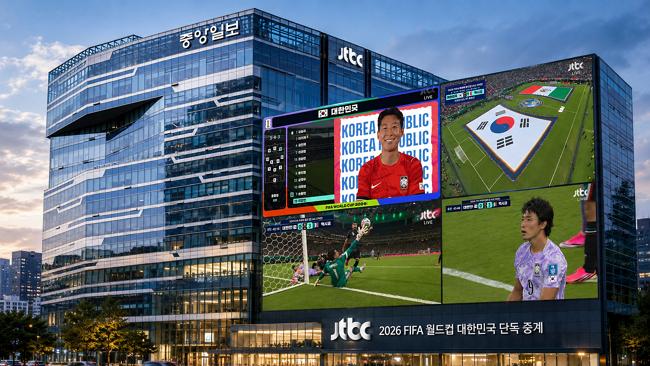
 A composite image combining the JTBC/JoongAng Group headquarters and a World Cup broadcast screen. The issue of unpaid broadcasting fees amidst the rehabilitation process is escalating into a risk for universal viewing rights. [Photo = Hanmi Ilbo Graphics]A controversy is growing following a report by the Japan-based TBS affiliate JNN, which alleged that JTBC has failed to pay a portion of its 2026 FIFA World Cup broadcasting rights fees and raised concerns about potential disruptions to broadcasts after the knockout stage. JTBC immediately refuted the report, stating, "We will broadcast the tournament without disruption through the final."
At this stage, there is no evidence to conclude that the World Cup broadcasts will be halted. However, with JTBC having filed for court receivership and the court having issued preservation orders and comprehensive injunctions, the issue of paying expensive sports broadcasting fees is no longer just a financial matter for the broadcaster; it has the potential to spiral into a risk for universal access to events of national interest.
The core issue is not the willingness to broadcast. Even if JTBC promises normal coverage, within the framework of rehabilitation proceedings, variables such as the exact amount owed, payment deadlines, liquidity, and court approval become far more critical.
This also adds to the responsibility of broadcasting authorities for prior monitoring. If the World Cup is a subject of guaranteed universal viewing rights, broadcasting authorities should have inspected whether broadcast stability could be maintained after the rights were secured.
JNN Report and JTBC's Rebuttal
On the 23rd, JNN reported that JTBC had failed to pay part of its World Cup broadcasting fees to FIFA, and that if payment is not made by the deadline, there is a risk that TV broadcasts in South Korea will not be authorized after the knockout stage beginning on the 29th. The report also cited a source claiming that a JTBC representative had traveled to Switzerland to discuss plans to continue the broadcasts with FIFA.
However, the JNN report did not disclose the specific amount of the outstanding payment, the deadline, or the conditions under which broadcasting could be suspended according to the contract. Therefore, it is difficult to conclude that a broadcast disruption will occur based solely on this report.
What is confirmed is that a Japanese broadcaster raised concerns about the non-payment of fees and potential broadcast disruptions, and that JTBC denied these claims.
In a statement on the 24th, JTBC refuted the JNN report as "false information," reiterating that "we will broadcast without disruption through the final." For viewers, the promise of normal coverage is the priority.
However, the answer required by the rehabilitation court and creditors is different. The central issue remains: is there still money to be paid to FIFA, and if so, what is the legal nature of that debt?
The Nature of Funds Following Preservation Orders is Critical
JTBC and major affiliates of the JoongAng Group filed for rehabilitation amid a liquidity crisis. The Seoul Rehabilitation Court has issued preservation orders and comprehensive injunctions against JTBC and its affiliates.
Once a preservation order is in place, a company cannot arbitrarily expend large sums of money as it did before. The disposal of major assets, repayment of existing debts, provision of collateral, and new borrowing all come under the court's control.
Therefore, if there are indeed outstanding broadcasting fees owed to FIFA as reported by JNN, this is not a matter JTBC can decide on its own.
The court will evaluate whether the payment is necessary to preserve the rehabilitation estate, whether it results in preferential treatment for a specific creditor, and whether the losses would be greater if the payment were not made.
If the unpaid broadcasting fee is a simple debt that arose before the rehabilitation filing, paying FIFA first could be perceived as preferential repayment to a specific creditor.
Conversely, if the payment is deemed essential to maintain the World Cup broadcasts and protect revenue from advertising, sub-licensing, and digital platforms, the assessment changes. In this case, the payment to FIFA would not be seen as a favor to a specific creditor, but as a necessary cost to preserve the value of the rehabilitation.
Ultimately, the court's key question is not "can they pay FIFA," but rather "will the overall rehabilitation value be further damaged if they do not pay FIFA?"
The Key Lies in Outstanding Amounts and Liquidity
According to related reports, JTBC's rights for the 2026 North and Central America World Cup are valued at approximately $125 million, which is around 180 to 190 billion won.
JTBC reached an agreement for joint broadcasting with KBS, and the sub-licensing fee from KBS has been reported as approximately 14 billion won. While there may be additional revenue from digital platforms like Naver, it is difficult to determine the actual net cost borne by JTBC based on currently disclosed figures alone.
What matters is the remaining unpaid balance rather than the total rights fee. If the outstanding amount is in the billions of won and payment can secure the broadcasts of the knockout stage and related revenues, there is room for the court and creditors to accept it.
However, if the unpaid amount reaches tens of billions of won, the situation changes. If a company already in a liquidity crisis and undergoing rehabilitation intends to prioritize paying a large sum to FIFA, the likelihood of opposition from existing creditors will inevitably rise.
JTBC’s stance that "there will be no disruption through the final" is the message viewers need.
However, the issues in the rehabilitation process are more concrete. The criteria for judgment will be: how much is the remaining balance owed to FIFA, is the payment subject to court approval, how much would be lost in advertising, sub-licensing, and platform revenue if not paid, and will the recovery rate for all creditors increase or decrease upon payment?
Universal Viewing Rights: Did the KCC Conduct Prior Inspections?
The World Cup is not merely a broadcasting product. In the broadcasting law framework, the World Cup is a representative event classified as one of national interest. A broadcaster or holder of broadcasting rights must ensure that a certain level of households can watch the content, and failing to provide real-time broadcasts through universal media without justifiable cause is restricted.
This is why the current controversy is expanding into the issue of universal viewing rights. If JTBC does indeed continue normal broadcasts through the final, the immediate infringement of viewing rights will not materialize.
However, the fact that the financial situation of a private broadcaster in rehabilitation and the issue of FIFA fee payments could threaten the stability of viewing for events of national interest is a matter that requires separate investigation.
Therefore, the role of broadcasting authorities such as the Korea Communications Commission (KCC) must also be examined. The question is whether they conducted prior checks on whether JTBC's exclusive rights acquisition, joint broadcasting with terrestrial channels, and digital platform distribution structure were sufficient, and whether the burden of rights fees and potential failure in sub-licensing negotiations could have impacted viewing stability.
The liquidity crisis, the rehabilitation filing, and the court's preservation orders for JTBC and the JoongAng Group were not sudden variables that appeared overnight. The universal viewing rights system should not end with ex-post sanctions but should function as a preventive mechanism to avert broadcast outages for events of national interest.
Remaining Verification Tasks
The remaining issues are clear.
First, the actual outstanding amount of broadcasting fees that JTBC must pay to FIFA needs to be verified.
Second, it must be determined whether this payment is subject to the rehabilitation court's approval, and if so, based on what logic it could be approved.
Third, the safety mechanisms provided by the joint broadcasting structure between JTBC and KBS, as well as digital platform streaming contracts with companies like Naver, must be evaluated regarding the guarantee of universal viewing rights.
Fourth, what checks, if any, the KCC and other broadcasting authorities conducted before and after JTBC’s rehabilitation filing must be verified.
The conclusion to the JTBC World Cup broadcast controversy remains open.
If the actual broadcasts continue without disruption through the final, the concerns raised in the JNN report will not become reality. However, this case is an instance where expensive sports broadcasting rights, the financial risks of a private broadcaster, the court’s control over fund execution, and the guarantee of universal viewing rights are all intertwined.
What needs to be verified now are not declarations, but figures and procedures.
The essence of this controversy lies in how much is owed to FIFA, whether there is capacity to pay, and how the court will categorize these expenses.
At the same time, broadcasting authorities must explain how they monitored the mechanisms for protecting universal viewing rights before the risks associated with the broadcasting fees were highlighted by foreign media reports.
#JTBC #WorldCupBroadcast #JNNReport #UniversalViewingRights #JoongAngGroupRehabilitation #FIFABroadcastingFees #RehabilitationCourt #KCC #ViewingRightsConcerns

 Iranian Foreign Ministry: "Continuing Message Exchanges with the U.S. and Activities of Mediating Countries"
Esmaeil Baghaei, Spokesperson for the Iranian Ministry of Foreign Affairs [Xinhua, Yonhap News file photo]Esmaeil Baghaei, spokesperson for the Iranian Ministry of Foreign Affairs, stated on the 26th
Iranian Foreign Ministry: "Continuing Message Exchanges with the U.S. and Activities of Mediating Countries"
Esmaeil Baghaei, Spokesperson for the Iranian Ministry of Foreign Affairs [Xinhua, Yonhap News file photo]Esmaeil Baghaei, spokesperson for the Iranian Ministry of Foreign Affairs, stated on the 26th
 President Yoon: "Do You Think You Are Safe from the Special Counsel?"... Final Statement Video Released
President Yoon Suk Yeol rebuking the special prosecutor on the 24th. [Court video / @birds_justice X account subtitle GIF] A video of President Yoon Suk Yeol's closing statement at his trial rega
President Yoon: "Do You Think You Are Safe from the Special Counsel?"... Final Statement Video Released
President Yoon Suk Yeol rebuking the special prosecutor on the 24th. [Court video / @birds_justice X account subtitle GIF] A video of President Yoon Suk Yeol's closing statement at his trial rega
 President Yoon, regarding the first-instance ruling on the Public Official Election Act: “An excessive political verdict that distorts the facts… We will appeal immediately.”
The first-instance sentencing hearing for President Yoon Suk Yeol regarding violations of the Public Official Election Act is being broadcast live at Seoul Station on the 27th. [Photo=Yonhap News]Pres
President Yoon, regarding the first-instance ruling on the Public Official Election Act: “An excessive political verdict that distorts the facts… We will appeal immediately.”
The first-instance sentencing hearing for President Yoon Suk Yeol regarding violations of the Public Official Election Act is being broadcast live at Seoul Station on the 27th. [Photo=Yonhap News]Pres
 WSJ: "SK Hynix ADR Premium Is a Sign of AI Trading Overheat"
Advertisement for SK Hynix ADR listing in New York's Times Square [Reuters=Yonhap News file photo]The Wall Street Journal (WSJ) has pointed out that the price of SK Hynix’s American Depositary Recei
WSJ: "SK Hynix ADR Premium Is a Sign of AI Trading Overheat"
Advertisement for SK Hynix ADR listing in New York's Times Square [Reuters=Yonhap News file photo]The Wall Street Journal (WSJ) has pointed out that the price of SK Hynix’s American Depositary Recei
 'Godfather of Japanese Mystery Novels' Keigo Higashino Passes Away After Battle with Cancer at 68
Famous Japanese mystery novelist Keigo Higashino [AFP=Yonhap News]It has been belatedly reported that Keigo Higashino, the "godfather of Japanese mystery novels" and author of bestsellers such as "The
'Godfather of Japanese Mystery Novels' Keigo Higashino Passes Away After Battle with Cancer at 68
Famous Japanese mystery novelist Keigo Higashino [AFP=Yonhap News]It has been belatedly reported that Keigo Higashino, the "godfather of Japanese mystery novels" and author of bestsellers such as "The
 [Park Pil-kyu Security Column] To the Ignorant Trying to Clothe a Beast in Sheep's Clothing
Rep. Kim Byung-joo of the Democratic Party of Korea [Photo=Yonhap News]“The Air Force Academy doesn't teach you how to fly a plane!” “The Army, Navy, and Air Force academies are exactly the
[Park Pil-kyu Security Column] To the Ignorant Trying to Clothe a Beast in Sheep's Clothing
Rep. Kim Byung-joo of the Democratic Party of Korea [Photo=Yonhap News]“The Air Force Academy doesn't teach you how to fly a plane!” “The Army, Navy, and Air Force academies are exactly the
 [Issue Diagnosis] Two Effects of the Election Petition Review
 [Photo] Evidence of Election Fraud Flooding U.S. Media… Trump Had 2.7 Million Votes Stolen
 [Video] U.S. Semiquincentennial Air Show... 'Art in the Sky' streaks across New York
 [Editorial Cartoon] A Draconian Law That Undermines Freedom of Expression

 List
List









