 The outdoor large-scale weaponry exhibition at the ‘War Memorial of Korea.’ We must also improve upon conventional terminology. Calling the tragedy of war a ‘commemoration’ (記念) is a contradiction in terms. ⒸHanmi Ilbo
It has been 76 years since the outbreak of the Korean War (6·25). The Korean War was instigated by the war criminal Kim Il-sung, acting under the instigation of the Soviet Union and Communist China. As a result of this conflict, there were 5 million total casualties and 10 million separated families, including both North and South. The Korean War was the largest and most tragic global conflict of the Cold War era following World War II.
From the perspective of the Republic of Korea, the primary victim of this war, North Korea—which initiated the invasion—and Communist China—which committed the largest number of troops—are our main adversaries. The 16 UN-aligned combatant nations and 24 nations that provided wartime supplies and medical equipment are allies we must never forget. Because of the participation of these allied nations, we are able to enjoy the freedom and prosperity we have today.
Despite the vivid reality, memories, and records of the Korean War, the recent controversy over the ‘War to Resist America and Aid Korea’ (抗美援朝) exhibit at the War Memorial of Korea demonstrates just how ignorant and defenseless we are in this historical war. Perhaps this is the result of our failure to properly define the nature of the Korean War.
Words define reality, and names determine the identity of events; yet, we simply refer to the event by the date ‘June 25.’ This has effectively erased the values of freedom, anti-communism, and the sacrifices of the fallen soldiers that we defended alongside our allies. Conversely, war-criminal states like North Korea and Communist China are distorting and fabricating history through purpose-driven naming.
1. We must see through the communist strategy hidden in the naming of the Korean War by communist states
North Korea refers to the Korean War as the ‘Fatherland Liberation War,’ concealing the reality of their war crime (a surprise southward invasion) and masking their goal of communizing the peninsula. It is a disingenuous war name fitting for a group that illegally occupies the territory of the Republic of Korea under the constitution.
Communist China, which deployed a total of 2.4 million personnel—starting with four divisions (approx. 80,000 troops) of the Chinese People's Volunteer Army composed of former Joseon Volunteer Army members in October 1950—was an aggressor against a neighboring country. Yet, with a sense of brazen audacity, they denounce the intervention of UN forces as illegal and have institutionalized their own narrative by using the ‘War to Resist America and Aid Korea’—a Chinese-centric wrapper meaning ‘resisting America to help North Korea.’ The justification put forth by Communist China is rooted entirely in hegemonistic, self-centered thinking.
The naming of the Korean War by North Korea and Communist China contains a calculated strategy of communization intended to threaten and occupy the Republic of Korea. On the other hand, the term ‘Korean War,’ which we thoughtlessly use as if it were an international standard, obscures the responsibility of the true perpetrators—North Korea, the Soviet Union, and Communist China—and carries the risk of reducing the conflict to a mere internal civil war.
‘Korean War’ is a name that reflects a communist, leftist historical view, one that seeks to dilute the essence of the conflict as an ‘anti-communist war’ and a ‘world war’ in which we, alongside free allies, defeated an ‘invasion by communist states.’ The free right-wing should stop using the term ‘Korean War.’
2. The Korean War is still just a truce, yet war names vary
The Korean Peninsula is currently in a severe state of crisis, with the tightening ties between the North, China, and Russia—the instigators of the war—and Communist China attempting to advance into the East Sea via the Tumen River, accompanied by a flood of white papers expressing a desire for retaliation against the U.S. Yet, acts of security sabotage are being repeated in our country. There are over 20 major instances of such security-threatening actions.
A nation and its people that do not know their security history will find it difficult to defend their present, let alone their future. For a country that cannot even define the nature of its own war, security is a luxury.
We use fragmented terms such as ‘6·25 Incident,’ ‘Gyeongin Disturbance,’ and ‘Korean War.’ The United States, which deployed troops and provided astronomical amounts of war supplies to save the Republic of Korea from communist aggression, suffered significant human losses during the Korean War, including 36,574 deaths, 103,284 injuries, and 7,140 missing or captured personnel.
The U.S. calls it the Korean War, ‘The Forgotten War,’ and ‘The Unknown War.’ The names used by both Korea and the U.S. are vague regarding the essence of why the war occurred and what was preserved.
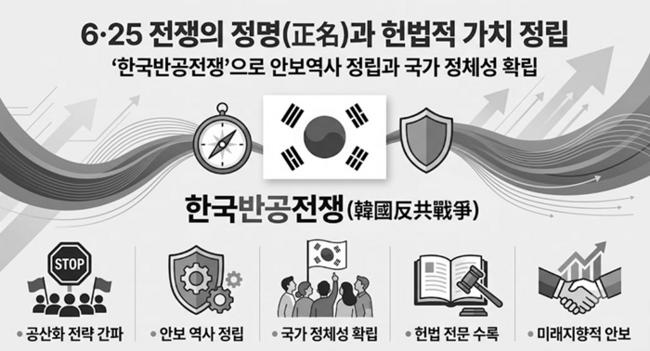
3. We must correctly name the 6·25 war as the ‘Korean Anti-Communist War’
The reason we must correctly name the 6·25 conflict as the ‘Korean Anti-Communist War’ is to restore the essence of the war and establish the identity of the Republic of Korea. While the enemy justifies its aggression with purpose-driven names like ‘Fatherland Liberation War’ and ‘Resist America and Aid Korea,’ the neutral term ‘Korean War’ leaves room to dilute the responsibility of the war criminals—North Korea, Communist China, and the Soviet Union—and reduces the conflict to a simple civil war.
Therefore, by naming it the ‘Korean Anti-Communist War’—combining ‘Anti-Communist’ with ‘Korean War’—we capture the historical core of how we defeated communist totalitarian aggression to protect liberal democracy. We must adopt this correct name to block Communist China's communization strategy through unrestricted warfare and to pass on our national identity of protecting freedom to the next generation.
4. The history of the ‘Korean Anti-Communist War’ must be included in the Preamble of the Constitution
The Constitution is the crystallization of national consensus and a compass for the future. The reason we must specify the ‘Korean Anti-Communist War’ in the Preamble of the Constitution is clear.
First, it proclaims the history of protecting freedom, having overcome the greatest national crisis since the founding of the Republic of Korea.
The Republic of Korea began as a liberal democratic republic in 1948, and through the 6·25 war, we defended that liberal democratic system with our blood. The bridge connecting the legal traditions of the Provisional Government of the March 1st Movement and the democratic ideals of the April 19 Revolution is precisely the ‘anti-communist spirit’ of the Korean War. By explicitly stating the history of the anti-communist war and the spirit of defending freedom in our Constitution, we can firmly pass on the identity of a ‘nation that fights for freedom’ to our allies and the next generation.
Second, it serves as a powerful constitutional defense mechanism against attempts by Communist China and North Korea to distort the war.
The reason North Korea and Communist China define the Korean War as a ‘civil war’ or ‘liberation war’ is a ruse to eventually block the withdrawal of U.S. forces and deter the intervention of allied forces. If we clearly define it as the ‘Korean Anti-Communist War’ in our Constitution, it will serve as a powerful legal foundation to declare our unwavering security resolve to the international community.
We must also improve upon conventional terminology. Calling the tragedy of war a ‘commemoration’ (記念) is a contradiction in terms. We should transition to terms like ‘Korean Anti-Communist War Remembrance Ceremony’ or ‘Korean Anti-Communist War Reflection Event,’ which honor the sacrifices and engrave the values in our hearts. Ensuring that the noble sacrifices of the veterans from 40 nations shine under the name of ‘defending freedom’ is our duty.
5. A nation and people that remember their history of war have a present and a future
On a bronze plaque beneath the Taegeukgi (Korean flag) in the Garden of Gratitude at Gwanghwamun, we should engrave: ‘The Republic of Korea defended its freedom against communist aggression and will continue to fight for freedom in the future.’ Furthermore, we must proudly record the history of the ‘Korean Anti-Communist War’ in the Preamble of the Constitution of the Republic of Korea. That is the reason we enjoy prosperity today, and the most certain mental fortification to prevent a second 6·25 war.
Reflecting this clear truth and historical mission in elementary school textbooks and enshrining it in the Constitution is the most urgent historical command given to our generation today.

◆ Commissioner Park Pil-gyu
Editorial Commissioner of Hanmi Ilbo
40th Class, Korea Military Academy

 Iranian Foreign Ministry: "Continuing Message Exchanges with the U.S. and Activities of Mediating Countries"
Esmaeil Baghaei, Spokesperson for the Iranian Ministry of Foreign Affairs [Xinhua, Yonhap News file photo]Esmaeil Baghaei, spokesperson for the Iranian Ministry of Foreign Affairs, stated on the 26th
Iranian Foreign Ministry: "Continuing Message Exchanges with the U.S. and Activities of Mediating Countries"
Esmaeil Baghaei, Spokesperson for the Iranian Ministry of Foreign Affairs [Xinhua, Yonhap News file photo]Esmaeil Baghaei, spokesperson for the Iranian Ministry of Foreign Affairs, stated on the 26th
 President Yoon: "Do You Think You Are Safe from the Special Counsel?"... Final Statement Video Released
President Yoon Suk Yeol rebuking the special prosecutor on the 24th. [Court video / @birds_justice X account subtitle GIF] A video of President Yoon Suk Yeol's closing statement at his trial rega
President Yoon: "Do You Think You Are Safe from the Special Counsel?"... Final Statement Video Released
President Yoon Suk Yeol rebuking the special prosecutor on the 24th. [Court video / @birds_justice X account subtitle GIF] A video of President Yoon Suk Yeol's closing statement at his trial rega
 President Yoon, regarding the first-instance ruling on the Public Official Election Act: “An excessive political verdict that distorts the facts… We will appeal immediately.”
The first-instance sentencing hearing for President Yoon Suk Yeol regarding violations of the Public Official Election Act is being broadcast live at Seoul Station on the 27th. [Photo=Yonhap News]Pres
President Yoon, regarding the first-instance ruling on the Public Official Election Act: “An excessive political verdict that distorts the facts… We will appeal immediately.”
The first-instance sentencing hearing for President Yoon Suk Yeol regarding violations of the Public Official Election Act is being broadcast live at Seoul Station on the 27th. [Photo=Yonhap News]Pres
 WSJ: "SK Hynix ADR Premium Is a Sign of AI Trading Overheat"
Advertisement for SK Hynix ADR listing in New York's Times Square [Reuters=Yonhap News file photo]The Wall Street Journal (WSJ) has pointed out that the price of SK Hynix’s American Depositary Recei
WSJ: "SK Hynix ADR Premium Is a Sign of AI Trading Overheat"
Advertisement for SK Hynix ADR listing in New York's Times Square [Reuters=Yonhap News file photo]The Wall Street Journal (WSJ) has pointed out that the price of SK Hynix’s American Depositary Recei
 'Godfather of Japanese Mystery Novels' Keigo Higashino Passes Away After Battle with Cancer at 68
Famous Japanese mystery novelist Keigo Higashino [AFP=Yonhap News]It has been belatedly reported that Keigo Higashino, the "godfather of Japanese mystery novels" and author of bestsellers such as "The
'Godfather of Japanese Mystery Novels' Keigo Higashino Passes Away After Battle with Cancer at 68
Famous Japanese mystery novelist Keigo Higashino [AFP=Yonhap News]It has been belatedly reported that Keigo Higashino, the "godfather of Japanese mystery novels" and author of bestsellers such as "The
 [Park Pil-kyu Security Column] To the Ignorant Trying to Clothe a Beast in Sheep's Clothing
Rep. Kim Byung-joo of the Democratic Party of Korea [Photo=Yonhap News]“The Air Force Academy doesn't teach you how to fly a plane!” “The Army, Navy, and Air Force academies are exactly the
[Park Pil-kyu Security Column] To the Ignorant Trying to Clothe a Beast in Sheep's Clothing
Rep. Kim Byung-joo of the Democratic Party of Korea [Photo=Yonhap News]“The Air Force Academy doesn't teach you how to fly a plane!” “The Army, Navy, and Air Force academies are exactly the
 [Issue Diagnosis] Two Effects of the Election Petition Review
 [Photo] Evidence of Election Fraud Flooding U.S. Media… Trump Had 2.7 Million Votes Stolen
 [Video] U.S. Semiquincentennial Air Show... 'Art in the Sky' streaks across New York
 [Editorial Cartoon] A Draconian Law That Undermines Freedom of Expression

 List
List










