 June 3 Local Election Suffrage Infringement Fact-Finding Special Committee [Photo = Yonhap News]
“Since the alleged disenfranchisement and election management irregularities raised during the June 3 election are difficult to clarify through current investigations and election lawsuits alone, a special prosecutor and a special judicial panel are necessary.”
Verification ① Is this case limited only to a shortage of ballots?
According to data submitted to the National Assembly by the National Election Commission (NEC), 7,194 ballots were insufficient at 91 polling stations nationwide, and voting was halted at 26 locations. The longest interruption lasted 105 minutes, and the exact suspension time could not even be verified at three of those locations. This figure is approximately 1.5 times higher than the initial shortage of 4,726 ballots reported.
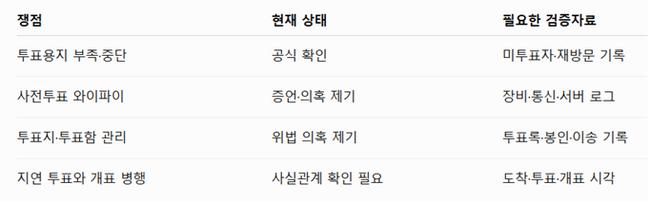
However, this controversy does not end with ballot shortages alone. Wired communication failures at early voting stations, the use of Wi-Fi, the connection process to the integrated electoral roll, the additional printing and transfer of ballots, the sealing, storage, and transport of ballot boxes, and delayed voting that continued while vote counting was already underway in other regions have all been raised as subjects for verification. [See Table 1]
These allegations cannot be labeled as confirmed illegal acts. However, to determine the facts, raw data from equipment and servers held by the NEC, voting logs, observation records, video footage, and internal reports are required.
Verdict: False
Verification ② Can this be sufficiently clarified through current election lawsuits?
Article 224 of the Public Official Election Act stipulates that an election, in whole or in part, shall be invalidated only when there is a violation of election regulations and it is “deemed to have affected the result of the election.”
The law does not contain the phrase “outcome of the candidate’s election.” However, the Supreme Court has interpreted “affected the result of the election” as a case where, had there been no violation, it is possible that the result of the candidate’s election would have been different from reality.
In the 2020 general election invalidation lawsuit, the Supreme Court also ruled that the plaintiff must specifically argue and prove the perpetrator, time, place, and method of the violation, or prove circumstances that reasonably and clearly infer the fact of the violation. It did not hold that the burden of proof is shifted solely because evidence is structurally concentrated within the NEC.
The problem is that key materials, such as communication logs, ballot counts, ballot box transport records, and internal reports, are held by the NEC. The plaintiffs who filed the election lawsuit do not have the authority to conduct search and seizures or digital forensics.
Ultimately, the structure is such that the NEC, which is under scrutiny, holds the evidence, while the burden of proving the illegality and its impact on the results falls on the plaintiffs who lack access to that data.
Verdict: Highly limited
Verification ③ Does every election law violation require proof of “impact on the election outcome”?
The Public Official Election Act does not require proof of impact on the election outcome for every illegal act.
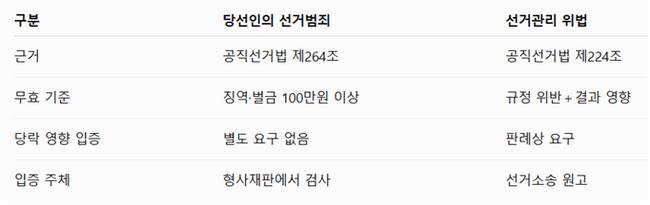
Article 264 invalidates the election of a successful candidate if they commit a crime under the Public Official Election Act or a crime related to election expenses under the Political Funds Act in connection with the election and receive a sentence of imprisonment or a fine of 1 million won or more. Whether the crime actually overturned the vote count is not a separate requirement.
On the other hand, to invalidate an election itself due to the illegality of the election management agency, Article 224 and Supreme Court precedents require that not only the illegality but also the possibility of a change in the election outcome be acknowledged. [See Table 2]
In essence, there is an asymmetry where a candidate's election crime does not require an examination of the vote gap, while in cases where citizens could not vote due to the illegality of a state agency, the victimized citizens must prove the possibility of a changed outcome.
Verdict: False
Verification ④ Is a special prosecutor necessary?
The reason a special prosecutor is needed is not to pre-determine the allegations as facts. It is because the raw data needed to verify the allegations is concentrated within the NEC, the very entity subject to accountability.
A special prosecutor could secure through compulsory investigation the raw logs of early voting communication networks and integrated electoral rolls, quantities of ballots printed, distributed, and collected, records of ballot box sealing and transport, decisions on voting suspension and resumption, and whether internal reports were omitted or data was tampered with.
Based on this, it could be determined whether these were simple operational errors, whether the risks were known in advance but neglected, whether there was subsequent downplaying or cover-up, and the possibility of applying charges of professional negligence, abuse of power, or obstruction of fair elections.
Current election lawsuits are procedures to judge the validity of an election, not procedures to compulsorily investigate criminal charges. Therefore, the necessity of a special prosecutor is recognized to independently secure raw data rather than relying solely on materials submitted by the NEC.
Verdict: Necessity recognized
Verification ⑤ Is a special judicial panel also necessary?
Precedents for having a specialized panel under a special law adjudicate specific matters of national importance already exist. The “Special Act on Criminal Procedures for Crimes of Insurrection, Foreign Aggression, and Rebellion,” which took effect in January 2026, mandated the appointment of warrant-exclusive judges and a dedicated judicial panel for the swift and fair trial of such cases.
Given that the disenfranchisement and doubts about the integrity of the entire election process are directly linked to popular sovereignty and the legitimacy of state institutions, there is sufficient basis for establishing a dedicated panel under a special law.
However, establishing a separate panel alone is ineffective. If the existing legal doctrine that “election results = candidate outcome” and the plaintiff’s burden of proof are applied as they are, a special judicial panel could also conclude that “there was illegality, but the impact on the outcome could not be proven.”
Therefore, a special law must include the NEC's obligation to submit raw data, unfavorable inferences in cases of non-creation, loss, or refusal to submit records, a reduction in the plaintiff’s burden of proof, and strengthened judicial power for ex officio evidence investigation. The “impact on the election result” must also be judged to include not only the candidate's outcome but also the completeness of voting opportunities and results, and the possibility of objective verification.
Verdict: Conditionally necessary
Comprehensive Verdict
A special prosecutor is necessary; a special judicial panel is necessary on the condition of a special law.
The argument that “current investigations and election lawsuits alone can sufficiently clarify the June 3 election allegations and remedy suffrage infringement” is unconvincing.
In current election lawsuits, despite the fact that the NEC holds the core evidence, the plaintiff is required to specifically prove both the fact of illegality and the possibility of a changed outcome. While a candidate's election crime results in the invalidation of the election for a fine of 1 million won or more without questioning the actual impact on the outcome, a higher threshold for remedy is applied to the management failures of state agencies.
A special prosecutor is necessary to independently secure raw data held by the NEC and to clarify criminal responsibility. A special judicial panel is also necessary, but a separate panel applying existing legal principles is insufficient. A special law that corrects the structure of data submission and the burden of proof must be a prerequisite.
A special prosecutor and a special judicial panel are not mechanisms to pre-determine a conclusion of election fraud. They are procedures that allow the state to prove whether the raised allegations are true using raw data, and for an independent judiciary to judge the results. Verifying these allegations is not a rejection of the election results, but a task of restoring the legitimacy of the election.
※ This article was published in the 15th issue of Weekly Hanmi Ilbo (4th week of June).

 Iranian Foreign Ministry: "Continuing Message Exchanges with the U.S. and Activities of Mediating Countries"
Esmaeil Baghaei, Spokesperson for the Iranian Ministry of Foreign Affairs [Xinhua, Yonhap News file photo]Esmaeil Baghaei, spokesperson for the Iranian Ministry of Foreign Affairs, stated on the 26th
Iranian Foreign Ministry: "Continuing Message Exchanges with the U.S. and Activities of Mediating Countries"
Esmaeil Baghaei, Spokesperson for the Iranian Ministry of Foreign Affairs [Xinhua, Yonhap News file photo]Esmaeil Baghaei, spokesperson for the Iranian Ministry of Foreign Affairs, stated on the 26th
 President Yoon: "Do You Think You Are Safe from the Special Counsel?"... Final Statement Video Released
President Yoon Suk Yeol rebuking the special prosecutor on the 24th. [Court video / @birds_justice X account subtitle GIF] A video of President Yoon Suk Yeol's closing statement at his trial rega
President Yoon: "Do You Think You Are Safe from the Special Counsel?"... Final Statement Video Released
President Yoon Suk Yeol rebuking the special prosecutor on the 24th. [Court video / @birds_justice X account subtitle GIF] A video of President Yoon Suk Yeol's closing statement at his trial rega
 President Yoon, regarding the first-instance ruling on the Public Official Election Act: “An excessive political verdict that distorts the facts… We will appeal immediately.”
The first-instance sentencing hearing for President Yoon Suk Yeol regarding violations of the Public Official Election Act is being broadcast live at Seoul Station on the 27th. [Photo=Yonhap News]Pres
President Yoon, regarding the first-instance ruling on the Public Official Election Act: “An excessive political verdict that distorts the facts… We will appeal immediately.”
The first-instance sentencing hearing for President Yoon Suk Yeol regarding violations of the Public Official Election Act is being broadcast live at Seoul Station on the 27th. [Photo=Yonhap News]Pres
 WSJ: "SK Hynix ADR Premium Is a Sign of AI Trading Overheat"
Advertisement for SK Hynix ADR listing in New York's Times Square [Reuters=Yonhap News file photo]The Wall Street Journal (WSJ) has pointed out that the price of SK Hynix’s American Depositary Recei
WSJ: "SK Hynix ADR Premium Is a Sign of AI Trading Overheat"
Advertisement for SK Hynix ADR listing in New York's Times Square [Reuters=Yonhap News file photo]The Wall Street Journal (WSJ) has pointed out that the price of SK Hynix’s American Depositary Recei
 'Godfather of Japanese Mystery Novels' Keigo Higashino Passes Away After Battle with Cancer at 68
Famous Japanese mystery novelist Keigo Higashino [AFP=Yonhap News]It has been belatedly reported that Keigo Higashino, the "godfather of Japanese mystery novels" and author of bestsellers such as "The
'Godfather of Japanese Mystery Novels' Keigo Higashino Passes Away After Battle with Cancer at 68
Famous Japanese mystery novelist Keigo Higashino [AFP=Yonhap News]It has been belatedly reported that Keigo Higashino, the "godfather of Japanese mystery novels" and author of bestsellers such as "The
 [Park Pil-kyu Security Column] To the Ignorant Trying to Clothe a Beast in Sheep's Clothing
Rep. Kim Byung-joo of the Democratic Party of Korea [Photo=Yonhap News]“The Air Force Academy doesn't teach you how to fly a plane!” “The Army, Navy, and Air Force academies are exactly the
[Park Pil-kyu Security Column] To the Ignorant Trying to Clothe a Beast in Sheep's Clothing
Rep. Kim Byung-joo of the Democratic Party of Korea [Photo=Yonhap News]“The Air Force Academy doesn't teach you how to fly a plane!” “The Army, Navy, and Air Force academies are exactly the
 [Issue Diagnosis] Two Effects of the Election Petition Review
 [Photo] Evidence of Election Fraud Flooding U.S. Media… Trump Had 2.7 Million Votes Stolen
 [Video] U.S. Semiquincentennial Air Show... 'Art in the Sky' streaks across New York
 [Editorial Cartoon] A Draconian Law That Undermines Freedom of Expression

 List
List









