 Uber autonomous vehicle under test driving (File) [Yonhap News file photo]
A proposal has been made suggesting the need for specialized sentencing guidelines that determine the proportion of criminal liability between drivers and manufacturers based on the level of autonomous driving in the event of an accident involving an autonomous vehicle.
Ryu Bu-gon, a professor of law at the Korean National Police University, presented this view as a speaker at the 16th Symposium of the Sentencing Research Committee under the Sentencing Commission, held on the afternoon of the 29th at the main auditorium of the Supreme Court in Seocho-gu, Seoul, under the theme of "Traffic Crimes and Sentencing."
Professor Ryu explained, "In an environment of autonomous driving mediated by artificial intelligence (AI), the driver's ability to control the vehicle is significantly reduced or virtually non-existent," adding, "The limitations in attributing responsibility centered on the driver ultimately mean that manufacturers and others who design and operate autonomous driving systems will emerge as new subjects of liability."
Professor Ryu emphasized the need to "establish new sentencing guidelines specialized for autonomous vehicle accidents," such as by differentiating the proportion of responsibility according to the autonomous driving level of the vehicle involved in an accident.
Among autonomous driving levels 0 (no automation) to 5 (full automation), in levels 4 (high automation; the system performs all aspects of driving independently) and above, the burden of responsibility can be placed primarily on the manufacturer and the operation manager.
Professor Ryu further explained that since it is difficult to determine the cause of an accident due to issues with interpreting algorithms, factors such as whether the manufacturer actively cooperates by submitting driving data to investigative agencies, and whether they implemented post-accident risk control measures like immediate recalls, could be reflected as mitigating factors in sentencing.
Regarding cases of driving under the influence of drugs, Professor Ryu offered the opinion that they should not be viewed merely from the perspective of "narcotic driving," but rather "reconstructed on a new coordinate system premised on the medical use of drugs by ordinary citizens."
He argued that the reality must be considered where 4 out of 10 citizens are prescribed medical narcotics, and 96% of drugs detected in drug-driving crackdowns are medical narcotics or non-narcotic medications.
He stressed the need to precisely reflect multi-layered sentencing factors, such as the type of drug (illegal narcotics, prescribed medication, non-narcotic medication) and the actor's awareness (whether a warning against driving was provided upon prescription).
For accidents involving elderly drivers, he suggested that socio-structural conditions, such as accessibility to public transport and whether driving is a means of livelihood, should be specified as sentencing factors, and a structure for managing risks through measures like a conditional driver's license system should be established.
On the other hand, discussant So Jun-seop, a judge at the Gangneung Branch of the Chuncheon District Court, argued for caution in preparing sentencing guidelines for drug-driving at this stage, stating, "The revised Road Traffic Act (which increased statutory penalties for drug-driving) has not even been in effect for three months, so there is an inherent limitation in that sentencing cases have not yet been accumulated."
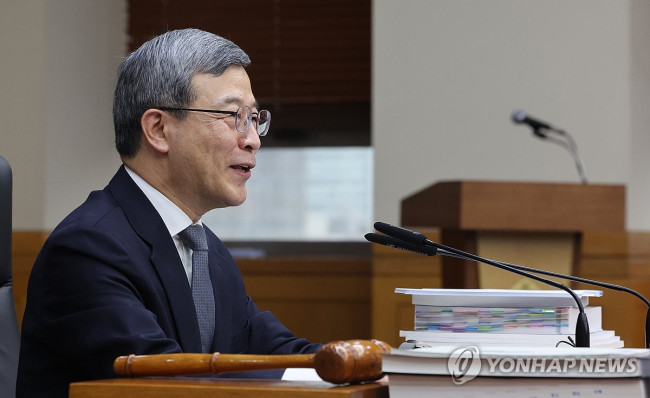 Lee Dong-won, Chairperson of the Sentencing Commission [Yonhap News file photo]
Meanwhile, there was also a suggestion that the sentencing guidelines for the "Min-sik Law," which imposes aggravated punishment for traffic accidents in school zones (child protection zones), have been set excessively high and should be re-examined as they could lead to harsh punishments even for minor actions.
This is because, while child traffic accidents encompass even minor negligence, the sentencing range is set at a level equivalent to dangerous driving resulting in death or injury.
Even when compared to other crime categories, the lower bound of the sentencing guideline for child traffic accidents resulting in injury is 6 months in prison or a 3-million-won fine, and 1 year and 6 months in prison for those resulting in death—which is on the higher side compared to assault resulting in death or general bodily injury (lower bound of 2 months in prison) or serious injury (lower bound of 6 months in prison).
Judge Jeong Ji-woong of the Ansan Branch of the Suwon District Court pointed out, "Since child traffic accidents encompass even cases resulting from minor negligence, the content and degree of illegality are broad, yet by setting a higher lower bound for sentencing compared to other crimes, there is a high possibility of recommending excessive sentences even when the 'act-value' (negative judgment on the act itself) is weak."
Judge Jeong also stated that in sentencing practice, the average sentence handed down is close to the lower bound of the sentencing range, adding, "It appears that courts in most cases judge that the current sentencing guidelines for child traffic accidents set the sentencing range too high."
Judge Jeong also expressed the opinion that the sentencing range for refusing a breathalyzer test should be raised. He noted, "It is a serious violation of fairness in criminal justice that a person who drove while intoxicated but complied with the breathalyzer test could end up receiving a heavier sentence than someone who drove while intoxicated and then refused to be tested."

 Iranian Foreign Ministry: "Continuing Message Exchanges with the U.S. and Activities of Mediating Countries"
Esmaeil Baghaei, Spokesperson for the Iranian Ministry of Foreign Affairs [Xinhua, Yonhap News file photo]Esmaeil Baghaei, spokesperson for the Iranian Ministry of Foreign Affairs, stated on the 26th
Iranian Foreign Ministry: "Continuing Message Exchanges with the U.S. and Activities of Mediating Countries"
Esmaeil Baghaei, Spokesperson for the Iranian Ministry of Foreign Affairs [Xinhua, Yonhap News file photo]Esmaeil Baghaei, spokesperson for the Iranian Ministry of Foreign Affairs, stated on the 26th
 President Yoon: "Do You Think You Are Safe from the Special Counsel?"... Final Statement Video Released
President Yoon Suk Yeol rebuking the special prosecutor on the 24th. [Court video / @birds_justice X account subtitle GIF] A video of President Yoon Suk Yeol's closing statement at his trial rega
President Yoon: "Do You Think You Are Safe from the Special Counsel?"... Final Statement Video Released
President Yoon Suk Yeol rebuking the special prosecutor on the 24th. [Court video / @birds_justice X account subtitle GIF] A video of President Yoon Suk Yeol's closing statement at his trial rega
 President Yoon, regarding the first-instance ruling on the Public Official Election Act: “An excessive political verdict that distorts the facts… We will appeal immediately.”
The first-instance sentencing hearing for President Yoon Suk Yeol regarding violations of the Public Official Election Act is being broadcast live at Seoul Station on the 27th. [Photo=Yonhap News]Pres
President Yoon, regarding the first-instance ruling on the Public Official Election Act: “An excessive political verdict that distorts the facts… We will appeal immediately.”
The first-instance sentencing hearing for President Yoon Suk Yeol regarding violations of the Public Official Election Act is being broadcast live at Seoul Station on the 27th. [Photo=Yonhap News]Pres
 WSJ: "SK Hynix ADR Premium Is a Sign of AI Trading Overheat"
Advertisement for SK Hynix ADR listing in New York's Times Square [Reuters=Yonhap News file photo]The Wall Street Journal (WSJ) has pointed out that the price of SK Hynix’s American Depositary Recei
WSJ: "SK Hynix ADR Premium Is a Sign of AI Trading Overheat"
Advertisement for SK Hynix ADR listing in New York's Times Square [Reuters=Yonhap News file photo]The Wall Street Journal (WSJ) has pointed out that the price of SK Hynix’s American Depositary Recei
 'Godfather of Japanese Mystery Novels' Keigo Higashino Passes Away After Battle with Cancer at 68
Famous Japanese mystery novelist Keigo Higashino [AFP=Yonhap News]It has been belatedly reported that Keigo Higashino, the "godfather of Japanese mystery novels" and author of bestsellers such as "The
'Godfather of Japanese Mystery Novels' Keigo Higashino Passes Away After Battle with Cancer at 68
Famous Japanese mystery novelist Keigo Higashino [AFP=Yonhap News]It has been belatedly reported that Keigo Higashino, the "godfather of Japanese mystery novels" and author of bestsellers such as "The
 [Park Pil-kyu Security Column] To the Ignorant Trying to Clothe a Beast in Sheep's Clothing
Rep. Kim Byung-joo of the Democratic Party of Korea [Photo=Yonhap News]“The Air Force Academy doesn't teach you how to fly a plane!” “The Army, Navy, and Air Force academies are exactly the
[Park Pil-kyu Security Column] To the Ignorant Trying to Clothe a Beast in Sheep's Clothing
Rep. Kim Byung-joo of the Democratic Party of Korea [Photo=Yonhap News]“The Air Force Academy doesn't teach you how to fly a plane!” “The Army, Navy, and Air Force academies are exactly the
 [Issue Diagnosis] Two Effects of the Election Petition Review
 [Photo] Evidence of Election Fraud Flooding U.S. Media… Trump Had 2.7 Million Votes Stolen
 [Video] U.S. Semiquincentennial Air Show... 'Art in the Sky' streaks across New York
 [Editorial Cartoon] A Draconian Law That Undermines Freedom of Expression

 List
List









