 Uber self-driving car on a test drive (file photo) [Yonhap News file photo]
A sitting judge has suggested that the sentencing guidelines for the so-called "Min-sik Law," which imposes heavier penalties for traffic accidents in school zones, are excessively high and require adjustment.
Jang Ji-woong, a judge at the Ansan Branch of the Suwon District Court, made these remarks while presenting at the 16th Symposium of the Sentencing Commission held at the Supreme Court auditorium in Seocho-gu, Seoul, on the afternoon of the 29th, under the theme of "Traffic Crimes and Sentencing."
The "Min-sik Law" was enacted following the 2019 death of Kim Min-sik (then 7 years old) in a traffic accident within a school zone in Asan, South Chungcheong Province. It mandates a maximum penalty of life imprisonment for fatal accidents involving children in school zones.
A look at the detailed sentencing guidelines shows that the lower limit for child traffic injury crimes is six months in prison or a 3 million won fine, while the lower limit for fatal accidents is one year and six months. These are high compared to other categories of crime (e.g., the lower limit for assault resulting in death or general physical injury is two months in prison, and six months for serious injury).
Judge Jang pointed out, "Child traffic accidents are cases of pure negligence that may include minor breaches of duty, and we cannot rule out instances where the illegality of the act is negligible." He further argued that because the sentencing range is set at a level comparable to "dangerous driving resulting in death or injury," there is a risk that even minor negligence could be punished excessively.
"The current sentencing range, particularly the lower limit, is set somewhat high, and it is necessary to reasonably adjust the range so that the degree of responsibility in individual cases can be more accurately reflected," he added.
Attorney Lee Eun-mi (a public defender at the Seoul Eastern District Court), also participating as a panelist, stated, "Since child traffic accidents involve a wide variety of degrees of negligence and circumstances, it is necessary to continuously review the appropriateness of the current sentencing range so that sentences proportionate to the degree of individual responsibility can be handed down."
Judge Jang also expressed the opinion that the sentencing range for refusing a breathalyzer test should be increased. He noted, "It is a severe violation of equity in criminal justice that a person who drives under the influence but complies with a breathalyzer test may be punished more heavily than someone who drives under the influence and also refuses the test."
Lee Seung-jun, a professor at Yonsei Law School who participated in the discussion, agreed, stating, "Refusing a breathalyzer test is not a mere failure to comply with administrative obligations, but constitutes a serious crime of obstruction of justice. Considering the deterrent effect, an increase in the sentencing range can be considered."
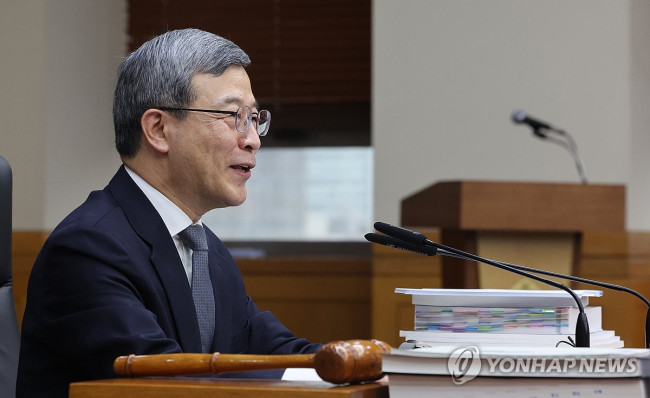 Lee Dong-won, Chairperson of the Sentencing Commission [Yonhap News file photo]
Ryu Bu-gon, a professor at the Korean National Police University's Department of Law, presented on "New Issues in Traffic Crimes and Sentencing Policy," proposing the need for more precise sentencing guidelines regarding drug-impaired driving, elderly driving, and autonomous vehicle driving.
Regarding autonomous vehicle accidents, Professor Ryu explained, "In an autonomous driving environment mediated by artificial intelligence (AI), the driver's ability to exert control is significantly reduced or virtually non-existent. The limitations of attributing responsibility solely to the driver mean that manufacturers who design and operate autonomous driving systems will inevitably emerge as new subjects of responsibility."
He emphasized the need to "establish new sentencing guidelines specialized for autonomous vehicle accidents," such as differentiating the weight of responsibility based on the level of autonomous driving of the vehicle involved. For level 4 (high automation, where the system performs all aspects of driving independently) or above on the 0–5 scale, the responsibility of the manufacturer could be considered absolute.
On the topic of drug-impaired driving, Professor Ryu suggested that it should be "reconstructed on a new coordinate system that assumes the medical use of drugs by ordinary citizens," rather than viewing it solely through the lens of "illegal narcotics."
He argued that the reality must be taken into account: four out of 10 citizens are prescribed medical narcotics, and 96% of drugs detected in drug-impaired driving crackdowns are medical narcotics or non-narcotic prescription drugs.
He stressed the importance of precisely reflecting multi-layered sentencing factors, such as the type of drug (illegal narcotics, medical prescription drugs, or non-narcotic medications) and the offender's awareness (whether a warning against driving was provided upon prescription).
For accidents involving elderly drivers, he suggested explicitly stating socio-structural conditions—such as accessibility to public transport and whether driving is a means of livelihood—as sentencing factors, and creating a framework to manage risks through systems like conditional licensing.
On the other hand, panelist Judge So Jun-seop of the Chuncheon District Court’s Gangneung Branch argued, "The amended Road Traffic Act (which increased statutory penalties for drug-impaired driving) has been in effect for less than three months, leading to an inherent limitation in that sufficient sentencing cases have not yet accumulated." He maintained that caution is required in establishing sentencing guidelines for drug-impaired driving at this stage.

 Iranian Foreign Ministry: "Continuing Message Exchanges with the U.S. and Activities of Mediating Countries"
Esmaeil Baghaei, Spokesperson for the Iranian Ministry of Foreign Affairs [Xinhua, Yonhap News file photo]Esmaeil Baghaei, spokesperson for the Iranian Ministry of Foreign Affairs, stated on the 26th
Iranian Foreign Ministry: "Continuing Message Exchanges with the U.S. and Activities of Mediating Countries"
Esmaeil Baghaei, Spokesperson for the Iranian Ministry of Foreign Affairs [Xinhua, Yonhap News file photo]Esmaeil Baghaei, spokesperson for the Iranian Ministry of Foreign Affairs, stated on the 26th
 President Yoon: "Do You Think You Are Safe from the Special Counsel?"... Final Statement Video Released
President Yoon Suk Yeol rebuking the special prosecutor on the 24th. [Court video / @birds_justice X account subtitle GIF] A video of President Yoon Suk Yeol's closing statement at his trial rega
President Yoon: "Do You Think You Are Safe from the Special Counsel?"... Final Statement Video Released
President Yoon Suk Yeol rebuking the special prosecutor on the 24th. [Court video / @birds_justice X account subtitle GIF] A video of President Yoon Suk Yeol's closing statement at his trial rega
 President Yoon, regarding the first-instance ruling on the Public Official Election Act: “An excessive political verdict that distorts the facts… We will appeal immediately.”
The first-instance sentencing hearing for President Yoon Suk Yeol regarding violations of the Public Official Election Act is being broadcast live at Seoul Station on the 27th. [Photo=Yonhap News]Pres
President Yoon, regarding the first-instance ruling on the Public Official Election Act: “An excessive political verdict that distorts the facts… We will appeal immediately.”
The first-instance sentencing hearing for President Yoon Suk Yeol regarding violations of the Public Official Election Act is being broadcast live at Seoul Station on the 27th. [Photo=Yonhap News]Pres
 WSJ: "SK Hynix ADR Premium Is a Sign of AI Trading Overheat"
Advertisement for SK Hynix ADR listing in New York's Times Square [Reuters=Yonhap News file photo]The Wall Street Journal (WSJ) has pointed out that the price of SK Hynix’s American Depositary Recei
WSJ: "SK Hynix ADR Premium Is a Sign of AI Trading Overheat"
Advertisement for SK Hynix ADR listing in New York's Times Square [Reuters=Yonhap News file photo]The Wall Street Journal (WSJ) has pointed out that the price of SK Hynix’s American Depositary Recei
 'Godfather of Japanese Mystery Novels' Keigo Higashino Passes Away After Battle with Cancer at 68
Famous Japanese mystery novelist Keigo Higashino [AFP=Yonhap News]It has been belatedly reported that Keigo Higashino, the "godfather of Japanese mystery novels" and author of bestsellers such as "The
'Godfather of Japanese Mystery Novels' Keigo Higashino Passes Away After Battle with Cancer at 68
Famous Japanese mystery novelist Keigo Higashino [AFP=Yonhap News]It has been belatedly reported that Keigo Higashino, the "godfather of Japanese mystery novels" and author of bestsellers such as "The
 [Park Pil-kyu Security Column] To the Ignorant Trying to Clothe a Beast in Sheep's Clothing
Rep. Kim Byung-joo of the Democratic Party of Korea [Photo=Yonhap News]“The Air Force Academy doesn't teach you how to fly a plane!” “The Army, Navy, and Air Force academies are exactly the
[Park Pil-kyu Security Column] To the Ignorant Trying to Clothe a Beast in Sheep's Clothing
Rep. Kim Byung-joo of the Democratic Party of Korea [Photo=Yonhap News]“The Air Force Academy doesn't teach you how to fly a plane!” “The Army, Navy, and Air Force academies are exactly the
 [Issue Diagnosis] Two Effects of the Election Petition Review
 [Photo] Evidence of Election Fraud Flooding U.S. Media… Trump Had 2.7 Million Votes Stolen
 [Video] U.S. Semiquincentennial Air Show... 'Art in the Sky' streaks across New York
 [Editorial Cartoon] A Draconian Law That Undermines Freedom of Expression

 List
List









