
South Korea’s fire service has achieved world-class response capabilities through the dedication of its frontline personnel and the implementation of remarkable technologies. The recent mandate for "interlinked fire detectors" in row houses and multi-household dwellings is a welcome milestone, resolving the persistent issue of delayed fire detection and fostering a more unified response.
However, we must now ask more fundamental and incisive questions. Beyond "how do we sound the alarm after a fire starts?" we must ask, "how do we prevent a fire before it happens?" Unfortunately, the numerous mandatory fire safety regulations we have meticulously woven remain trapped within the rigid, outdated mindset of "post-incident response."
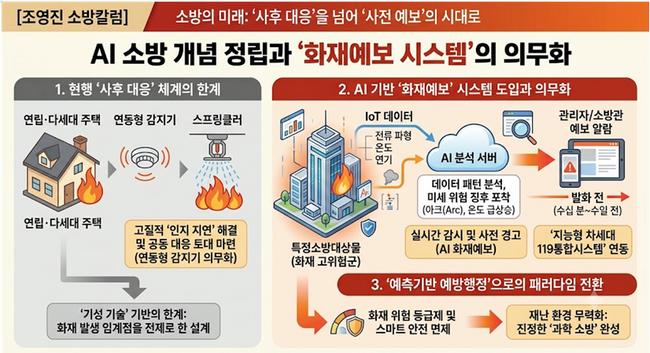
The mandatory provisions of the current "Act on Installation and Management of Firefighting Systems" still do not transcend the boundaries of "legacy technology." For instance, fire detectors are reactive devices that physically sense changes in concentration after heat or smoke is generated, while sprinkler heads are delayed response systems that only activate once a certain temperature is reached. Similarly, visual alarms and automated fire transmission systems only trigger after a fire has already been recognized.
These existing mandates are designed around the threshold of "fire occurrence." However, as Artificial Intelligence (AI) and the Internet of Things (IoT) reshape every aspect of daily life, the fire safety paradigm must shift from "post-incident response," which passively tracks physical phenomena, to "preemptive forecasting," which predicts risks by analyzing data patterns.
Fire safety technology is shifting from "detection"—which assumes a fire will occur—to "forecasting," which prevents the very possibility of one. The technology has already reached a level ready for field deployment. AI-based Electrical Fire Early Warning Systems (ETEC-DPS) analyze electrical current waveforms in distribution boards in real-time to detect minute arcs resulting from wire degradation or faulty connections. They identify warning signs dozens of minutes or even days before an actual fire breaks out and send alerts to facility managers.
Furthermore, "thermal imaging digital twin integration" technology can detect sudden temperature spikes in high-risk areas like underground electric vehicle parking lots and provide firefighters with the optimal response route. Low-Power Wide-Area (LPWA) networks eliminate blind spots in wired infrastructure, allowing entire buildings to be managed as a single, integrated organism.
The problem lies in the fact that laws and institutions remain rooted in the technological soil of the past. The current Act on Installation and Management of Firefighting Systems requires equipment that "detects fires," not systems that "predict and prevent them."
The National Fire Agency must now focus its capabilities on establishing new mandatory regulations for the adoption of "Fire Forecasting Systems." It should legislate the installation of AI-based fire forecasting systems for high-risk fire targets and integrate them with the agency's big data infrastructure to update a city-wide "fire risk map" in real-time. With rising AI learning efficiency and decreasing technological costs, integrating data across all fire safety facilities is no longer a distant future.
Furthermore, the National Fire Agency must shift its paradigm toward "prediction-based preventive administration." Moving beyond the outdated regulations and rigid facility standards noted in forums like the LH technology exchange, I propose a "smart safety exemption system linked to fire risk ratings."
In this model, if a building owner adopts an AI-based forecasting system and shares real-time safety data with authorities, they could be granted exemptions from certain rigid existing standards or provided with incentives. This would create a virtuous cycle that encourages voluntary corporate innovation while providing the fire authorities with precise data, dramatically improving the quality of preventive administration.
The true perfection of a "scientific fire service" lies not in "erasing" disasters, but in utilizing data-driven intelligence to "neutralize" the environments where disasters could occur. Mandating fire forecasting systems is the most certain investment for protecting the lives and property of the people, and it is the inevitable future path for firefighting in the era of the Fourth Industrial Revolution.
Now is the critical moment for the National Fire Agency and the National Assembly to put their heads together and transform old, post-incident-focused bills into proactive safety provisions suitable for the AI forecasting era. I call for and propose a collaborative meeting of officials from all fire and disaster-related departments to seize this opportunity to launch South Korea toward becoming a true "global leader in disaster safety" through decisions that keep pace with the speed of technology.

◆ CEO Cho Young-jin
CEO of Roze AI
What do you think of this article?

 Iranian Foreign Ministry: "Continuing Message Exchanges with the U.S. and Activities of Mediating Countries"
Esmaeil Baghaei, Spokesperson for the Iranian Ministry of Foreign Affairs [Xinhua, Yonhap News file photo]Esmaeil Baghaei, spokesperson for the Iranian Ministry of Foreign Affairs, stated on the 26th
Iranian Foreign Ministry: "Continuing Message Exchanges with the U.S. and Activities of Mediating Countries"
Esmaeil Baghaei, Spokesperson for the Iranian Ministry of Foreign Affairs [Xinhua, Yonhap News file photo]Esmaeil Baghaei, spokesperson for the Iranian Ministry of Foreign Affairs, stated on the 26th
 President Yoon: "Do You Think You Are Safe from the Special Counsel?"... Final Statement Video Released
President Yoon Suk Yeol rebuking the special prosecutor on the 24th. [Court video / @birds_justice X account subtitle GIF] A video of President Yoon Suk Yeol's closing statement at his trial rega
President Yoon: "Do You Think You Are Safe from the Special Counsel?"... Final Statement Video Released
President Yoon Suk Yeol rebuking the special prosecutor on the 24th. [Court video / @birds_justice X account subtitle GIF] A video of President Yoon Suk Yeol's closing statement at his trial rega
 President Yoon, regarding the first-instance ruling on the Public Official Election Act: “An excessive political verdict that distorts the facts… We will appeal immediately.”
The first-instance sentencing hearing for President Yoon Suk Yeol regarding violations of the Public Official Election Act is being broadcast live at Seoul Station on the 27th. [Photo=Yonhap News]Pres
President Yoon, regarding the first-instance ruling on the Public Official Election Act: “An excessive political verdict that distorts the facts… We will appeal immediately.”
The first-instance sentencing hearing for President Yoon Suk Yeol regarding violations of the Public Official Election Act is being broadcast live at Seoul Station on the 27th. [Photo=Yonhap News]Pres
 WSJ: "SK Hynix ADR Premium Is a Sign of AI Trading Overheat"
Advertisement for SK Hynix ADR listing in New York's Times Square [Reuters=Yonhap News file photo]The Wall Street Journal (WSJ) has pointed out that the price of SK Hynix’s American Depositary Recei
WSJ: "SK Hynix ADR Premium Is a Sign of AI Trading Overheat"
Advertisement for SK Hynix ADR listing in New York's Times Square [Reuters=Yonhap News file photo]The Wall Street Journal (WSJ) has pointed out that the price of SK Hynix’s American Depositary Recei
 'Godfather of Japanese Mystery Novels' Keigo Higashino Passes Away After Battle with Cancer at 68
Famous Japanese mystery novelist Keigo Higashino [AFP=Yonhap News]It has been belatedly reported that Keigo Higashino, the "godfather of Japanese mystery novels" and author of bestsellers such as "The
'Godfather of Japanese Mystery Novels' Keigo Higashino Passes Away After Battle with Cancer at 68
Famous Japanese mystery novelist Keigo Higashino [AFP=Yonhap News]It has been belatedly reported that Keigo Higashino, the "godfather of Japanese mystery novels" and author of bestsellers such as "The
 [Park Pil-kyu Security Column] To the Ignorant Trying to Clothe a Beast in Sheep's Clothing
Rep. Kim Byung-joo of the Democratic Party of Korea [Photo=Yonhap News]“The Air Force Academy doesn't teach you how to fly a plane!” “The Army, Navy, and Air Force academies are exactly the
[Park Pil-kyu Security Column] To the Ignorant Trying to Clothe a Beast in Sheep's Clothing
Rep. Kim Byung-joo of the Democratic Party of Korea [Photo=Yonhap News]“The Air Force Academy doesn't teach you how to fly a plane!” “The Army, Navy, and Air Force academies are exactly the
 [Issue Diagnosis] Two Effects of the Election Petition Review
 [Photo] Evidence of Election Fraud Flooding U.S. Media… Trump Had 2.7 Million Votes Stolen
 [Video] U.S. Semiquincentennial Air Show... 'Art in the Sky' streaks across New York
 [Editorial Cartoon] A Draconian Law That Undermines Freedom of Expression

 List
List









