 Patriotic citizens are guarding the vote-counting station inside the Olympic Park Handball Gymnasium, which may contain evidence of election fraud. ⒸHanmi Ilbo
Public distrust and anger toward the National Election Commission (NEC) have reached an all-time high, sparked by the shortage of ballot papers during the June 3 local elections. Evidence of suspected election fraud continues to surface, wave after wave.
During this June 3 local election, a total of 49 reports of suspected fraud were filed with the Election Fraud and Corruption Prevention Corps (Bugbangdae) reporting center, and countless tips via phone calls and emails poured into the <Hanmi Ilbo>.
Numerous subsequent issues have emerged, leading to the inference that this election involved fraud at a much more serious level than any previous one. Following the last installment, we will again take the time to summarize the cases of election fraud in this edition.
30. Mass discovery of forged ballots with copied stamps
At a vote-counting station in Dongan-gu, Anyang-si, Gyeonggi-do, a large quantity of early voting ballots was discovered featuring copied stamps of the early voting administrator. The "Park Hye-jin" stamp, bearing the administrator’s name, was printed within a white square; because the ballot paper was off-white, the distinction was clearly visible.
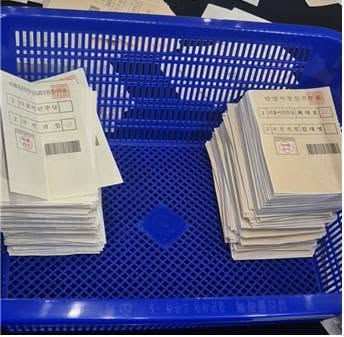
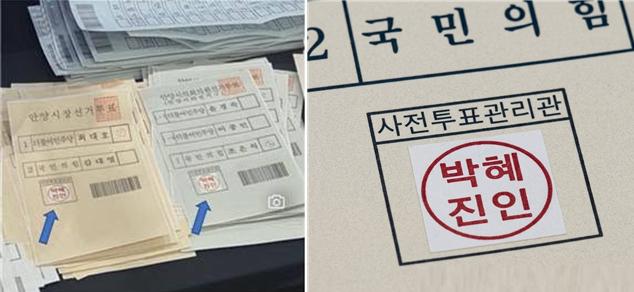 At a vote-counting station in Dongan-gu, Anyang-si, Gyeonggi-do, a large quantity of early voting ballots was discovered featuring copied stamps of the early voting administrator. The problem is that for white ballot papers for National Assembly members, these strange squares would likely have gone unnoticed because they would blend in with the white background.
These forged ballots with copied and pasted stamps were not just one or two; they were piled high in baskets. As is well known, early voting ballots are printed in front of the voter using a ballot printer. Since both the background color and the stamp are printed simultaneously, such a boundary cannot occur.
The Bugbangdae side asked, "An investigation must be conducted into Early Voting Administrator Park Hye-jin and the NEC, which managed the production of these stamps, to clarify the truth," and added, "Will the NEC, which created rules contrary to the Public Official Election Act preventing voting administrators from using their own personal stamps, also recognize ballots marked with these copied stamps as valid?"
31. Discrepancies in the number of voters in the NEC statistical system
The National Election Commission (NEC) publishes the population and the number of eligible voters on the "Final Status Table" of the electoral roll. The number of voters is the number of people with voting rights determined before the election based on a specific point in time, and it should not change during the election period.
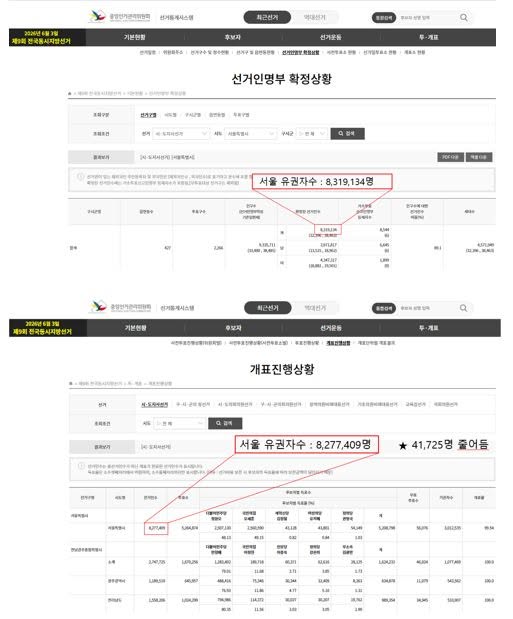 The number of voters in Seoul is 8,319,134 on the final electoral roll status table. However, it is shown as 8,277,409 on the vote-counting progress table. This is a decrease of 41,725 people.
However, the number of voters in Seoul is 8,319,134 on the final electoral roll status table, yet it appears as 8,277,409 on the vote-counting progress table. This is a reduction of 41,725 people.
The number of actual voters changes by date and time depending on whether they cast their votes or not. However, the number of eligible voters, once finalized, serves as the basis for voter turnout and must never be altered.
The Bugbangdae side argued, "It is truly absurd that even the number of eligible voters is inconsistent within the NEC's election statistics system," adding, "Can we trust the election results produced by such a system? Dissolving the NEC is the only solution."
32. Abnormal phenomena in the NEC voting status table
Bugbangdae released a 12-hour surveillance video of the NEC's voting progress table, uncovering abnormal phenomena.
https://www.youtube.com/live/qC97n_ue22w
The video shows that from 15:09:59 to 16:30:01, the number of votes did not change for 1 hour and 20 minutes. Then, at 17:06:00, the number of voters decreased, and from that point until 18:04:30, the number of votes remained stagnant again for 58 minutes and 30 seconds. The Bugbangdae side stated, "It appears that the computer was not tallying during this time but was performing other tasks."
33. NEC's 'Rubber Band Voter Count': Computer manipulation screen captured!
The "number of voters" who cast ballots is an absolute figure that should be finalized immediately upon the close of voting on election day.
However, real-time video footage of the voting progress table shows that the number of voters remained as announced on election day until 18:18:40, when voting concluded. At 18:18:41, a computer manipulation screen was captured where the number of voters was being altered.
https://www.youtube.com/live/krihqEr6jPE
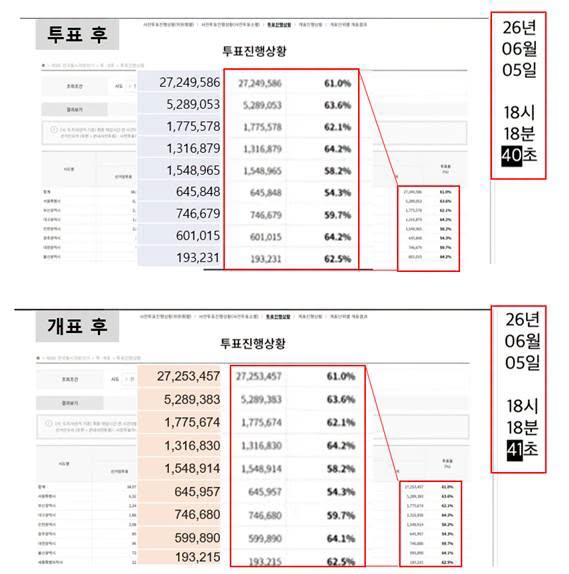 The number of voters remained as announced on election day until 18:18:40, when voting concluded, but a computer manipulation occurred at 18:18:41 where the number of voters was changed.
34. Zero consistency rate between the number of voters and ballot count in 17 cities and provinces
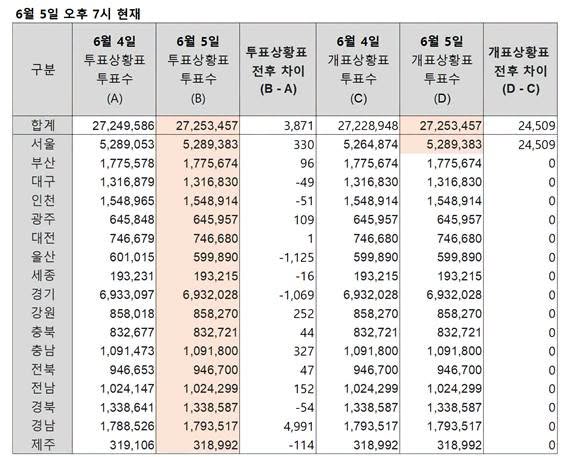
The number of people who voted at polling stations on election day and the number of ballots counted at counting stations should match. However, Bugbangdae revealed that on June 4, the number of voters in the voting progress tables for cities and provinces nationwide did not match the number of ballots in the counting status tables.
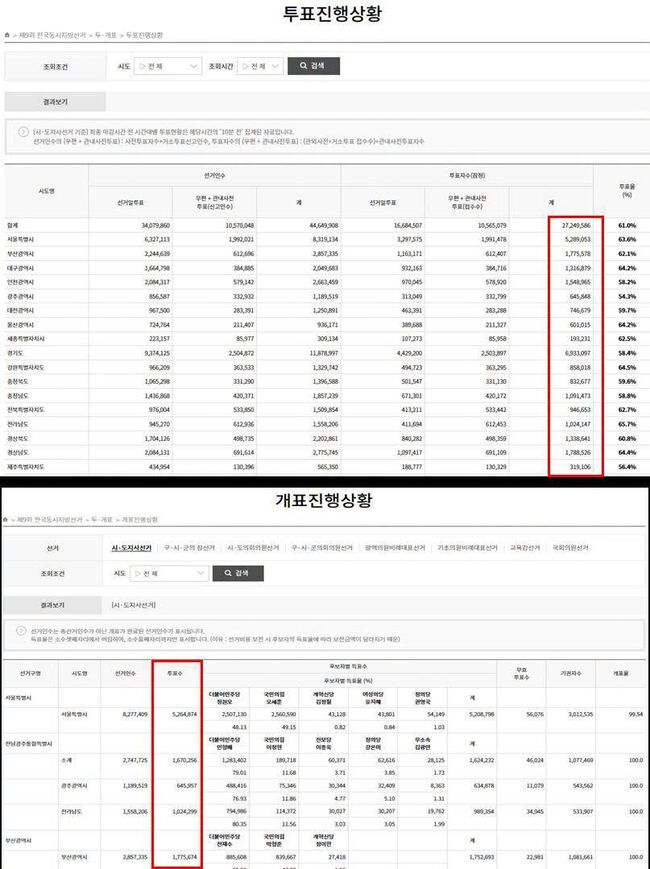 Circumstances where the number of voters in the voting progress tables and the number of ballots in the counting status tables did not match in cities and provinces nationwide were captured on June 4.
Consequently, the NEC unilaterally changed the number of voters in the voting progress tables—which had been announced after voting closed—to match the number of ballots in the counting status tables two days later, on June 5.
One can only say an election was conducted accurately if the number of votes in the voting progress table and the counting status table match. However, looking at the table, there is not a single region among the 17 cities and provinces where the two figures match.
As of 7 p.m. on June 4, the counting rate in Seoul was 99.54%, and the remaining 16 cities and provinces had reached 100%. The counting rate in Songpa-gu, Seoul, is 93.44%. Considering the number of voters on election day in Songpa-gu (347,722), approximately 22,811 ballots remained uncounted. In Seoul alone, 1,368 votes have effectively disappeared. In Ulsan, there were 1,125 (0.19%) fewer ballots than voters, and in Gyeongnam, there were 4,991 (0.28%) more ballots than voters.
Regions with fewer ballots than voters include Seoul, Daegu, Incheon, Ulsan, Sejong, Gyeonggi, Gyeongbuk, and Jeju, while regions with more ballots than voters include Busan, Gwangju, Gangwon, Chungbuk, Chungnam, Jeonbuk, Jeonnam, and Gyeongnam. Daejeon showed the smallest difference, with 1 extra ballot. In any case, a discrepancy is a problem.
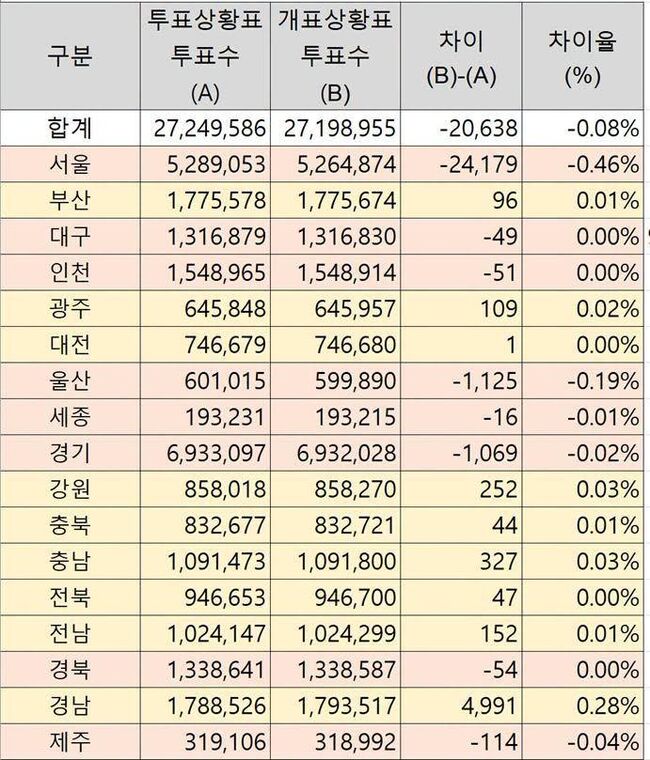 The consistency rate between the number of voters and the number of ballots in 17 cities and provinces was zero.
The Bugbangdae side argued, "Stretching and shrinking the voter count like a rubber band to match the counting results is clear election distortion," adding, "The public can never trust a 'rubber band' voter count that is manipulated ex-post facto without any basis."
Furthermore, they asserted, "Unreliable election data is evidence that the NEC is managing elections in a mess. It is strong supporting material for the dissolution of the NEC."
35. Olyu 1-dong, where ballot papers were excessively surplus
In the 6·3 local elections, an unprecedented "ballot shortage" occurred in the history of South Korean elections, tragically trampling on the sacred right of the people to vote. However, while one side was in an uproar due to a lack of ballots, an event occurred where ballots were left over in another area.
While tragedies involving the infringement of sovereignty—where voters were turned away because ballots ran out—occurred in places like Songpa and Gangnam in Seoul, some areas like Olyu 1-dong in Guro-gu, Seoul, had an excessive surplus of remaining ballot papers.
The surplus was so large that, according to on-site reports, the amount could not even fit into the return bags, causing serious delays in the return process.
Areas that were deprived of voting rights due to a lack of ballots, such as Songpa-gu in Seoul, are traditionally considered to have strong right-wing leanings, whereas Olyu 1-dong in Guro-gu, Seoul, is a region with strong left-wing leanings, causing the public to perceive this situation as something beyond a mere administrative error.
Regarding this incident, where ballot paper allocation fluctuated based on regional voter tendencies, one netizen remarked, "I don't know if this is the NEC's extreme incompetence or a meticulous strategy to control voter turnout in specific areas."
The Bugbangdae side denounced the situation, stating, "The National Election Commission, which has completely collapsed the fairness and credibility of the election, must take legal and political responsibility for this incident," and demanded, "The government and investigative agencies must thoroughly investigate the distribution standards by region and whether there was any intent, so that not a single suspicion remains before the public."
36. Site captured where ballots were issued without voter identity verification
Amidst the national uproar over the ballot shortage in the 6·3 local elections, a report was filed stating that at the 1st Polling Station in Olyu 1-dong, Guro-gu, Seoul, a bizarre incident occurred where ballots were issued before the voters' identities were verified.
According to an informant who visited the polling station at the time, a woman who appeared to be in her mid-50s shouted, "Pen, give me a pen!" before entering the voting booth immediately after receiving her first ballot.
It is common knowledge that any voter in their 50s who has participated in elections for decades should be aware that one must use a "designated stamp" for marking the ballot, not a writing instrument like a ballpoint pen.
Because of this, witnesses at the scene expressed suspicions that the woman might be Chinese and unfamiliar with South Korea's election culture.
The more serious problem occurred afterward. When the informant, who was watching the middle-aged woman place her ballot in the box after marking it, asked if she had gone through normal identity verification, she reportedly admitted, to everyone's surprise, that "identity verification was not performed."
The polling station, finally realizing the situation, rushed to perform identity verification for the woman, only after which the second ballot was issued in a farcical display.
"Identity verification," which confirms whether the voter is the correct person and is listed on the electoral roll, is the first line of defense for a fair election and a legal procedure that can never be omitted.
The fact that the NEC issued ballots indiscriminately while skipping even the most basic procedures explicitly shows how serious the loopholes and gaps were in this election management system.
The NEC must clarify why this serious management failure occurred at the 1st Polling Station in Olyu 1-dong, Guro-gu, and the National Assembly's Special Committee on Election Management must thoroughly investigate the entire process of voter identity verification and ballot management.
37. The 'Black-Top' Ballot
In the 6·3 By-election for the National Assembly in Pyeongtaek-si (Eul), a "black-top ballot" with a black rectangle printed on the top appeared. Candidate Hwang Kyo-ahn stated, "It seems to be a sibling of the 'cabbage leaf ballots' that appeared in the April 15 general election in 2020," and added, "I have filed a lawsuit to invalidate the election."
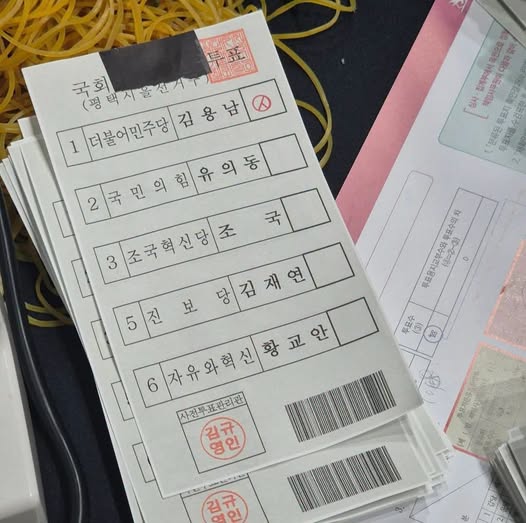 In the 6·3 Pyeongtaek-si (Eul) National Assembly by-election, a "black-top ballot" with a black rectangle printed at the top appeared. [Photo: Bugbangdae]
One netizen raised suspicions, saying, "The black rectangle is a problem, but it is even more suspicious that the edges of the ballot in the photo are white," suggesting, "Isn't it possible that the entire ballot, which was already marked, was reprinted as a single original document?"
The netizen claimed, "If this color difference reflects the actual printing state, it could be interpreted as the entire ballot, including the candidate information, the marking box, and even the mark itself, having been printed as a single image file."
In simpler terms, while only the necessary printing elements should be placed on a white sheet, this ballot appears as if an image of a ballot—including the white paper itself—was reprinted onto paper. In that case, a subtle color difference could appear between the actual paper on the outside and the "paper background" printed inside it.
Therefore, the netizen argued that to confirm this suspicion, one should not just look at the photo, but analyze the actual object using a precision microscope to see if only the necessary elements were printed on the paper, or if the entire ballot, including the mark, was reprinted.
38. Ballot paper with only 2 candidates printed out of 6
The 6·3 local elections were flooded with unusually strange reports. It is claimed that ballot papers were produced and distributed in two versions. In other words, some ballot papers listed only two candidates, while others listed all 5 or 6 remaining candidates.
At first, it was hard to understand, but since there was more than one informant and the details were very specific, there was no choice but to believe it.
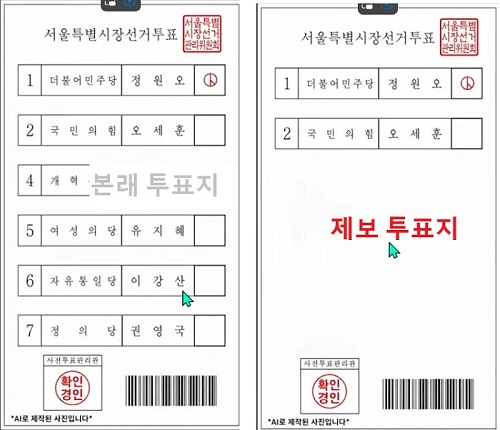 Testimonies are appearing online that voters cast ballots on papers where only two Seoul mayoral candidates were printed on the day of the 6·3 local elections. The photo is a reconstruction of the situation at the time via AI.
First, here is the account revealed to the <Hanmi Ilbo> on the 6th by a senior journalist. The informant testified, "My wife and I received ballots with only Jeong Won-oh and Oh Se-hoon printed on them and voted at the Wonchon Middle School polling station in Banpo 1-dong." He voted around 5:40 p.m., just before the polls closed.
However, he later received a call from an acquaintance saying, "There are papers with only 2 Seoul mayoral candidates, and papers with 6." Because the informant knew that "under the Public Official Election Act, ballots must be of only one type and two types cannot exist," he called people around him to confirm.
He found out that his eldest daughter, son-in-law, and second grandson had voted on the two-candidate ballots, while his eldest grandson had voted on a six-candidate ballot. Also, his second daughter had a six-candidate ballot, but two of her friends living in Gaepo-dong and Jamsil had also received ballots with only the two candidates, Jeong Won-oh and Oh Se-hoon. The more he investigated, the more similar cases he found.
Now for the Gyeonggi-do case. The informant is a retired high-ranking public official residing in Dongtan, Gyeonggi-do. He went to the polling station at 6:10 a.m. on election day, and while the Hwaseong mayoral and Gyeonggi-do superintendent of education ballots were long, the green Gyeonggi-do gubernatorial ballot was short. Seeing only two candidates, Choo Mi-ae and Yang Hyang-ja, he asked an election worker, "Are there only two gubernatorial candidates this time?" and the election worker confirmed it.
Thinking, "This will make it easier to vote," he stamped his ballot, returned home, and while watching PD Lee Young-don’s YouTube channel, he heard that many ballots with only two candidates had appeared in Seoul. Feeling shocked as if hit in the head, the informant started calling his friends living in Gyeonggi-do to investigate.
While many couldn't remember clearly, one junior colleague replied, "It was a ballot with only Choo Mi-ae and Yang Hyang-ja." There were 5 gubernatorial candidates at the time.
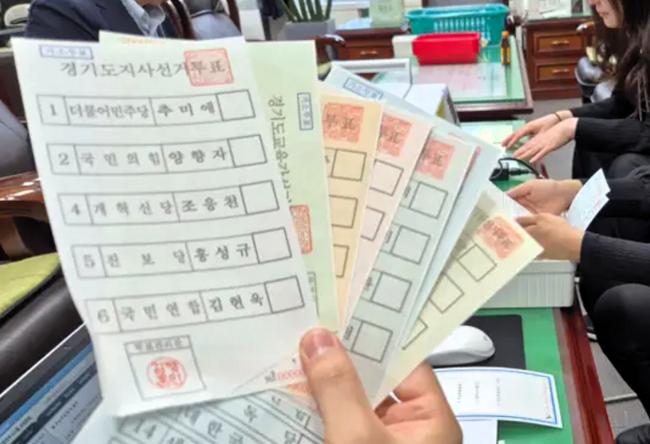 A ballot listing all five Gyeonggi-do gubernatorial candidates. [Photo: Gyeonggi-do Election Commission]
The informant said, "If you check the polling station CCTV, around 6:30 a.m., there should be footage of me receiving the short ballot while talking to the election worker."
However, he called again in the afternoon in an agitated voice. After inquiring with Bugbangdae (Election Fraud and Corruption Prevention Corps), he learned that "there were quite a few reports of people voting on such abnormal ballots," and the bigger problem is that "the two-candidate ballots did not appear at the counting station." He was speechless, asking, "How could this happen unless they swapped the entire lot of ballots?"
39. Too many 'twin' vote counts
In the Incheon mayoral election counting results for the 6·3 nationwide simultaneous local elections, the vote counts for major candidates in the neighboring Incheon Songdo 1-dong and 2-dong early voting were tallied exactly the same, not even differing by a single decimal point.
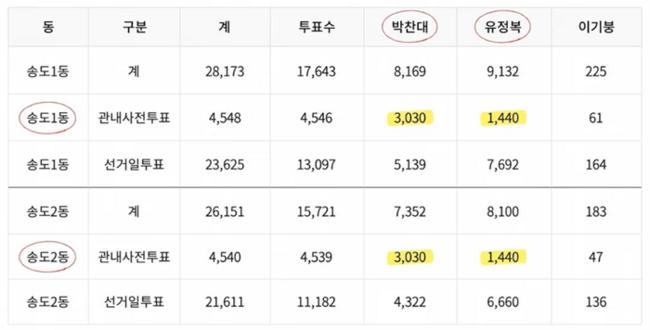 Songdo 1-dong and 3-dong had different total numbers of voters, invalid votes, abstentions, and vote counts for the minor Reform Party candidate Lee Gi-bung (Songdo 1-dong 61 votes, Songdo 2-dong 47 votes). However, strangely enough, the vote counts for the two candidates from the major parties exactly matched at 3030 and 1440 votes, respectively. [Data: Bugbangdae]
According to the Central Election Commission's election statistics system on June 8, early voting results in the Incheon mayoral election showed that the number of votes obtained by Democratic Party candidate Park Chan-dae and People Power Party candidate Yoo Jeong-bok in Songdo 1-dong and Songdo 2-dong matched perfectly.
The two regions had different total numbers of voters, invalid votes, abstentions, and vote counts for the minor Reform Party candidate Lee Gi-bung (Songdo 1-dong 61 votes, Songdo 2-dong 47 votes). However, strangely enough, the vote counts for the two candidates from the major parties exactly matched at 3,030 and 1,440 votes, respectively.
This phenomenon was not just a problem in the Incheon Songdo area. Jang Dong-hyuk, leader of the People Power Party, held a press conference on June 9, prepared with a placard reading 'Early voting, identical vote counts in 12 locations nationwide.'
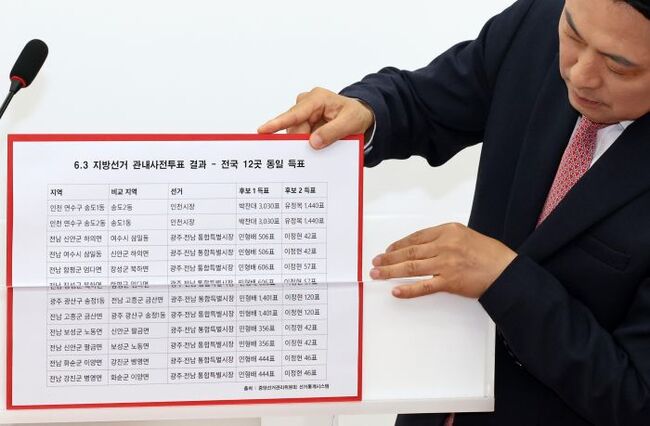 Jang Dong-hyuk, leader of the People Power Party, points to the 12 identical voting results nationwide, saying, "It is a probability of 1 in 590 million, which has to be multiplied 6 times." [Photo: Yonhap News]
Leader Jang stated, "The probability that the vote counts between candidate Yoo Jeong-bok and candidate Park Chan-dae would match exactly is 1 in 590 million," adding, "If you add the Jeonnam and Gwangju election cases, you have to multiply that 1 in 590 million probability 6 times." He emphasized, "If a coincidental event that would be hard to happen even once until the end of the world occurs, it is necessary to resolve public suspicion."
There were even 15 cases (7 in Jeonnam, 6 in Gyeonggi, 2 in Seoul) of "triplet vote counts" where the vote counts of 3 candidates matched simultaneously. Voices demanding transparent verification have continued on online communities and social media, asking, "How can such numbers come out without artificial manipulation?"
Reporter Lim Yo-hee

 Iranian Foreign Ministry: "Continuing Message Exchanges with the U.S. and Activities of Mediating Countries"
Esmaeil Baghaei, Spokesperson for the Iranian Ministry of Foreign Affairs [Xinhua, Yonhap News file photo]Esmaeil Baghaei, spokesperson for the Iranian Ministry of Foreign Affairs, stated on the 26th
Iranian Foreign Ministry: "Continuing Message Exchanges with the U.S. and Activities of Mediating Countries"
Esmaeil Baghaei, Spokesperson for the Iranian Ministry of Foreign Affairs [Xinhua, Yonhap News file photo]Esmaeil Baghaei, spokesperson for the Iranian Ministry of Foreign Affairs, stated on the 26th
 President Yoon: "Do You Think You Are Safe from the Special Counsel?"... Final Statement Video Released
President Yoon Suk Yeol rebuking the special prosecutor on the 24th. [Court video / @birds_justice X account subtitle GIF] A video of President Yoon Suk Yeol's closing statement at his trial rega
President Yoon: "Do You Think You Are Safe from the Special Counsel?"... Final Statement Video Released
President Yoon Suk Yeol rebuking the special prosecutor on the 24th. [Court video / @birds_justice X account subtitle GIF] A video of President Yoon Suk Yeol's closing statement at his trial rega
 President Yoon, regarding the first-instance ruling on the Public Official Election Act: “An excessive political verdict that distorts the facts… We will appeal immediately.”
The first-instance sentencing hearing for President Yoon Suk Yeol regarding violations of the Public Official Election Act is being broadcast live at Seoul Station on the 27th. [Photo=Yonhap News]Pres
President Yoon, regarding the first-instance ruling on the Public Official Election Act: “An excessive political verdict that distorts the facts… We will appeal immediately.”
The first-instance sentencing hearing for President Yoon Suk Yeol regarding violations of the Public Official Election Act is being broadcast live at Seoul Station on the 27th. [Photo=Yonhap News]Pres
 WSJ: "SK Hynix ADR Premium Is a Sign of AI Trading Overheat"
Advertisement for SK Hynix ADR listing in New York's Times Square [Reuters=Yonhap News file photo]The Wall Street Journal (WSJ) has pointed out that the price of SK Hynix’s American Depositary Recei
WSJ: "SK Hynix ADR Premium Is a Sign of AI Trading Overheat"
Advertisement for SK Hynix ADR listing in New York's Times Square [Reuters=Yonhap News file photo]The Wall Street Journal (WSJ) has pointed out that the price of SK Hynix’s American Depositary Recei
 'Godfather of Japanese Mystery Novels' Keigo Higashino Passes Away After Battle with Cancer at 68
Famous Japanese mystery novelist Keigo Higashino [AFP=Yonhap News]It has been belatedly reported that Keigo Higashino, the "godfather of Japanese mystery novels" and author of bestsellers such as "The
'Godfather of Japanese Mystery Novels' Keigo Higashino Passes Away After Battle with Cancer at 68
Famous Japanese mystery novelist Keigo Higashino [AFP=Yonhap News]It has been belatedly reported that Keigo Higashino, the "godfather of Japanese mystery novels" and author of bestsellers such as "The
 [Park Pil-kyu Security Column] To the Ignorant Trying to Clothe a Beast in Sheep's Clothing
Rep. Kim Byung-joo of the Democratic Party of Korea [Photo=Yonhap News]“The Air Force Academy doesn't teach you how to fly a plane!” “The Army, Navy, and Air Force academies are exactly the
[Park Pil-kyu Security Column] To the Ignorant Trying to Clothe a Beast in Sheep's Clothing
Rep. Kim Byung-joo of the Democratic Party of Korea [Photo=Yonhap News]“The Air Force Academy doesn't teach you how to fly a plane!” “The Army, Navy, and Air Force academies are exactly the
 [Issue Diagnosis] Two Effects of the Election Petition Review
 [Photo] Evidence of Election Fraud Flooding U.S. Media… Trump Had 2.7 Million Votes Stolen
 [Video] U.S. Semiquincentennial Air Show... 'Art in the Sky' streaks across New York
 [Editorial Cartoon] A Draconian Law That Undermines Freedom of Expression

 List
List









