 OpenAI CEO Sam Altman [Reuters=Yonhap News]
OpenAI is in detailed discussions to transfer a 5% equity stake to the Donald Trump administration, the Financial Times (FT) reported on the 2nd (local time).
According to the FT, OpenAI CEO Sam Altman has been discussing the matter with President Trump, Commerce Secretary Howard Lutnick, and Treasury Secretary Scott Bessent.
Two sources familiar with the matter stated that Altman proposed the 5% stake during initial consultations, arguing that providing a financial stake is the best way to share the wealth generated by AI with the public.
CNBC also reported early last month that discussions have been ongoing for over a year, ever since Altman first presented the idea to the Trump administration last year.
With OpenAI’s corporate valuation at $852 billion as of March, a 5% stake is worth approximately $42.6 billion (about 66 trillion KRW). While OpenAI had been pushing for an IPO as early as this year, the FT reported that the listing could be delayed until next year.
The core of the proposal is for OpenAI to provide equity to the government to establish a "Public Wealth Fund," which would invest in long-term diversified assets and distribute the returns directly to citizens.
This model is similar to the Alaska Permanent Fund, which pays annual dividends to residents from the profits of oil companies.
The proposal includes provisions for other AI companies such as Anthropic, Google, and Meta to offer similar stakes, though it remains unclear whether they have agreed to such terms.
The FT noted that providing equity to the government could help maintain positive relations with the administration and may be interpreted as an attempt to mitigate political backlash by sharing the wealth created by AI with the general public.
Concerns have been growing among the American public and politicians regarding the construction of large-scale AI data centers and the impact of AI on jobs and cybersecurity.
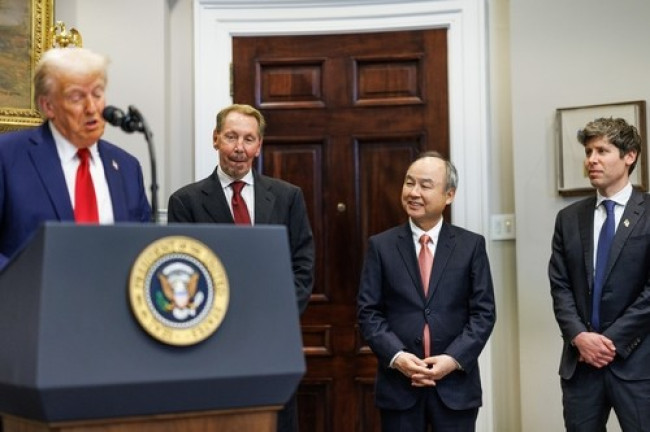 Press conference for the 'Stargate' project at the White House [UPI Yonhap News File Photo]
The Trump administration has already acquired stakes in companies in the semiconductor, quantum computing, and critical minerals sectors, including a $8.9 billion acquisition of a 10% stake in Intel.
This initiative came to public attention early last month. After Senator Bernie Sanders proposed a bill requiring companies like OpenAI, Anthropic, and xAI to pay corporate taxes in stock rather than cash—thereby allowing the government to acquire equity—CEO Altman visited Senator Sanders on June 3rd to discuss the concept of public equity.
President Trump also responded to questions from reporters aboard Air Force One on June 5th, stating that "having the people be a partner in this revolution" would be a "beautiful thing" regarding the government acquiring stakes in major AI firms.
Sources indicated that the discussions are currently in the early stages and that achieving an agreement may require congressional legislation. It is also unclear whether the administration intends to proceed with the stake acquisition.
In a separate op-ed for the FT that same day, CEO Altman proposed that the U.S. lead the creation of global standards and frameworks to ensure AI safety.
Altman described this initiative as a "U.S.-led international forum that establishes agreed-upon standards, provides expert and impartial analysis of capabilities and risks, and allows participating countries and companies that follow the rules to utilize the technology," adding that it could involve "government representatives and independent technical experts."
He argued that such an international forum would provide a "governance mechanism" for AI research and development firms and protect them from dangerous commercial competition, citing global aviation safety, international financial standards, and the International Atomic Energy Agency (IAEA) as potential precedents.
Altman asserted, "Democratic institutions should not outsource their responsibilities to AI labs. Labs develop the technology, but the rules should be made by citizens and their elected representatives," adding, "The most important decisions about how AI technology is used must be made through democratic processes, not by a handful of companies in San Francisco."

 Iranian Foreign Ministry: "Continuing Message Exchanges with the U.S. and Activities of Mediating Countries"
Esmaeil Baghaei, Spokesperson for the Iranian Ministry of Foreign Affairs [Xinhua, Yonhap News file photo]Esmaeil Baghaei, spokesperson for the Iranian Ministry of Foreign Affairs, stated on the 26th
Iranian Foreign Ministry: "Continuing Message Exchanges with the U.S. and Activities of Mediating Countries"
Esmaeil Baghaei, Spokesperson for the Iranian Ministry of Foreign Affairs [Xinhua, Yonhap News file photo]Esmaeil Baghaei, spokesperson for the Iranian Ministry of Foreign Affairs, stated on the 26th
 Yoon “Do you think you’ll be safe from a special prosecutor?”... Final statement video released
President Yoon Suk Yeol rebuking the special prosecutor on the 24th. [Court Video / Subtitled GIF from @birds_justice X account] A video of President Yoon Suk Yeol’s final statement during his trial
Yoon “Do you think you’ll be safe from a special prosecutor?”... Final statement video released
President Yoon Suk Yeol rebuking the special prosecutor on the 24th. [Court Video / Subtitled GIF from @birds_justice X account] A video of President Yoon Suk Yeol’s final statement during his trial
 President Yoon, regarding the first-instance ruling on the Public Official Election Act: “An excessive political verdict that distorts the facts… We will appeal immediately.”
The first-instance sentencing hearing for President Yoon Suk Yeol regarding violations of the Public Official Election Act is being broadcast live at Seoul Station on the 27th. [Photo=Yonhap News]Pres
President Yoon, regarding the first-instance ruling on the Public Official Election Act: “An excessive political verdict that distorts the facts… We will appeal immediately.”
The first-instance sentencing hearing for President Yoon Suk Yeol regarding violations of the Public Official Election Act is being broadcast live at Seoul Station on the 27th. [Photo=Yonhap News]Pres
 WSJ: "SK Hynix ADR Premium Is a Sign of AI Trading Overheat"
Advertisement for SK Hynix ADR listing in New York's Times Square [Reuters=Yonhap News file photo]The Wall Street Journal (WSJ) has pointed out that the price of SK Hynix’s American Depositary Recei
WSJ: "SK Hynix ADR Premium Is a Sign of AI Trading Overheat"
Advertisement for SK Hynix ADR listing in New York's Times Square [Reuters=Yonhap News file photo]The Wall Street Journal (WSJ) has pointed out that the price of SK Hynix’s American Depositary Recei
 'Godfather of Japanese Mystery Novels' Keigo Higashino Passes Away After Battle with Cancer at 68
Famous Japanese mystery novelist Keigo Higashino [AFP=Yonhap News]It has been belatedly reported that Keigo Higashino, the "godfather of Japanese mystery novels" and author of bestsellers such as "The
'Godfather of Japanese Mystery Novels' Keigo Higashino Passes Away After Battle with Cancer at 68
Famous Japanese mystery novelist Keigo Higashino [AFP=Yonhap News]It has been belatedly reported that Keigo Higashino, the "godfather of Japanese mystery novels" and author of bestsellers such as "The
 [Park Pil-kyu Security Column] To the Ignorant Trying to Clothe a Beast in Sheep's Clothing
Rep. Kim Byung-joo of the Democratic Party of Korea [Photo=Yonhap News]“The Air Force Academy doesn't teach you how to fly a plane!” “The Army, Navy, and Air Force academies are exactly the
[Park Pil-kyu Security Column] To the Ignorant Trying to Clothe a Beast in Sheep's Clothing
Rep. Kim Byung-joo of the Democratic Party of Korea [Photo=Yonhap News]“The Air Force Academy doesn't teach you how to fly a plane!” “The Army, Navy, and Air Force academies are exactly the
 [Issue Diagnosis] Two Effects of the Election Petition Review
 [Photo] Evidence of Election Fraud Flooding U.S. Media… Trump Had 2.7 Million Votes Stolen
 [Video] U.S. Semiquincentennial Air Show... 'Art in the Sky' streaks across New York
 [Editorial Cartoon] A Draconian Law That Undermines Freedom of Expression

 List
List









