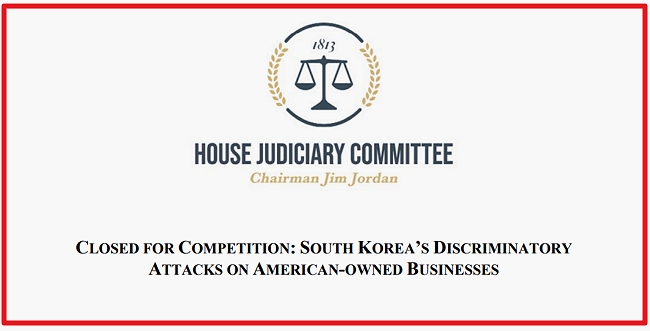
 Interim staff report by the Republican side of the U.S. House Judiciary Committee [Photo: Screen capture of the report cover]
The "Interim Staff Report by the Republican Side of the U.S. House Judiciary Committee" is expanding beyond the controversy surrounding Coupang’s data breach into a trade risk that could shake South Korea’s semiconductor industry and stock market.
The official title of the report is "Closed for Competition: South Korea’s Discriminatory Attacks on American-owned Businesses."
The cover identifies the House Judiciary Committee, Chairman Jim Jordan, the Subcommittee on the Administrative State, Regulatory Reform, and Antitrust, Chairman Scott Fitzgerald, and is dated July 1, 2026, as an interim staff report.
This report did not emerge suddenly.
Hanmi Ilbo has already been tracking the Coupang case, framing it not merely as a data privacy dispute, but as a trajectory that could lead to discrimination against U.S. companies, platform regulation, pressure under Section 301 of the U.S. Trade Act, and risks to tariffs and the semiconductor industry.
Last February, when the House Judiciary Committee held a hearing regarding Coupang, Hanmi Ilbo analyzed it as "a new variable in South Korea-U.S. trade conflict that transcends a simple corporate incident."
This report is an extension of that warning.
A press release from the House Judiciary Committee explained that the report addresses the issue of South Korea’s discrimination against American-owned businesses and the "harassment campaign" against Coupang. Coupang is positioned as a key case study in the report's table of contents.
Chapter II is titled "South Korea Has Weaponized Its Government Agencies to Attack Coupang," and includes sections on unauthorized access by a former employee, allegations of National Intelligence Service (NIS) involvement, National Assembly hearings, and retaliation by the South Korean government.
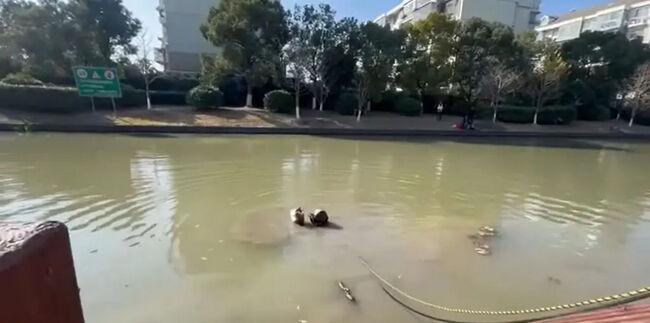 The waterfront area in Shanghai known to be where Coupang retrieved laptops related to the data breach in China. [Photo: Provided by Coupang]
The government and the NIS are refuting the report's content.
However, the danger in this situation is not about "whose claims are ultimately true."
The U.S. is already interpreting this case not as a domestic data privacy sanction, but through the language of "discrimination against U.S. companies" and "digital trade barriers." In particular, the allegations of NIS involvement are points the U.S. could use to argue a lack of fairness in the investigation.
Actual trade procedures are already in motion.
The USTR website includes a separate entry for "Section 301 – Korea’s Acts, Policies, and Practices Concerning Coupang (Petition)."
While it is more accurate to view this as being in the petition stage rather than the retaliation phase, the very fact that the Coupang issue is under the framework of Section 301 of the Trade Act is significant.
The explanatory material for the U.S.-Korea Strategic Trade and Investment Agreement also aligns with this flow.
A fact sheet on the U.S.-Korea Strategic Trade and Investment Agreement released by the USTR includes language ensuring that U.S. companies do not face discrimination or unnecessary barriers in laws and policies related to digital services. "Network usage fees and online platform regulations" were explicitly mentioned as examples.
However, the possibility of the U.S. immediately striking the entire South Korean semiconductor industry is limited.
This is because South Korean memory chips and High Bandwidth Memory (HBM) are linked to Nvidia, U.S. AI data centers, and the capital expenditures of Big Tech. A harsh blow to Korean semiconductors would not only shake the Korean stock market but would also create a backlash against the U.S. AI supply chain and the Nasdaq rally.
Therefore, the expected approach is sophisticated pressure rather than all-out retaliation.
Possible actions include the initiation or expansion of a Section 301 investigation, public pressure regarding Korea’s digital regulations in general, a review of tariff conditions under Section 232 for semiconductors, delays in equipment and technology licensing, stricter screening of end-users related to China, and monitoring compliance with the U.S.-Korea fact sheet.
A "direct hit" does not necessarily mean only immediate high tariffs. Methods that increase the future costs for semiconductor companies—such as revoking tariff exemptions, stalling equipment licensing, or intensifying end-user screening for China—function as direct hits to the market.
The Korean stock market has already responded to the trailer.
On July 2, the won weakened against the dollar, and foreign investors net sold 4.3 trillion won worth of domestic stocks. Foreigners have maintained a net selling streak for 10 consecutive trading days as of that day, and the won has slid to levels near its weakest point since March 2009.
If foreign selling and currency depreciation move separately, interpretations can differ.
If there is only foreign selling, it could be profit-taking; if there is only currency depreciation, it could be dollar strength. However, the story changes when foreigners sell trillions of won in Korean stocks, the won weakens, and large-cap semiconductor stocks shake the entire index simultaneously. The market has no choice but to read this not as simple profit-taking, but as an increase in the risk premium for Korean assets.
Reuters also reported that in the first half of this year, foreign investors sold Asian stocks at the fastest pace on record, with $70.8 billion pulled out of South Korea alone.
South Korea and Taiwan were classified as markets that had risen excessively due to the AI semiconductor rally, and it was analyzed that foreign investors were proceeding with profit-taking and rebalancing in the overcrowded AI winner stocks.
Ultimately, the next point of impact for the Coupang report may not be Coupang itself.
The moment the U.S. uses this report as grounds for claims of discrimination against U.S. companies, digital trade barriers, and flaws in investigation fairness, the tip of the retaliatory blade could turn toward semiconductors—the heart of the Korean stock market.
Even if the U.S. does not impose actual tariffs, the mere mention of a Section 301 investigation and Section 232 tariff cards causes the market to adjust prices in advance.
The Coupang report is not just a problem for Coupang. It is an interim summary of the flow that Hanmi Ilbo has been tracking: the Coupang saga, platform regulation, U.S. congressional investigations, and USTR pressure.
While the Korean media dismisses this as "Coupang's one-sided argument" or merely a "U.S. House Republican report," the U.S. is translating it into the "language of trade retaliation." The Korean stock market is already shaking from the trailer.
※ Hanmi Ilbo will provide an in-depth analysis of this issue in the 17th weekly issue of Hanmi Ilbo. We will provide a comprehensive and in-depth look at the structure of the U.S. House Judiciary Committee's Republican staff report, its connection to Hanmi Ilbo's previous reports, the USTR Section 301 petition and Section 232 semiconductor card, and the impact of foreign selling and currency depreciation on the Korean stock market.

 Iranian Foreign Ministry: "Continuing Message Exchanges with the U.S. and Activities of Mediating Countries"
Esmaeil Baghaei, Spokesperson for the Iranian Ministry of Foreign Affairs [Xinhua, Yonhap News file photo]Esmaeil Baghaei, spokesperson for the Iranian Ministry of Foreign Affairs, stated on the 26th
Iranian Foreign Ministry: "Continuing Message Exchanges with the U.S. and Activities of Mediating Countries"
Esmaeil Baghaei, Spokesperson for the Iranian Ministry of Foreign Affairs [Xinhua, Yonhap News file photo]Esmaeil Baghaei, spokesperson for the Iranian Ministry of Foreign Affairs, stated on the 26th
 President Yoon: "Do You Think You Are Safe from the Special Counsel?"... Final Statement Video Released
President Yoon Suk Yeol rebuking the special prosecutor on the 24th. [Court video / @birds_justice X account subtitle GIF] A video of President Yoon Suk Yeol's closing statement at his trial rega
President Yoon: "Do You Think You Are Safe from the Special Counsel?"... Final Statement Video Released
President Yoon Suk Yeol rebuking the special prosecutor on the 24th. [Court video / @birds_justice X account subtitle GIF] A video of President Yoon Suk Yeol's closing statement at his trial rega
 President Yoon, regarding the first-instance ruling on the Public Official Election Act: “An excessive political verdict that distorts the facts… We will appeal immediately.”
The first-instance sentencing hearing for President Yoon Suk Yeol regarding violations of the Public Official Election Act is being broadcast live at Seoul Station on the 27th. [Photo=Yonhap News]Pres
President Yoon, regarding the first-instance ruling on the Public Official Election Act: “An excessive political verdict that distorts the facts… We will appeal immediately.”
The first-instance sentencing hearing for President Yoon Suk Yeol regarding violations of the Public Official Election Act is being broadcast live at Seoul Station on the 27th. [Photo=Yonhap News]Pres
 WSJ: "SK Hynix ADR Premium Is a Sign of AI Trading Overheat"
Advertisement for SK Hynix ADR listing in New York's Times Square [Reuters=Yonhap News file photo]The Wall Street Journal (WSJ) has pointed out that the price of SK Hynix’s American Depositary Recei
WSJ: "SK Hynix ADR Premium Is a Sign of AI Trading Overheat"
Advertisement for SK Hynix ADR listing in New York's Times Square [Reuters=Yonhap News file photo]The Wall Street Journal (WSJ) has pointed out that the price of SK Hynix’s American Depositary Recei
 'Godfather of Japanese Mystery Novels' Keigo Higashino Passes Away After Battle with Cancer at 68
Famous Japanese mystery novelist Keigo Higashino [AFP=Yonhap News]It has been belatedly reported that Keigo Higashino, the "godfather of Japanese mystery novels" and author of bestsellers such as "The
'Godfather of Japanese Mystery Novels' Keigo Higashino Passes Away After Battle with Cancer at 68
Famous Japanese mystery novelist Keigo Higashino [AFP=Yonhap News]It has been belatedly reported that Keigo Higashino, the "godfather of Japanese mystery novels" and author of bestsellers such as "The
 [Park Pil-kyu Security Column] To the Ignorant Trying to Clothe a Beast in Sheep's Clothing
Rep. Kim Byung-joo of the Democratic Party of Korea [Photo=Yonhap News]“The Air Force Academy doesn't teach you how to fly a plane!” “The Army, Navy, and Air Force academies are exactly the
[Park Pil-kyu Security Column] To the Ignorant Trying to Clothe a Beast in Sheep's Clothing
Rep. Kim Byung-joo of the Democratic Party of Korea [Photo=Yonhap News]“The Air Force Academy doesn't teach you how to fly a plane!” “The Army, Navy, and Air Force academies are exactly the
 [Issue Diagnosis] Two Effects of the Election Petition Review
 [Photo] Evidence of Election Fraud Flooding U.S. Media… Trump Had 2.7 Million Votes Stolen
 [Video] U.S. Semiquincentennial Air Show... 'Art in the Sky' streaks across New York
 [Editorial Cartoon] A Draconian Law That Undermines Freedom of Expression

 List
List










