 [AI-Generated Image/ChatGPT]
"Could the posts I upload to social media be subject to punishment?"
As the revised Information and Communications Network Act is set to take effect on the 7th, interest and controversy surrounding the regulation of online false and manipulated information are mounting.
The government explains that this system is a mechanism designed to curb the repetitive and profit-driven distribution of false and manipulated information that has been adjudicated by the courts, and to enhance trust in the online environment.
On the other hand, some users and civic groups raise concerns that the regulation process could stifle freedom of expression or lead platform operators to excessively delete posts to avoid controversy.
Amid anxiety online—with some asking, "Should I delete my existing posts?"—the government is cautioning against excessive interpretation, stating that "simple expressions of opinion, criticism, or political assertions themselves are not subject to regulation."
 [AI-Generated Image/ChatGPT]
◇ Curbing the repetitive distribution of false and manipulated information... Mandating responses from major platforms
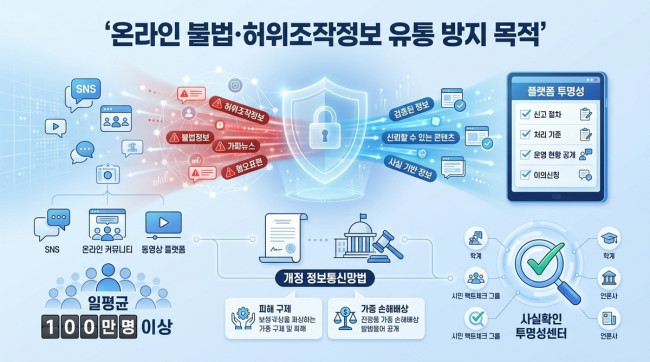
The revised Information and Communications Network Act was enacted to prevent the distribution of illegal, false, and manipulated information online and to strengthen victim relief.
There have been persistent criticisms that even when damage from false information occurs, it is difficult to identify the author or receive compensation, and the need for institutional response has been raised as the distribution of false information aimed at views and advertising revenue has continued.
In response, the National Assembly revised the law last January to establish obligations to prevent the distribution of false and manipulated information and to create procedures for victim relief, while also allowing for punitive damages for harm caused by intent or gross negligence.
The Korea Communications Commission (KCC) recently finalized the follow-up institutional framework by approving the enforcement decree and relevant notifications.
Following the enforcement of the revised law, large-scale information and communications service providers—such as social media, online communities, and video-sharing services with an average of 1 million or more daily users over the past three months—must establish operational policies for responding to false and manipulated information.
Given the user count criteria, major social media platforms like YouTube and Instagram, as well as large online communities and video platforms like DC Inside, are expected to be included. They are required to regularly disclose their operational status, including user reporting procedures, processing criteria, and plans to link with fact-checking activities.
Furthermore, when a report is received, the service must notify the relevant party of the report, and if measures such as deletion or blocking are taken, the reasons and the appeal process must be communicated to both the reporter and the poster.
The KCC has designated the International Fact-Checking Network (IFCN) principles as the standard for fact-checking activities. It also plans to support cooperation between private fact-checking organizations and platforms, and operate a 'Transparency Center' to back these efforts.
 [AI-Generated Image/ChatGPT]
◇ "Will my social media posts be punished?"... Court judgment and profit-driven distribution are the criteria
Ahead of the law's implementation, concerns have been spreading online, with many asking, "Will my posts also be subject to punishment?"
However, the government clarifies that the law is not intended to regulate general expressions of opinion or political arguments themselves.
The targets for administrative fines are profit-seeking posters who distribute content found to be illegal or false/manipulated by a final court judgment two or more times. They must also meet criteria such as having posted three or more such pieces of information in the previous three months to generate advertising or sponsorship revenue, and having 100,000 or more subscribers or an average of 100,000 or more monthly views.
There is also a distinction in the services to which this applies.
Closed interpersonal communication services, such as KakaoTalk, are excluded from regulation. Conversely, services where an unspecified number of people participate and information is distributed publicly, such as open chat rooms, may be subject to regulation.
This is a result of focusing on regulating information distribution in the public online sphere rather than private conversations. Search services and open markets, which were initially considered, were ultimately excluded based on the recommendations of the Regulatory Rationalization Committee.
While the strongest sanction is a fine of up to 1 billion won, the scope of its application is limited.
The KCC stated that it plans to calculate fines by reflecting aggravating and mitigating factors based on the gravity of the violation.
It reiterated that receiving a report does not automatically lead to a judgment of "false and manipulated information," and that the imposition of fines is predicated on a final court judgment.
 [AI-Generated Image/ChatGPT]
◇ Concerns over stifled expression persist... The task of balancing fact-checking and freedom
The government expects this system to serve as an opportunity to suppress the spread of false and manipulated information and enhance trust in the online space.
Kim Jong-chul, Chairman of the KCC, recently stated at a plenary session, "The revised Information and Communications Network Act is an institutional safety net to respond to false and manipulated information that undermines trust."
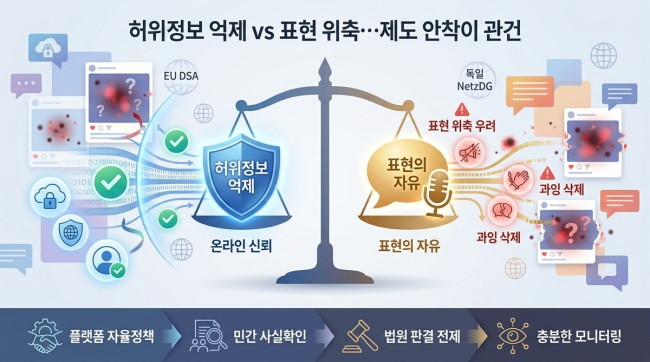
However, some domestic users are demanding the law's repeal through petitions to the National Assembly, and concerns are being raised in online communities that it "could become a means of government censorship" or that "legitimate posts could be deleted."
On one large community for mothers, posts such as "Won't we be punished if we say one wrong word?" have appeared, and in some online communities, photos of pickets with the phrase "On July 7th, your voice will disappear" have been shared.
Even within the KCC, the possibility of over-enforcement in the initial stages of implementation has been mentioned.
At a recent plenary session, Commissioner Choi Soo-young pointed out the need for sufficient monitoring, noting the possibility that businesses might excessively delete posts due to fears of legal risk.
Similar controversies have occurred overseas as well. A trend of countries strengthening regulations to respond to online false and illegal information is emerging.
The European Union (EU) has strengthened the responsibilities of large platforms through the Digital Services Act (DSA), and Germany imposes obligations to delete illegal content through the Network Enforcement Act (NetzDG).
However, experts note that while the domestic system is similar in that it strengthens platform responsibility, it differs in that it regulates the repetitive and profit-driven distribution of content already determined to be illegal or false by court judgment, rather than imposing broad deletion obligations on platforms.
The KCC explained that the structure is not one where the government directly judges whether information is false or manipulated, but one where it is judged through operational policies autonomously established by platforms and private fact-checking procedures.
It added that it has also provided safeguards for freedom of expression, such as excluding reports made for public interest or cases where there is a reasonable belief in the truth of the information from the scope of punitive damages.
Ultimately, the success or failure of the new system will likely be determined by its actual operation following implementation.
Key points to watch in the future include how the platforms' deletion and blocking criteria will be operated, whether concerns regarding businesses' excessive responses will materialize, the scope to which courts will judge information as false or manipulated, and whether a balance can be maintained between curbing false information and protecting freedom of expression.

 Iranian Foreign Ministry: "Continuing Message Exchanges with the U.S. and Activities of Mediating Countries"
Esmaeil Baghaei, Spokesperson for the Iranian Ministry of Foreign Affairs [Xinhua, Yonhap News file photo]Esmaeil Baghaei, spokesperson for the Iranian Ministry of Foreign Affairs, stated on the 26th
Iranian Foreign Ministry: "Continuing Message Exchanges with the U.S. and Activities of Mediating Countries"
Esmaeil Baghaei, Spokesperson for the Iranian Ministry of Foreign Affairs [Xinhua, Yonhap News file photo]Esmaeil Baghaei, spokesperson for the Iranian Ministry of Foreign Affairs, stated on the 26th
 President Yoon: "Do You Think You Are Safe from the Special Counsel?"... Final Statement Video Released
President Yoon Suk Yeol rebuking the special prosecutor on the 24th. [Court video / @birds_justice X account subtitle GIF] A video of President Yoon Suk Yeol's closing statement at his trial rega
President Yoon: "Do You Think You Are Safe from the Special Counsel?"... Final Statement Video Released
President Yoon Suk Yeol rebuking the special prosecutor on the 24th. [Court video / @birds_justice X account subtitle GIF] A video of President Yoon Suk Yeol's closing statement at his trial rega
 President Yoon, regarding the first-instance ruling on the Public Official Election Act: “An excessive political verdict that distorts the facts… We will appeal immediately.”
The first-instance sentencing hearing for President Yoon Suk Yeol regarding violations of the Public Official Election Act is being broadcast live at Seoul Station on the 27th. [Photo=Yonhap News]Pres
President Yoon, regarding the first-instance ruling on the Public Official Election Act: “An excessive political verdict that distorts the facts… We will appeal immediately.”
The first-instance sentencing hearing for President Yoon Suk Yeol regarding violations of the Public Official Election Act is being broadcast live at Seoul Station on the 27th. [Photo=Yonhap News]Pres
 WSJ: "SK Hynix ADR Premium Is a Sign of AI Trading Overheat"
Advertisement for SK Hynix ADR listing in New York's Times Square [Reuters=Yonhap News file photo]The Wall Street Journal (WSJ) has pointed out that the price of SK Hynix’s American Depositary Recei
WSJ: "SK Hynix ADR Premium Is a Sign of AI Trading Overheat"
Advertisement for SK Hynix ADR listing in New York's Times Square [Reuters=Yonhap News file photo]The Wall Street Journal (WSJ) has pointed out that the price of SK Hynix’s American Depositary Recei
 'Godfather of Japanese Mystery Novels' Keigo Higashino Passes Away After Battle with Cancer at 68
Famous Japanese mystery novelist Keigo Higashino [AFP=Yonhap News]It has been belatedly reported that Keigo Higashino, the "godfather of Japanese mystery novels" and author of bestsellers such as "The
'Godfather of Japanese Mystery Novels' Keigo Higashino Passes Away After Battle with Cancer at 68
Famous Japanese mystery novelist Keigo Higashino [AFP=Yonhap News]It has been belatedly reported that Keigo Higashino, the "godfather of Japanese mystery novels" and author of bestsellers such as "The
 [Park Pil-kyu Security Column] To the Ignorant Trying to Clothe a Beast in Sheep's Clothing
Rep. Kim Byung-joo of the Democratic Party of Korea [Photo=Yonhap News]“The Air Force Academy doesn't teach you how to fly a plane!” “The Army, Navy, and Air Force academies are exactly the
[Park Pil-kyu Security Column] To the Ignorant Trying to Clothe a Beast in Sheep's Clothing
Rep. Kim Byung-joo of the Democratic Party of Korea [Photo=Yonhap News]“The Air Force Academy doesn't teach you how to fly a plane!” “The Army, Navy, and Air Force academies are exactly the
 [Issue Diagnosis] Two Effects of the Election Petition Review
 [Photo] Evidence of Election Fraud Flooding U.S. Media… Trump Had 2.7 Million Votes Stolen
 [Video] U.S. Semiquincentennial Air Show... 'Art in the Sky' streaks across New York
 [Editorial Cartoon] A Draconian Law That Undermines Freedom of Expression

 List
List









