 Lee Jae-myung speaks at the Public-Private Joint Mega-Project Review Meeting held at the Blue House on the 6th. Samsung Electronics President Kim Yong-kwan and SK Hynix CEO Kwak Noh-jung attended the meeting as corporate representatives. [Photo=Yonhap News]
On the 6th, during the Public-Private Joint Mega-Project Review Meeting at the Blue House, Lee Jae-myung emphasized that "speed is the only thing that matters" regarding what the government calls the "Three Mega-Projects," or what Hanmi Ilbo has effectively dubbed the "Honam Semiconductor" initiative. Samsung Electronics President Kim Yong-kwan and SK Hynix CEO Kwak Noh-jung attended the meeting as representatives of their respective companies.
At the meeting, Lee stated, "We must organize the implementation framework today and discuss and finalize the site selection in concrete terms."
The rhetoric was framed as corporate support. However, the reality of the meeting told a different story.
The companies have not yet confirmed these as definite investments. The regulatory filings submitted by Samsung Electronics and SK Hynix were "fair disclosure filings regarding future business and management plans," not official announcements of finalized investment decisions. These filings included caveats regarding potential changes in scale and schedule, requirements for future board approval, and the tentative nature of the potential sites.
Yet, in the Blue House meeting, topics such as finalizing site selection, conducting administrative procedures in parallel, simultaneously proceeding with land acquisition, utilizing existing environmental impact assessment results, and preemptively securing power and water supplies were all discussed at once.
This scene resembled corporate coercion more than industrial policy.
A normal government process involves companies assessing investment viability based on market demand, product mix, long-term customer contracts, and financial conditions, with the government then respecting those judgments and providing necessary infrastructure support. The government can rightfully assist with electricity, water, roads, power grids, tax incentives, and permits.
However, demand, pricing, and the feasibility of recouping an investment cannot be manufactured by presidential decree.
Lee told the company representatives, "Stop with the pleasantries and abstract talk, and tell us specifically what you need." But the issue for these companies is not about formalities.
The first thing a company must consider is demand. What kind of semiconductor can they sell, to which customers, at what price, and for how many years? An 800 trillion won investment that cannot answer these questions is not a national strategic industry; it is a national-level gamble.
800 Trillion Won Without a Definitive Filing: Why Does the Government Speak as if It’s Confirmed?
Hanmi Ilbo has previously pointed out this problem through three in-depth analyses.
The first piece determined, based on the filings by Samsung Electronics and SK Hynix, that the "800 Trillion Won Honam Semiconductor" project is not a confirmed investment, but rather a conditional concept involving future plans, guidelines, potential sites, and the possibility of change.
The second piece pointed out that memory shortages in 2026 are not a sufficient condition for four new fabs in the 2030s, and that long-term supply contracts, product mix, limitations of existing hubs, and verification of total costs must come first.
The third piece examined issues related to power, water, RE100, nuclear energy, and KEPCO's grid. <See related articles below>
However, power and water are not the entirety of the issue. While important, they are secondary. With enough time and money, power grids can be laid and water pipes can be buried. Site and infrastructure can also be built to some extent through tax support, subsidies, special legislation, and expedited permitting.
The real problem is: "Will the factories built on that foundation actually make money for the next 20 or 30 years?"
A Yonhap News report cited industry insiders as saying, "For companies, if the site is secured and infrastructure like power and water are provided quickly, there is no reason not to invest." However, this explanation only aligns with half of economic common sense.
Having sites and infrastructure improves the conditions for investment. But it does not equate to a confirmed business feasibility. Being able to build a factory and being able to make money by operating it are entirely different matters. Infrastructure is the former; business viability is the latter.
An investment decision that bypasses business viability does not align with economic logic. Power and water are conditions for running a factory, not customers for the products. Power grids cannot create demand, and water pipes cannot guarantee prices.
Pushing for an 800 trillion won investment through a "speed-first" approach, without disclosing concrete grounds for sales volume, pricing, and potential for return on investment, is not industrial policy—it is a dangerous national-level bet.
800 Trillion Won is Not the End
800 trillion won is not a sum that can be dismissed as a mere numbers game. The total expenditure of the Republic of Korea for 2026 is 727.9 trillion won. The 800 trillion won figure discussed for the Honam Semiconductor investment is larger than the entire national budget for a single year.
Furthermore, it is unlikely that this figure includes all costs for public infrastructure such as power, water, power grids, industrial complex facilities, tax support, and subsidies.
From the corporate perspective, securing a site itself can act as a strategic option.
They can secure the land first, and if market conditions improve, they can build the factory then. Conversely, if demand drops or prices collapse, they can delay the investment. If land values rise in the meantime, the company might be able to hedge some of its losses.
However, it is different for the state.
If the government and local authorities lay down the power grids, water networks, roads, industrial infrastructure, tax benefits, and subsidies first, and then the companies decide, "It is not yet time to invest," the burden remains on the public.
For companies, securing land may be an option, but for the state, preemptive infrastructure investment can become a sunk cost.
Therefore, the actual national burden of the Honam Semiconductor project does not end at 800 trillion won.
It could lead to a structure where the companies put money into factories and equipment, while the state supports them with power, water, land, and tax breaks. If the business succeeds, it could be a massive windfall for the national industry.
However, if the demand forecast is wrong, it won’t just be corporate investment that falters. The public’s tax money and investment in public infrastructure will also be at risk.
The semiconductor industry is a cyclical one where the risk of oversupply upon completion often follows investment decisions made during shortages.
The current AI and HBM boom does not guarantee the profitability of massive new production capacity in the 2030s. The potential for return on investment varies completely depending on whether it is for general-purpose memory, HBM, advanced packaging, or foundry.
The statement that "semiconductor demand is increasing" cannot substitute for an 800 trillion won investment judgment.
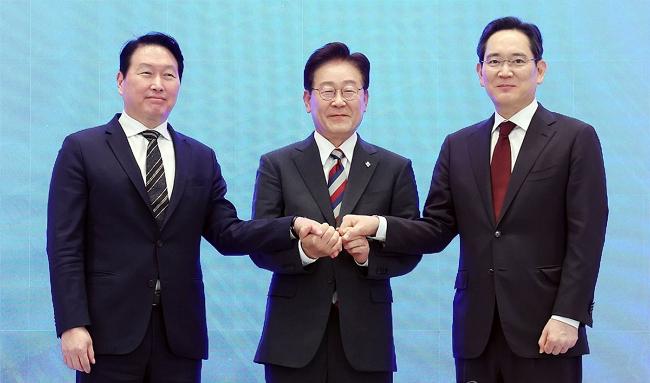 Lee Jae-myung shakes hands with Samsung Electronics Chairman Lee Jae-yong and SK Group Chairman Chey Tae-won at the 3 Mega-Projects National Report Meeting held at the Blue House on the 29th of last month. At the time, companies announced large-scale investment plans, but the filings were of a "future business and management plan" nature, not a finalized investment decision. [Photo=Yonhap News]
If It Is a Confirmed Investment, Then File It
Last year, regarding Samsung Electronics' 450 trillion won investment announcement, Hanmi Ilbo asked, "Why was it a press release rather than a regulatory filing?" It was a warning that announcing large-scale investment plans only via press releases could lead to controversy over investor protection and disclosure responsibilities under international standards. <See related articles below>
The Honam Semiconductor project follows in that same vein. This time, the companies did make filings. However, those filings were more like defensive notices to the market indicating that the investment was not confirmed, rather than declarations of a finalized investment.
If the question regarding the 2025 Samsung 450 trillion won controversy was, "Why was it a press release and not a filing?", the question for the 2026 Honam Semiconductor controversy is, "The companies have drawn a line in their filings saying it is unconfirmed, so why is the government pushing it as if it were a confirmed project?"
The document the market needs to verify after today’s Blue House meeting is not the transcript of the president’s remarks.
It is the regulatory filings of Samsung Electronics and SK Hynix. If Lee Jae-myung's judgment is correct, then Samsung Electronics and SK Hynix should respond with a filing for a confirmed investment.
If, as the government claims, the 800 trillion won Honam Semiconductor project is a definitive investment that will determine the nation's future, and if its business viability is sufficient enough to justify a "speed-first" push for site selection, permitting, and power and water support, then the two companies must explain this to the market through a formal investment decision filing, not through press releases or event remarks.
If a real investment decision has been made, it must be accompanied by board resolutions, investment amounts, investment periods, investment purposes, funding sources, and plans for sites and facilities. That is the responsibility they owe to the market and their shareholders.
Conversely, if Samsung Electronics and SK Hynix cannot make a filing for a confirmed investment, it means this project is not yet at the stage of a confirmed investment, even within the companies themselves.
We cannot have a situation where the government speaks as if it is confirmed while companies defensively state in their filings that it is not.
800 trillion won is an amount that exceeds South Korea’s annual national budget. Added to this are the separate costs for public infrastructure such as power, water, power grids, industrial complex facilities, tax support, and subsidies.
Pushing such a project through political events and presidential rhetoric is not normal industrial policy.
Gambling does not always mean losing. If you succeed, it could be a jackpot. If the Honam Semiconductor project secures long-term demand, sustains the boom in the AI and HBM market, and creates a complementary relationship with the existing semiconductor belt, it could become another breakthrough for the Korean industry.
However, if it fails, the scale of the loss will be national. If demand forecasts for an 800 trillion won investment are wrong and oversupply occurs, it won’t just be corporate capital that is shaken. Land, power grids, water, tax support, subsidies, local government infrastructure, and national treasury funds will all be tied up together.
If it goes well, it's a jackpot; if it goes wrong, both the national budget and corporate balance sheets could be severely damaged. This is why it is criticized as a gamble.
The government's role is not to make investment decisions on behalf of corporations. When companies observe the market and decide to invest, the government should support them with infrastructure.
Yet, what was heard at the Blue House meeting was not respect for corporate judgment, but a push for a "speed-first" race.
Semiconductors That Don't Sell Cannot Be Sold by Power
To summarize, it is simple.
If Lee Jae-myung's judgment is correct, the companies must respond with a confirmed investment filing. If the companies cannot respond with a confirmed filing, the government must not speak as if it is a confirmed project.
If it is a confirmed investment, file it. If you cannot file it, do not speak as if it is confirmed.
Infrastructure can be laid with money, but demand cannot be created with power. A "hurry-up" approach without business viability is not industrial policy—it is placing both the nation and its companies on a dangerous gambling table.

 Iranian Foreign Ministry: "Continuing Message Exchanges with the U.S. and Activities of Mediating Countries"
Esmaeil Baghaei, Spokesperson for the Iranian Ministry of Foreign Affairs [Xinhua, Yonhap News file photo]Esmaeil Baghaei, spokesperson for the Iranian Ministry of Foreign Affairs, stated on the 26th
Iranian Foreign Ministry: "Continuing Message Exchanges with the U.S. and Activities of Mediating Countries"
Esmaeil Baghaei, Spokesperson for the Iranian Ministry of Foreign Affairs [Xinhua, Yonhap News file photo]Esmaeil Baghaei, spokesperson for the Iranian Ministry of Foreign Affairs, stated on the 26th
 President Yoon: "Do You Think You Are Safe from the Special Counsel?"... Final Statement Video Released
President Yoon Suk Yeol rebuking the special prosecutor on the 24th. [Court video / @birds_justice X account subtitle GIF] A video of President Yoon Suk Yeol's closing statement at his trial rega
President Yoon: "Do You Think You Are Safe from the Special Counsel?"... Final Statement Video Released
President Yoon Suk Yeol rebuking the special prosecutor on the 24th. [Court video / @birds_justice X account subtitle GIF] A video of President Yoon Suk Yeol's closing statement at his trial rega
 President Yoon, regarding the first-instance ruling on the Public Official Election Act: “An excessive political verdict that distorts the facts… We will appeal immediately.”
The first-instance sentencing hearing for President Yoon Suk Yeol regarding violations of the Public Official Election Act is being broadcast live at Seoul Station on the 27th. [Photo=Yonhap News]Pres
President Yoon, regarding the first-instance ruling on the Public Official Election Act: “An excessive political verdict that distorts the facts… We will appeal immediately.”
The first-instance sentencing hearing for President Yoon Suk Yeol regarding violations of the Public Official Election Act is being broadcast live at Seoul Station on the 27th. [Photo=Yonhap News]Pres
 WSJ: "SK Hynix ADR Premium Is a Sign of AI Trading Overheat"
Advertisement for SK Hynix ADR listing in New York's Times Square [Reuters=Yonhap News file photo]The Wall Street Journal (WSJ) has pointed out that the price of SK Hynix’s American Depositary Recei
WSJ: "SK Hynix ADR Premium Is a Sign of AI Trading Overheat"
Advertisement for SK Hynix ADR listing in New York's Times Square [Reuters=Yonhap News file photo]The Wall Street Journal (WSJ) has pointed out that the price of SK Hynix’s American Depositary Recei
 'Godfather of Japanese Mystery Novels' Keigo Higashino Passes Away After Battle with Cancer at 68
Famous Japanese mystery novelist Keigo Higashino [AFP=Yonhap News]It has been belatedly reported that Keigo Higashino, the "godfather of Japanese mystery novels" and author of bestsellers such as "The
'Godfather of Japanese Mystery Novels' Keigo Higashino Passes Away After Battle with Cancer at 68
Famous Japanese mystery novelist Keigo Higashino [AFP=Yonhap News]It has been belatedly reported that Keigo Higashino, the "godfather of Japanese mystery novels" and author of bestsellers such as "The
 [Park Pil-kyu Security Column] To the Ignorant Trying to Clothe a Beast in Sheep's Clothing
Rep. Kim Byung-joo of the Democratic Party of Korea [Photo=Yonhap News]“The Air Force Academy doesn't teach you how to fly a plane!” “The Army, Navy, and Air Force academies are exactly the
[Park Pil-kyu Security Column] To the Ignorant Trying to Clothe a Beast in Sheep's Clothing
Rep. Kim Byung-joo of the Democratic Party of Korea [Photo=Yonhap News]“The Air Force Academy doesn't teach you how to fly a plane!” “The Army, Navy, and Air Force academies are exactly the
 [Issue Diagnosis] Two Effects of the Election Petition Review
 [Photo] Evidence of Election Fraud Flooding U.S. Media… Trump Had 2.7 Million Votes Stolen
 [Video] U.S. Semiquincentennial Air Show... 'Art in the Sky' streaks across New York
 [Editorial Cartoon] A Draconian Law That Undermines Freedom of Expression

 List
List










