 Kim Young-sam (left) and Kim Dae-jung, who were lifelong rivals. Their failure to unite as a single candidacy led to Roh Tae-woo’s election as president in 1987. [Photo = Yonhap News]1987 was a year in which South Korean democracy underwent a massive institutional shift. The timeline included the death of Seoul National University student Park Jong-chul under torture on January 14, President Chun Doo-hwan’s constitutional preservation measure on April 13, the fatal tear gas injury of Yonsei University student Lee Han-yeol on June 9, nationwide protests on June 10, the June 29 Declaration by Roh Tae-woo of the Democratic Justice Party, the promulgation of the Sixth Republic Constitution on October 29, and the 13th presidential election on December 16.
It was the first time in 16 years, since the 7th presidential election in 1971, that the direct presidential election system had been revived. The National Election Commission’s records also describe the 1987 election as the “revival of the direct election system after 16 years.” However, it is also evaluated as an election marred by regionalism, smear campaigns, violence, and money-driven politics. Although the door to democratization was opened, South Korean politics, upon passing through that threshold, was unstable from the very beginning.
1987: Neither Votes Nor Candidates United
The results of the 1987 presidential election are clearer when viewed in numbers. Roh Tae-woo of the Democratic Justice Party was elected with 8,282,738 votes (36.6%). Kim Young-sam of the Reunification Democratic Party received 6,337,581 votes (28.0%), Kim Dae-jung of the Peace and Democracy Party received 6,113,375 votes (27.1%), and Kim Jong-pil of the New Democratic Republican Party received 1,823,067 votes (8.1%).
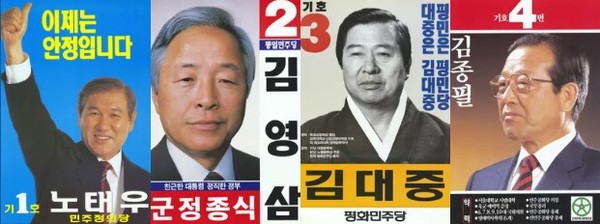 1987 Presidential Election Poster
Combined, the votes for Kim Young-sam and Kim Dae-jung totaled 12,450,956 (55.1%). However, politics is not mere arithmetic. The votes did not unite, and neither did the candidates. While the democratic forces appeared as one in the streets of June, they were divided by the regional sentiments of the Yeongnam, Honam, Chungcheong, and Capital regions at the polling stations in December.
Herein lay the first delusion of the pro-North Korean, leftist activist movement post-1987. Although they had achieved the constitutional amendment for direct elections, they could not accept the results of the election itself. To them, Roh Tae-woo’s victory was clearly an extension of the military authoritarian regime. Certainly, that criticism may have been valid.
The problem, however, was what followed. Once the system was opened, they should have persuaded the public within the framework of that system. If they lost an election, they should have analyzed why. Yet, some activists did not use the public’s choice as an opportunity for self-reflection.
Instead, they deflected responsibility outward, claiming that “the masses have not yet awakened,” “regionalism distorted the public will,” “the division system dominated the election,” or “the U.S. and conservative forces rigged the game.” This was the origin of a “loser’s mindset that refuses to acknowledge defeat.”
The June Democratic Struggle of 1987 was clearly an achievement for South Korean democracy. But the presidential election of December 1987 was an equal part of the democratic process. One cannot claim that the streets in June represent the people, while the polling stations in December do not. Respecting the cheers of the streets while denying the results of the ballot box is not democracy.
However, the pro-North Korean, leftist activist movement blurred this very distinction. The moments they won were labeled the “victory of the masses,” while the moments they lost were labeled as the “immaturity of mass consciousness.” This logic remained deeply embedded in Korean leftist political culture for a long time. If they won, it was democracy; if they lost, it was a conspiracy. If they won, it was the people’s choice; if they lost, it was the manipulation of conservative media. If they won, it was the public sentiment; if they lost, it was regionalism. This mindset became even more blatant following the 1987 election defeat.
An Era of Revelations, Hearings, Street Mobilization, and Ideological Struggle
The Roh Tae-woo government was inaugurated on February 25, 1988, marking the beginning of the Sixth Republic. However, the political situation did not stabilize immediately after its launch. The 13th National Assembly election was held on April 26, 1988. The National Election Commission describes this election as the “second showdown of ‘One Roh, Three Kims’” following the 1987 presidential election.
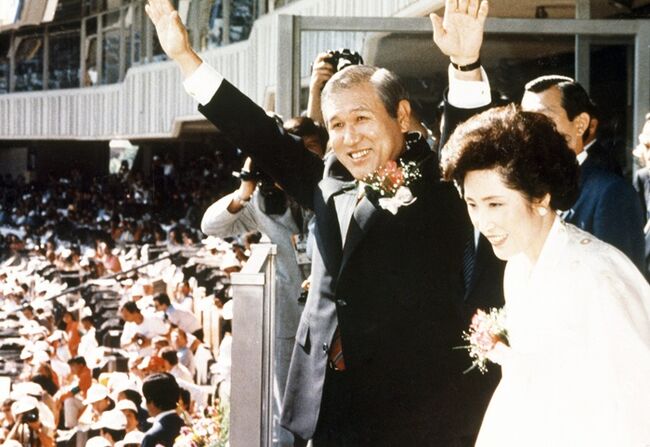 President Roh Tae-woo attending the opening ceremony of the 1988 Seoul Olympics with First Lady Kim Ok-sook. [Photo = Yonhap News]
The Democratic Justice Party failed to secure a parliamentary majority, and the Peace and Democracy Party, the Reunification Democratic Party, and the New Democratic Republican Party emerged as powerful opposition forces. The 13th general election was held only four months after the presidential election, and the Roh Tae-woo government had to face a National Assembly where the opposition held more seats than the ruling party from the very start.
This “ruling minority, opposition majority” setup was a significant milestone in the development of democracy. It marked a shift from an era where the president held absolute power to one where the National Assembly became a stage for checking that power. However, it was also the starting point of chaos. This was because institutional politics veered toward revelations, hearings, street mobilizations, and ideological struggles rather than mature debate and compromise.
In 1988, the National Assembly became a space for liquidating the legacies of the Fifth Republic, addressing the Gwangju issue, and interrogating the responsibilities for media control and military politics. The problem was that this process was consumed in a way that fostered “distrust in the system as a whole” rather than the settlement of liberal democratic institutions.
The pro-North Korean, leftist movement exploited this void. They did not stop at criticizing the Roh Tae-woo government. They defined the very liberal democratic system of the Republic of Korea as a “division system,” a “subservient system to foreign powers,” and an “anti-people system.” This is where the difference between general democratic forces and the pro-North Korean left became clear.
General democratic forces criticized the authoritarian government and demanded the normalization of constitutional order. In contrast, the pro-North Korean left viewed the constitutional order itself as an imperfect shell. To them, the 1987 system was not a completed democracy but a “transitional period before the revolution.” Direct presidential elections, parliamentary elections, party politics, and the expansion of media freedom were not enough in themselves. They trusted street mobilization politics more than electoral democracy.
The Workers’ Great Struggle that took place from July to September 1987 was also an important backdrop that fueled this chaos. According to the Encyclopedia of Korean Culture, out of 3,749 labor disputes in 1987, 3,341 occurred between July and September.
The number of labor unions reached 4,103 by the end of December 1987, a significant increase from 2,675 in 1986. The number of union members also grew from 1,035,890 in 1986 to 1,267,457 in 1987. Data from the KDI Economic Information Center also explains that the number of strikes in the three months from July to September 1987 was double that of the previous 10 years, and the number of participants was five times that of the previous decade.
The workers' demands for wage increases, improved working conditions, and the guarantee of the three basic labor rights were justified in many respects. The problem was that these legitimate demands were co-opted by some radical activists as fuel for anti-system struggle.
In industrial cities and factory zones such as Ulsan, Changwon, Masan, Busan, Incheon, Guro, Seongnam, Ansan, and Bucheon, labor sites became outposts for political struggle. Industrial sites like Hyundai Heavy Industries, Hyundai Motor Company, Daewoo Shipbuilding & Marine Engineering, Hanjin Heavy Industries, Guro Industrial Complex, and Bupyeong Industrial Complex were transformed beyond simple spaces of labor-management conflict into venues for ideological struggle.
The issue of workers’ wages was combined with the slogan of “people’s liberation,” and workplace democratization was expanded into the language of “anti-American independence” and “breaking the division system.” This was the way the pro-North Korean left infiltrated the labor movement after 1987.
During this period, the activist movement did not acknowledge defeat. They believed that while they lost the 1987 presidential election, they had won historically. This was even more dangerous. They lost in the election, but won in the streets. They had not captured power, but they believed the zeitgeist was theirs. Although the majority of the public had not yet chosen them, they believed the direction of history was on their side.
This consciousness is nothing more than a revolutionary’s self-assurance, not democracy. The moment one believes in “historical laws” more than election results, and in the “subconscious of the masses” more than the judgment of the people, politics departs from reality. The pro-North Korean, leftist movement stepped onto exactly that path.
Using Freedom to Attack Liberal Democracy
The essence of the chaos following the 1987 transition lies here. South Korea was moving from authoritarianism to liberal democracy. However, some activists used that freedom to attack liberal democracy.
As censorship weakened, anti-American slogans grew louder. As the space for student movements expanded, North Korean-style nationalism spread across college campuses. As the labor movement grew, the language of class struggle entered the field. As parliamentary hearings were held, sentiments of system denial grew stronger than power surveillance. Democratization meant an expansion of freedom, but through the gaps of that freedom, forces that denied freedom also entered the legal sphere.
Therefore, 1987 was a year with two faces. One was the year of the revival of the direct presidential election and the inauguration of the Sixth Republic. The other was the year the pro-North Korean left began to enter the legal political space, college campuses, labor sites, and civil society in earnest.
Before 1987, activist movements primarily justified themselves in the name of opposing dictatorship. However, after 1987, that name alone was no longer sufficient, because institutional democracy had opened up. At that time, the activists had to choose: would they enter into liberal democracy, or would they continue to cling to a revolutionary line that aimed to go beyond it? The pro-North Korean left chose the latter.
As a result, a strange structure emerged in South Korean politics after 1987. The institutions were democratized, but the political language remained stuck in a wartime posture. The president was elected directly, yet the government remained a target for “regime overthrow.” The National Assembly was in session, but the streets still acted as the ultimate judge. Media freedom was expanded, but conspiracy theories and agitation also grew. Labor rights were expanded, but parts of the labor movement became channels for criticizing the Republic of Korea’s system.
This was the chaos that followed the transition of the 1987 system. And at the heart of that chaos were the pro-North Korean, leftist activists who could not acknowledge their defeat and instead transformed that loss into a revolutionary theory.
◆ Songsan Jung Gwang-je
A poet and researcher of history and philosophy. Former board member of the Syngman Rhee Institute. Currently serves as a research advisor to the Korean Modern and Contemporary History Research Association and representative of the philosophy forum Lyceum. He has published four volumes of poetry, co-translated "Heroes of Hook Ridge," and authored humanistic books such as "Joseon, Turned into Myth," "Humanities on Tatami Mats," and "A Liberal Reading Gramsci." Songsan (松山) is his pen name.

 Iranian Foreign Ministry: "Continuing Message Exchanges with the U.S. and Activities of Mediating Countries"
Esmaeil Baghaei, Spokesperson for the Iranian Ministry of Foreign Affairs [Xinhua, Yonhap News file photo]Esmaeil Baghaei, spokesperson for the Iranian Ministry of Foreign Affairs, stated on the 26th
Iranian Foreign Ministry: "Continuing Message Exchanges with the U.S. and Activities of Mediating Countries"
Esmaeil Baghaei, Spokesperson for the Iranian Ministry of Foreign Affairs [Xinhua, Yonhap News file photo]Esmaeil Baghaei, spokesperson for the Iranian Ministry of Foreign Affairs, stated on the 26th
 President Yoon: "Do You Think You Are Safe from the Special Counsel?"... Final Statement Video Released
President Yoon Suk Yeol rebuking the special prosecutor on the 24th. [Court video / @birds_justice X account subtitle GIF] A video of President Yoon Suk Yeol's closing statement at his trial rega
President Yoon: "Do You Think You Are Safe from the Special Counsel?"... Final Statement Video Released
President Yoon Suk Yeol rebuking the special prosecutor on the 24th. [Court video / @birds_justice X account subtitle GIF] A video of President Yoon Suk Yeol's closing statement at his trial rega
 President Yoon, regarding the first-instance ruling on the Public Official Election Act: “An excessive political verdict that distorts the facts… We will appeal immediately.”
The first-instance sentencing hearing for President Yoon Suk Yeol regarding violations of the Public Official Election Act is being broadcast live at Seoul Station on the 27th. [Photo=Yonhap News]Pres
President Yoon, regarding the first-instance ruling on the Public Official Election Act: “An excessive political verdict that distorts the facts… We will appeal immediately.”
The first-instance sentencing hearing for President Yoon Suk Yeol regarding violations of the Public Official Election Act is being broadcast live at Seoul Station on the 27th. [Photo=Yonhap News]Pres
 WSJ: "SK Hynix ADR Premium Is a Sign of AI Trading Overheat"
Advertisement for SK Hynix ADR listing in New York's Times Square [Reuters=Yonhap News file photo]The Wall Street Journal (WSJ) has pointed out that the price of SK Hynix’s American Depositary Recei
WSJ: "SK Hynix ADR Premium Is a Sign of AI Trading Overheat"
Advertisement for SK Hynix ADR listing in New York's Times Square [Reuters=Yonhap News file photo]The Wall Street Journal (WSJ) has pointed out that the price of SK Hynix’s American Depositary Recei
 'Godfather of Japanese Mystery Novels' Keigo Higashino Passes Away After Battle with Cancer at 68
Famous Japanese mystery novelist Keigo Higashino [AFP=Yonhap News]It has been belatedly reported that Keigo Higashino, the "godfather of Japanese mystery novels" and author of bestsellers such as "The
'Godfather of Japanese Mystery Novels' Keigo Higashino Passes Away After Battle with Cancer at 68
Famous Japanese mystery novelist Keigo Higashino [AFP=Yonhap News]It has been belatedly reported that Keigo Higashino, the "godfather of Japanese mystery novels" and author of bestsellers such as "The
 [Park Pil-kyu Security Column] To the Ignorant Trying to Clothe a Beast in Sheep's Clothing
Rep. Kim Byung-joo of the Democratic Party of Korea [Photo=Yonhap News]“The Air Force Academy doesn't teach you how to fly a plane!” “The Army, Navy, and Air Force academies are exactly the
[Park Pil-kyu Security Column] To the Ignorant Trying to Clothe a Beast in Sheep's Clothing
Rep. Kim Byung-joo of the Democratic Party of Korea [Photo=Yonhap News]“The Air Force Academy doesn't teach you how to fly a plane!” “The Army, Navy, and Air Force academies are exactly the
 [Issue Diagnosis] Two Effects of the Election Petition Review
 [Photo] Evidence of Election Fraud Flooding U.S. Media… Trump Had 2.7 Million Votes Stolen
 [Video] U.S. Semiquincentennial Air Show... 'Art in the Sky' streaks across New York
 [Editorial Cartoon] A Draconian Law That Undermines Freedom of Expression

 List
List









