 On the morning of the 9th, vehicles are restricted from entering the Mushimcheon riverside road in Cheongju as the stream has swelled significantly with muddy water due to heavy rains that have continued since the previous day. [Photo = Yonhap News]
As heavy rain continues across the country, facility damage, resident evacuations, and closures of high-risk areas are increasing rapidly. The Central Disaster and Safety Countermeasures Headquarters (CDSCHQ) announced in its 'Report on Heavy Rain Response from July 8–9' as of 6:00 AM on the 9th that while there have been no confirmed casualties from the current downpour, a total of 94 cases of facility damage have been reported.
According to the CDSCHQ, this status report is based on provisional figures as of 5:00 AM on the 9th. The 94 cases of facility damage represent an increase of 49 from the previous report. Of these, 83 cases involve public facilities, including 35 cases of fallen trees, 13 sinkholes, 10 flooded roads, 9 manhole overflows, 6 landslides, 2 drainage issues, 2 flooded underground spaces, 2 fallen streetlights, and 1 power outage.
Damage to private facilities totaled 11 cases, including 4 flooded houses, 3 damaged houses, 1 clogged sewer, 1 flooded plastic greenhouse, 1 poor drainage in a machine room, and 1 faulty drainage pump in an underground parking lot. Agricultural damage also amounted to 7.4 hectares, with 1.6 hectares of oriental melons affected in Seongju (Gyeongbuk), 4.4 hectares of melons and cucumbers in Buyeo (Chungnam), and 1.4 hectares of red peppers and ginseng in Geumsan (Chungnam).
Evacuations of residents have also continued. The CDSCHQ stated that 147 people from 133 households have temporarily evacuated in regions including Sejong, North Chungcheong, South Chungcheong, and North Gyeongsang. This includes 7 people from 5 households in Sejong, 28 people from 22 households in Cheongju (North Chungcheong), 106 people from 102 households in the South Chungcheong region, and 6 people from 4 households in Pohang, Yeongju, and Sangju (North Gyeongsang). Temporary housing, primarily at community centers and senior citizen halls, has been provided to 125 people from 120 households, while some residents have moved in with relatives.
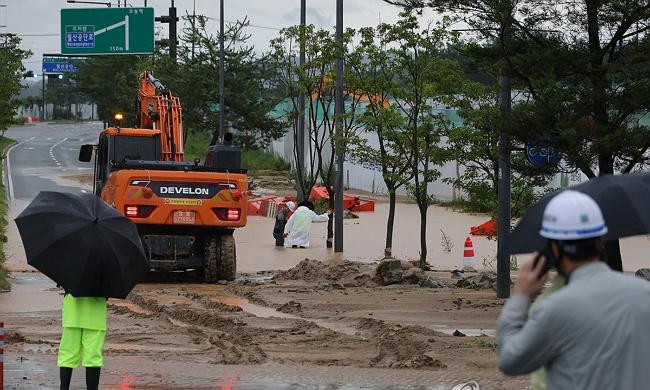 On the 9th, when heavy rain hit the region, a road near the BRT intersection in Hanbyeol-dong, Sejong City, was submerged in soil and rainwater. The Central Disaster and Safety Countermeasures Headquarters reported 94 cases of facility damage as of 5:00 AM that day. [Photo = Yonhap News] The scale of restrictions due to the heavy rain has also expanded. The CDSCHQ reported that as of 5:00 AM on the 9th, 554 locations across the country were restricted, an increase of 233 from the previous report. In national parks, 234 sections across 12 parks, including Mudeungsan, Songnisan, Woraksan, Gyeryongsan, Naejangsan, and Jirisan, have been closed. Restrictions also include 71 riverside parking lots, 73 submerged bridges (sewolgyo), 27 riverside areas, and 5 campsites.
Some roads, riverside roads, and underground underpasses are also under restriction. Specifically, 2 roads, 26 riverside roads, and 4 underground underpasses have been closed, while access to 112 other facilities, including walking trails, tourist sites, and river access points, has been limited. Railway services are operating normally, and 3 flights to and from Cheongju and Jeju that were canceled the previous day have resumed normal operations.
The weather situation remains critical. As of 5:20 AM on the 9th, heavy rain warnings were in effect for 8 areas, including Daejeon, Sejong, Boeun and Cheongju (North Chungcheong), Gongju and Gyeryong (South Chungcheong), Imsil (North Jeolla), and Damyang (South Jeolla). Heavy rain advisories were issued for 51 areas, including Gwangju, South Jeolla, Gyeonggi, Gangwon, North Chungcheong, South Chungcheong, North Jeolla, North Gyeongsang, and South Gyeongsang. Preliminary heavy rain alerts have also been issued for 11 areas, including Gangwon, South Chungcheong, North Chungcheong, and North Gyeongsang.
Cumulative precipitation has also risen rapidly. From midnight on the 8th to 5:00 AM on the 9th, rainfall recorded reached 172.0 mm in Gyeryong (South Chungcheong), 163.5 mm in Buyeo (South Chungcheong), 148.0 mm in Pyeongchang (Gangwon), 147.0 mm in Wonju (Gangwon), 146.0 mm in Daejeon, 135.1 mm in Boeun (North Chungcheong), 126.5 mm in Cheongju (North Chungcheong), 124.5 mm in Anseong (Gyeonggi), and 114.5 mm in Damyang (South Jeolla).
The intensity of hourly rainfall was particularly high. Maximum 60-minute rainfall reached 73.0 mm in Gyeryong (South Chungcheong), 68.5 mm in Buyeo (South Chungcheong), 68.0 mm in Damyang (South Jeolla), and 66.0 mm in Pyeongchang (Gangwon). Heavy rain of around 30–50 mm per hour is currently falling, mainly in the Sejong, North Jeolla, and North Chungcheong regions, and it is forecasted that strong rainfall of 20–30 mm per hour will continue until dawn on the 10th, mainly in the metropolitan and Gangwon regions.
Although there have been no casualties from this rainfall to date, the situation remains precarious as the number of facility damages, evacuees, and restricted areas continues to rise rapidly. In particular, when intense rain is concentrated within a short period, the risks of rising river levels, flooding in low-lying areas, entrapment in underground spaces, and landslides may increase. The scale of damage may further increase based on the results of local government assessments.

 Iranian Foreign Ministry: "Continuing Message Exchanges with the U.S. and Activities of Mediating Countries"
Esmaeil Baghaei, Spokesperson for the Iranian Ministry of Foreign Affairs [Xinhua, Yonhap News file photo]Esmaeil Baghaei, spokesperson for the Iranian Ministry of Foreign Affairs, stated on the 26th
Iranian Foreign Ministry: "Continuing Message Exchanges with the U.S. and Activities of Mediating Countries"
Esmaeil Baghaei, Spokesperson for the Iranian Ministry of Foreign Affairs [Xinhua, Yonhap News file photo]Esmaeil Baghaei, spokesperson for the Iranian Ministry of Foreign Affairs, stated on the 26th
 Yoon “Do you think you’ll be safe from a special prosecutor?”... Final statement video released
President Yoon Suk Yeol rebuking the special prosecutor on the 24th. [Court Video / Subtitled GIF from @birds_justice X account] A video of President Yoon Suk Yeol’s final statement during his trial
Yoon “Do you think you’ll be safe from a special prosecutor?”... Final statement video released
President Yoon Suk Yeol rebuking the special prosecutor on the 24th. [Court Video / Subtitled GIF from @birds_justice X account] A video of President Yoon Suk Yeol’s final statement during his trial
 President Yoon, regarding the first-instance ruling on the Public Official Election Act: “An excessive political verdict that distorts the facts… We will appeal immediately.”
The first-instance sentencing hearing for President Yoon Suk Yeol regarding violations of the Public Official Election Act is being broadcast live at Seoul Station on the 27th. [Photo=Yonhap News]Pres
President Yoon, regarding the first-instance ruling on the Public Official Election Act: “An excessive political verdict that distorts the facts… We will appeal immediately.”
The first-instance sentencing hearing for President Yoon Suk Yeol regarding violations of the Public Official Election Act is being broadcast live at Seoul Station on the 27th. [Photo=Yonhap News]Pres
 WSJ: "SK Hynix ADR Premium Is a Sign of AI Trading Overheat"
Advertisement for SK Hynix ADR listing in New York's Times Square [Reuters=Yonhap News file photo]The Wall Street Journal (WSJ) has pointed out that the price of SK Hynix’s American Depositary Recei
WSJ: "SK Hynix ADR Premium Is a Sign of AI Trading Overheat"
Advertisement for SK Hynix ADR listing in New York's Times Square [Reuters=Yonhap News file photo]The Wall Street Journal (WSJ) has pointed out that the price of SK Hynix’s American Depositary Recei
 'Godfather of Japanese Mystery Novels' Keigo Higashino Passes Away After Battle with Cancer at 68
Famous Japanese mystery novelist Keigo Higashino [AFP=Yonhap News]It has been belatedly reported that Keigo Higashino, the "godfather of Japanese mystery novels" and author of bestsellers such as "The
'Godfather of Japanese Mystery Novels' Keigo Higashino Passes Away After Battle with Cancer at 68
Famous Japanese mystery novelist Keigo Higashino [AFP=Yonhap News]It has been belatedly reported that Keigo Higashino, the "godfather of Japanese mystery novels" and author of bestsellers such as "The
 [Park Pil-kyu Security Column] To the Ignorant Trying to Clothe a Beast in Sheep's Clothing
Rep. Kim Byung-joo of the Democratic Party of Korea [Photo=Yonhap News]“The Air Force Academy doesn't teach you how to fly a plane!” “The Army, Navy, and Air Force academies are exactly the
[Park Pil-kyu Security Column] To the Ignorant Trying to Clothe a Beast in Sheep's Clothing
Rep. Kim Byung-joo of the Democratic Party of Korea [Photo=Yonhap News]“The Air Force Academy doesn't teach you how to fly a plane!” “The Army, Navy, and Air Force academies are exactly the
 [Issue Diagnosis] Two Effects of the Election Petition Review
 [Photo] Evidence of Election Fraud Flooding U.S. Media… Trump Had 2.7 Million Votes Stolen
 [Video] U.S. Semiquincentennial Air Show... 'Art in the Sky' streaks across New York
 [Editorial Cartoon] A Draconian Law That Undermines Freedom of Expression

 List
List









