KMA cadets performing aerial maneuvers during basic airborne ground training. [Provided by the Korea Military Academy]
The current administration is proposing to establish a "National Armed Forces University" to consolidate the Army, Navy, and Air Force academies into individual colleges, and to split the student body by separating first/second-year students from third/fourth-year students. This is a clear sign that they do not understand the reality of the situation. Under such a bizarre academic structure, it is absolutely impossible to cultivate elite officers like those currently produced by the Korea Military Academy (KMA).
While one might excuse the Minister of National Defense—given his background in defense procurement—the KMA alumni who are scrambling to keep their positions and support this plan seem to be suffering from "early-onset dementia."
The Four-Year KMA Course is a Crucible
I cannot help but reflect on my own days as a cadet here. Having experienced it 60 years ago, it may be a "tale from the past" quite different from the daily lives of current KMA cadets, yet I believe the KMA spirit—which has lived and breathed throughout our history and tradition—remains unchanged.
The four-year course at the KMA before commissioning is comparable to a crucible. It is a process where raw iron ore (the freshmen) is forged through the flames to emerge as high-quality steel (the upperclassmen). It has always been the duty of the seniors to kindle the fire in that crucible, feed in the raw ore, melt it, refine it, and forge it.
They pass down the secrets of survival so that their juniors can overcome the same grueling processes they once endured. Second, third, and fourth-year students each play their part, exquisitely balancing strict discipline with care. That is the essence of the cadet self-governance system.
After passing the entrance exams and shedding their high school demeanor, students enter Hwarangdae as "provisional cadets." From the very first day, they must pass the basic military training, known as "Beast Training," in a high-pressure environment that demands split-second reactions. Only then are they officially admitted as freshmen.
In that process, words like "rationality" or "democracy" are mere luxuries. Nowadays, with media filled with content about special forces training, there is no need to explain in detail just how much these individuals must endure in extreme conditions.
When I first joined the Cadet Corps, I openly complained about the upperclassmen inspecting my diary, only to bring upon myself even harsher punitive training because "the little guy has too many excuses."
Even when the sores on my waist caused by the cartridge belt festered, I squeezed out the pus myself and endured, fearing that if I went to the infirmary, I would fall behind the formation. We were energetic young men, and we endured it all with pure grit and tenacity.
Cadet Life: Always on the Battlefield
The daily life of a soldier is "Hangjae-jeonjang" (恒在戰場), meaning one is always on the battlefield. Can rationality and human rights be fully guaranteed on a battlefield? That is an impossible fantasy.
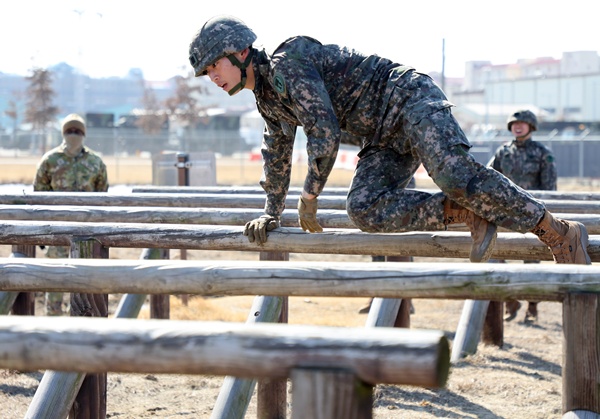 KMA cadets undergoing training at the U.S. 2nd Infantry Division's Camp Humphreys in Pyeongtaek, Gyeonggi Province. [Photo: Yonhap News]
Freshmen are thrown into a battlefield-like environment before they have even shed their civilian skin. Who creates such an absurd and harsh environment? It is the upperclassmen. When I entered the KMA in 1967, second-year cadets were exclusively responsible for managing the freshmen.
The freshmen of that year—my peers—were assigned to the same company for all four years of cadet life. We spent our entire time in the company we were initially assigned to, sharing joys and sorrows in the same barracks building.
Because of this, an unbreakable bond and friendship sprout among peers. This company-based friendship leads to strong cohesion even after graduation, such as when companies take turns managing the alumni association.
Each company in the Cadet Corps is composed of students from the first to the fourth year. Under the command of a fourth-year company commander cadet, they engage in orderly unit activities through the "cadet self-governance system," following a structure of platoon and squad leaders.
In this process, cadets assimilate into the unique traditions of their respective companies that have been handed down by seniors over many years. Each company has a different symbolic animal—the Tiger, Eagle, Lion, Polar Bear, Bull, Blue Dragon, Elephant, or White Horse—and the cadets' personalities eventually resemble those symbols. These diverse characteristics harmonize to form the powerful heart and soul of the KMA.
The command cadets who lead the basic military training are the very same upperclassmen from the companies the freshmen will join. Since they are training their own "offspring-like" juniors, they pour their hearts into it. They may drive them harshly, but they do so with a deep, underlying compassion.
Internalizing Command and Leadership Before Commissioning
The day provisional cadets first step into the Cadet Corps at Hwarangdae is the "Freshman Welcome Ceremony." The regimental commander cadet, the highest-ranking position in the cadet self-governance system, greets the freshmen with a roar of authority.
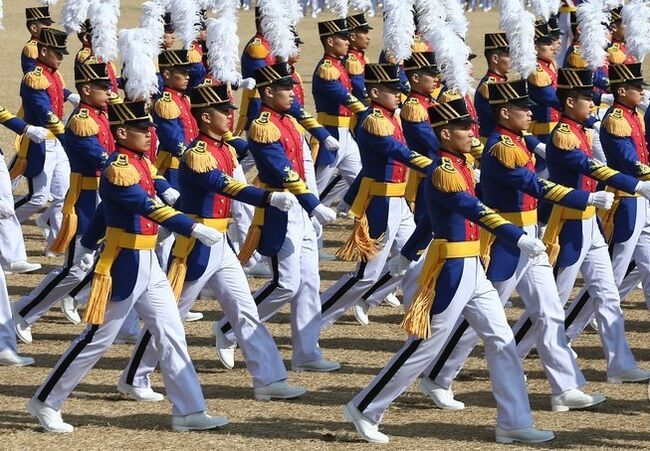 KMA cadets marching. [Photo: Yonhap News]
Just as the story goes that a lion pushes its cub off a cliff to ensure only the strongest survive, this basic training is a process of being pushed off the cliff; the lecture explains that one must survive this to be worthy of training as an official cadet. Overwhelmed by the majesty and authority, the freshmen are deeply tense, yet they begin their first year with firm resolve.
But becoming an official cadet is not the end. The following year is true hell. First-year freshmen live like moles, barely seeing the sun due to the strict control imposed by the second-year cadets immediately above them. They intentionally create a harsh environment so that students learn to survive and become stronger under the worst conditions. In the past, this even included corporal punishment.
Freshmen are placed in squads of three and share a living room with one fourth-year squad leader cadet. (Second and third-year students room with their peers.) The foundation of cadet life is punctuality in every daily routine: waking up, morning cleaning, meals, moving to classes, lunch, exercise, running, self-study, bedtime, and night watch. However, freshmen, being new to this life, are inevitably late at times. Furthermore, upperclassmen sometimes deliberately create environments where lateness is inevitable.
For example, if there is a shortage of cleaning rags compared to the number of rooms, a scramble for tools ensues. Even then, the excuse, "We were late for the meal formation because we lacked rags," does not work. In a real-world combat situation, if supplies run short or you are forced to retreat due to bad conditions, what exactly will be "guaranteed" for you? You must find fulfillment in scarcity and create something out of nothing.
The same applies to academic studies. During a 90-minute lecture on mathematics or physics, 20 to 30 pages of material are covered, and dozens of practice problems are poured out. However, there are only two problems on the daily test. Each is worth 50 points; getting both right earns 100, one earns 50, and getting the logic right earns 25. Scores are strictly distributed: 0, 25, 50, 75, or 100. If these tests accumulate and your semester average drops below 67 points per subject, you cannot go on vacation and must take a re-examination; if you fail that, you are expelled for poor academic performance. It is a constant, perilous tightrope walk.
Therefore, among numerous practice problems, you must accurately predict the two most likely to appear and bet everything on them. There is no need to complain. Quick and accurate judgment is essential to succeed in operations on the battlefield and prevent the sacrifice of your subordinates. We cultivated that tactical advantage and decision-making ability through these daily tests.
It is truly a grueling life. However, there is an exquisite harmony in cadet life that allows one to endure it. If there is a second-year cadet in the squad who plays the "bad cop" like a guerrilla training instructor to toughen up the freshmen, there is also a third-year cadet who gently supports them from behind, skillfully passing on the know-how of cadet life.
And then there is the fourth-year squad leader cadet, who comforts the exhausted freshmen returning to the room with a warmth that is authoritative simply by his presence. Of course, the fourth-year cadet is not always gentle. Living in the same room, they identify the strengths and weaknesses of the freshmen best and may give invisible guidance to the second and third-year squad members, saying, "That guy is lacking in this area, so help him improve."
In this self-governance system, which flows from squad to platoon, company, battalion, and regiment, relationships between seniors and juniors, and superiors and subordinates, are formed. Cadets learn to internalize command and leadership before they are even commissioned. Thanks to this, even when they go into the field to take on immediate practical duties, they can perfectly perform the role of a platoon leader. In this culture of cheolchatakma—honing one's character through intense friction and strife—patriotism and the will to defend the nation are solidified.
If the KMA is Abolished, the Tradition of Defending the Nation Will Disappear
What would happen if there were no senior cadets to look up to and learn from, and no junior cadets to command and lead? If the academic year is split according to the government's proposed "2+2" distributed accommodation plan for the National Armed Forces University, the mentorship and solidarity between seniors and juniors—as well as the multi-generational tradition of patriotism and the will to defend the nation—will be severed in an instant.
Furthermore, moving and dispersing the military academy to local areas will inevitably lead to a decline in the intellectual competence of cadets, and the "crucible" culture that created a sense of unity over four years will disappear, rendering them mentally weak and intellectually soft.
I have written at length because I wanted to help the policymakers—who lack field experience—understand. Does the authority truly intend to foster excellent cadets and raise elite officers, or are they bent on destroying the very cradle that produces them?
I genuinely want to ask: "Do you even know what the 'taste of crab' is? Do you know anything about the traditions of a military academy?"
◆ Il-go Kim Myung-soo
27th Class, Korea Military Academy
Retired Army Major
Former Director of the Psychological Warfare Bureau, Agency for National Security Planning

 Trump pressures for rate cut again ahead of FOMC... "Should be the lowest in the world"
U.S. President Donald Trump. [Photo = The White House] U.S. President Donald Trump once again pressured the Federal Reserve, the U.S. central bank, to lower interest rates on the 27th (local time
Trump pressures for rate cut again ahead of FOMC... "Should be the lowest in the world"
U.S. President Donald Trump. [Photo = The White House] U.S. President Donald Trump once again pressured the Federal Reserve, the U.S. central bank, to lower interest rates on the 27th (local time
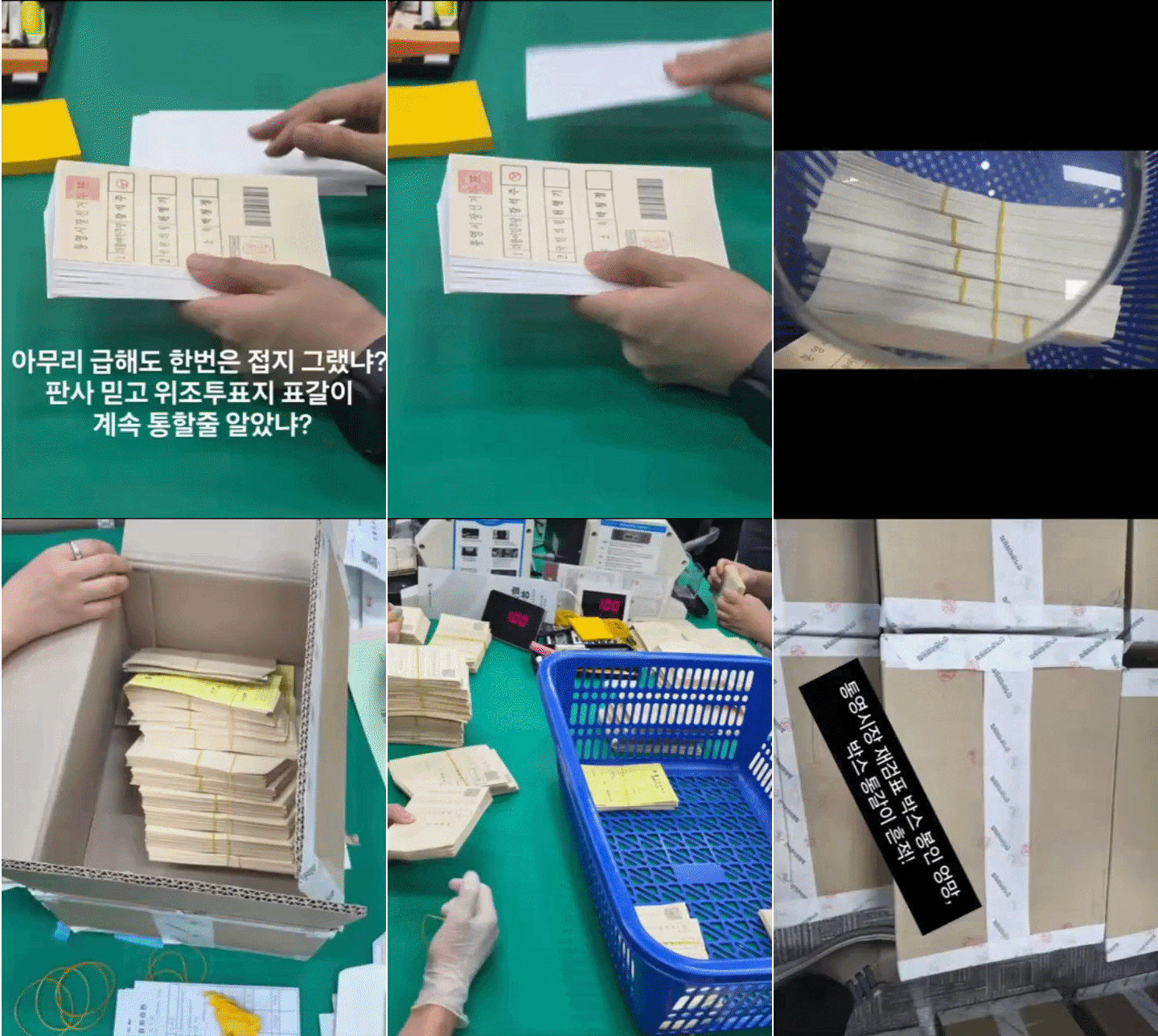 “Ignoring crisp ballots and damaged seals”… Tongyeong mayoral recount concludes with ‘no change in outcome,’ leaving suspicions and public outrage behind
Suspected counterfeit ballots discovered in Tongyeong [GIF from social media of Representative Hwang Kyo-ahn / Attorney Park Joo-hyun]During a recount of the Tongyeong mayoral election in South Gyeong
“Ignoring crisp ballots and damaged seals”… Tongyeong mayoral recount concludes with ‘no change in outcome,’ leaving suspicions and public outrage behind
Suspected counterfeit ballots discovered in Tongyeong [GIF from social media of Representative Hwang Kyo-ahn / Attorney Park Joo-hyun]During a recount of the Tongyeong mayoral election in South Gyeong
 President Yoon, regarding the first-instance ruling on the Public Official Election Act: “An excessive political verdict that distorts the facts… We will appeal immediately.”
The first-instance sentencing hearing for President Yoon Suk Yeol regarding violations of the Public Official Election Act is being broadcast live at Seoul Station on the 27th. [Photo=Yonhap News]Pres
President Yoon, regarding the first-instance ruling on the Public Official Election Act: “An excessive political verdict that distorts the facts… We will appeal immediately.”
The first-instance sentencing hearing for President Yoon Suk Yeol regarding violations of the Public Official Election Act is being broadcast live at Seoul Station on the 27th. [Photo=Yonhap News]Pres
 WSJ: "SK Hynix ADR Premium Is a Sign of AI Trading Overheat"
Advertisement for SK Hynix ADR listing in New York's Times Square [Reuters=Yonhap News file photo]The Wall Street Journal (WSJ) has pointed out that the price of SK Hynix’s American Depositary Recei
WSJ: "SK Hynix ADR Premium Is a Sign of AI Trading Overheat"
Advertisement for SK Hynix ADR listing in New York's Times Square [Reuters=Yonhap News file photo]The Wall Street Journal (WSJ) has pointed out that the price of SK Hynix’s American Depositary Recei
 'Godfather of Japanese Mystery Novels' Keigo Higashino Passes Away After Battle with Cancer at 68
Famous Japanese mystery novelist Keigo Higashino [AFP=Yonhap News]It has been belatedly reported that Keigo Higashino, the "godfather of Japanese mystery novels" and author of bestsellers such as "The
'Godfather of Japanese Mystery Novels' Keigo Higashino Passes Away After Battle with Cancer at 68
Famous Japanese mystery novelist Keigo Higashino [AFP=Yonhap News]It has been belatedly reported that Keigo Higashino, the "godfather of Japanese mystery novels" and author of bestsellers such as "The
 [Park Pil-kyu Security Column] To the Ignorant Trying to Clothe a Beast in Sheep's Clothing
Rep. Kim Byung-joo of the Democratic Party of Korea [Photo=Yonhap News]“The Air Force Academy doesn't teach you how to fly a plane!” “The Army, Navy, and Air Force academies are exactly the
[Park Pil-kyu Security Column] To the Ignorant Trying to Clothe a Beast in Sheep's Clothing
Rep. Kim Byung-joo of the Democratic Party of Korea [Photo=Yonhap News]“The Air Force Academy doesn't teach you how to fly a plane!” “The Army, Navy, and Air Force academies are exactly the
 [Issue Diagnosis] Two Effects of the Election Petition Review
 [Photo] Evidence of Election Fraud Flooding U.S. Media… Trump Had 2.7 Million Votes Stolen
 [Video] U.S. Semiquincentennial Air Show... 'Art in the Sky' streaks across New York
 [Editorial Cartoon] A Draconian Law That Undermines Freedom of Expression

 List
List