 U.S. President Donald Trump [AFP=Yonhap News file photo]
U.S. President Donald Trump has officially declared an end to the ceasefire with Iran, while Iran has countered by stating that there will be "no surrender," pushing the two nations into a phase of intense confrontation.
Although both sides maintain that they are willing to continue dialogue, there is a growing consensus that the framework of the existing Memorandum of Understanding (MOU), which was intended to lead to end-of-war negotiations based on a ceasefire, has effectively been nullified.
On the 10th (local time), President Trump stated on his social media platform, Truth Social, "The Islamic Republic of Iran has asked us to continue 'talks.' We have agreed to this, but the United States has firmly informed the Iranian side that the ceasefire has ended."
This official declaration follows his remarks on the 8th during a meeting with NATO Secretary General Mark Rutte, where he stated that the end-of-war MOU with Iran "seems to be over."
By explicitly declaring an end to the ceasefire while keeping the door open for dialogue, Trump is signaling that the environment for negotiations has shifted from one based on a ceasefire to one where armed conflict could resume at any moment.
This appears to reflect President Trump's determination to maintain military pressure in response to what the U.S. views as Iran's violations of the MOU, such as attacks on merchant ships in the Strait of Hormuz.
Iran has also expressed its intent to respond firmly.
Mohammad Bagher Ghalibaf, the Speaker of Parliament who has led Iran's end-of-war negotiations, stated on the same day, "While it is clear that ending the war is our top priority, this conflict will never end with Iran's surrender."
He warned, "We have never dismantled our national defense readiness in case the U.S. breaks the agreement," adding, "If the U.S. provokes us again, we will reclaim our legitimate rights through a full-scale defensive war."
Furthermore, regarding President Trump's claim that "Iran asked to continue talks," Iranian Foreign Ministry spokesperson Esmaeil Baghaei denied the assertion, saying, "We have not requested negotiations with the U.S."
However, Baghaei added that Iran has accepted a visit from Qatari mediators.
Qatar is credited with playing a decisive role in narrowing key differences during the conclusion of the U.S.-Iran MOU last month.
Despite both nations demonstrating a willingness to use force if necessary, neither side has completely closed the door on negotiations.
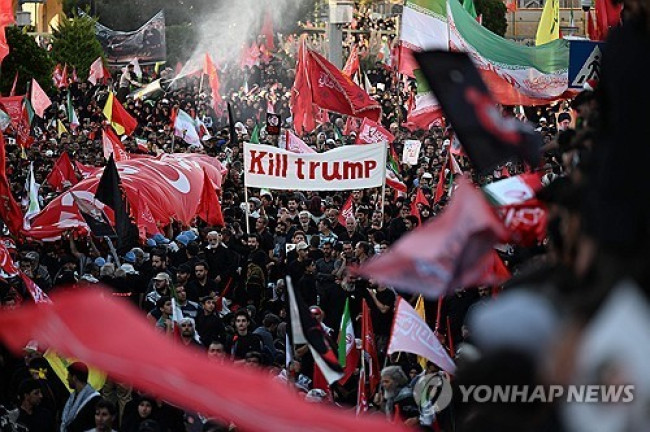 Anti-American slogans displayed at Ayatollah Khamenei's burial ceremony [AFP=Yonhap News]
With tensions rising again due to Iran's attacks on civilian merchant ships in the Strait of Hormuz and subsequent U.S. retaliatory airstrikes, observers suggest that the potential for a prolonged "tit-for-tat" confrontation has increased.
Even if future talks continue, significant difficulties are expected in reaching a new agreement, as the conditions for negotiation have deteriorated far beyond what they were under the end-of-war MOU that both sides had previously recognized.
In particular, analysts suggest that the situation in the Strait of Hormuz, which served as the direct trigger for the recent armed clashes, stems from fundamental differences in how the two sides interpret the MOU.
Article 5 of the MOU stipulates that Iran will take necessary measures to resume shipping in the Strait of Hormuz, which was blockaded due to the war, ensure safe navigation, and make efforts to remove military obstacles such as naval mines.
It also includes provisions for Iran to consult with Oman and neighboring countries on future management of the strait.
While the U.S. interprets Article 5 as the basis for guaranteeing safe passage through the Strait of Hormuz, Iran views it as a clause recognizing its exclusive control over the strait.
In practice, Iran has been attacking merchant ships that do not follow designated routes along its coastline, insisting that vessels use only those paths.
The U.S. has labeled this a violation of the MOU and continues to respond aggressively, combining retaliatory airstrikes with additional sanctions. Following the restoration of sanctions on Iranian oil on the 7th, the U.S. also announced sanctions on the financiers of Iranian Supreme Leader Mojtaba Khamenei on the same day.
Nevertheless, it is reported that neither side has abandoned the ultimate desire to restore the original framework for ending the war. Back-channel discussions via mediators and other parties appear to be continuing.
The U.S. online media outlet Axios, citing sources, reported that additional negotiations between the U.S. and Iran are scheduled to be held in Switzerland next week.
A diplomat familiar with the back-channel discussions told Axios that representatives from mediator Qatar would visit Iran after coordinating with the U.S. on the same day to meet with Iranian officials.
The diplomat stated, "It is clear that both sides want to return to the MOU."
However, given that mutual distrust has deepened due to recent armed clashes, it is expected that additional confidence-building measures will be required before the MOU framework can function normally again.
It is anticipated that the key negotiating conditions will be stability in the Strait of Hormuz and the resumption of nuclear talks for the U.S., and an end to further airstrikes and the easing of sanctions for Iran.
Whether both sides can use dialogue to return to a ceasefire and stabilize the framework of negotiations will likely be the turning point for the future of Middle Eastern affairs.

 Iranian Foreign Ministry: "Continuing Message Exchanges with the U.S. and Activities of Mediating Countries"
Esmaeil Baghaei, Spokesperson for the Iranian Ministry of Foreign Affairs [Xinhua, Yonhap News file photo]Esmaeil Baghaei, spokesperson for the Iranian Ministry of Foreign Affairs, stated on the 26th
Iranian Foreign Ministry: "Continuing Message Exchanges with the U.S. and Activities of Mediating Countries"
Esmaeil Baghaei, Spokesperson for the Iranian Ministry of Foreign Affairs [Xinhua, Yonhap News file photo]Esmaeil Baghaei, spokesperson for the Iranian Ministry of Foreign Affairs, stated on the 26th
 Yoon “Do you think you’ll be safe from a special prosecutor?”... Final statement video released
President Yoon Suk Yeol rebuking the special prosecutor on the 24th. [Court Video / Subtitled GIF from @birds_justice X account] A video of President Yoon Suk Yeol’s final statement during his trial
Yoon “Do you think you’ll be safe from a special prosecutor?”... Final statement video released
President Yoon Suk Yeol rebuking the special prosecutor on the 24th. [Court Video / Subtitled GIF from @birds_justice X account] A video of President Yoon Suk Yeol’s final statement during his trial
 President Yoon, regarding the first-instance ruling on the Public Official Election Act: “An excessive political verdict that distorts the facts… We will appeal immediately.”
The first-instance sentencing hearing for President Yoon Suk Yeol regarding violations of the Public Official Election Act is being broadcast live at Seoul Station on the 27th. [Photo=Yonhap News]Pres
President Yoon, regarding the first-instance ruling on the Public Official Election Act: “An excessive political verdict that distorts the facts… We will appeal immediately.”
The first-instance sentencing hearing for President Yoon Suk Yeol regarding violations of the Public Official Election Act is being broadcast live at Seoul Station on the 27th. [Photo=Yonhap News]Pres
 WSJ: "SK Hynix ADR Premium Is a Sign of AI Trading Overheat"
Advertisement for SK Hynix ADR listing in New York's Times Square [Reuters=Yonhap News file photo]The Wall Street Journal (WSJ) has pointed out that the price of SK Hynix’s American Depositary Recei
WSJ: "SK Hynix ADR Premium Is a Sign of AI Trading Overheat"
Advertisement for SK Hynix ADR listing in New York's Times Square [Reuters=Yonhap News file photo]The Wall Street Journal (WSJ) has pointed out that the price of SK Hynix’s American Depositary Recei
 'Godfather of Japanese Mystery Novels' Keigo Higashino Passes Away After Battle with Cancer at 68
Famous Japanese mystery novelist Keigo Higashino [AFP=Yonhap News]It has been belatedly reported that Keigo Higashino, the "godfather of Japanese mystery novels" and author of bestsellers such as "The
'Godfather of Japanese Mystery Novels' Keigo Higashino Passes Away After Battle with Cancer at 68
Famous Japanese mystery novelist Keigo Higashino [AFP=Yonhap News]It has been belatedly reported that Keigo Higashino, the "godfather of Japanese mystery novels" and author of bestsellers such as "The
 [Park Pil-kyu Security Column] To the Ignorant Trying to Clothe a Beast in Sheep's Clothing
Rep. Kim Byung-joo of the Democratic Party of Korea [Photo=Yonhap News]“The Air Force Academy doesn't teach you how to fly a plane!” “The Army, Navy, and Air Force academies are exactly the
[Park Pil-kyu Security Column] To the Ignorant Trying to Clothe a Beast in Sheep's Clothing
Rep. Kim Byung-joo of the Democratic Party of Korea [Photo=Yonhap News]“The Air Force Academy doesn't teach you how to fly a plane!” “The Army, Navy, and Air Force academies are exactly the
 [Issue Diagnosis] Two Effects of the Election Petition Review
 [Photo] Evidence of Election Fraud Flooding U.S. Media… Trump Had 2.7 Million Votes Stolen
 [Video] U.S. Semiquincentennial Air Show... 'Art in the Sky' streaks across New York
 [Editorial Cartoon] A Draconian Law That Undermines Freedom of Expression

 List
List









