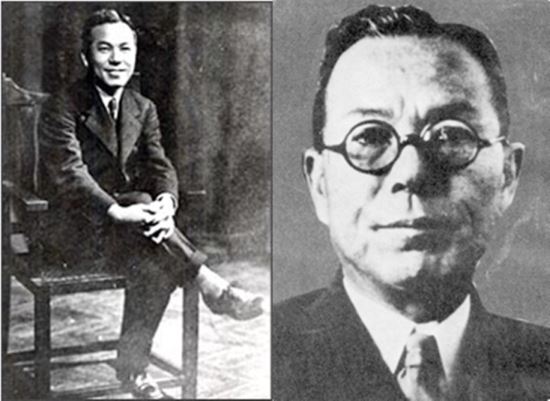
 Inchon Kim Seong-su
It is July, the season of the monsoon rains, and as always, the touch-me-nots have bloomed beneath the fence. They are simply beautiful in the rain. Even as they let raindrops slide down their deep pink petals, their color remains unchanged. They are flowers that appear affectionate, despite looking so lonely and beautiful in their solitude. Why did the people of the past describe the touch-me-nots blooming by the fence as "forlorn"?
Whenever I see touch-me-nots, I am reminded of Inchon Kim Seong-su. Inchon lived a beautiful life and left behind countless achievements for our nation, yet he has become a figure cast aside under the misunderstandings of a certain era.
Kim Seong-su was a journalist, businessman, and educator during the Japanese colonial period. Born in 1891 as the eldest son of Kim Gyeong-jung, a wealthy man in Buan, Gochang, North Jeolla Province, he went to Tokyo in 1908 and graduated from the Department of Political Science and Economics at Waseda University in 1914. Upon returning to Korea, he began his path as an educator and businessman by acquiring the Joongang School in 1915 and the textile company "Kyungsung Spinning and Weaving" in 1917.
Inchon expanded the textile company into Kyungbang (Kyungsung Spinning) in October 1919, the year of the March First Independence Movement, and founded the Dong-A Ilbo in April 1920. In 1932, he acquired the Bosung College to continue the cause of national education.
Furthermore, Inchon’s life was never far removed from the independence movement. He was a hidden independence activist who supported the cause for a long period.
It is a widely known anecdote that when he acquired the Joongang School and devoted himself to national education, the March First Movement was essentially brought to life in the school’s duty room. Song Gye-baek, a student studying in Tokyo, returned home with a draft of the February 8th Independence Declaration and sought out Hyun Sang-yun, his senior at Waseda University and a teacher at Joongang School. Subsequently, Kim Seong-su, Hyun Sang-yun, and Song Jin-woo discussed the plan in that very duty room.
Following this, Choe Nam-seon and Choe Rin joined in, and the seeds of the March First Movement were sown. This is why it is often said that it is difficult to explain the March First Movement without mentioning Inchon Kim Seong-su.
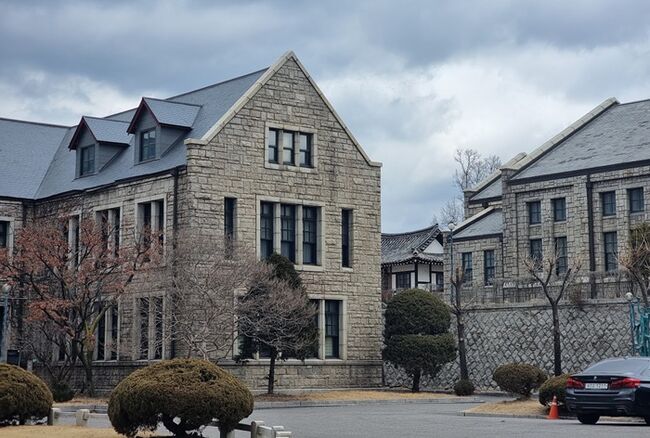 The small hanok nestled between the Western-style buildings of Joongang High School is the school duty room where the March First Movement was conceived. [Photo courtesy of Hanmi Ilbo]
After the March First Movement, Inchon Kim Seong-su, believing that national capital was necessary to counter Japanese imperialism, established Kyungsung Spinning and Weaving, Korea’s first joint-stock company. He then realized the importance of a national press and founded the Dong-A Ilbo, and later took office as the principal of the struggling Bosung College, laying the foundation for what would eventually become Korea University.
There are many anecdotes about Inchon’s involvement in the independence movement. It is said that when independence fighters asked for funds, he would leave the safe open and step away. There is also testimony that he provided General Kim Jwa-jin with enough funds to "buy hundreds of cows," and that he also provided financial support to Syngman Rhee and the Provisional Government in Shanghai.
While such support was difficult to record at the time to maintain secrecy, the fact that Kim Gu and Syngman Rhee expressed great gratitude after liberation adds weight to these claims. After liberation, Inchon contributed to the nation-building process of the Republic of Korea and served as Vice President, dedicating his efforts to establishing the founding ideology and national order of the country.
For these reasons, Inchon was posthumously awarded the Order of Merit for National Foundation (Presidential Award) in 1962. However, his decoration was later revoked as his actions during the Pacific War were labeled as pro-Japanese.
It was a tumultuous era and a life too full of hardships for a person of a lost nation to live through. Inchon had to endure the fate of his times, often having to bow his head and hide his intentions while navigating the watchful eyes of the Japanese. Thus, even until his passing in 1955, his final moments were defined by his devotion to his homeland.
Who will understand the paradox of an era where one had to betray the nation while simultaneously carrying out national education? Today, there is nothing in Inchon’s hometown that commemorates him. I looked for even a single touch-me-not blooming by the fence of his old home, hoping to find one, but none were to be seen.
I have once defined Inchon as "living humanities" that preserved the spirit during the Japanese colonial era. Without him, our literature, arts, and education would not have flourished. So many writers were protected under his wing. In his memoir Forty Years of Intoxication, Suju Byeon Yeong-ro wrote that whenever writers were drinking and lacked money for the bill, they would always seek out Inchon.
Inchon was the one who protected Joseon’s poets and writers and embraced their creative worlds while traversing the harsh Japanese colonial period. Yet, to those far-removed descendants who never experienced that era, Inchon is condemned as a pro-Japanese collaborator.
A beautiful yet forlorn flower. The sadness of the touch-me-not—blooming not in a magnificent garden but in a small corner beneath a fence, displaying its charming deep and light pink petals—feels so palpable.
I am also from Gochang, North Jeolla Province. Remembering Inchon’s life, I have never once felt the need to raise a question mark about it. I am convinced that Inchon was a "humble greatness" who walked the path of patriotism in silence. And ever since the humanities of Joseon were preserved by his hands, the Republic of Korea has been able to blossom into the brilliant culture we see today.
I gaze at the touch-me-nots beneath the fence. Monsoon rain flows like tears over the petals. And then, there is the life of Inchon, abandoned as a pro-Japanese collaborator. Standing before his old house, which lacks even a single information plaque, I cannot help but sob.
It is the "tears of Gochang."
Commentary: Although Lyuh Woon-hyung was a communist, he was posthumously decorated as a person of merit for independence under a left-wing administration. Joo Se-juk, the wife of Park Heon-young, is also treated as a person of merit for independence, and even Park Jong-sik, the father of Park Ji-won, is recognized as such. Yet, Mr. Inchon’s decoration was revoked by the Moon Jae-in administration in 2018. How can such a thing be?
“Balsam Standing by the Fence” is the first Korean art song, with lyrics by Kim Hyung-jun set to music by Hong Nan-pa in 1926. If this song touches your heart, please take a moment to think of Mr. Inchon Kim Seong-su.
Balsam Standing by the Fence
Lyrics by Kim Hyung-jun, Music by Hong Nan-pa
Balsam standing by the fence,
Your appearance is forlorn.
In the long, long summer days,
When you bloomed so beautifully,
Lovely young maidens
Welcomed you and played by your side.
Before we knew it, summer passed,
And the autumn breeze blew softly.
Cruelly, it assaulted
Your beautiful blossoms,
Fallen petals, you have grown old,
Your appearance is forlorn.
Even when your brothers vanish
In the cold wind of the northern blizzard,
Your soul, dreaming a peaceful dream,
Remains here.
I hope for your reincarnation
In the warm spring breeze.
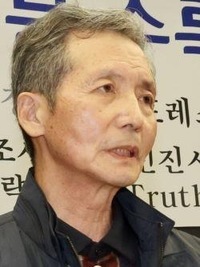
◆ Poet Jung Jae-hak
Poet, National Merit Recipient, Columnist, Promotional Committee Member for President Park Chung-hee, 36 years of service as an educator in Jeolla-do

 Iranian Foreign Ministry: "Continuing Message Exchanges with the U.S. and Activities of Mediating Countries"
Esmaeil Baghaei, Spokesperson for the Iranian Ministry of Foreign Affairs [Xinhua, Yonhap News file photo]Esmaeil Baghaei, spokesperson for the Iranian Ministry of Foreign Affairs, stated on the 26th
Iranian Foreign Ministry: "Continuing Message Exchanges with the U.S. and Activities of Mediating Countries"
Esmaeil Baghaei, Spokesperson for the Iranian Ministry of Foreign Affairs [Xinhua, Yonhap News file photo]Esmaeil Baghaei, spokesperson for the Iranian Ministry of Foreign Affairs, stated on the 26th
 President Yoon: "Do You Think You Are Safe from the Special Counsel?"... Final Statement Video Released
President Yoon Suk Yeol rebuking the special prosecutor on the 24th. [Court video / @birds_justice X account subtitle GIF] A video of President Yoon Suk Yeol's closing statement at his trial rega
President Yoon: "Do You Think You Are Safe from the Special Counsel?"... Final Statement Video Released
President Yoon Suk Yeol rebuking the special prosecutor on the 24th. [Court video / @birds_justice X account subtitle GIF] A video of President Yoon Suk Yeol's closing statement at his trial rega
 President Yoon, regarding the first-instance ruling on the Public Official Election Act: “An excessive political verdict that distorts the facts… We will appeal immediately.”
The first-instance sentencing hearing for President Yoon Suk Yeol regarding violations of the Public Official Election Act is being broadcast live at Seoul Station on the 27th. [Photo=Yonhap News]Pres
President Yoon, regarding the first-instance ruling on the Public Official Election Act: “An excessive political verdict that distorts the facts… We will appeal immediately.”
The first-instance sentencing hearing for President Yoon Suk Yeol regarding violations of the Public Official Election Act is being broadcast live at Seoul Station on the 27th. [Photo=Yonhap News]Pres
 WSJ: "SK Hynix ADR Premium Is a Sign of AI Trading Overheat"
Advertisement for SK Hynix ADR listing in New York's Times Square [Reuters=Yonhap News file photo]The Wall Street Journal (WSJ) has pointed out that the price of SK Hynix’s American Depositary Recei
WSJ: "SK Hynix ADR Premium Is a Sign of AI Trading Overheat"
Advertisement for SK Hynix ADR listing in New York's Times Square [Reuters=Yonhap News file photo]The Wall Street Journal (WSJ) has pointed out that the price of SK Hynix’s American Depositary Recei
 'Godfather of Japanese Mystery Novels' Keigo Higashino Passes Away After Battle with Cancer at 68
Famous Japanese mystery novelist Keigo Higashino [AFP=Yonhap News]It has been belatedly reported that Keigo Higashino, the "godfather of Japanese mystery novels" and author of bestsellers such as "The
'Godfather of Japanese Mystery Novels' Keigo Higashino Passes Away After Battle with Cancer at 68
Famous Japanese mystery novelist Keigo Higashino [AFP=Yonhap News]It has been belatedly reported that Keigo Higashino, the "godfather of Japanese mystery novels" and author of bestsellers such as "The
 [Park Pil-kyu Security Column] To the Ignorant Trying to Clothe a Beast in Sheep's Clothing
Rep. Kim Byung-joo of the Democratic Party of Korea [Photo=Yonhap News]“The Air Force Academy doesn't teach you how to fly a plane!” “The Army, Navy, and Air Force academies are exactly the
[Park Pil-kyu Security Column] To the Ignorant Trying to Clothe a Beast in Sheep's Clothing
Rep. Kim Byung-joo of the Democratic Party of Korea [Photo=Yonhap News]“The Air Force Academy doesn't teach you how to fly a plane!” “The Army, Navy, and Air Force academies are exactly the
 [Issue Diagnosis] Two Effects of the Election Petition Review
 [Photo] Evidence of Election Fraud Flooding U.S. Media… Trump Had 2.7 Million Votes Stolen
 [Video] U.S. Semiquincentennial Air Show... 'Art in the Sky' streaks across New York
 [Editorial Cartoon] A Draconian Law That Undermines Freedom of Expression

 List
List









