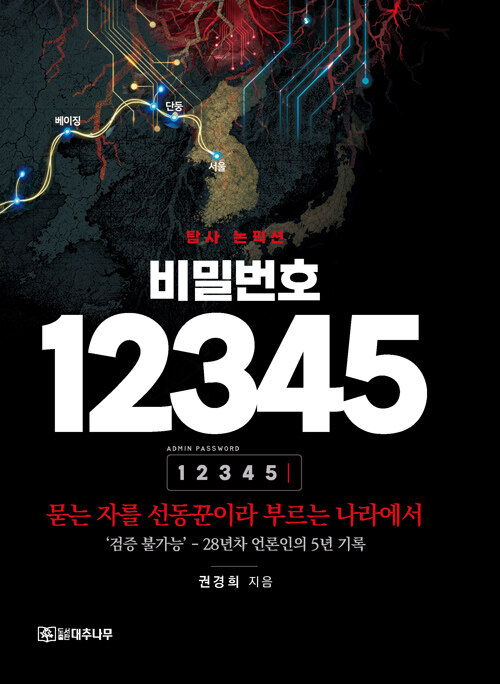
In September 2024, a journalist remarked on a broadcast: “The only way to legally conduct a forensic examination of the National Election Commission (NEC) server is through martial law... but who would stake their presidency on that?”
Yet, three months later, on December 3, 2024, martial law was indeed declared. During a time when all legal avenues—legislative, judicial, executive, the NEC, and the media—were effectively closed, martial law became the only legal means in the Republic of Korea to open the servers of the NEC, a constitutionally independent body.
Password 12345, an investigative non-fiction work by 28-year veteran journalist Kwon Kyung-hee, is a report on the "black box" of South Korean elections. It chronicles five years of documenting polling and vote-counting stations across the country, a journey that began in the early hours of 2021 when an economic newspaper editor-in-chief was unexpectedly handed a reporting assignment.
Five Years Initiated by an Economic Reporter
The author was not a political reporter; she was the editor-in-chief of a financial and economic newspaper. At the time, the topic of election fraud was being avoided by all major media outlets, including the Chosun, JoongAng, and Dong-A Ilbo. Nonetheless, starting in 2021, she began participating as an observer in every early and general election, gathering evidence. She encountered strange ballots at the Yeonsu-gu recount, numbers that did not add up, votes that vanished and reappeared, and equipment of unknown purpose. Whenever she asked, the NEC’s answer was always the same: “It’s a mistake,” or “Humans make errors; it happens.”
Following the general election in April 2024, when she requested an explanation for the discrepancy between the number of overseas voters reported by diplomatic missions and the figures held by the NEC, she received the response: “Verification is impossible.” If a person has voted, the ballot count must align, and the result should be verifiable with clear numbers. Yet, the answer was “verification impossible.” From then on, no matter what question was asked, only those same five words were returned.
During her investigation, a company called HandySoft caught her eye. One of the founding members was a university senior who had been a mentor to the author for 30 years. She asked him directly while he was in the United States, “What happened when HANDYSOFT was sold to Dasan?” Instead of answering, he immediately blocked her on KakaoTalk.
As soon as the NEC server came under scrutiny due to martial law, the company responsible for integrated server operations began the process of shutting down. The timing was too perfect to be a coincidence. When a complaint targeting the server was filed, the investigator assigned to a junior prosecutor said, “The Prosecutor General has ordered us to wrap up this investigation quickly.” This was a Prosecutor General appointed by the President.
In January 2025, on a flight to attend Donald Trump’s inauguration, she introduced herself to a passenger: “I’m a reporter from South Korea who came to report on election fraud.” His eyes widened. “I am also someone who was unfairly defeated due to election fraud.” He was a former member of the U.S. House of Representatives from Michigan—a key state in American election controversies and a victim himself. This meeting became the catalyst for the book’s section on the United States.
The Law of Large Numbers, 254 Electoral Districts
As the sample size increases, the average converges toward the population mean. This is a fundamental law of statistics that has never failed in 300 years and is taught in textbooks worldwide. Yet, in South Korean elections, this law did not hold. The same statistical anomaly appeared in all 254 electoral districts. The author asserts that if this is wrong, then the world’s textbooks must be rewritten; and if it is a situation unique to Korea, then it is an event the world must pay attention to. A vote that cannot be verified is not a vote.
This book does not merely raise suspicions. The author knocked on every door for five years. No member of the National Assembly would even grant her a meeting room, and the only response she received was, “This could be seen as refusing to accept election results.” Major media desks asked her back, “Is there really election fraud?” Standing before those closed doors, the author argues that this is not just ‘irregularity,’ but ‘election fraud’—the theft of the people’s votes. And her pursuit now extends beyond Korea, tracing the connections of a global election fraud cartel. This book is the beginning of that record.
“I knocked on every door. Not a single one opened. But I did not stop.” Thus, the reporting that began with a single comment in the early morning five years ago has become a book.
Reporter Im Yo-hee

 Iranian Foreign Ministry: "Continuing Message Exchanges with the U.S. and Activities of Mediating Countries"
Esmaeil Baghaei, Spokesperson for the Iranian Ministry of Foreign Affairs [Xinhua, Yonhap News file photo]Esmaeil Baghaei, spokesperson for the Iranian Ministry of Foreign Affairs, stated on the 26th
Iranian Foreign Ministry: "Continuing Message Exchanges with the U.S. and Activities of Mediating Countries"
Esmaeil Baghaei, Spokesperson for the Iranian Ministry of Foreign Affairs [Xinhua, Yonhap News file photo]Esmaeil Baghaei, spokesperson for the Iranian Ministry of Foreign Affairs, stated on the 26th
 Yoon “Do you think you’ll be safe from a special prosecutor?”... Final statement video released
President Yoon Suk Yeol rebuking the special prosecutor on the 24th. [Court Video / Subtitled GIF from @birds_justice X account] A video of President Yoon Suk Yeol’s final statement during his trial
Yoon “Do you think you’ll be safe from a special prosecutor?”... Final statement video released
President Yoon Suk Yeol rebuking the special prosecutor on the 24th. [Court Video / Subtitled GIF from @birds_justice X account] A video of President Yoon Suk Yeol’s final statement during his trial
 President Yoon, regarding the first-instance ruling on the Public Official Election Act: “An excessive political verdict that distorts the facts… We will appeal immediately.”
The first-instance sentencing hearing for President Yoon Suk Yeol regarding violations of the Public Official Election Act is being broadcast live at Seoul Station on the 27th. [Photo=Yonhap News]Pres
President Yoon, regarding the first-instance ruling on the Public Official Election Act: “An excessive political verdict that distorts the facts… We will appeal immediately.”
The first-instance sentencing hearing for President Yoon Suk Yeol regarding violations of the Public Official Election Act is being broadcast live at Seoul Station on the 27th. [Photo=Yonhap News]Pres
 WSJ: "SK Hynix ADR Premium Is a Sign of AI Trading Overheat"
Advertisement for SK Hynix ADR listing in New York's Times Square [Reuters=Yonhap News file photo]The Wall Street Journal (WSJ) has pointed out that the price of SK Hynix’s American Depositary Recei
WSJ: "SK Hynix ADR Premium Is a Sign of AI Trading Overheat"
Advertisement for SK Hynix ADR listing in New York's Times Square [Reuters=Yonhap News file photo]The Wall Street Journal (WSJ) has pointed out that the price of SK Hynix’s American Depositary Recei
 'Godfather of Japanese Mystery Novels' Keigo Higashino Passes Away After Battle with Cancer at 68
Famous Japanese mystery novelist Keigo Higashino [AFP=Yonhap News]It has been belatedly reported that Keigo Higashino, the "godfather of Japanese mystery novels" and author of bestsellers such as "The
'Godfather of Japanese Mystery Novels' Keigo Higashino Passes Away After Battle with Cancer at 68
Famous Japanese mystery novelist Keigo Higashino [AFP=Yonhap News]It has been belatedly reported that Keigo Higashino, the "godfather of Japanese mystery novels" and author of bestsellers such as "The
 [Park Pil-kyu Security Column] To the Ignorant Trying to Clothe a Beast in Sheep's Clothing
Rep. Kim Byung-joo of the Democratic Party of Korea [Photo=Yonhap News]“The Air Force Academy doesn't teach you how to fly a plane!” “The Army, Navy, and Air Force academies are exactly the
[Park Pil-kyu Security Column] To the Ignorant Trying to Clothe a Beast in Sheep's Clothing
Rep. Kim Byung-joo of the Democratic Party of Korea [Photo=Yonhap News]“The Air Force Academy doesn't teach you how to fly a plane!” “The Army, Navy, and Air Force academies are exactly the
 [Issue Diagnosis] Two Effects of the Election Petition Review
 [Photo] Evidence of Election Fraud Flooding U.S. Media… Trump Had 2.7 Million Votes Stolen
 [Video] U.S. Semiquincentennial Air Show... 'Art in the Sky' streaks across New York
 [Editorial Cartoon] A Draconian Law That Undermines Freedom of Expression

 List
List









